|

Kanikka Kapur’s ‘Batwara 1947’ look has fans convinced it is Kiara Advani

A fresh poster from Batwara 1947 is making waves online for a rather unexpected reason. Fans have started comparing debutant actress Kanikka Kapur’s appearance in the poster to Bollywood actress Kiara Advani.

The buzz began after the poster dropped on July 30. It featured Kanikka alongside co-star Karan Deol. The partition-era drama boasts a solid ensemble cast. This includes Sunny Deol, Preity Zinta, Shabana Azmi, Ali Fazal, Karan Deol, and Kanikka Kapur in key roles.

Almost immediately after the poster surfaced, comment sections lit up. Viewers pointed out a striking resemblance between the two actresses. In the poster, Kanikka wears a floral outfit paired with a light brown dupatta. Her makeup was kept simple and understated. That styling choice seemed to be what triggered the comparisons in the first place.

Kanikka shared the same poster on her personal Instagram account. Alongside it, she wrote a simple caption. “Watch #Batwara1947 in cinemas this Partition Day, 14th August,” she posted.

The comments under her post soon filled up with reactions from fans. One user wrote, “Congratulations @kanikkakapur I really thought it was Kiara Advani on the poster!” Another commented, “I thought it is Kiara Advani…but happy for you Kanika ji…God bless you with huge success.”

Many other users chimed in with similar observations. Kiara Advani’s name kept coming up repeatedly across the replies.

For Kanikka Kapur, Batwara 1947 marks her big Bollywood debut. Before stepping into films, she built a name for herself on television. She played the role of Suman Tiwari in Ek Duje Ke Vaaste 2. She has also worked on digital projects, including Dono, Modern Parivar, and Murderbad.

Separately, director Rajkumar Santoshi recently shared an emotional detail about the film. He revealed that Batwara 1947 was the very last film veteran actor Dharmendra watched before his death.

According to Santoshi, Dharmendra grew emotional while listening to the film’s narration. Tears welled up in his eyes as he offered his blessings for the project. Santoshi also mentioned that after watching the film, Dharmendra praised it warmly. He reportedly told the director that the film would go on to do exceptionally well.

Batwara 1947 is all set to hit cinemas on August 14, 2026, coinciding with Partition Day.

Similar Posts

  • | |

    Modi unveils free coaching and AI training plan to…

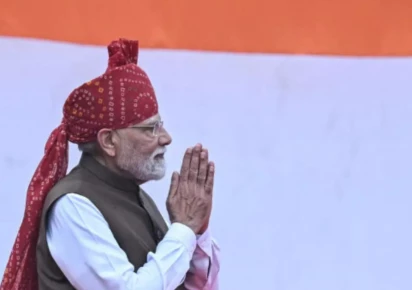
    NEW DELHI: Indian Prime Minister Narendra Modi has announced a major education and skills initiative aimed at addressing growing concerns among young people over employment, competitive exams and the rising cost of education. Speaking at India’s Independence Day ceremony at the Red Fort, Modi said the government would offer free online coaching for a range of competitive examinations. He said the programme would help reduce the financial pressure on families whose children spend years preparing for highly competitive entrance and recruitment tests. The announcement follows nationwide youth protests sparked by allegations of examination paper leaks and recruitment irregularities. The demonstrations intensified pressure on the government and contributed to the resignation of Education Minister Dharmendra Pradhan last month. Modi also announced an ambitious artificial intelligence skills programme, saying 10 million young Indians would receive AI-related training over the next year. The government hopes the initiative will equip young people with skills needed in a rapidly changing job market. India’s competitive education system has created a large private coaching industry, with many families spending heavily on preparation courses. Modi said free digital coaching would allow students to remain with their families while reducing the financial burden associated with preparation. During his speech, Modi also outlined a broader seven-point development and reform agenda covering manufacturing, agriculture, technology, defence and sectors linked to India’s cultural influence. He reiterated his goal of transforming India into a developed economy within the next two decades. The prime minister also announced plans for additional semiconductor facilities and nuclear reactors, with the government seeking to expand domestic manufacturing and energy capacity. Modi said India’s young population would be central to achieving the country’s development ambitions, describing youth as the biggest potential beneficiaries of a more prosperous and developed India.

  • | |

    Canada’s pushback against Trump tests bounda…

    Two days before trade negotiations between the United States and Canada collapsed dramatically over the weekend, Vice President JD Vance told an audience at a private fundraiser that Canadian Prime Minister Mark Carney was, in his words, a very sweet guy. According to a private audio recording obtained by a Canadian news outlet, Vance went on to describe Carney as someone who talks tough and claims he can out tough Donald Trump, before ultimately backing down on major issues, a pattern Vance called hilarious. Those remarks, which drew significant attention across Canada, may not have directly caused Carney’s negotiating team to walk away from the table, but they certainly did not help matters. Carney’s decision abruptly ended talks over a new trade agreement and triggered a fresh round of tariffs between two countries that conduct more than 872 billion dollars in annual bilateral trade. The deepening rift, paired with Vance’s comments, offers the latest example of an American administration willing to apply pressure against both allies and adversaries alike, underscoring how such tactics can produce unpredictable consequences on the world stage. If Trump anticipated that Canada would eventually yield to American pressure, following a pattern seen among other US allies over the past year and a half, that assumption may prove mistaken, and the fallout could shape the remainder of his presidency. Tension between Washington and Ottawa did not begin this weekend. It traces back to the first Trump administration and the negotiations that produced the USMCA, the agreement that replaced the original 1990s era North American Free Trade Agreement. Personal friction between Trump and former Canadian Prime Minister Justin Trudeau complicated those earlier talks. As Trump prepared to return to office in late 2024, he mockingly referred to Trudeau as governor and to Canada as America’s 51st state. Behind those remarks sat a broader worldview in which the United States positions itself as the dominant power within its own hemisphere, entitled to shape political, military and economic outcomes across the region, Canada included. Administration officials have argued that Canada contributes too little to regional defense spending while benefiting disproportionately from trade with its southern neighbor. Within Trump’s framework, where economic and national security are treated as inseparable, Canada and Mexico, two of America’s largest trading partners, emerged as early targets. Drew DeLong, head of corporate statecraft at the Kearney Foresight think tank, said officials across the State, Treasury and Commerce departments frequently repeat the phrase that economic security equals national security. By early this year, as North American trade talks moved forward unevenly, Trump’s focus shifted away from Canada toward military interventions in Venezuela and later the Middle East. Even so, the central thread running through Trump’s foreign policy approach has remained consistent, treating the United States as a dominant power capable of imposing its will for national advantage. That power has limits, however, and Trump’s second term has repeatedly tested where those limits lie. Despite the obvious differences between an active conflict with Iran and a trade dispute with Canada, the underlying dynamics share similarities. In both cases, the United States confronts a counterpart with far less overall power but still capable of retaliation. Iran has leaned on its ability to threaten US allies and disrupt global commerce through chokepoints like the Strait of Hormuz. Canada, meanwhile, has begun testing its own capacity to inflict economic pressure, with this week’s targeted tariffs marking an initial step. Future Canadian measures could include limiting American access to Canadian energy and critical minerals, alongside consumer boycotts targeting US products. DeLong said that as the broader global landscape shifts toward economic security concerns, countries increasingly search for chokepoints and leverage across global supply chains, adding that such opportunities exist for nations willing to look for them. For now, clear paths toward resolution remain limited. Trump has escalated his public rhetoric, repeatedly accusing Canada of ripping off the United States, while Ontario Premier Doug Ford responded sharply, telling the American president to kiss his ass. Imran Bayoumi, deputy director of the GeoStrategy Initiative at the Atlantic Council, said that pushing allies and partners away tends to incentivize them to seek new relationships rather than comply with American demands. Room still exists for tensions to ease. Canada’s new tariffs take effect in two weeks, while the most significant American countermeasure, a 50 percent tariff on Canadian built vehicles and auto parts, will not take effect until early 2027. Escalation cycles in economic or military conflicts can be difficult to reverse, but the several month gap before the next round of US tariffs gives both sides room to potentially resume negotiations, which had shown signs of progress before talks collapsed Friday night. A more immediate deadline looms in November’s US midterm elections. Democratic gains in Congress could limit Trump’s authority significantly, while unexpected Republican success could strengthen his position further. Ottawa currently appears to be betting on the former scenario, calculating that concern over midterm losses in industrial swing states like Michigan and Ohio will pressure Trump to soften his stance before voters head to the polls. Bayoumi said he does not see the kind of internal political division within Canada that the Trump administration may have anticipated, adding that Carney has considerable political room to negotiate a favorable outcome for Canada rather than settle for less. Carney has also raised another possibility publicly since Trump returned to office, suggesting Canada may continue drifting away from the United States altogether and deliberately widen the distance between the two nations. Carney has said Canada cannot depend on traditional alliances now that the rules of engagement have fundamentally shifted. While geographic proximity guarantees the two countries will remain connected in some form, the deeply integrated economic relationship built over recent decades may be approaching its end. This stands in contrast to Mexico, which appears to be pursuing closer economic integration with the United States rather than distancing itself. Meanwhile, other global trading partners, including US allies across Europe and Asia, are closely watching Canada’s assertive stance

  • | | |

    IHC judge urges lawyers to improve courtroom condu…

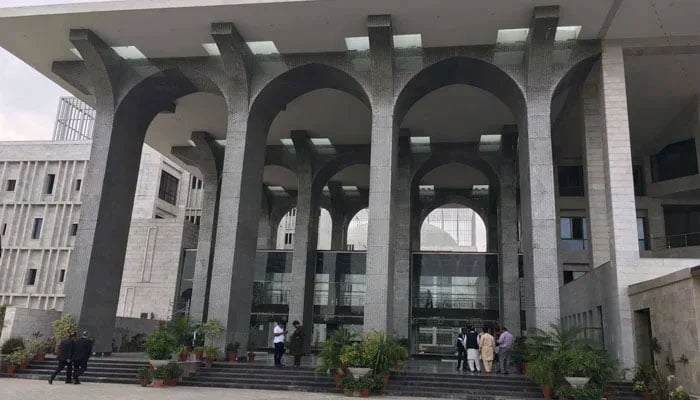
    Islamabad High Court (IHC) Justice Khadim Hussain Soomro has expressed serious concern over the conduct of lawyers in the federal capital. He urged the leadership of the legal community to take steps to improve professional behaviour in courts. The judge made the remarks during the hearing of a case in which Supreme Court Bar Association President Haroon Rashid appeared before the court. Justice Soomro said he felt deeply disappointed after observing the attitude of some lawyers in Islamabad. He said lawyers were expected to cooperate with the court and maintain a respectful environment during proceedings. The judge observed that lawyers in Islamabad did not provide the level of assistance that he expected. He said the behaviour he had witnessed was painful and disappointing. Justice Soomro also referred to his background. He said he belonged to a village where people did not behave in such a manner. He remarked that even in his hometown, people showed greater respect while communicating with one another. “I came here to learn, but I did not learn anything,” the judge said while expressing his disappointment over the situation. He further criticised the manner in which some people spoke in the courtroom. He said it was regrettable to see people using inappropriate or disrespectful language during legal proceedings. Justice Soomro asked the Supreme Court Bar president to take up the matter with lawyers’ representative bodies. He urged him to visit the bar council and bar association and advise lawyers to maintain professional standards. The judge stressed that Islamabad was the federal capital. He said lawyers practising in the capital should demonstrate responsible and professional conduct. Addressing Haroon Rashid, Justice Soomro said he was the president of one of the country’s largest and most influential bar associations. He asked him to play an active role in guiding lawyers and improving the atmosphere in courts. The judge’s remarks highlighted the importance of discipline, mutual respect and cooperation between lawyers and judges. He said a healthy courtroom environment was essential for the smooth administration of justice.

  • | |

    Federal constitutional court overturns 16-year-old…

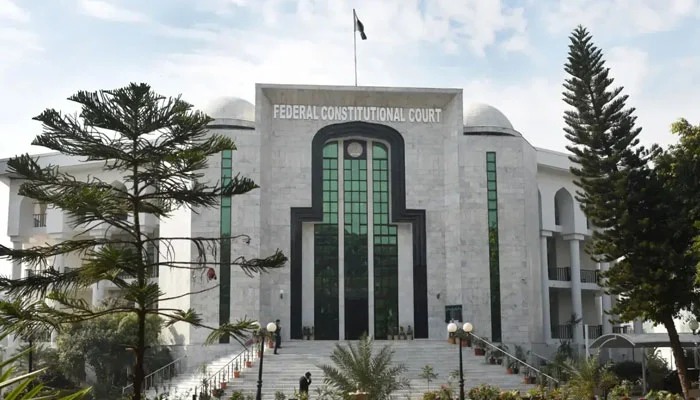
    Pakistan’s Federal Constitutional Court (FCC) has overturned a 16-year-old Supreme Court ruling concerning land acquisition and claims for additional compensation, delivering a significant judgment on the legal rights of landowners. A three-member bench headed by FCC Chief Justice Amin-ud-Din Khan announced the decision on review petitions challenging the Supreme Court’s 2010 majority judgment. Justice Ali Baqar Najafi and Justice Syed Arshad Hussain Shah were also members of the bench. The 47-page judgment, authored by Chief Justice Amin-ud-Din Khan, held that parts of the Supreme Court’s earlier decision in the Sadaqat Ali Khan case were not legally sustainable. The court ruled that a landowner who accepts compensation without raising an objection cannot subsequently claim additional compensation. It also held that a landowner who fails to file a reference within the prescribed legal period cannot later seek additional compensation. Another important finding was that landowners who were not parties to earlier proceedings cannot automatically claim the benefit of higher compensation awarded to other landowners through court proceedings. The Federal Constitutional Court observed that the Land Acquisition Act, 1894 provides a comprehensive legal framework for land acquisition and determination of compensation. Anyone seeking additional compensation must follow the procedure established under the law. According to the judgment, once the prescribed period for legal proceedings expires, the award issued by the Land Acquisition Collector becomes final. Courts cannot use their powers to bypass mandatory statutory requirements. The court further clarified that the principle of equality under Article 25 of the Constitution cannot eliminate statutory limitation periods or mandatory legal conditions. Similarly, the power to do complete justice cannot be used to create a new legal right that does not exist under the relevant law. The Supreme Court’s 2010 majority ruling had extended the benefit of additional compensation to certain landowners who were not parties to the original proceedings. The National Highway Authority chairman and other authorities subsequently challenged the ruling through review petitions. The Federal Constitutional Court accepted the review petitions filed by the concerned authorities and also allowed related civil appeals. Decisions of the Peshawar and Lahore High Courts concerning additional compensation were consequently set aside, while the original orders of the Land Acquisition Collectors and other competent authorities were restored. However, Justice Syed Arshad Hussain Shah’s additional note clarified that additional compensation already paid in good faith under the earlier judgment cannot be recovered. Recovery would not be permissible where the money was obtained without fraud, misrepresentation or an unlawful method. The ruling could have significant implications for future land acquisition and compensation disputes by emphasizing statutory procedures, legal deadlines and the finality of compensation awards.

  • |

    Andrew Garfield sets his terms for a Spider-Man return

    Andrew Garfield has finally given fans a real answer on when he might swing back into the Spider-Man suit. The 42-year-old actor first played the superhero in The Amazing Spider-Man and its 2014 sequel. He returned briefly in 2021, teaming up with Tobey Maguire for a surprise cameo in Tom Holland’s No Way Home. That appearance only fueled the speculation. Fans have been asking him about a full comeback ever since, and Garfield has mostly dodged the question with vague replies. That changed recently. With Brand New Day now out in theatres, the topic resurfaced in a new interview, and this time Garfield spelled out his actual condition. He said any future project would need to feel nothing like the Spider-Man stories audiences already know. The actor wants something genuinely unexpected, a version of the character dropped into a completely different kind of film. As an example, he floated the idea of a road trip movie built around Spider-Man, something far removed from the usual superhero formula. The comment set off a wave of reactions online. Fans have started pitching their own concepts for what a Garfield return could look like. Much of the excitement ties back to a running theory that Tom Holland’s latest Spider-Man film quietly teased Miles Morales through a post-credits scene. Riding that theory, one fan on X proposed that Garfield’s Spider-Man could take on a mentor role opposite Miles, rather than headline another solo outing. There’s also a sense among supporters that Garfield has been shortchanged by the studio. Both Maguire and Holland got three Spider-Man films apiece, while Garfield only appeared in two before his brief cameo. Many fans see that gap as proof he deserves another proper shot at the role. For now, nothing is confirmed. But Garfield’s comments make one thing clear: a simple return to the character wouldn’t be enough for him. He’s looking for something that reinvents what a Spider-Man movie can even be, not just another sequel wearing the same mask. Whether Sony or Marvel ever build a project around that idea is still unknown. Until then, Garfield’s fans will keep speculating, and keep hoping he gets the film he’s actually asking for.

  • |

    Indian ex-editor jailed 10 years for rape

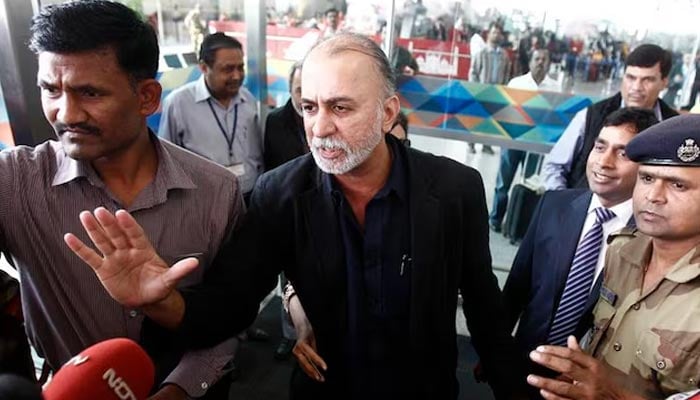
    An Indian court has sentenced former investigative magazine editor Tarun Tejpal to 10 years of rigorous imprisonment after convicting him in a rape case involving a junior colleague, bringing a high-profile legal battle that has spanned more than a decade to a major turning point. The case stems from allegations that Tejpal sexually assaulted a female journalist inside a lift at a luxury hotel in the coastal state of Goa during a media event in November 2013. A trial court had acquitted Tejpal in 2021 of charges including rape, sexual harassment and wrongful restraint. However, the Goa government challenged the verdict before the Bombay High Court, which overturned the acquittal and found him guilty. The court ordered Tejpal to surrender within two weeks to begin serving his sentence. In addition to the prison term, he was directed to pay a financial penalty imposed by the court. Following the verdict, Tejpal announced that he would challenge the conviction before India’s Supreme Court. He maintained that the case against him was politically motivated and claimed he had faced a prolonged campaign against him over the past 13 years. Tejpal was first arrested in 2013 after the allegations surfaced and spent several months in custody before being granted bail by the Supreme Court. Throughout the proceedings, he consistently denied the allegations and argued that the prosecution was driven by political considerations. The case attracted nationwide attention because it emerged during a period of heightened public concern over violence against women in India. Public debate over sexual assault had intensified following the 2012 gang rape and murder of a young woman in New Delhi, which led to widespread protests and significant reforms to India’s criminal laws on sexual offences. The conviction also had a lasting impact on Tehelka, once regarded as one of India’s leading investigative publications. The scandal severely damaged the magazine’s reputation and influence, despite continuing operations under new management.

Leave a Reply

Your email address will not be published. Required fields are marked *