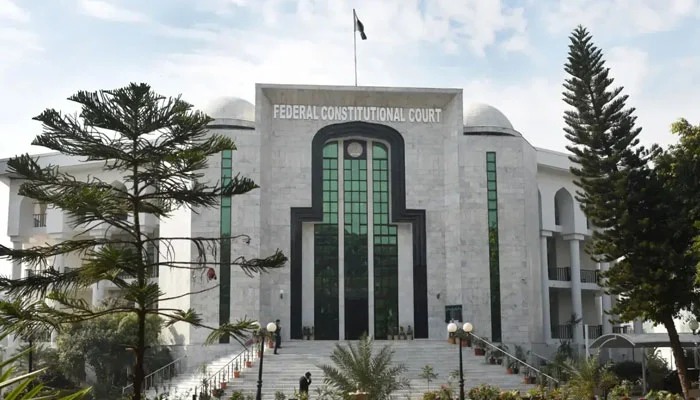
federal constitutional court
| |

Federal constitutional court overturns 16-year-old…

Pakistan’s Federal Constitutional Court (FCC) has overturned a 16-year-old Supreme Court ruling concerning land acquisition and claims for additional compensation, delivering a significant judgment on the legal rights of landowners.

A three-member bench headed by FCC Chief Justice Amin-ud-Din Khan announced the decision on review petitions challenging the Supreme Court’s 2010 majority judgment. Justice Ali Baqar Najafi and Justice Syed Arshad Hussain Shah were also members of the bench.

The 47-page judgment, authored by Chief Justice Amin-ud-Din Khan, held that parts of the Supreme Court’s earlier decision in the Sadaqat Ali Khan case were not legally sustainable.

The court ruled that a landowner who accepts compensation without raising an objection cannot subsequently claim additional compensation. It also held that a landowner who fails to file a reference within the prescribed legal period cannot later seek additional compensation.

Another important finding was that landowners who were not parties to earlier proceedings cannot automatically claim the benefit of higher compensation awarded to other landowners through court proceedings.

The Federal Constitutional Court observed that the Land Acquisition Act, 1894 provides a comprehensive legal framework for land acquisition and determination of compensation. Anyone seeking additional compensation must follow the procedure established under the law.

According to the judgment, once the prescribed period for legal proceedings expires, the award issued by the Land Acquisition Collector becomes final. Courts cannot use their powers to bypass mandatory statutory requirements.

The court further clarified that the principle of equality under Article 25 of the Constitution cannot eliminate statutory limitation periods or mandatory legal conditions. Similarly, the power to do complete justice cannot be used to create a new legal right that does not exist under the relevant law.

The Supreme Court’s 2010 majority ruling had extended the benefit of additional compensation to certain landowners who were not parties to the original proceedings. The National Highway Authority chairman and other authorities subsequently challenged the ruling through review petitions.

The Federal Constitutional Court accepted the review petitions filed by the concerned authorities and also allowed related civil appeals. Decisions of the Peshawar and Lahore High Courts concerning additional compensation were consequently set aside, while the original orders of the Land Acquisition Collectors and other competent authorities were restored.

However, Justice Syed Arshad Hussain Shah’s additional note clarified that additional compensation already paid in good faith under the earlier judgment cannot be recovered. Recovery would not be permissible where the money was obtained without fraud, misrepresentation or an unlawful method.

The ruling could have significant implications for future land acquisition and compensation disputes by emphasizing statutory procedures, legal deadlines and the finality of compensation awards.


Similar Posts

  • | |

    Madison Beer announces engagement to Justin Herbert

    Singer-songwriter Madison Beer has announced her engagement to NFL quarterback Justin Herbert, sharing the joyful news with fans through her official Instagram account. The surprise announcement quickly captured widespread attention, marking a major personal milestone for the couple after months of public appearances and growing speculation about their relationship. Beer revealed the engagement by posting a collection of photographs from the proposal, which took place in a scenic outdoor setting surrounded by flowers and mountain views. The images showed Herbert getting down on one knee before the pair embraced and celebrated the moment together. Keeping the caption simple yet meaningful, Beer wrote, “meet my fiancé,” confirming the engagement to her millions of followers. The post immediately drew an outpouring of congratulations from fans, friends, and fellow celebrities, with many celebrating the couple’s happy news in the comments. Within hours, the announcement had generated millions of likes and widespread discussion across social media platforms. Beer and Herbert were first linked romantically in 2025 before making their relationship public. Since then, they have occasionally shared glimpses of their life together while largely maintaining a private relationship. Earlier this year, Herbert also made an appearance in Beer’s “Lovergirl” music video, giving fans another look at their partnership beyond the headlines. Beer has built a successful music career through projects including Life Support and Silence Between Songs, earning praise for her emotional songwriting and powerful vocals. Herbert, meanwhile, has established himself as one of the NFL’s leading quarterbacks, admired for his performances on the field and calm leadership. Although the couple has not announced wedding plans or shared additional details about the ceremony, the engagement marks an exciting new chapter in both of their lives. For fans who have followed Beer’s journey over the years, the Instagram announcement offered a heartfelt glimpse into a deeply personal moment, one that was celebrated around the world almost instantly after it was shared. https://www.forbes.com/sites/jeffbenjamin/2026/07/28/madison-beer-engaged-to-nfl-star-justin-herbert/

  • | |

    Capital one defends closure of Trump organization accounts

    Capital One Financial has responded to a lawsuit filed over its decision to close bank accounts linked to the Trump Organization, arguing that the move was based on internal anti-money laundering reviews rather than political or ideological motivations. The bank, in a legal filing submitted on Friday, stated that it closed the accounts following a detailed assessment conducted by its anti-money laundering (AML) specialists. The company argued that the decision was made after months of analysis and was consistent with its internal policies as well as regulatory requirements. The filing represents the first time a major bank has publicly connected concerns related to money laundering risks with its decision to end a banking relationship involving the Trump family business. However, Capital One clarified that it has never accused the Trump Organization of committing illegal money laundering activities. Instead, the bank said that the account closures were the result of routine compliance procedures. Capital One argued that documents presented in the case, along with the plaintiffs’ own claims, demonstrate that the decision was related to AML concerns rather than any attempt to discriminate against the company because of political beliefs. The dispute began after Capital One informed the Trump Organization in March 2021 that it planned to close more than 300 accounts associated with businesses connected to former U.S. President Donald Trump. The Trump Organization and Eric Trump, Trump’s son, later filed a lawsuit in March 2025 in a Florida federal court, claiming that the bank had unfairly “debanked” them because of political pressure and what they described as the company’s “woke” policies. The lawsuit alleged that Capital One’s decision was influenced by the political environment following the January 6, 2021, attack on the U.S. Capitol. The plaintiffs argued that the bank wanted to distance itself from Trump and his supporters during a period of intense public and political scrutiny. A federal court in Miami has already dismissed two versions of the complaint but allowed the plaintiffs opportunities to revise and submit updated claims. Capital One argued in its latest filing that the amended complaint continues to contain the same weaknesses as earlier versions and fails to establish evidence of unlawful discrimination. The bank accused the Trump Organization of presenting selective information and relying on statements taken out of context. Capital One maintained that the allegations of political motivation were unsupported and ignored the broader circumstances behind the account closures. According to the bank’s filing, certain transaction patterns identified during its review matched types of activities that federal banking authorities commonly recognize as requiring additional examination. Capital One said its AML team followed established procedures before reaching the decision to terminate the accounts. The legal battle comes during a broader political debate in the United States over the issue of “debanking,” with some conservatives accusing financial institutions of unfairly targeting individuals and organizations because of their political views. During his second presidential term, Trump’s administration has criticized such practices and taken steps aimed at preventing what it describes as discriminatory banking decisions. The controversy has also involved other major financial institutions. Trump previously filed a lawsuit against JPMorgan Chase, making similar allegations regarding political discrimination. During his first term in office, Trump also took legal action against Capital One and Deutsche Bank in an effort to prevent the release of his financial records to Congress. The case continues to highlight the growing tension between banking compliance practices, political concerns, and the debate over whether financial institutions should have broader restrictions on ending relationships with controversial clients.

  • | |

    Danny Ramirez reveals biggest surprise about Aveng…

    Danny Ramirez has opened up about one of the most memorable parts of filming Avengers: Doomsday, revealing that the biggest surprise was not the blockbuster action or the star-studded cast, but the chance to reunite with one of his closest friends. Speaking to People magazine during San Diego Comic-Con on July 25, the actor reflected on his experience working on the highly anticipated Marvel film and described the atmosphere on set as unforgettable.  Ramirez reprises his role as Joaquin Torres, the new Falcon, in Avengers: Doomsday. The actor said returning to the Marvel Cinematic Universe was exciting on its own, but sharing the experience with longtime friend Lewis Pullman made it even more special. The two actors previously worked together on Top Gun: Maverick and have remained close ever since. According to Ramirez, reuniting on another major project felt like “summer camp,” with the cast enjoying a fun and supportive environment behind the scenes.  The actor explained that the chemistry among the cast members helped create a positive work atmosphere despite the enormous scale of the production. With Marvel bringing together heroes from the Avengers, Fantastic Four and X-Men franchises, Ramirez admitted it was surreal to see so many iconic characters sharing the same set. He said every day offered new surprises, making the experience unlike anything he had worked on before.  Ramirez also spoke about working alongside legendary performers such as Sir Patrick Stewart and Sir Ian McKellen. In another Comic-Con interview, he praised both actors for their professionalism and dedication, saying he learned a great deal simply by watching them perform. He noted that their decades of experience and command of storytelling inspired him to become a better actor.  Avengers: Doomsday is shaping up to be one of Marvel Studios’ biggest crossover events to date. Directed by Joe and Anthony Russo, the film features the return of several beloved MCU stars while introducing major characters from other Marvel franchises. Robert Downey Jr. will make his highly anticipated return to the Marvel universe, this time portraying the iconic villain Doctor Doom instead of Iron Man.  For Ramirez, however, the film’s biggest highlight was far more personal than any action sequence or special effect. He said reconnecting with Pullman reminded him of why he loves making movies, emphasizing the friendships that can grow through years of collaboration. That sense of camaraderie, he explained, made every day on set enjoyable and helped create lasting memories beyond the cameras.  As anticipation builds for Avengers: Doomsday, Ramirez’s comments have given fans a glimpse into the film’s positive behind-the-scenes atmosphere. While audiences are eagerly waiting to see Marvel’s biggest heroes unite on screen, the actor says the genuine friendships formed during production may be the most rewarding part of the entire journey. 

  • |

    Protests erupt in Bologna after man’s death during police restraint

    Thousands of people marched through the Italian city of Bologna after the death of a Moroccan born man who died while being restrained by police, prompting a criminal investigation and violent clashes that left dozens of officers injured. The protests were held in memory of Abderrahim Fakir, whose death on Sunday has sparked widespread public anger and renewed debate over police conduct in Italy. Demonstrators gathered to demand justice before a smaller group broke away from the main rally and clashed with riot police late into the night. Authorities said 64 police officers were injured during the unrest as protesters threw objects, confronted security forces and set two vehicles on fire. Police eventually brought the situation under control. The incident that led to the demonstrations began after officers responded to reports of a man behaving erratically in Bologna’s Pilastro neighbourhood. According to police, Fakir was seen kicking garage doors before officers attempted to calm him. They later used pepper spray during the confrontation. A video widely shared by Italian media shows two police officers holding Fakir face down on the ground while another man restrains his legs. Emergency medical workers are also visible nearby. In the footage, Fakir can be heard asking the officers to stop before he gradually stops moving. After he became unresponsive, officers handcuffed him and attempted to wake him before medical staff intervened. Prosecutors have opened a manslaughter investigation involving the police officers and emergency workers who were present at the scene. The inquiry will examine whether the restraint methods or medical response contributed to Fakir’s death. Several witnesses told local media that although Fakir appeared distressed, he was unarmed and did not pose a threat to anyone nearby. His sister, Khadija Fakir, called for a full investigation and said the family wanted answers about how he died while in police custody. Bologna Mayor Matteo Lepore also expressed shock after watching the video and organised Monday’s public demonstration in support of Fakir’s family. During the rally, Fakir’s niece addressed the crowd, describing her uncle as a caring and respected member of the community. She said he deserved compassion, dignity and help rather than the outcome that followed. Although the main demonstration remained peaceful, officials said a small number of protesters later turned violent. Mayor Lepore condemned the unrest while drawing a distinction between peaceful demonstrators and those who resorted to violence. The police union defended the officers’ actions and argued that the available video showed they had acted appropriately under difficult circumstances. Union representatives said the officers immediately handed over body camera footage to investigators and insisted the use of force was justified because officers faced resistance during the incident. Prime Minister Giorgia Meloni called for a thorough investigation into Fakir’s death while strongly condemning the violence that followed. She said determining the truth about the incident was essential but stressed that attacks on law enforcement could not be justified. Fakir’s death has drawn comparisons with previous high profile cases involving deaths in police custody in Italy. Opposition politicians have criticised the government’s strong support for police, while human rights advocates say the investigation must establish whether officers followed proper procedures during the arrest. The case has intensified public discussion over policing practices and accountability across the country.

  • |

    Eight Palestinians killed in fresh Gaza strikes

    At least eight Palestinians were killed in fresh Israeli airstrikes across the Gaza Strip on Sunday, according to Gaza’s civil defence authorities, as violence continued despite renewed diplomatic efforts aimed at restoring a ceasefire. Officials said the latest strikes targeted several locations across the enclave, including Deir el-Balah, Khan Younis and Gaza City. Among the victims were a man and a woman who were killed when an Israeli helicopter struck a residential apartment in southern Deir el-Balah. Additional attacks claimed the lives of three people in Khan Younis and another person in Gaza City’s Old City. The latest escalation came just days after the United States unveiled a new roadmap intended to revive the stalled Gaza ceasefire agreement. The proposed plan reportedly includes steps toward Hamas’ disarmament and a phased Israeli military withdrawal from the territory. However, both sides remain divided over the conditions for implementing the proposal. Hamas has maintained that it will only place its weapons under supervision after Israeli military operations end and troops withdraw in accordance with the previously agreed ceasefire framework. Israeli officials, meanwhile, have insisted that any withdrawal depends on what they describe as the complete and genuine disarmament of Hamas. Israeli Prime Minister Benjamin Netanyahu has not publicly commented on the latest proposal, while some members of his coalition have rejected the initiative and called for continued military operations against Hamas. Diplomatic contacts are continuing in an effort to reduce tensions and revive negotiations. Former Palestinian official Mohammed Dahlan said discussions involving senior US representatives were ongoing and focused on securing an end to the fighting, although no breakthrough has yet been announced. Meanwhile, another Israeli strike reportedly destroyed a medical supply warehouse in central Gaza, causing extensive damage and raising further concerns over the humanitarian situation.

  • HSA VC dismissal upheld in harassment case

    Islamabad: The President of Pakistan rejected the appeal of Health Services Academy Vice Chancellor Dr Shahzad Ali Khan and maintained his dismissal from service. The latest order held that retaliatory action against Dr Ayesha Khan created a hostile work environment and amounted to gender based harassment, justifying the punishment of dismissal. The decision creates a major legal twist in the high profile HSA case. The President’s legal forum clearly observed that this was not established as a case of sexual harassment in the manner found earlier by the Federal Ombudsperson for Protection Against Harassment of Women at the Workplace. It said the earlier FOSPAH decision contained serious weaknesses, including failure to properly examine the nature of the relationship between the two parties and failure to frame separate questions on several important parts of the dispute. However, those weaknesses did not save Dr Shahzad Ali Khan from dismissal. The final order stated that his later conduct, especially the abrupt termination of Dr Ayesha Khan, could not be ignored. It held that the retaliatory measures created a hostile work environment for her and amounted to gender-based harassment. The President approved the recommendation to dismiss Dr Shahzad Ali Khan’s representation and maintain the penalty of dismissal from service. The final decision also strongly observed that Dr Shahzad Ali Khan had not approached the President with clean hands. It questioned his claim that he had been honey trapped when that claim was examined together with what the decision described as extreme retaliatory measures taken against Dr Ayesha Khan. One important point was the timing of her removal from service. The record showed that Dr Ayesha Khan registered an FIR and her employment was terminated the following day. The presidential decision said this sequence was important when deciding whether retaliation had occurred. At the same time, the President’s legal forum strongly criticised major parts of the original FOSPAH reasoning. It said FOSPAH failed to properly establish the timeline of the different complaints and legal actions between the two parties. It also found contradictions and unanswered questions in the case. The decision said FOSPAH should have separately examined the exact nature of the relationship, whether any employment benefit was linked to a romantic or sexual demand, whether electronic evidence was reliable, what the financial transactions represented and whether Dr Ayesha Khan’s termination was retaliation. Instead, FOSPAH had mainly framed the broad question of whether harassment had occurred and who was responsible. The President’s legal forum described that approach as inadequate for such a complicated case. The order went further and stated that not a single specific incident of sexual harassment had been identified in the complaint. It said the sexual harassment conclusion was reached through indirect reasoning instead of being linked to a particular incident. The forum therefore concluded that the dispute could not properly be treated as sexual harassment on that basis. The decision described the dispute as involving two people who had remained close for several years before serious differences developed. Dr Ayesha Khan’s position was that the relationship involved marriage or a promise of marriage. Dr Shahzad Ali Khan denied that a marriage existed and claimed he had been honey trapped. The presidential forum said neither honey trapping nor marriage had been established on the record before it. It observed that questions over whether a valid marriage existed should be decided by a competent family court rather than through workplace harassment proceedings. The case originally started with complaints and counter complaints between Dr Shahzad Ali Khan and Dr Ayesha Khan. Dr Shahzad Ali Khan accused Dr Ayesha Khan of blackmail, honey trapping, financial fraud, threats and misuse of authority. He alleged that she extracted Rs 27.44 million from him through threats and manipulation for an alleged property investment. He also alleged that she threatened his wife while demanding Rs 30 million. According to his version, money from the sale of two vehicles, worth around Rs 10 million, was also handed to Dr Ayesha Khan for investment and was not returned. Dr Ayesha Khan denied those accusations. She alleged that Dr Shahzad Ali Khan made personal and inappropriate remarks, discussed private marital matters with her, promised marriage and later took retaliatory action against her. She also accused him of workplace harassment and alleged physical harassment in an official vehicle. She maintained that her termination and other actions followed her resistance to him and her pursuit of legal action. The original FOSPAH order took a much stronger view against Dr Shahzad Ali Khan. It found that he had misused his authority while serving as a teacher and later Vice Chancellor, developed an inappropriate relationship with a student who later became his junior colleague and gave her unusual professional benefits. FOSPAH ordered his removal from service after finding quid pro quo harassment. WhatsApp messages also became an important part of the original case. The record included messages from Dr Shahzad Ali Khan’s number in which Dr Ayesha Khan was addressed with personal names including Zalim Princess and other affectionate expressions. FOSPAH considered these messages important evidence against the honey trap allegation and viewed them as showing personal communication initiated from a position of authority. The Ombudsperson also found that allegations of financial misappropriation against Dr Ayesha Khan had not been proved through enough documentary evidence. Dr Shahzad Ali Khan challenged the FOSPAH decision before the President. His lawyers argued that Dr Ayesha Khan had given different versions of important events before different legal forums. They also challenged the use of WhatsApp screenshots, saying the material was incomplete and had not been properly examined through forensic testing. His side denied any marriage, sexual favour or sexual relationship and argued that the finding of quid pro quo sexual harassment was based on assumptions rather than direct evidence. Dr Ayesha Khan’s lawyers opposed the appeal. They argued that the original order had followed a full inquiry, evidence and cross examination. Her side said the WhatsApp messages came from Dr Shahzad Ali Khan’s registered number and argued that his

Leave a Reply

Your email address will not be published. Required fields are marked *