president donald trump
|

US President Donald Trump backtracks on promise allowing Ukraine to produce Patriot missiles

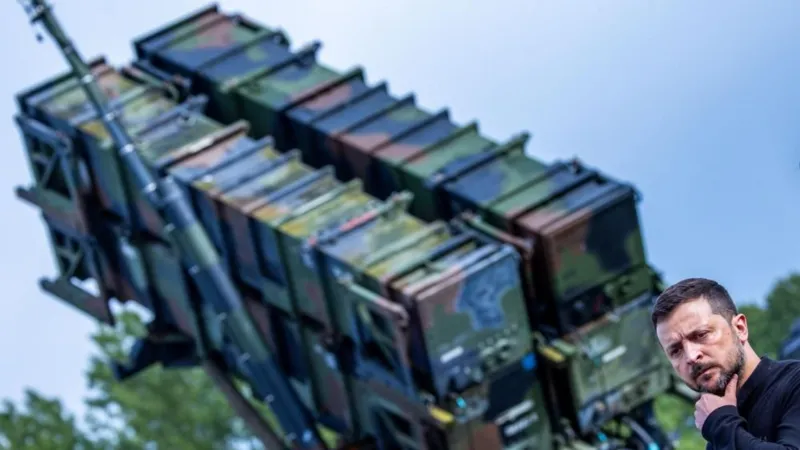
US President Donald Trump has walked back his previous offer to grant Ukraine a license to domestically produce Patriot interceptor missiles, stating during a Cabinet meeting at Camp David that the United States has “not agreed” to share the technology.

Trump expressed caution over transferring sensitive defense hardware, warning that “they can someday turn on you” and emphasising the need to safeguard advanced military systems.

The reversal comes just three weeks after Trump publicly promised Ukrainian President Volodymyr Zelensky at a NATO summit in Ankara that Washington would grant Kyiv the manufacturing rights to build the air defense interceptors.

Although Zelensky recently stated after a White House visit that the production licensing had been approved, Trump clarified that no final commitment has been made. The decision arrives as Kyiv faces intensified Russian drone and ballistic missile strikes, with Ukrainian military officials warning that critical shortages of Patriot interceptors are severely compromising their air defense capabilities.

Similar Posts

  • |

    US Consulate in Toronto targeted in second shooting

    TORONTO: Canadian police have launched an investigation after gunfire was reported outside the US Consulate in downtown Toronto. The incident marks the second shooting near the diplomatic facility this year. Authorities are investigating the motive and examining security measures around the building. Police were alerted after hearing a gunshot near the consulate on University Avenue. Officers later found evidence that a firearm had been discharged. Investigators recovered a single shell casing from the area. The exterior of the consulate also suffered minor damage. No injuries were reported in the incident. Police said a white Honda sedan without a licence plate was seen leaving the area at high speed. Officers briefly pursued the vehicle but ended the chase because of safety concerns. The consulate was previously targeted in a shooting on March 10. Several arrests were later made in connection with that incident. Toronto police have also been investigating claims that criminal networks were recruiting young people to carry out shootings at prominent locations across the city. Officials have previously mentioned the US Consulate and Jewish institutions among the reported targets. Police have not yet established whether the latest shooting is linked to the earlier incident. Authorities said it was too early to determine a definite motive. Security around the consulate has remained under close watch following previous incidents. Police said in June that young people in the Toronto area were allegedly being offered money to carry out shootings at different locations. The reported targets included synagogues, Jewish schools and the US Consulate. Three people were arrested in connection with the March shooting. A police officer was killed during the operation linked to those arrests. The US State Department said it was cooperating with Canadian authorities following the latest incident. A department spokesperson thanked Canadian law enforcement agencies for their continued efforts to protect the consulate. The US Embassy and consulates across Canada remain open. However, some routine consular services in Toronto have been rescheduled. Ontario Premier Doug Ford condemned the latest incident. He also criticised recent shootings and acts of vandalism reported in Toronto. Ford said police investigations were underway and called for those responsible to be identified and prosecuted.

  • | |

    Arjumand Rahim opens up about anxiety and multiple ER visits

    Arjumand Rahim is one of Pakistani television’s most enduring and respected performers. She began her career in the 1990s and has built a body of work that spans three decades, evolving alongside the industry itself and consistently delivering performances that leave a mark. Her recent role in Sher reminded audiences precisely what she is capable of, earning widespread praise and reinforcing her standing as one of the finest actors of her generation. Away from the screen, however, she has been quietly navigating a health struggle that was far more frightening than anything she has portrayed on camera. Appearing as a guest on Vasay Chaudhary’s show, Arjumand spoke with remarkable candour about a period in her life when she repeatedly found herself in the emergency room with no clear explanation for what was happening to her body. She described feeling faint and physically unwell on multiple occasions, with each ER visit leaving her more shaken than the last. Adding to her fear was a deeply personal detail: her father had passed away due to cardiac arrest, and the physical symptoms she was experiencing brought that grief rushing back in the most frightening way possible. Every episode of faintness or discomfort carried the shadow of that loss. It was only when she received a proper diagnosis that the picture began to make sense. She was found to be suffering from extreme anxiety and depression, conditions that had been manifesting through very real and alarming physical symptoms. For someone who had not understood what was happening to her, the diagnosis, while difficult to hear, was also the beginning of clarity. She sought professional help, underwent therapy, and received the treatment she needed to begin recovering. She described the period before the diagnosis as truly frightening, a time when she did not know what was wrong with her and could not explain what her body was doing or why. The uncertainty, layered on top of grief and the physical toll of the episodes themselves, made for an extraordinarily difficult stretch of time. The good news, and she was clear about this, is that she is doing significantly better now. The treatment worked, and the willingness to seek help made the difference. Her decision to speak openly about what she went through carries weight beyond her own story. In Pakistan, conversations around mental health and its physical manifestations remain challenging, and the stigma surrounding anxiety, depression and therapy continues to prevent many people from reaching out. When a figure of Arjumand Rahim’s stature speaks plainly about her own diagnosis and her experience of getting treatment, it sends a message that reaching for help is not weakness but the beginning of getting better. That is a message worth hearing.

  • |

    Progressive outsider Abdul El-Sayed claims victory in Michigan Senate primary

    In a dramatic outcome that has sent shockwaves through the Democratic establishment, progressive public health advocate Dr Abdul El-Sayed has secured the Democratic nomination for the United States Senate in Michigan, narrowly defeating establishment-backed Representative Haley Stevens. The contest to replace retiring Democratic Senator Gary Peters had emerged as a central battleground between the party’s moderate and progressive factions. Stevens, a four-term congresswoman with deep ties to Washington leadership, had entered the primary with formidable institutional backing and substantial financial support, including over $30 million (£23.5 million) spent on her behalf by political action committees affiliated with the American Israel Public Affairs Committee (AIPAC). Despite being outspent by a margin of roughly nine to one, El-Sayed built a coalition anchored by strong turnout among young voters, working-class communities, and urban centres such as Detroit and Ann Arbor. Backed by prominent progressive figures including Senator Bernie Sanders and Representative Alexandria Ocasio-Cortez, El-Sayed campaigned on a platform of universal healthcare, campaign finance reform, higher taxes on wealthy corporations, and an immediate end to foreign military aid. “We built this campaign brick by brick”, El-Sayed told cheering supporters at his election night watch party in Detroit, emphasising that grassroots engagement ultimately proved more powerful than dark-money political action committees. The progressive momentum extended down-ballot across the state. In Michigan’s 13th Congressional District, Democratic Socialist Donavan McKinney unseated incumbent Representative Shri Thanedar, an outspoken supporter of military aid to Israel, while progressive activist William Lawrence clinched the nomination in another competitive congressional district. The primary result sets up a high-stakes November general election against Republican nominee Mike Rogers, a former congressman who ran unopposed. Rogers and national Republican strategists have already signalled plans to paint El-Sayed’s left-wing platform as out of touch with Midwestern swing-state voters. For Democrats, the contest will serve as an ultimate test of whether a bold progressive message can unite the party base and retain a seat vital to determining control of the US Senate.

  • | | |

    Policeman martyred in Swat anti-terror operation

    A police constable was martyred during an ongoing operation against suspected terrorists in Swat’s Kabal tehsil, police said on Wednesday. The operation is being carried out in the Shalkho Sar area. Security forces launched the action after receiving information about the presence of terrorists in the region. According to Swat police, Elite Force Constable Gulfam embraced martyrdom while fighting the militants on Tuesday night. Police said he showed courage during the operation and sacrificed his life in the line of duty. The operation is being conducted jointly by the Counter-Terrorism Department, Swat Police and Upper Swat Police. Senior police officials are supervising the operation. The Malakand regional police officer and the district police officers of Swat and Upper Swat are overseeing the security action. Police said security personnel have surrounded the area where the terrorists are believed to be present. The suspects have reportedly been confined to the Shalkho Sar area. Officials also reported that the operation may have caused heavy casualties among the terrorists. However, further details about the number of casualties were not immediately available. The security forces continue to search the area as the operation remains underway. Officials are taking measures to prevent the suspects from escaping. Swat District Police Officer Umar Khan said the police force remains committed to maintaining peace in the region. He said law enforcement personnel would continue their efforts to protect the public. He also stressed that police would remain prepared to make sacrifices in the fight against terrorism. The latest incident comes as security concerns continue to affect parts of Khyber Pakhtunkhwa. Reports in recent months have pointed to the presence of militants in Kabal and Matta tehsils of Swat. Security forces have increased operations in areas where militant activity has been reported. Khyber Pakhtunkhwa has remained one of the major regions affected by militant violence. Law enforcement agencies have continued conducting intelligence-based and targeted operations to counter terrorist threats. A security assessment released in June by the Pakistan Institute for Conflict and Security Studies also highlighted the worsening security situation. The assessment said Pakistan’s security environment had deteriorated significantly in May after showing improvement during the previous two months. According to the assessment, the increase was largely linked to rising militant violence in Khyber Pakhtunkhwa and Balochistan.

  • |

    Viral 1970s PTV clip reignites debate over changing TV standards

    A vintage clip from a 1970s Pakistan Television (PTV) drama has gone viral on social media, reigniting conversations about how the country’s television industry and cultural standards have changed over the decades. PTV, Pakistan’s oldest television network, first went on air in November 1964 and quickly became known for producing memorable dramas, educational programs, and family-oriented entertainment. Many of its productions from the 1960s and 1970s are still remembered for their strong storytelling, talented actors, and high production quality. Over the years, however, the broadcaster’s programming evolved alongside Pakistan’s changing political and social landscape. The recently resurfaced clip is from the classic PTV play Parchaiyaan. In the scene, several female characters are seen wearing elegant sarees paired with sleeveless blouses, a fashion choice that has caught many younger viewers by surprise. The attire, which reflected the style of that era, has sparked widespread discussion online, with many people saying such costumes would be unlikely to appear on mainstream Pakistani television today. The video quickly gained traction across social media platforms, where users compared the fashion and creative freedom of the 1970s with modern television standards. Many viewers expressed surprise that such scenes were once broadcast on the country’s state-owned television network. Some social media users described the clip as evidence that Pakistani television once embraced a more modern and progressive visual style. Others questioned whether the footage was authentic, with one user asking if it had really aired on PTV. Another remarked that the television industry of the time appeared far more liberal than many people assume today. Not everyone viewed the clip positively. Some users argued that the clothing shown in the scene was too revealing by today’s standards, while others said the discussion highlighted how cultural expectations and public attitudes have shifted over the decades. Several viewers, however, praised the actresses featured in the clip for carrying the traditional outfits with grace and elegance. One user admired the woman dressed in a black saree, saying she wore the outfit confidently despite the short-sleeved blouse. Others pointed out that sarees were a common part of formal fashion in Pakistan during that period, particularly among urban families and in television productions. The viral discussion has also revived broader conversations about the evolution of Pakistan’s entertainment industry. Many users reflected on how television content has changed over time due to shifting social values, cultural preferences, and broadcasting policies. Some believe earlier productions offered greater artistic freedom, while others argue that changing audience expectations naturally influenced the direction of television programming. As the clip continues to circulate online, it serves as a reminder of how fashion, media, and public opinion evolve across generations. Whether viewed as a symbol of artistic expression or simply a reflection of its time, the decades-old scene has once again placed PTV’s rich television history at the center of public conversation.

  • |

    Pakistan’s trade deficit surges 25% to nearly $4 billion in July 

    ISLAMABAD: Pakistan’s trade deficit expanded sharply during the first month of the new fiscal year, reaching nearly $4 billion in July, as a strong rise in imports continued to outpace export growth, highlighting persistent weaknesses in the country’s external sector despite a series of incentives announced for exporters. According to the latest figures released by the Pakistan Bureau of Statistics (PBS), the country’s trade deficit widened to $3.95 billion in July 2026, compared to $3.16 billion recorded during the same month last year. The deficit increased by approximately $794 million, representing an annual rise of 25.2%. The widening gap was primarily driven by a substantial increase in imports, which climbed to $6.9 billion from $5.8 billion in July 2025. This reflects an increase of more than $1 billion, or 18% year-on-year, indicating stronger demand for imported goods and raw materials. Exports Show Growth but Remain Below Key Milestone While Pakistan’s exports registered positive growth, they once again failed to cross the important $3 billion monthly mark. Exports reached $2.94 billion, falling short of the milestone by around $61 million. On an annual basis, exports increased by 9.5%, adding nearly $256 million compared to July last year. Although the improvement reflects steady recovery in overseas shipments, analysts believe the pace remains insufficient to counter the rapid expansion in imports. Exports had crossed the $3 billion threshold in January 2026, touching approximately $3.05 billion, but the country has been unable to maintain that level in the months that followed. Tariff Reforms Under Scrutiny The latest trade figures have renewed debate over Pakistan’s tariff liberalisation policy, introduced under broader economic reforms supported by international financial institutions, including the World Bank and the International Monetary Fund (IMF). The government has gradually lowered tariff barriers to increase competition and integrate Pakistan more closely into global markets. However, economists argue that the economy was opened before domestic industries were provided with sufficient support to compete effectively. Business leaders have repeatedly pointed out that exporters continue to face high energy prices, elevated financing costs, tax-related uncertainties and exchange rate volatility, all of which reduce their competitiveness in international markets. Earlier projections by the World Bank had suggested that tariff reforms would increase exports by 14% while limiting import growth to around 7%. However, the latest figures suggest imports have grown much faster than anticipated, while export gains have remained comparatively modest. Government Rolls Out Fresh Export Incentives To strengthen export performance, the federal government has announced a series of financial support measures during the current fiscal year. In the federal budget, Prime Minister Shehbaz Sharif reduced the minimum and advance tax on exporters to 1.25% and abolished the 10% super tax on export earnings in an effort to improve liquidity and encourage investment in export-oriented industries. More recently, the government approved a Rs98 billion export support package aimed at improving competitiveness and increasing foreign exchange earnings. Under the revised Export Finance Scheme (E-EFS), exporters will be able to obtain six-month working capital loans at an interest rate of 8.5%, with the government absorbing 5 percentage points of the financing cost. The subsidy for this component alone is estimated at Rs58 billion during the current fiscal year. ECC Approves New Financing Facilities The Economic Coordination Committee (ECC) has also expanded access to concessional financing by increasing the ceiling of the existing short-term financing portfolio from Rs1 trillion to Rs1.5 trillion. In addition, the committee approved the launch of a new Long-Term Growth Financing Facility, allowing exporters to access loans at an interest rate of 2% for the first two years, followed by a fixed 5% rate for the subsequent eight years. The government has also introduced a performance-based rebate scheme, effective from July 1, 2026, with an estimated annual allocation of Rs15 billion. Under the programme, exporters recording annual export growth of up to 10% over the previous year will receive a rebate equal to 1% of the incremental export value, while exporters achieving growth exceeding 10% will qualify for a 2% rebate on additional exports. Long-Term Challenges Persist Despite successive incentive packages introduced over several decades, Pakistan continues to struggle with achieving sustained export-led growth. Industry observers note that no single Pakistani exporter has generated $1 billion in annual export earnings, underscoring the structural challenges facing the country’s export sector. These challenges include limited product diversification, low industrial productivity, rising production costs, inconsistent policy implementation and insufficient value addition. Monthly Performance Offers Some Relief On a month-on-month basis, the trade data presented a more encouraging picture. Exports increased by 31% in July compared to June, rising by approximately $697 million, while imports remained largely unchanged at around $6.9 billion. As a result, the monthly trade deficit narrowed by nearly 15%, or around $709 million, compared with the previous month.

Leave a Reply

Your email address will not be published. Required fields are marked *