delegation walks out
|

US delegation walks out of UN Security Council after dispute with France

The United States walked out of a United Nations Security Council meeting on Monday during remarks by France’s ambassador, escalating a diplomatic dispute between the two allies over human rights and the leadership of the UN’s top human rights office.

The disagreement began after a recent vote on extending the term of Volker Turk as the United Nations High Commissioner for Human Rights. The United States joined Russia and North Korea in opposing his reappointment, placing Washington on the same side as two countries it has frequently criticized over human rights issues.

Following the vote, France’s mission to the United Nations strongly criticized the US position on social media, saying Washington had once been a global symbol of human rights but no longer deserved that reputation. The statement drew a sharp response from American officials and set the stage for the diplomatic confrontation that followed.

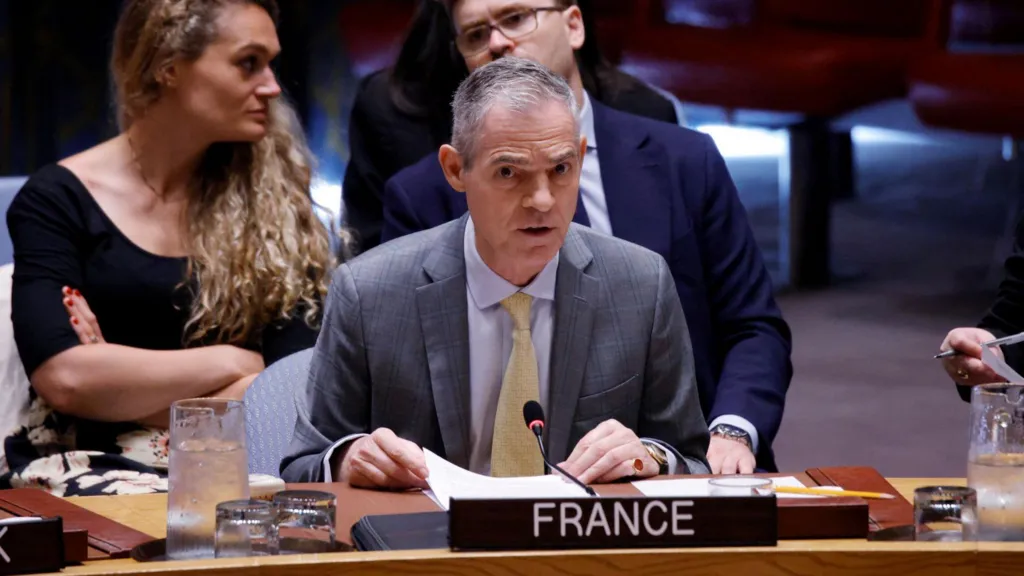
The latest tension unfolded during an emergency Security Council meeting on Russia’s war in Ukraine. As France’s UN Ambassador Jerome Bonnafont began speaking, members of the US delegation left the chamber in protest.

US Ambassador Dan Negrea later said the walkout was a direct response to what he described as France’s disrespectful and condescending language toward the United States. He warned that similar protests would continue unless France changed its approach and withdrew its criticism.

Earlier, US Ambassador Mike Waltz defended Washington’s opposition to Turk’s second term. He argued that the human rights chief had unfairly criticized democratic countries while failing to take a strong enough stance against governments with poor human rights records. Waltz did not identify specific examples to support his criticism.

During his time in office, Turk has repeatedly condemned Russia’s invasion of Ukraine and has also raised concerns about Israel’s military operations in Gaza. Despite US objections, his second term was approved by a large majority of UN member states, with 144 countries voting in favor, 10 voting against and 13 abstaining.

The dispute reflects broader tensions between the United States and the United Nations under President Donald Trump’s administration. In recent years, Washington has reduced financial support for several UN agencies and withdrawn from a number of UN bodies as part of a wider review of its international commitments.

After the vote on Turk’s reappointment, US Ambassador Jeff Bartos warned that the United States would reconsider its participation, engagement and funding for UN institutions. He accused the organization of allowing procedural abuses and political deals to influence key appointments.

France, however, strongly defended Turk’s leadership. Ambassador Bonnafont described him as a principled and impartial official who had carried out his responsibilities with integrity during his first term. France argued that his reappointment reflected the confidence of the overwhelming majority of UN member states.

A spokesperson for the United Nations declined to comment directly on the American walkout but said the organization expects all member countries to respect decisions made through its established voting process. The incident has added to growing friction between Washington and the UN at a time when international cooperation is already under pressure from several global conflicts.

Similar Posts

  • | | |

    Israel strikes southern Lebanon, Hezbollah Command…

    BEIRUT: A fragile ceasefire in southern Lebanon is facing another major test after Israeli strikes killed at least 11 people, including civilians, according to Lebanese officials and international media reports. Israel said the attacks targeted Hezbollah positions and claimed to have killed a senior commander. The Israeli military said it had targeted Hezbollah infrastructure in southern Lebanon and claimed that a Hezbollah commander, identified in reports as Abu Hassan, was killed. Israeli officials have described the strikes as a response to Hezbollah activity in the area. Lebanese officials, however, said civilians were among those killed in the attacks. Reports said three children and two women were among the victims, while several others were wounded. One of the strikes reportedly hit a home in the village of Ansar, where members of the same family were killed. The latest violence comes despite a ceasefire intended to prevent a renewed escalation between Israel and Hezbollah. The continued strikes have raised fresh fears that the fragile truce could unravel. Lebanon’s leadership has condemned the attacks, warning that continued military action could undermine efforts to restore stability along the border. The escalation also comes amid unresolved disputes over Hezbollah’s weapons and Israel’s military presence in southern Lebanon. With tensions still high, residents in affected communities remain fearful that another cycle of violence could begin.

  • | |

    Govt raises education bar for LG polls, sets 14 ye…

    ISLAMABAD: The government has introduced minimum educational qualifications for candidates contesting local government elections, setting a 14-year education requirement for chairmen and 12 years for councillors. According to a notification issued by the Ministry of Local Government & Rural Development, candidates seeking to contest for chairman must have at least 14 years of education, equivalent to a BA/BSc degree, while councillor candidates must possess a minimum of 12 years of education, equivalent to FA/FSc. The notification, dated 20 August 2026, requires candidates to submit attested copies of their educational certificates or degrees along with their nomination papers as proof of eligibility. It further states that candidates providing false information or concealing facts may have their candidature rejected at any stage, while legal action may also be initiated against them. Officials and sources familiar with the development described the decision as a significant move toward promoting merit, transparency and greater participation of educated youth in local politics. Supporters of the measure said it could help reduce the influence of dynastic politics, feudal interests and nepotism by creating greater opportunities for candidates from ordinary households. The initiative is also being viewed as an attempt to encourage educated young people to enter public service and play a greater role in local governance and community development. The Local Government Department, Islamabad issued the notification on 18 August 2026.

  • | | |

    Netanyahu reacts to Trump’s Saudi deal condi…

    Israeli Prime Minister Benjamin Netanyahu has described the potential inclusion of Saudi Arabia in the Abraham Accords as a “historic” step for the Middle East, following US President Donald Trump’s announcement that a proposed US-Saudi civilian nuclear agreement would depend on the Kingdom formally joining the normalization pact. According to Reuters, Netanyahu shared his reaction in a post on X, calling Saudi participation in the Abraham Accords a major breakthrough that could reshape the region’s future and strengthen peace and security across the Middle East. “Saudi Arabia joining the Abraham Accords would be a historic and tremendous development for peace and stability in the region,” Netanyahu said, without directly referring to the proposed civilian nuclear agreement between Washington and Riyadh. His remarks came shortly after President Trump revealed that the United States is prepared to move forward with a civilian nuclear cooperation agreement with Saudi Arabia—but only if the Kingdom officially becomes part of the Abraham Accords, the US-backed normalization framework that established diplomatic ties between Israel and several Arab nations. Trump’s condition has immediately placed renewed global attention on the long-discussed possibility of Saudi-Israeli normalization, an issue widely regarded as one of the most significant diplomatic challenges in the Middle East. While Netanyahu welcomed the idea of Saudi Arabia joining the agreement, he carefully avoided commenting on Trump’s specific proposal linking the nuclear deal to normalization. His statement instead focused on the broader regional benefits that such a move could bring. The Abraham Accords, first signed in 2020, normalized relations between Israel and countries including the United Arab Emirates, Bahrain, Morocco and Sudan. Saudi Arabia has repeatedly maintained that any formal normalization with Israel would depend on progress toward resolving the Palestinian issue, making the latest US proposal particularly significant. Analysts say Trump’s latest announcement could revive diplomatic negotiations that had slowed amid regional tensions and the ongoing conflict in Gaza. However, they also caution that Riyadh’s position remains closely tied to broader political and security considerations. Whether the proposed civilian nuclear agreement can pave the way for Saudi Arabia’s entry into the Abraham Accords remains uncertain. Still, Netanyahu’s swift endorsement highlights Israel’s strong interest in expanding the landmark agreement and bringing the region’s largest Arab economy into the normalization framework, a move that could significantly alter the Middle East’s diplomatic landscape.

  • |

    Poland and Baltic states shield critical infrastructure against potential Russian false-flag drone attacks

    Poland, Lithuania, Latvia, and Estonia have tightened security around vital energy and national infrastructure, acting on intelligence warnings that Moscow may stage false-flag attacks using Ukrainian-made drones to provoke a political crisis within NATO. Lithuania deployed troops alongside riot police to protect its floating liquefied natural gas terminal at Klaipėda, an oil products terminal, a key power link with Poland, and the Kruonis hydro plant. Latvia reinforced security around the Daugava River dam near Riga and the Incukalns underground gas storage facility. In Poland, state-owned energy developers launched an investigation alongside security services after forged documents surfaced targeting the construction site of the country’s first nuclear power plant, a move traced to sources east of Poland. Military personnel also stepped up security around power grid interconnectors running to Ukraine. Baltic intelligence assessments indicate Russian military and domestic security agencies may execute a staged attack inside Russia or across the border using captured or forged Ukrainian drones. Regional officials warn that Moscow’s primary objective is to trigger political paralysis in Brussels by forcing NATO members into a divisive debate over how to respond. Kremlin spokesperson Dmitry Peskov dismissed the reports, calling warnings of Russian sabotage scare stories used to justify NATO militarisation. The surge in defensive measures follows a series of unexplained drone incidents across Europe, including an explosive-laden drone recently discovered at Leipzig/Halle Airport in Germany. With Russian forces facing continued pressure in Ukraine, intelligence analysts suggest Moscow may be attempting to destabilise European infrastructure to test the alliance’s political resolve.

  • | |

    PAC flags Rs19bn BISP payment irregularities

    A subcommittee of the Public Accounts Committee (PAC) has raised concerns over financial irregularities in the Benazir Income Support Programme (BISP) after audit officials revealed that more than Rs19 billion was paid outside the beneficiaries’ respective provinces or districts. The meeting was chaired by subcommittee convener Moeen Aamir Pirzada. Members reviewed a series of audit objections related to BISP covering the financial years from 2010-11 to 2022-23. During the briefing, audit officials informed the committee that payments worth over Rs19 billion had been made in locations different from the beneficiaries’ registered districts or provinces. The audit team said the transactions required further scrutiny to determine whether they resulted from administrative weaknesses, verification gaps or possible misuse of the programme. Committee members expressed concern over the findings and stressed the need for stronger monitoring and accountability in the country’s largest social welfare programme. They said public funds intended for deserving families must be distributed through a transparent and well-monitored system. The subcommittee examined the audit observations in detail and sought explanations from the relevant BISP officials regarding the irregular payments. Officials were asked to clarify how such payments were processed and whether adequate checks were in place to prevent similar cases. The committee also discussed measures to improve the verification process, strengthen oversight and ensure that future payments are made only to eligible beneficiaries through proper channels. Members emphasized that any financial irregularities should be investigated thoroughly and those responsible should be held accountable.

  • | | |

    Pakistan seeks early refinancing of $1.3 billion C…

    ISLAMABAD: Pakistan has formally requested China to speed up the refinancing of a $1.3 billion commercial loan as Islamabad seeks to strengthen its foreign exchange reserves and ease pressure on its external financing position. According to sources, Pakistani authorities are currently holding discussions with their Chinese counterparts to complete the refinancing process at the earliest. The two sides are working to finalize the required terms, conditions, and procedural requirements. Officials expect the refinancing arrangements to conclude soon, with the funds likely to reach Pakistan within the current month if the remaining formalities are completed on schedule. Sources within the Ministry of Finance said the government expects the timely arrival of the funds to provide much-needed support to the country’s foreign exchange reserves. The refinancing would also help Pakistan manage its external debt obligations without placing additional pressure on its existing reserve position. Pakistan made external payments of around $2.2 billion in July, including the repayment of approximately $1.3 billion in Chinese commercial financing. The government now seeks to refinance the repaid amount to maintain liquidity and strengthen its financial position. The move comes as Pakistan continues to manage its external financing requirements and maintain adequate foreign exchange reserves to meet upcoming debt repayments and other international payment obligations. The successful completion of the refinancing deal with China would offer temporary relief to the country’s external account and support overall financial stability.

Leave a Reply

Your email address will not be published. Required fields are marked *