israeli forces detain
|

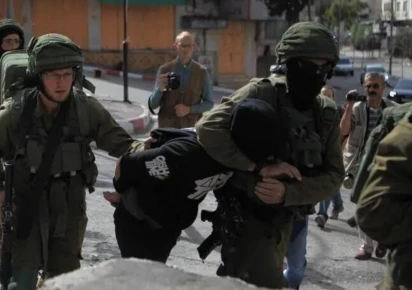
Israeli forces detain 48 Palestinians in West Bank raids

Israeli forces detained at least 48 Palestinians during raids across the occupied West Bank on Saturday, while eight Palestinians were reportedly injured in a separate attack, according to Palestinian sources and the Palestinian Red Crescent Society.

More than 40 young Palestinian men were detained during an ongoing military operation in the town of Tell, west of Nablus, Palestinian media reported.

Israeli troops reportedly took control of a residential building in the town and used it as a temporary interrogation facility. Raids and searches of homes were also reported across Tell, with forces reportedly surrounding the town from several directions.

The latest arrests came a day after Israeli authorities announced a large-scale military operation in Palestinian villages across the West Bank. The move followed an attack near the Havat Gilad settlement in which two Israeli soldiers were killed and three others were wounded.

Following the attack, Palestinian communities in the Nablus area reportedly came under further attacks. Local sources said homes and other Palestinian property were set on fire.

The Palestinian Health Ministry said four Palestinians were killed on Friday during violence involving Israeli forces and settlers in Tell.

Meanwhile, Israeli forces carried out additional raids in Jenin city and several surrounding communities before dawn, according to Palestinian reports. Troops searched homes and detained five Palestinians in the governorate as military activity continued in several locations.

Three more Palestinians were reportedly detained in the Bethlehem governorate.

In a separate incident in the northern West Bank, the Palestinian Red Crescent Society said eight Palestinians were injured during an attack in Farata village, east of Qalqilya. Six of the injured were reportedly struck by live ammunition.
Similar Posts

  • |

    Syria and Russia redefine military ties

    Syria and Russia have reached a new agreement regarding the future of two strategically important Mediterranean military sites, marking a major shift in Moscow’s role in the country after years of close military cooperation with the former Syrian government. According to Syria’s Foreign Ministry, the agreement will bring changes to the way Russia operates at the Hmeimim air base near Latakia and the Tartus naval facility on Syria’s Mediterranean coast. Both locations served as key Russian military positions during the rule of former President Bashar Assad, who relied heavily on Moscow’s political and military support throughout Syria’s long civil war from 2011 to 2024. The Hmeimim air base became one of Russia’s most important overseas military installations, supporting Russian air operations in Syria and strengthening Moscow’s influence in the eastern Mediterranean. Meanwhile, the naval base at Tartus provided Russia with its only major naval facility outside the former Soviet Union, allowing it to maintain a strategic presence in the region. Under the newly announced arrangement, Syria will assume control of the Hmeimim air base and the commercial section of Tartus port as part of its civilian administration. The remaining military areas at both locations will reportedly be transformed into joint training and qualification centers rather than serving as traditional Russian military outposts. Syria’s Foreign Ministry described the agreement as a “reorganization of the Russian presence” along the country’s coastline. The ministry said the deal represents the most significant step forward in negotiations that have continued for around 18 months and could open the door to a new stage in Syrian-Russian relations. Russia has not yet issued an official public response to the announcement. However, Moscow’s position in Syria has changed significantly since the fall of Assad’s government. During the uprising and subsequent conflict, Russia was one of Assad’s strongest supporters, providing military assistance that helped his government remain in power. After Assad was removed from office, Russia allowed him and his family to seek asylum, while many remaining Russian forces gradually withdrew from Syria. Despite these changes, Syria’s new leadership has attempted to maintain diplomatic relations with Moscow. Interim President Ahmad al-Sharaa has met Russian President Vladimir Putin in Moscow on two occasions since taking office, with the future of the Mediterranean bases being one of the main issues discussed during their talks. At the same time, Syria has expanded its diplomatic engagement with Western nations and regional Arab countries. Several states that had distanced themselves from Damascus during Assad’s crackdown on opposition movements have begun rebuilding relations with the new Syrian authorities. The United States has also removed many of the sanctions that had severely affected Syria’s economy, while European countries have increased diplomatic contacts. French President Emmanuel Macron’s visit to Syria in July marked another important step, with both countries announcing plans to appoint ambassadors for the first time in 14 years. The agreement over Hmeimim and Tartus reflects the changing balance of international influence in Syria. While Russia remains an important partner, the country’s new government appears to be pursuing broader relationships with multiple global and regional powers as it seeks to redefine Syria’s future after years of conflict.

  • |

    Pakistan’s auto tax policy sparks industry divide over EV incentives

    LAHORE: Pakistan’s automobile industry is witnessing growing divisions over the government’s taxation policy for vehicles, with local manufacturers warning that the current framework unfairly benefits expensive imported and premium new energy vehicles (NEVs) while placing a heavier tax burden on affordable cars purchased by middle-income families. The controversy has intensified following the government’s decision to introduce a range of fiscal incentives for new energy vehicles, including battery electric vehicles (BEVs), plug-in hybrid electric vehicles (PHEVs) and range-extended electric vehicles (REEVs). While the policy is designed to accelerate Pakistan’s transition towards cleaner transportation and reduce reliance on fossil fuels, established local assemblers argue that the incentives are skewed in favour of luxury vehicle buyers instead of promoting affordable green mobility. Industry representatives say the taxation gap between conventional locally assembled vehicles and premium electric vehicles has widened considerably, raising concerns over fairness, competitiveness and the long-term sustainability of Pakistan’s domestic automobile manufacturing sector. According to industry estimates, a locally assembled Suzuki Alto—one of the country’s most affordable passenger vehicles priced at around Rs3 million—bears nearly Rs550,000 in taxes, including sales tax, federal excise duty (FED) and the recently introduced New Energy Vehicle (NEV) levy. In contrast, a premium REEV costing close to Rs10 million reportedly attracts sales tax of only around Rs100,000 while remaining exempt from both the federal excise duty and the NEV levy. The tax disparity has triggered criticism from domestic manufacturers, who argue that the current structure effectively penalises middle-income consumers while offering generous incentives to buyers of high-end imported vehicles. Local Assemblers Raise Concerns Pak Suzuki Motor Company spokesperson Ikhlaq Virk said the taxation framework has created an uneven competitive environment that disadvantages affordable vehicles widely used by Pakistani families. He said entry-level models such as the Alto and Cultus serve as essential transportation for the country’s middle class but receive no meaningful tax relief despite their affordability. Virk further noted that premium hybrid and electric vehicles, valued at nearly Rs10 million or more, continue to enjoy substantial concessions under the government’s clean mobility policy. He also pointed to reports suggesting that the sales tax on certain plug-in hybrid and hybrid electric vehicles could be reduced from 25 percent to 18 percent after changes introduced through the Finance Bill, arguing that such relief would primarily benefit affluent consumers rather than encouraging mass-market adoption. IMF Programme Adds Complexity The debate comes at a time when Pakistan remains under an International Monetary Fund (IMF) programme, which has required the government to increase tax revenues, rationalise subsidies and implement fiscal reforms to stabilise the economy. Against this backdrop, industry stakeholders argue that taxation policies should strike a balance between environmental objectives and economic realities, ensuring that clean energy initiatives do not disproportionately favour a small segment of wealthy consumers. The discussion has also reopened a broader policy debate over whether Pakistan’s green mobility strategy should focus solely on reducing emissions or also safeguard domestic manufacturing, employment and industrial investment. Analysts Call for Balanced Incentives Automobile industry experts believe Pakistan’s transition towards cleaner transportation is necessary, but they stress that government incentives should encourage widespread adoption instead of being concentrated in the luxury vehicle segment. Yousuf M. Farooq, Director Research at Chase Securities, said environmental goals should be pursued alongside industrial development and economic sustainability. He noted that while encouraging cleaner transportation is an important national objective, incentive programmes should also consider vehicle affordability, localisation, environmental benefits and the contribution of manufacturers to Pakistan’s economy. Farooq emphasised the need for a consistent taxation framework across all vehicle categories, including conventional internal combustion engine vehicles, hybrids, plug-in hybrids and range-extended electric vehicles, while maintaining adequate protection for local assembly operations and the domestic auto parts industry. He added that environmental incentives should not undermine the competitiveness of local manufacturers or threaten employment generated by Pakistan’s automotive sector. Local Industry Fears Investment Slowdown Pakistan’s automobile industry has invested billions of rupees over the past three decades in assembly plants, localisation programmes and vendor development. The sector supports hundreds of component manufacturers and provides employment to thousands of skilled workers across the country. Industry stakeholders warn that if imported premium electric vehicles continue to enjoy significantly lower taxation than locally assembled conventional vehicles, future investment in domestic manufacturing could slow, weakening Pakistan’s automotive supply chain and localisation efforts. Manufacturers believe a prolonged imbalance may discourage further expansion by existing assemblers while affecting the viability of local parts suppliers that have developed alongside the country’s automobile industry. Government’s Green Mobility Vision Supporters of the government’s policy argue that Pakistan cannot afford to lag behind the global transition towards electric mobility. Many countries are offering tax incentives, subsidies and policy support to encourage electric vehicle adoption, reduce dependence on imported petroleum products and lower carbon emissions. Pakistan, which spends billions of dollars annually on fuel imports, could also benefit from increased electrification of its transport sector by reducing its import bill and improving environmental sustainability over the long term. However, industry observers believe the core issue is not whether electric vehicles deserve policy support but how those incentives should be structured.

  • | |

    PTI can’t escape Mall Road attack: Talal

    Minister of State for Interior Talal Chaudhry has said that the Pakistan Tehreek-e-Insaf (PTI) leadership cannot distance itself from the recent shooting incident on Rawalpindi’s Mall Road. Addressing a press conference in Islamabad, Chaudhry said the incident was deeply regrettable and alleged that the man involved had links with the PTI and had remained in contact with the party’s leadership. According to the minister, the suspect had previously stayed at the Khyber Pakhtunkhwa House and had met members of the PTI leadership. He also allegedly carried the party’s flag and appeared in social media videos showing attacks on security forces. Chaudhry said a security personnel was injured when the attacker opened direct fire on Mall Road. He argued that the PTI leadership could not simply deny responsibility by claiming that the individual had no connection with the party or suffered from mental health problems. “If his mental condition was not stable, why did he attack a security official instead of his own family or a party leader?” Chaudhry asked. He questioned why the individual had allegedly been placed at the frontline of protests if the party had no association with him. The minister accused the PTI of promoting a political culture based on confrontation, violence and hatred. He said the government had repeatedly urged the party to avoid spreading hostility and unrest among young people. Chaudhry linked such politics to previous violent incidents, including the events of May 9 and November 26, and warned that continuing to promote hatred could lead to further incidents. He also criticised what he described as vandalism and arson carried out in the name of politics. He questioned what the PTI had achieved for the people of Khyber Pakhtunkhwa during its long period in power in the province. “Setting things on fire and creating disorder is not politics,” he said, adding that such actions neither served the party nor the province. Referring to future political activities, Chaudhry warned that similar incidents could occur again if party workers continued to be exposed to what he described as hateful and inflammatory rhetoric. He also criticised PTI founder Imran Khan’s statements and speeches, alleging that they had contributed to political polarisation and unrest. Chaudhry further accused PTI supporters of disrespecting security personnel and national heroes, including through social media posts targeting the country’s fallen soldiers. The minister said investigations into the Rawalpindi incident were progressing and that authorities were conducting a transparent inquiry. He assured that the findings would be made public once the investigation was completed. Chaudhry said the government would not allow Pakistan to be pushed into further political instability and warned that those involved in attacks would face legal consequences.

  • | |

    16 militants killed in Balochistan operation

    Security forces have killed 16 militants during intelligence-based operations in several areas of Balochistan, according to security sources. The operations are being carried out under Operation Al-Azm following a series of terrorist attacks in the province. Authorities said several militant hideouts and ambush positions were destroyed during the ongoing action. Security personnel also recovered weapons, ammunition and explosive material from the targeted locations. Operations are continuing in areas including Killi Kundi Umrani, Khad Kocha and Mastung, where security forces are targeting militant networks blamed for recent attacks. The latest operations followed an attack on the Mangi Dam Police Station, after which security forces launched a separate campaign named Operation Shaban. The security situation in Mastung also came under renewed focus after unidentified armed men attacked a vehicle on a national highway. A district and sessions judge and his security guard were killed in the attack, while an additional sessions judge and another person were seriously injured. Security sources said counterterrorism operations would continue across Balochistan until militant infrastructure is dismantled and law and order is restored. The state refers to militants linked to the banned Balochistan Liberation Army (BLA) and other groups operating in the province as Fitna al-Hindustan. Chief of Defence Forces and Chief of Army Staff Field Marshal Syed Asim Munir recently reiterated the military’s determination to eliminate militant networks in Balochistan. He said targeted operations against Fitna al-Khawarij and Fitna al-Hindustan would continue until terrorism and those supporting it were eliminated. The latest operation comes amid a broader rise in militant violence in Pakistan, particularly in Balochistan and Khyber-Pakhtunkhwa. A United Nations Security Council assessment has also highlighted continuing threats from militant groups in the region. The report pointed to attacks claimed by the BLA against Pakistani security forces and infrastructure linked to the China-Pakistan Economic Corridor. The UN assessment also raised concerns about militant groups obtaining modern weapons and equipment through cross-border smuggling and illegal markets. It noted the reported use of advanced rifles, night-vision equipment, thermal imaging systems, sniper weapons and drones by the Tehreek-e-Taliban Pakistan. The report further cited assessments that the BLA and TTP have maintained coordination in some areas, including through shared resources and training networks.

  • |

    Three reasons Haroon is winning hearts in Aik Mohabbat Aur

    Haroon Malik has emerged as one of the most admired characters in Aik Mohabbat Aur because of his thoughtful personality and balanced approach to relationships. Rather than being portrayed as a flawless hero, Haroon is shown as an ordinary man who makes mistakes, learns from them, and grows through his experiences. His realistic nature has made him relatable to viewers, and several of his actions have highlighted positive values that are often missing in television dramas. A genuine bond with Pari One of Haroon’s most heartwarming qualities is the relationship he shares with Pari. Instead of trying to immediately take on the role of a father figure, he focuses on becoming someone she can trust and enjoy spending time with. He treats her with kindness, patience, and respect, allowing their connection to develop naturally. Haroon listens to Pari, joins in her playful moments, and makes her feel valued without expecting anything in return. Their relationship is built on friendship, understanding, and trust rather than obligation. This gentle approach allows Pari to accept him on her own terms, making their bond feel authentic and emotionally touching. Standing up for Maham Another defining moment for Haroon is the way he handles Maham’s difficult situation. While others choose to ignore her emotional struggles or dismiss them as private family matters, Haroon recognizes that she deserves to be heard. Instead of blindly supporting his brother, Faris, he acknowledges Maham’s pain and encourages the family to confront the real issues. Haroon also challenges his parents to understand that providing financial security alone does not excuse harmful behavior. He emphasizes that emotional well-being is equally important and that remaining silent in the face of abuse only allows the problem to continue. His willingness to hold both his brother and family accountable demonstrates maturity, fairness, and compassion. Respecting Khushbakht’s emotions Haroon’s relationship with Khushbakht Naaz is another reason audiences appreciate his character. Although he develops strong feelings for her, he never pressures her to return his affection immediately. Instead, he patiently gives her the time and space she needs to process her emotions. Even after their marriage, Haroon expresses his care through thoughtful actions rather than dramatic declarations. He values small moments of happiness and understands that love cannot be forced. His calm and respectful approach helps Khushbakht gradually become comfortable with him, especially after the emotional challenges she has experienced in the past. Rather than demanding love, Haroon chooses to earn trust through consistency, patience, and genuine kindness. This refreshing portrayal of romance has resonated with many viewers, setting him apart from more traditional television heroes. As Aik Mohabbat Aur continues, Haroon’s character proves that strength can be found in empathy, respect, and emotional intelligence. His relationships with Pari, Maham, and Khushbakht showcase a man who values understanding over control and compassion over pride. These qualities not only make him an engaging character but also reflect the evolving storytelling seen in modern Pakistani dramas. Written by Faiza Iftikhar and directed by Farooq Rind, Aik Mohabbat Aur features a talented cast including Ahad Raza Mir, Maya Ali, Samiya Mumtaz, Noorul Hasan, Munazza Arif, Saqib Sameer, Omair Rana, Hajra Yamin, Sachal Afzal, Fajar Sheikh, Qudsia Ali, Shamyl Khan, Abbas Ashraf, Rehan Sheikh, Dodi Khan, and several other notable actors.

  • | | |

    ISPR calls India’s ‘Operation Sindoor&…

    Pakistan has strongly rejected what it described as India’s attempt to reshape the history of the 2025 military confrontation through a recently produced documentary on “Operation Sindoor,” calling the production a highly dramatized and factually distorted portrayal of events. In a statement, Pakistan said the documentary relied on selectively edited interviews, emotional narration and cinematic reconstructions to present a version of the conflict designed primarily for domestic political consumption. It argued that the production failed to provide an objective account of the military engagements and instead sought to portray a disputed outcome as an unequivocal Indian victory. Pakistan also questioned the documentary’s chronology surrounding the Pahalgam incident of April 22, 2025. It said India had subsequently claimed that the alleged perpetrators of the incident were identified and eliminated on July 28, nearly three months after Operation Sindoor. Islamabad argued that this timeline raised questions about India’s assertion that the May 7 operation was specifically intended to punish those responsible for the Pahalgam attack. The statement further rejected India’s claim of “100 percent mission success,” maintaining that Pakistani forces had effectively responded to the Indian offensive during what Pakistan refers to as Marka-e-Haq. Islamabad claimed that eight Indian military aircraft were shot down during the confrontation and said Pakistan later launched Operation Bunyanum Marsoos, targeting military installations with precision-guided rockets and missiles, precision air-launched munitions, loitering munitions and artillery. Pakistan said the documentary itself contained admissions that undermined its portrayal of decisive Indian dominance. According to Islamabad, references by Indian military officials to Pakistani missile and drone activity, prolonged engagements along the Line of Control and the activation of Indian air-defence systems demonstrated that the confrontation involved significant military exchanges on both sides. The Pakistani statement also challenged New Delhi’s account of how hostilities ended. It noted that the documentary acknowledged communication between the two countries’ Directors General of Military Operations and an agreed cessation of military activity. Islamabad said this account was inconsistent with portraying the conclusion of the conflict as an unconditional Indian military victory, particularly given the role of international diplomatic engagement in facilitating the ceasefire. Pakistan further accused the documentary of presenting contradictory explanations for India’s approach to escalation. While the production reportedly emphasised surprise attacks, precision strikes and escalation dominance, it simultaneously portrayed India as deliberately restricting the scope of the conflict and offering Pakistan an opportunity to withdraw. Islamabad described the documentary as an attempt to create a politically convenient narrative rather than an impartial military assessment. It maintained that cinematic reconstructions and official claims could not alter the chronology of events, the military engagements or the losses suffered during the confrontation. Pakistan said it had no need to construct an alternative narrative around Marka-e-Haq, arguing that battlefield developments, diplomatic interactions and subsequent statements by Indian officials provided sufficient material for assessing the conflict. Reaffirming its stated commitment to regional peace and stability, Pakistan said its armed forces remained prepared to protect the country’s sovereignty and territorial integrity. It warned that any future military escalation would receive a strong response, while asserting that no subsequent narrative or media production could change the actual course of events on the battlefield.

Leave a Reply

Your email address will not be published. Required fields are marked *