sharif promises motorways
| | |

Sharif promises motorways, international airport f…

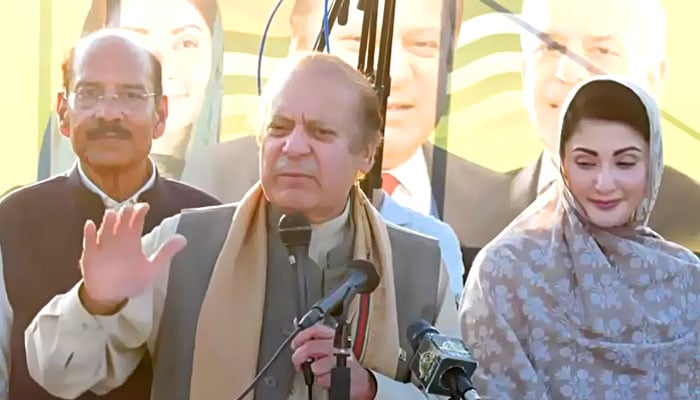
MIRPUR, Azad Jammu and Kashmir: Pakistan Muslim League-N (PML-N) President and former Prime Minister Nawaz Sharif announced a series of major development promises for Azad Jammu and Kashmir (AJK) while addressing a large public gathering in Mirpur. He said the PML-N would focus on improving infrastructure, healthcare, education and public transport if it returned to power in the region.

During his speech, Nawaz Sharif also made a light-hearted political remark directed at Pakistan Peoples Party (PPP) Chairman Bilawal Bhutto Zardari. He said Bilawal should not take his comments personally, adding that political rivalry should remain limited to healthy debate rather than conflict. Referring to the venue of the rally, he jokingly said Mirpur should not be confused with Kashmore or Mirpur Khas, stressing that it is Mirpur in Kashmir.

The former prime minister said Kashmir has always held a special place in his heart and described Azad Kashmir as his “first home” rather than a second home. He said he shared a strong emotional bond with the people of the region and had always worked for their welfare during his time in office.

Nawaz Sharif said Mirpur is one of the most beautiful cities in Azad Kashmir but added that its development had slowed after his government left power. He questioned what later governments had done for the people of Azad Kashmir and claimed that most major development projects in the region were initiated during the PML-N government.

He said he had come to Mirpur with a clear development agenda and a comprehensive manifesto for Azad Kashmir. According to him, every major project completed in Pakistan and AJK carries the stamp of the PML-N’s performance and commitment.

Speaking about future plans, Nawaz Sharif said education would remain the party’s highest priority. He stressed that young people must be provided with quality educational opportunities so they can contribute to the country’s progress.

He also announced plans to strengthen the healthcare system in Azad Kashmir. He said more specialised hospitals for cancer treatment and heart diseases should be established to ensure patients receive advanced medical care without travelling to distant cities.

Highlighting ongoing initiatives, Nawaz Sharif said Punjab Chief Minister Maryam Nawaz had arranged to provide modern electric buses for the people of Azad Kashmir. He added that 10 mobile hospitals would also be sent to improve healthcare services, especially in remote and underserved areas.

The former prime minister promised that if the PML-N formed the government in Azad Kashmir, it would launch large-scale infrastructure projects. These include the construction of new motorways and an expressway linking Murree with Muzaffarabad to improve regional connectivity, boost tourism and support economic growth.

Nawaz Sharif also pledged to personally visit every part of Azad Kashmir if his party received the public’s mandate. He promised to expand natural gas facilities to homes across Mirpur, saying better public services were essential for improving the quality of life.


Similar Posts

  • Senate seeks 16-year oil and gas profit record

    Islamabad: A Senate committee has raised serious questions over the distribution of billions of rupees generated from Pakistan’s oil and gas resources, demanding a complete financial breakdown of profits earned by oil and gas companies over the last 16 years. The Sub Committee of the Senate Functional Committee on Devolution directed authorities to provide a clear record of revenues and prepare a plan to ensure provinces receive their constitutional share from natural resources. The committee reviewed the implementation of Article 38(g) of the Constitution and examined whether provinces were receiving proper representation in federal institutions and a fair share from national resources. During the discussion on oil and gas revenues, the committee sought details of profits earned by oil and gas companies during the past 16 years. Officials were directed to verify and finalize the figures and prepare a proposal for the distribution of funds. Officials from the Petroleum Division informed the committee about the existing 50:50 revenue sharing system between the federal government and provinces. They explained that revenues generated from natural resources contribute to the national treasury through non tax income. However, the committee stressed that natural resources belong to the people and called for stronger transparency mechanisms to ensure that provinces receive their rightful share without unnecessary delays. Chairman Senator Zamir Hussain Ghumro directed authorities to introduce necessary legal and administrative improvements to strengthen the system of revenue distribution and prevent unequal treatment of provinces. The committee also focused on provincial employment representation in federal ministries and government linked corporate boards. The chairman expressed concern that constitutional provincial quotas were not being implemented effectively in some areas. He directed the Establishment Division to remove gaps in recruitment procedures and ensure that people from less developed and rural areas receive their due opportunities. The committee ordered officials to identify provinces facing representation shortages and take immediate steps to correct the imbalance. Officials were directed to submit a detailed compliance report in the next meeting, showing progress on both employment representation and natural resource revenue distribution.

  • | |

    Google slapped with $1bn EU fine, holds talks to dodge further penalties

    The European Union has fined Google about €890 million, or $1 billion. The fine punishes Google for breaking EU rules meant to control the power of big tech companies. But regulators also hinted that no more fines are coming soon, because Google is making good progress toward following the rules. The fine has two parts. The first part, €460 million, is for Google favoring its own products. When people search for things like shopping, hotels, flights, or sports scores, Google often showed its own results first instead of treating competitors fairly. The second part, €430 million, is about the Google Play app store. Google had stopped app makers from telling users about cheaper deals outside the app store. This is the first time Google has been fined under this specific EU law, called the Digital Markets Act. But counting older cases, Google has now paid six fines for unfair business practices. In total, the company has paid more than €10 billion in EU fines over about twenty years. EU officials said they are just enforcing the law. “Our job is to make sure the rules are followed,” said Teresa Ribera, the EU’s top antitrust official. Another official, Henna Virkkunen, said the goal is fair competition. Google now has 60 days to fix its practices. Google is not happy. A company spokesperson said the changes will hurt features people like, such as quick pricing for hotels and flights. He said the ruling is not really about fair competition, it is making Google’s products worse to please a small number of complainers. Even so, there is good news for Google too. The EU said Google has already started testing new ways of showing search results more fairly. It called this real progress. The EU may also apply the same rules to Google’s AI tools, like AI Overviews. Talks about this are still ongoing. Google’s changes to its app store rules were also seen as a step in the right direction. This fight is happening while tensions rise between the US and EU. The Trump administration says Europe is unfairly targeting American companies and has threatened tariffs in response. Some US lawmakers agree. Google’s fine comes after the EU already fined Apple and Meta last year under the same law. It shows the EU is serious about controlling big tech, even as pressure grows from the US side.

  • Thailand Allows 24-Hour Fuel Deliveries to Ease Nationwide Shortages

    BANGKOK — Oil tankers will be permitted to operate around the clock for one month under special government measures aimed at accelerating fuel deliveries to petrol stations across the country and alleviating crippling shortages that have left many pumps dry. Truckers End Laem Chabang Rally, Vow to Keep Pressing Government on Fuel Crisis Interior Permanent […]

  • |

    25 US states challenge Trump’s new tariffs in court

    NEW YORK: A coalition of 25 US states has filed a lawsuit against the administration of President Donald Trump, seeking to block a new round of tariffs imposed on imports from dozens of countries. The legal challenge was submitted to the US Court of International Trade in New York, where the states asked the court to suspend the tariffs, declare them unlawful and order the federal government to refund businesses that have already paid the import duties. The coalition argued that the administration exceeded its legal authority by introducing sweeping tariffs under Section 301 of the Trade Act of 1974. According to the lawsuit, the investigations cited by the administration as justification for the tariffs were used as a pretext to impose broad trade restrictions. The disputed tariffs, ranging from 10% to 12.5%, were introduced last month and apply to imports from 60 trading partners, covering a significant share of goods entering the United States. The Trump administration has defended the measures, saying they are intended to address concerns related to forced labour in international supply chains and to protect American trade interests. The White House maintains that the tariffs were imposed within the government’s legal authority and remain an important tool for securing fair trade practices. A White House spokesperson said the administration is using powers granted under US trade law to respond to what it considers unfair policies and practices affecting American commerce. Officials also argued that Section 301 tariffs have previously withstood legal scrutiny and continue to be a lawful instrument of trade policy. The lawsuit follows earlier legal disputes over President Trump’s tariff policies. Previous tariffs introduced under emergency economic powers were struck down by the US Supreme Court earlier this year, prompting the administration to replace them with the current Section 301 measures after a temporary global tariff expired in July. The states involved in the case contend that the latest tariffs are arbitrary and unlawful, arguing that while they support efforts to combat forced labour worldwide, such concerns cannot be used to justify what they describe as an illegal expansion of presidential tariff powers.

  • | |

    Nolan’s Odyssey explores the cost of flawed choices

    Christopher Nolan’s The Odyssey explores a character who is far from a conventional hero. Odysseus is brave, intelligent and determined. He is also deeply flawed. That complexity appears to be at the centre of Nolan’s interest in the ancient Greek epic. The nearly 3,000-year-old story follows Odysseus as he attempts to return to Ithaca after the Trojan War. His journey is filled with violence, loss, temptation and encounters with powerful gods and mythical creatures. Yet the film is not simply about a warrior trying to find his way home. It is also about the consequences of his decisions. Odysseus repeatedly makes choices that produce consequences he struggles to control. His actions often begin with understandable motives. Revenge, anger, pride and a desire to protect his men push him into increasingly dangerous situations. His treatment of the Trojans is one example. Odysseus considers himself a man who respects the rules of combat. However, the Trojan War forces him into tactics that contradict his personal principles. The wooden horse becomes the most striking example of this conflict. His deception helps the Greeks defeat Troy, but it also establishes a chain of events that follows him long after the war ends. His encounter with the Cyclops Polyphemus further exposes his weaknesses. Odysseus and his crew manage to escape the Cyclops’ cave. But instead of leaving quietly, Odysseus attacks again. His decision is driven by anger and revenge. The consequences are devastating. Polyphemus calls upon his father, Poseidon, to punish Odysseus. The resulting curse turns the journey home into an extended ordeal. Odysseus continues trying to save his men. However, his efforts repeatedly end in tragedy. One decision leads to another, and the consequences gradually become impossible to contain. His crew members begin to lose faith in their commander. The man determined to bring them home becomes the leader whose decisions ultimately contribute to their deaths. This moral conflict is familiar territory for Nolan. The director has repeatedly built stories around protagonists whose choices carry enormous consequences. Bruce Wayne, for example, attempts to protect Gotham by allowing a dangerous lie surrounding Harvey Dent to survive. The consequences eventually force him to confront the price of that decision. In Oppenheimer, the central character develops the atomic bomb in an attempt to help defeat Nazi Germany. Yet his success leaves him haunted by the destructive power he helped unleash. Dunkirk presents another interpretation of home. For the soldiers trapped on the beaches of France, home represents survival, safety and the possibility of returning with their dignity intact. For Oppenheimer, however, home becomes something more complicated. It represents the peace of mind he can no longer recover after witnessing the consequences of his work. For Odysseus, home is deeply personal. Ithaca represents his family, his kingdom and the identity he lost during two decades away. Returning home is therefore more than reaching a physical destination. His journey changes him. He leaves as a king and eventually returns disguised as a beggar. Along the way, he encounters monsters, hostile forces and divine punishment. He also watches his companions disappear one by one. By the time Odysseus reaches the end of his journey, the question is no longer simply whether he can return home. The bigger question is whether a man who has experienced so much violence can ever truly return as the person he once was. That question sits comfortably within Nolan’s broader storytelling style. His characters often achieve their goals but pay an enormous personal price. Their victories rarely come without consequences. The Odyssey brings that recurring theme to one of its most ancient and powerful forms. Odysseus survives the journey, but survival does not erase what happened along the way. His homecoming becomes a reckoning with the violence, losses and choices that shaped him. Nolan’s interpretation therefore turns the epic into more than an adventure story. It becomes a meditation on guilt, responsibility, identity and the lasting cost of extraordinary choices. At its heart, The Odyssey asks what happens when a man spends years fighting to return home, only to discover that the journey has changed the meaning of home itself.

  • |

    Kashmir solidarity protest held outside Indian High Commission in London on Youm-e-Istehsal

    A large number of Pakistanis and Kashmiris gathered outside the Indian High Commission in London on Wednesday to mark Youm-e-Istehsal-e-Kashmir, protesting against India’s August 5, 2019 decision to revoke the special constitutional status of Jammu and Kashmir. The demonstrators raised slogans in support of the right to self-determination for the people of Kashmir and expressed opposition to the policies implemented in the region following the 2019 decision. Participants also chanted slogans in support of Pakistan and the Pakistan Armed Forces, while carrying banners and placards highlighting their concerns over the Kashmir issue. Addressing the gathering, speakers said that the August 5, 2019 move had affected the political identity and rights of the Kashmiri people. They urged the international community to pay attention to the situation in Kashmir and play a role in addressing the long-standing dispute. The protesters called for a peaceful and lasting resolution of the Kashmir issue and reiterated their commitment to continuing support for what they described as the Kashmiri people’s right to self-determination. The demonstration concluded peacefully, with participants reaffirming solidarity with the people of Kashmir.

Leave a Reply

Your email address will not be published. Required fields are marked *