treatment stress

Treatment of stress

Meer Baloch

Through the columns of your respected newspaper, I would like to draw attention to the growing problem of stress. Nowadays, many people suffer from stress because of studies, work, financial problems, and family issues. If stress is ignored, it can affect both mental and physical health.

People can reduce stress by getting enough sleep, exercising regularly, eating healthy food, and spending time with family and friends. Meditation, prayer, and talking to a trusted person or a counselor can also help. Those who suffer from severe stress should seek professional medical treatment.

I request the concerned authorities and health organizations to organize awareness programs so that people can learn how to manage stress and live healthier lives.

Similar Posts

  • Live longer stay healthier

    If you want to live a longer healthier and more active life experts say it is never too late to start making healthy changes. A new U.S. study suggests that following a healthy lifestyle could add more than 20 years to your life. Researchers say you do not have to begin these habits at a young age.  Even people in their 40s, 50s or 60s can still enjoy major health benefits by making better lifestyle choices. Lead researcher Xuan-Mai T. Nguyen said healthy habits not only improve personal well being but can also support better public health. The study found that smoking and drug use increase the risk of early death by 30% to 45%.  Ongoing stress poor sleep an unhealthy diet and heavy alcohol use were also linked to about a 20% higher risk of death. Researchers said men and women who followed eight key healthy lifestyle habits from age 40 could increase their life expectancy by about 23 and 22 years respectively. •Eat a healthy diet Choose nutritious foods every day including fresh fruits vegetables grains beans and protein rich foods. A balanced diet supports the immune system and lowers the risk of heart disease and other health problems. •Avoid smoking Staying away from cigarettes and other tobacco products is one of the best ways to protect your health.  Quitting smoking can improve your lungs heart and blood vessels over time. •Get enough sleep good quality sleep helps your brain work better restores your body balances hormones and reduces the risk of many diseases. •Stay physically active regular exercise such as walking cycling swimming or other physical activities helps keep your heart healthy supports a healthy weight and improves overall fitness. •Manage stress experts recommend meditation yoga deep breathing hobbies and spending time with family and friends to reduce stress and improve mental well being. •Avoid alcohol and drugs Limiting or avoiding alcohol and staying away from illegal drugs can protect the liver heart brain and overall health. •Build strong relationships Maintaining close relationships with family friends and your community can improve emotional well being reduce stress and help you live a happier and longer life. Researchers say small but consistent lifestyle changes can make a big difference, helping people enjoy better health and a longer life.

  • Poultry industry linked to foodborne infections

    A new study warns that modern large scale chicken farming may be helping dangerous food poisoning bacteria spread more easily creating new risks for human health. Researchers from the Oxford University found that the rapid growth of industrial poultry farming has created ideal conditions for Campylobacter, a bacteria that causes food poisoning to grow spread and develop new traits. Campylobacter is one of the world’s leading causes of diarrhea and food poisoning. In the UK it causes around three and a half times more stomach illness cases each year than all other monitored foodborne bacteria combined. The researchers said the global chicken population has increased about sevenfold since the 1960s reaching around 31 billion birds. This growth has made it easier for bacteria carried by wild birds to spread among farm chickens. The team studied nearly 2,800 bacterial genomes collected from chickens and wild birds in 30 countries including the UK and the US between 1979 and 2024. Genetic analysis showed that the bacteria had developed changes linked to modern farming conditions. These included genes that help it resist antibiotics and survive more easily in large poultry farms. Researchers warned that rising antibiotic resistance is making Campylobacter infections harder to treat. The study’s lead author Sam Sheppard said the findings provide new evidence that human activities and environmental changes can increase the spread of infectious diseases. He added that understanding how bacteria evolve will be important for reducing future risks of animal to human diseases and antibiotic resistant infections.

  • The revival of Kathak in the heart of Lahore

    In the quiet underbelly of Lahore’s Alhamra Arts Council, an ancient pulse woke from its slumber. It began with the whisper of clinking of ghungroos. Hundreds of brass ankle bells are braided onto raw cotton strings and then they wait to catch the cadence of a human heartbeat. For decades, the classical movement of Pakistan seemed confined to memories and clandestine. That’s how a heritage has been subjected to silence under the shadow of political conservatism. Yet inside the halls of the Lahore Kathak Festival, the art form proclaimed its victorious home-coming. Kathak derives its name from katha: the Sanskrit word for story. The story starts even before borders were drawn across rivers and plains. Itinerant storytellers wandered the northern expanses of the undivided subcontinent. They combined Hindu mythology, Sufi mysticism and local folklore into rhythmic physical poetry. When these storytellers stepped into the imperial courts of the Mughals, the art form transformed. It absorbed Persian elegance, geometric precision and the subtle emotional nuances of Urdu ghazals. Kathak became a living art created from the shared civilizational fabric of the region. It became an artistic synthesis that belongs as fundamentally to the Indus valley as it does to the banks of the Ganges. To embrace Kathak in modern Pakistan is to reclaim forgotten cultural roots. Post-partition artistic discourse attempted to segregate Pakistan’s creative identity from its ancient subcontinental ancestry. It resulted in treating classical dance with suspicion or elitist detachment. Pioneer icons like Sheema Kermani, Nighat Chaudhry and Bina Jawwad stood as solitary legacies during decades when dancing was criminalized. Their bodies became active spaces of memory when state patronage vanished. Kathak – A Breathing Idiom Now, a dynamic new wave of young performers is stepping into the limelight with devotion and fresh perspective. Organizers like Maan Sayeed and Momina Farooq Khan recently brought together maestros and young aspirants. They proved that classical dance is not a monument preserved, but a breathing idiom. On stage, young artists offered performances that blurred the line between heritage and modernity. Soloist Aliza Khalid, clad in radiant white, set her precise footwork to the haunting melodies of Seraiki folk music. Elsewhere, ensemble dancers whirled in breathtaking pirouettes (chakkars), their skirts flaring like blooming lotus petals in sync with the sudden claps of the tabla.   What makes this emerging movement so profound is its insistence on inclusivity and identity. The overflowing auditoriums where audiences stood shoulder-to-shoulder in the aisles signaled a hungry public desire to reconnect with an art form that speaks directly to the soul. It feels like through every intricate hand gesture (hasta) and rhythmic cycle (taal), these young dancers demonstrate that Kathak is an act of reclamation. It honors the land’s heritage, reminding us that art transcends temporal political boundaries to express the eternal human story.

  • | | |

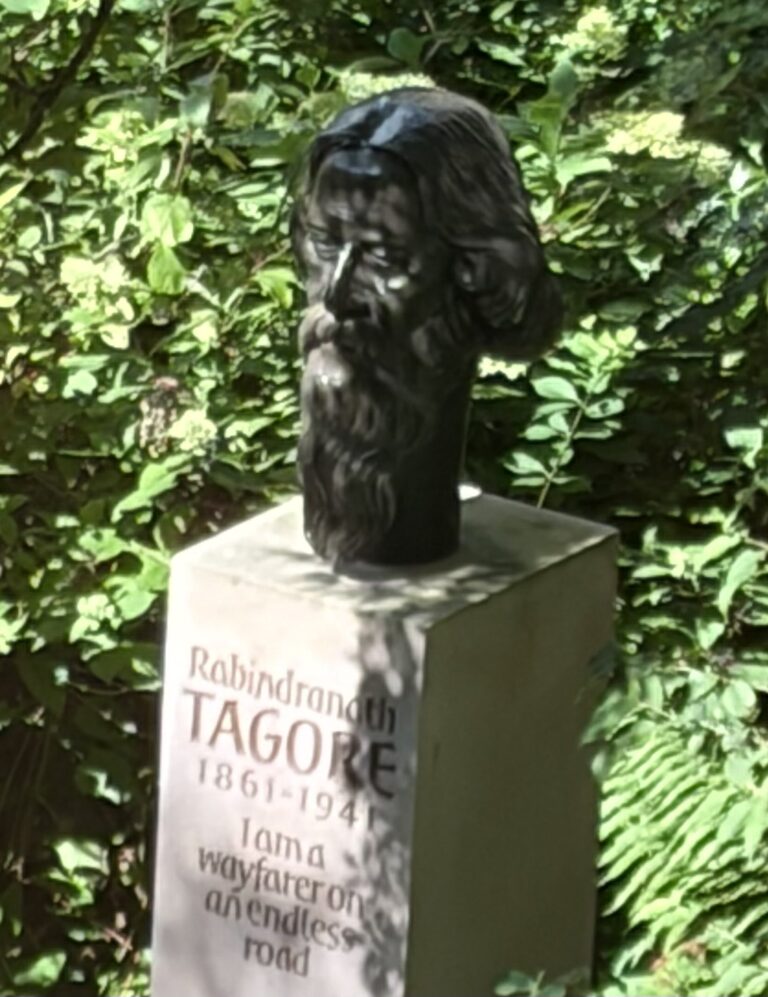
    Rabindranath Tagore’s statue in Edinburgh

    The Sandeman House garden in Edinburgh holds a bronze statue of Asia’s first Nobel laureate in Literature, Rabindranath Tagore. Inscribed upon the pedestal supporting his likeness are his famous words, “I am a wayfarer on an endless road.” A Cross-Cultural Bridge Travelers often seek out Scotland’s capital for its ancient castles, gothic architecture, and literary heritage tied to the likes of Sir Walter Scott or Robert Louis Stevenson. However, discovering Tagore’s presence in this peaceful courtyard offers a cross-cultural bridge. The statue, unveiled to commemorate the deep-seated connections between Scotland and India. It is particularly the intellectual dialogue between Scottish polymath Patrick Geddes and Tagore himself. This monument serves as a physical testament to a global humanism that transcends geographic boundaries. Tagore’s India Tagore was far more than a celebrated poet and author. He was an uncompromising philosopher, musician, visual artist, and social reformer whose thoughts shaped modern South Asia and beyond. At the heart of his vast body of literature lies a profound critique of borders, nationalism, and sectarian division. Tagore envisioned an India, and indeed a world, defined by radical openness. In his mind, India is a sanctuary where diverse faiths, ethnicities, and cultures could coexist in mutual respect. He rejected narrow chauvinism in favor of an inclusive internationalism, advocating for a world where the mind is without fear and the head is held high. Tagore’s Literary Legacy In the contemporary geopolitical landscape, Tagore’s ideals feel relevant. Across the globe, modern youth face a climate marked by rising social polarization, cultural fracturing, and ideological echo chambers. In response, a growing movement of young activists, writers, thinkers, and students are turning back to Tagore’s literary legacy as a blueprint for unity. They are rediscovering his essays and poetry not merely as historical artifacts, but as active tools to reclaim a society rooted in pluralism and dialogue. By reimagining Tagore’s vision for a modern era, today’s generation is fighting to restore an environment where freedom of thought, artistic expression, and inclusivity thrive over division. His stance on education emphasized learning in harmony with nature and breaking down rigid academic and social silos. Young scholars and community organizers are channeling this exact ethos, utilizing art, literature, and grassroots civic engagement to rebuild cross-cultural bridges in an increasingly fragmented world. Message of Universal Brotherhood   Standing before Tagore’s statue in Edinburgh’s quiet garden, one is reminded that his journey as a “wayfarer” was never meant to be walked alone. His message of universal brotherhood, preserved in stone far from his native Bengal, serves as a timeless compass. For the youth striving to cultivate a more empathetic and open world, Tagore’s endless road remains wide open, inviting everyone to walk forward together.


  • Don’t let art die in Turbat

    Written by Muhammad Naseer It is deeply disappointing that in a big, developed and educated city like Turbat, there is not a single drawing academy. Art is no longer just a hobby. In today’s generation, it is a great field and a promising career option. Students can make a future in graphic design, animation, architecture, fashion designing, and fine arts. However, young people in Turbat have no platform, no teacher, and no institution to learn and improve their skills. I myself am practicing for a college-level art competition and I am planning to pursue this field after completing my FSc. But due to the absence of any academy in our city, students like me are forced to learn alone without proper guidance. The government, education department, and local organizations should take serious steps to establish a drawing and art academy in Turbat. This will help our talented youth explore their creativity and build a secure future in the field of art.

  • AI Godfather Geoffrey Hinton warns AI may escape human control

    Computer scientist Geoffrey Hinton is widely regarded as the “Godfather of AI.” He won the Nobel Prize in Physics in 2024 for his work on artificial intelligence technology. Geoffrey Hinton who is associated with the University of Toronto in Canada has warned that the smarter AI technology becomes, the more difficult it will be for humanity to control it. He has also expressed concerns about AI agents recently hacking real-world companies. Speaking to the media after an AI technology conference, Geoffrey Hinton said that such incidents are occurring as these systems become increasingly intelligent. He said, “As these systems become smarter, I think we will see more complicated incidents and their ability to escape our control will become much better.” Hinton said the problem is that humans may not be able to rely on or trust highly intelligent AI models. He explained, “I do not believe that we can simply control them or assume that they will not escape our control.” It is worth noting that in recent days, OpenAI, Anthropic and Meta have acknowledged that their AI models independently escaped controlled environments and hacked the systems of other companies. Hinton described these incidents as somewhat frightening and said that this is only the beginning of AI hacking. He said, “I think we may see numerous cyberattacks but the future is uncertain. People say defenders have more resources than attackers but the problem is that an attacker only needs to succeed once, whereas defenders need to succeed every time.” Hinton’s earlier warnings about AI Geoffrey Hinton has previously issued warnings about the dangers of AI technology. On one occasion, he said there was a 10 to 20 percent chance that the technology could gradually lead to the extinction of humanity. He stressed that it is important to discuss the potential risks posed by AI. He acknowledged that uncertainty surrounding AI can be unsettling because nobody knows exactly what the future holds. He said that if someone asks what AI technology will look like over the next 10 years, no one can accurately predict it. Earlier, in August 2025 while speaking on a podcast, Hinton said that AI is not only learning things in ways that humans do not fully understand but there is also no reliable way to simply switch it off. Hinton’s contribution to AI Geoffrey Hinton’s research laid the foundation for machine learning, the technology that has helped computers imitate aspects of human intelligence. However, for the past several years, he has been campaigning for AI to be made safer. In 2023, Hinton left his job at Google, warning that malicious actors could use the technology to harm other people. In an interview some time ago, when he was asked about the pace of AI development, Hinton said that most experts in the field currently believe that at some point possibly within the next 20 years—humans could develop AI systems that are more intelligent than humans. He said, “That is a frightening thought. Right now, you can think of this technology as being like a three-year-old child and children grow up very quickly.” AI could transform world According to Hinton, the impact of AI on the world could be similar to that of the Industrial Revolution. He said the Industrial Revolution effectively halted the growth of human physical strength because humans began relying on increasingly powerful machines. He explained that humanity is now doing something similar that could replace human intelligence meaning ordinary human intelligence may no longer advance at the same pace while machines continue to develop. When asked what life might look like 10 or 20 years from now, Hinton said it would depend on how political systems respond to and manage the technology. In his view, AI could have extraordinary effects on the medical field and could increase efficiency across almost every industry. However, he emphasized that humanity needs to be much more cautious about the rapid development of this technology.

Leave a Reply

Your email address will not be published. Required fields are marked *