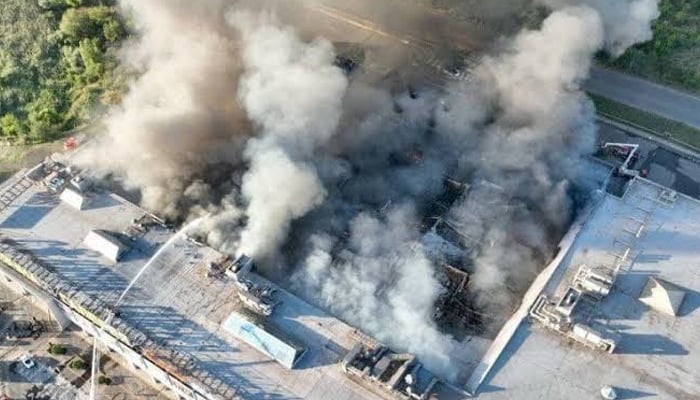
russian drone strike
|

Russian drone strike kills 16 in Kryvyi Rih


At least 16 people were killed and around 130 others injured after a series of Russian drone strikes hit the Ukrainian city of Kryvyi Rih, Ukrainian authorities said.

Ukrainian President Volodymyr Zelenskyy said Russian forces targeted a shopping centre in the city in successive drone attacks. According to Zelenskyy, the second strike came about 30 minutes after the first, increasing the casualties and damage at the site.

Emergency crews rushed to the area to search for survivors and assist the injured. The attacks also caused significant damage to civilian infrastructure, according to Ukrainian officials.

Zelenskyy condemned the strikes as an act of terrorism and called for a stronger international response to Russia’s attacks on Ukrainian cities. He said the international community must take effective measures to prevent further attacks against civilians.

Meanwhile, Russia’s Defence Ministry claimed that its forces had carried out strikes against Ukrainian ports and vessels that Moscow says support the Ukrainian military. Russia has repeatedly described such facilities as part of Ukraine’s military infrastructure.

Ukraine, in turn, claimed that its forces had targeted a Russian oil refinery and a military airfield as part of its ongoing attacks on Russian military and energy-related infrastructure.

The latest strikes come as fighting between Russia and Ukraine continues, with both sides increasingly targeting infrastructure and military facilities far from the front lines. The exchange of attacks has also raised renewed concerns over civilian safety as the war enters another phase of intense hostilities.

Similar Posts

  • | |

    Congo tightens grip on mineral exports with ban on…

    The Democratic Republic of Congo has prohibited exports of copper concentrate and cobalt concentrate, according to a government order reviewed on Thursday, marking the latest step in an ongoing push to force more mineral processing to happen inside the country and capture a larger share of the value generated by its mining sector. News of the ban sent benchmark three month copper prices on the London Metal Exchange up by as much as 1.8 percent to $14,369.50 a metric ton, the highest level since January 29, when the metal touched an all time peak of $14,527.50. Prices stood at $14,300 as of 0930 GMT following the report. Congo holds the position of the world’s largest cobalt supplier and ranks among the top sources of copper and other minerals critical to the global energy transition. The government is using that leverage to encourage the build out of domestic processing capacity rather than allowing raw or partially processed materials to leave the country. The order, dated June 29 and signed jointly by Mines Minister Louis Kabamba Watum, Foreign Trade Minister Julien Paluku Kahongya and Economy Minister Daniel Mukoko Samba, states plainly that exporting copper and cobalt concentrates is now prohibited. The prohibition took effect immediately, though the order allows for one year export waivers to be granted under unspecified strategic circumstances. The same order also establishes a new tax structure covering economically significant mining by products, with a three month transition period built in before the new rules take full effect. Officials said the export ban aims to push mining companies toward marketing or exporting higher value processed mineral products rather than raw concentrate. This marks the fourth time Congo has restricted concentrate exports, following similar bans imposed in 2013, 2019 and 2023, each of which included waivers in cases where domestic smelting capacity could not keep pace with output. The new order formally repeals the 2023 measure and its associated exemptions, replacing it with a broader regulatory framework governing both mineral exports and taxation of significant by products recovered during processing. Congo already exports the vast majority of its copper in refined form. During the first quarter of 2026, the country shipped 696,725 tons of copper cathodes, compared with just 53,926 tons of copper concentrate containing roughly 18,863 tons of copper metal, according to official figures. Over the same period, Congo exported 51,940 tons of cobalt hydroxide containing about 17,054 tons of cobalt metal. Christian Geraud Neema, a mining analyst with the nonprofit China Global South Project, said the new ban is unlikely to significantly disrupt most mining operators since the bulk of Congo’s copper and cobalt already undergoes domestic refining before export. He said the operation most likely to feel the impact is the Kamoa Kakula venture, jointly owned by Ivanhoe Mines, China’s Zijin Mining and the Congolese government, which still exports some volume of concentrate under existing exemptions. Neither Ivanhoe nor Zijin responded immediately to requests for comment, and the Congolese chamber of mines also did not respond. The newly introduced tax regime applies broadly across mineral categories, extending to trace and ultra trace minerals recovered during the refining process. These by products will be taxed using a 55 percent valuation coefficient, with royalties applied alongside those already charged on the primary mineral being extracted. The policy fits into a broader pattern across resource rich African nations seeking to move beyond raw material exports and capture more manufacturing and processing value domestically, a shift that has gained momentum as global demand for energy transition minerals like copper and cobalt continues to grow.

  • | |

    EU plans sweeping new sanctions on Russia

    The European Union is preparing its most extensive round of sanctions against Russia since the war in Ukraine began, with the proposed measures aimed primarily at Moscow’s military-industrial complex. EU foreign policy chief Kaja Kallas told German newspaper Die Welt that the new sanctions would significantly increase pressure on Russia and could raise the number of sanctioned Russian individuals and entities by about one-third. EU diplomatic sources said the European External Action Service is expected to propose sanctions against around 1,600 people and entities linked to Russia’s defence sector. The proposed measures would include asset freezes as well as travel and transaction restrictions. The EU has already sanctioned nearly 3,000 Russian individuals and companies. According to EU diplomatic sources, the new list could be presented to member states in early September, with formal adoption targeted for October. Unlike broader sanctions packages, the proposed designations are not expected to include new sector-wide restrictions, a move intended to speed up approval. Kallas said the EU would continue increasing economic pressure until Moscow ends its war in Ukraine. However, EU sanctions require unanimous approval from all member states, and previous measures have faced delays because of disagreements among countries. The latest move comes as the EU seeks to strengthen its pressure on Russia while avoiding the lengthy disputes that have complicated previous sanctions packages.

  • |

    Trump rejects Justice Department findings on Lincoln Memorial Reflecting Pool damage

    US President Donald Trump has publicly rejected the findings of his own Justice Department after federal prosecutors concluded that construction problems, rather than vandalism, were responsible for damage to the recently renovated Lincoln Memorial Reflecting Pool in Washington. In a post on his Truth Social platform on Saturday, Trump said he strongly disagreed with US Attorney for the District of Columbia Jeanine Pirro and insisted that vandals were responsible for the damage. He argued that although there may have been issues with the construction work, the main cause of the deterioration was deliberate vandalism. The disagreement follows a court filing submitted on Friday by Jeanine Pirro and Assistant US Attorney Michael Spence, who asked a judge to dismiss the government’s case against David Hearn, a 67 year old former Olympian. Hearn had been accused of damaging the Reflecting Pool, an allegation that became part of a wider debate over the Trump administration’s renovation project in the nation’s capital. According to the filing, newly received documents from the Department of the Interior showed that the problems were linked to a rushed and defective installation process. Prosecutors said the pool’s lining experienced repeated failures during construction and that extensive peeling occurred across the surface because of installation defects rather than intentional damage. The Lincoln Memorial Reflecting Pool underwent a renovation costing around 14.7 million dollars. Soon after the project was completed, the site experienced several problems, including algae growth that turned the water green and sections of the blue lining peeling away. The issues attracted public criticism and raised questions about the quality of the renovation work. Throughout the controversy, Trump repeatedly claimed that vandals had deliberately damaged the pool. Following the Justice Department’s decision to withdraw the case, he continued to defend that position. In another social media post, the president shared previously released video footage from the US Park Police that he said supported his claim. He argued that the footage showed people damaging the Reflecting Pool while maintenance workers were cleaning algae from the water. However, the video does not clearly show acts of vandalism. It remains unclear whether the individuals seen in the footage were intentionally damaging the lining or simply handling material that had already begun peeling because of the reported construction flaws. The Justice Department has not publicly responded to Trump’s criticism. Jeanine Pirro’s office also did not immediately comment on the president’s remarks. The dispute highlights a rare public disagreement between President Trump and his own administration’s legal team. While federal prosecutors have concluded that faulty construction caused the damage, the president continues to argue that criminal vandalism was primarily responsible, keeping the controversy surrounding the renovation project in the public spotlight.

  • |

    Algeria bus plunge kills 25, dozens injured

    At least 25 people were killed and 44 others injured after a passenger bus veered off the road and plunged into a ravine near the coastal city of Boumerdes in northern Algeria on Friday. According to Algeria’s civil defence agency, the crash occurred at around 9:40am local time, prompting an immediate emergency response. Rescue teams rushed to the scene to recover victims, provide medical assistance and transport the injured to nearby hospitals. Officials said the bus left the roadway for reasons that are still under investigation. Authorities warned that the death toll could increase as several of the injured remain in critical condition. The accident is one of Algeria’s deadliest road tragedies in recent years. Investigators are working to determine the exact cause of the crash. Road accidents continue to claim thousands of lives across Algeria each year. Safety officials have repeatedly identified speeding, reckless driving and human error as the leading causes of fatal crashes. The latest tragedy follows several major bus accidents in recent years. In August 2025, 18 people were killed when a bus plunged into a ravine near Algiers. A few months later, in December, another bus overturned in the Bechar region, leaving 14 people dead. Official road safety data shows that traffic accidents claimed 3,838 lives and injured more than 37,000 people across Algeria in 2025, highlighting the country’s ongoing road safety challenges.

  • | |

    Modi calls for mercy as India moves past exam prot…

    NEW DELHI: Indian Prime Minister Narendra Modi has called for compassion toward students who participated in recent nationwide protests over a controversial examination paper leak, saying that punishment alone would not resolve the underlying issues that triggered one of the biggest political challenges of his third term. In a video message shared on social media, Modi said he wanted to forgive students who shouted abusive slogans against him during demonstrations held across the country last month. He argued that dragging young protesters through lengthy legal proceedings would not help restore trust or address their concerns. “These are misguided children. It is our responsibility to show them the right path,” Modi said. “Punishing them, making them appear repeatedly in court or subjecting them to social humiliation will not solve the problem.” The protests erupted after the leak of national examination papers forced authorities to conduct a retest for nearly two million students, sparking widespread anger over transparency, fairness and employment opportunities for young people. The demonstrations quickly spread to several cities, including the capital, New Delhi, where clashes broke out between protesters and security personnel. Police used tear gas and baton charges to disperse crowds attempting to march toward Parliament, while authorities registered cases against hundreds of demonstrators following incidents of violence and anti-government slogans. The student-led movement, identifying itself as the Cockroach Janta Party, has claimed that hundreds of protesters were arrested across different states despite government assurances that police cases against demonstrators would be withdrawn. Following weeks of sustained protests, the government accepted the movement’s key demands, including reforms to the examination system and the resignation of the education minister. The demonstrations were subsequently called off. At the same time, the Modi government has moved to tighten laws against examination fraud by introducing new legislation in Parliament. The proposed bill seeks stricter punishments, including longer prison terms and heavier financial penalties, for individuals involved in leaking examination papers or manipulating public examinations. Political analysts say Modi’s latest remarks appear aimed at easing tensions and encouraging national reconciliation after weeks of unrest. However, they note that public confidence will ultimately depend on the government’s ability to implement meaningful reforms that ensure transparent examinations and restore trust among millions of students preparing for competitive tests across India.

  • | | | |

    US strikes Iran for 13th night as Trump escalates threats

    The United States carried out fresh air strikes on Iran for the 13th consecutive night, further intensifying the military confrontation between the two countries. The latest attacks came as US President Donald Trump warned that Washington is prepared to launch even larger military operations if Iran continues targeting American interests and regional allies. According to the US military, the strikes targeted facilities linked to Iran’s Islamic Revolutionary Guard Corps (IRGC). Officials said the operation was intended to reduce Iran’s military capabilities and protect commercial shipping routes and US forces operating in the Middle East. Reports from Iran said explosions were heard in several parts of the country. Blasts were reported on Qeshm Island as well as in Khuzestan province. Missile strikes were also reported in the cities of Andimeshk and Omidiyeh. In the southern port city of Bandar Abbas, local media reported that attacks on a residential neighbourhood injured at least two civilians. Speaking earlier, President Trump said he was considering the largest military operation against Iran since the conflict began. He stated that preparations were complete and that a final decision could be taken soon if Iran continued its attacks on US allies and military assets in the region. The latest American strikes followed another round of Iranian missile and drone attacks on Bahrain, Kuwait and Jordan. Iranian military officials said the attacks targeted US military facilities stationed in those countries. Tehran described the strikes as retaliation for continued US attacks on Iranian territory and infrastructure. Iran also claimed responsibility for striking a telecommunications tower in Kuwait. Iranian officials said the attack was carried out in response to previous US strikes on communication facilities inside Iran. Kuwaiti authorities later confirmed that hostile drones also targeted the Abdali border crossing with Iraq, raising security concerns along the frontier. Iranian Foreign Minister Abbas Araghchi warned that the country would continue responding to every attack under an “eye for an eye” policy. Military officials said Iran’s retaliatory operations would continue for as long as American forces targeted Iranian infrastructure and coastal areas. The conflict has now spread beyond Iran and the United States, increasing fears of a wider regional war. Yemen’s Houthi movement claimed responsibility for attacks on two Saudi oil tankers in the Red Sea. The group warned that additional energy infrastructure could also become a target if the conflict continues. The growing violence has disrupted security across key maritime routes, including the Strait of Hormuz and the Bab al-Mandeb Strait, both of which are among the world’s most important oil shipping corridors. Continued attacks have increased risks to commercial shipping and raised concerns over global energy supplies. The worsening conflict has also pushed international oil prices above $100 per barrel, reflecting fears of prolonged supply disruptions. Analysts warned that further escalation could place additional pressure on the global economy by increasing fuel prices, disrupting trade and creating greater uncertainty in international energy markets.

Leave a Reply

Your email address will not be published. Required fields are marked *