want install solar
| | | | |

Want to install solar panels? How DOE’s simplified rules apply to you

MANILA, Philippines – Filipinos who want to install solar panels to ease their electricity bills may now have less paperwork to deal with, but exactly how simple the process becomes depends on what kind of system they install.

The Department of Energy’s (DOE) new rules cover solar systems meant primarily for the consumer’s own electricity use rather than for selling power back to the grid under a net-metering program. But within that broad category are three different setups, each with its own requirements: connected zero-export systems, isolated zero-export systems, and small micro-solar systems (MSS).

The biggest change is that distribution utilities such as Meralco and electric cooperatives can no longer require pre-installation clearances, technical permits, or inspection fees as a condition for installing systems covered by the policy. Utilities may still study how installations affect their networks, but must shoulder the cost themselves and cannot use the study to delay or block installation.

Which rules apply to you?

The easiest category is an MSS, which are small, consumer-grade or plug-and-play setup.

To qualify, the solar panels must have a total capacity of no more than 1 kilowatt (kW), paired with a micro-inverter with a maximum output of 0.8 kW. The system must also meet electrical and safety requirements. (READ: What will it take for solar power to take off in the Philippines?)

For consumers installing an MSS, they simply need to notify their distribution utility — such as Meralco — using the DOE’s prescribed form. No building permit or Certificate of Compliance (COC) from the Energy Regulatory Commission is required under the circular.

Consumers with analog meters also don’t have to wait for a meter replacement before installation. The utility has up to 12 months after notification to replace the meter with one suitable for MSS installations, while the existing meter may continue to be used temporarily.

Those with larger solar installations fall under what the DOE calls Self-Generating Facility Zero-Export Solar Systems (SGF ZESS). Unlike an MSS, there is no capacity ceiling, but the system must be configured so that electricity is not exported to the distribution grid.

There are two kinds: connected SGF ZESS and isolated SGF ZESS.
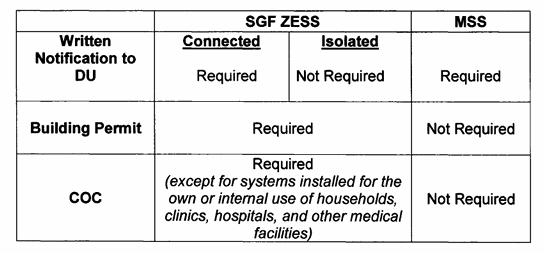
SIMPLIFIED. Table of requirements for each type of solar system. DOE Department Circular 2026-08-0017.

A connected SGF ZESS remains connected to the distribution system but uses equipment that prevents excess solar electricity from flowing into the grid. Consumers installing one must notify their distribution utility and secure a building permit.

A completely isolated SGF ZESS, meanwhile, operates independently from the distribution grid. No notification to the utility is required, but a building permit still is.

While both connected and isolated SGF ZESS require a building permit, consumers may not have to get a new one if their local government verifies that an existing building permit is sufficient for the solar installation.

The COC requirement depends on who will use the system. Households, clinics, hospitals, and other medical facilities are exempt from securing a COC for SGF ZESS installations. Other users, such as businesses, generally still need one.

And if you’re hoping to earn from the excess electricity your solar panels generate, these streamlined rules are not for you. Any electricity sent back to the grid under these arrangements will not earn bill credits or payments.

To receive credits for excess solar power, consumers still have to enroll in the net-metering program and enter into a net-metering agreement with their distribution utility, which are goverened by a different set of paperwork requirements.

Energy Secretary Sharon Garin said the policy is intended to remove costs and requirements that can discourage consumers from adopting solar in the first place.

“By simplifying the process and removing unnecessary costs and requirements, we are opening the door for more households, clinics, and small businesses to generate clean electricity for their own use,” Garin said.

According to the Department of Energy, the measure is meant to directly support the energy directive of President Ferdinand Marcos Jr. in his 2026 State of the Nation Address. Marcos had called for faster renewable energy adoption and for rooftop solar and battery storage installation to become simpler and more affordable.

The Philippines currently gets 25% of its energy from renewables and hopes to reach a renewable energy target of 35% of the power generation mix by 2030 and 50% by 2040. – Rappler.com

Must Read

[READOUT] The race to deliver cheaper power


[READOUT] The race to deliver cheaper power

Similar Posts

  • | | |

    IMF hurdle blocks fuel levy cut, Senate told

    Petroleum Minister Ali Pervaiz Malik has said the government is unlikely to reduce the petroleum levy unless it can identify another source of revenue to compensate for the financial shortfall, warning that such a move would be difficult to secure without the approval of the International Monetary Fund (IMF). Speaking during a meeting of the Senate Standing Committee on Petroleum, the minister explained that any reduction in the levy would affect government revenues and would require a credible alternative before it could be considered. He said the IMF was unlikely to support the proposal unless Pakistan presented a replacement revenue stream. The committee also discussed the country’s fuel pricing mechanism, with several lawmakers expressing concerns over the introduction of daily price adjustments. Members argued that frequent revisions create uncertainty for consumers and make it difficult for the public to understand fuel costs. Responding to the criticism, Malik defended the system, saying the government had removed political influence from fuel pricing by giving the Oil and Gas Regulatory Authority (OGRA) the authority to determine prices through an independent and transparent process. He said the mechanism was designed to reflect international market trends more accurately. The OGRA chairman informed the committee that local petrol and diesel prices are linked to fuel product prices in the Singapore market rather than international crude oil prices. He said the daily pricing system allows authorities to respond quickly to changes in global markets and helps reduce the impact of sudden price fluctuations. However, some lawmakers remained unconvinced. They argued that the pricing formula is too complicated for ordinary consumers and warned that frequent changes place additional financial pressure on households already struggling with rising living costs. The committee also raised concerns over the lack of performance audits of oil drilling rigs operating in the country. Members directed the relevant authorities to complete and submit an audit report within seven days to assess operational standards and efficiency. During the meeting, lawmakers questioned the continued delay in appointing a permanent chairman of OGRA. The petroleum minister replied that the recruitment process had been restarted after the earlier selection exercise failed to identify a suitable candidate.

  • | | | |

    Petrol pump owners announce nationwide strike over…

    The All Pakistan Petrol Pumps Owners Association (APPPOA) has announced a nationwide strike beginning Wednesday night after negotiations with the government over the proposed daily petroleum pricing mechanism ended without an agreement. The decision was announced following talks between representatives of the association and a government delegation led by Petroleum Minister Ali Pervaiz Malik. The discussions focused on the government’s plan to introduce daily fuel price adjustments, but both sides failed to reach a consensus. Speaking after the meeting, APPPOA leaders said the proposed pricing system was unacceptable and would seriously affect the financial stability of petrol pump owners across the country. They argued that the new mechanism would create uncertainty for businesses already operating on narrow profit margins. Association officials said nearly 15,000 petrol pumps across Pakistan are expected to remain closed if the strike goes ahead, warning that the shutdown could disrupt fuel supplies nationwide. Vice Chairman Nauman Ali Butt said petrol dealers wanted petroleum prices to continue being revised on a monthly basis rather than daily. He also pointed out that dealers’ commissions had not been increased for the past three years despite rising operating costs. APPPOA Chairman Humayun Khan said petrol pump owners were already facing financial pressure due to regulatory requirements, policies of oil marketing companies and increasing business expenses. He argued that daily price revisions would benefit oil marketing companies while placing additional risks on retail dealers. According to the association, frequent price changes could create confusion in the market and make inventory management more difficult for petrol pump operators. The association also criticised the government for introducing the policy without consulting key stakeholders. It urged authorities to suspend the daily pricing mechanism, increase dealers’ commissions and involve petrol pump owners in future policy decisions. Meanwhile, the Pakistan Petroleum Dealers Association (PPDA) said it would hold a meeting of its executive committee on Wednesday to decide whether it would also join the nationwide strike. PPDA representatives acknowledged that discussions with government officials and the Oil and Gas Regulatory Authority (OGRA) had taken place. They said OGRA officials sought additional time to review the concerns raised by dealers before making further recommendations to the government. The government maintains that the new pricing mechanism is intended to improve transparency and ensure domestic fuel prices reflect changes in international oil markets more quickly. Under the proposed system, petroleum prices would be updated daily using a rolling average of global market prices.

  • | | | | |

    Banks, retirees, the business: Where will ABS-CBN’s P6-billion rescue go?

    When stockholders of ABS-CBN finally meet on Wednesday, August 19, the question hanging is no longer simply who was willing to rescue it. It is where the rescue money will go, how much will be spent paying for ABS-CBN’s past, and how much will remain to build its future.

  • | | | | | |

    FULL INTERVIEW: Mike Dizon on drumming for 3 bands, love for food

    Dizon sits down with Rappler to talk about his beginnings in music, what it’s like for him to move from genre to genre as the drummer of TEETH, Sandwich, and Pedicab, and how he discovered his love for documenting the restaurants he comes across

Leave a Reply

Your email address will not be published. Required fields are marked *