
afghan fathers struggle
|

Afghan fathers struggle as girls remain barred from secondary schools

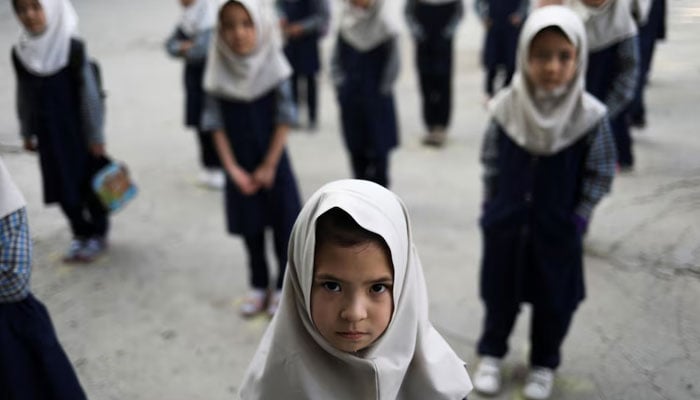
KABUL: Afghan fathers are facing growing distress as their daughters remain unable to continue their education beyond primary school under restrictions imposed by the Taliban authorities.

Families across Afghanistan say the education ban is creating deep emotional and financial pressure. Some fathers are openly questioning the policy, despite their religious beliefs and support for other government measures.

The Taliban administration has defended the restrictions as temporary and based on its interpretation of religious principles. However, many Afghan men say they cannot understand why girls should be prevented from receiving secondary education.

A United Nations survey conducted last year found that about nine out of 10 Afghan men considered it important for girls to attend secondary school. Nearly two-thirds also viewed supporting a daughter’s education as a religiously commendable act.

Girls were barred from secondary schools after the Taliban returned to power in 2021. Women were later also prohibited from attending universities. The restrictions have affected a large number of young Afghan women and girls.

For many families, the approaching end of primary education has become a source of fear. Fathers worry that their daughters will lose their chance to pursue higher education and build professional careers.

One father, identified as Ahmad, said he had never imagined that his daughters could be forced to stop studying. His wife is a mathematics teacher who is also unable to continue teaching secondary-level students.

Ahmad said his eldest daughter is approaching the end of primary school. The family has considered private and underground educational options, but the cost is difficult to manage.

Another father, a doctor identified as Mohammad, said he had always wanted his daughters to attend leading universities. He believes women are essential to Afghanistan’s development and should have opportunities beyond household responsibilities.

His daughters are approaching the age when they will be forced to leave formal schooling. The family has considered sending them abroad, including to Pakistan, but changing regional circumstances have made that option difficult.

Some families have turned to private schools that secretly provide general education alongside religious studies. These institutions often charge high fees and may not provide recognised graduation certificates.

Parents also fear that authorities could take action against schools operating outside official restrictions. This leaves families caught between protecting their children and trying to continue their education.

Another father from Kandahar said his young daughter has a strong interest in astronomy. She asks questions about the solar system, gravity and science.

The girl reportedly asked her father how she could continue learning if she could not study beyond the sixth grade. Her question has become a painful reminder of the limited opportunities available to girls.

Some families have moved to Kabul in search of better educational opportunities. Others are relying on online courses, home schooling and secret classes.

The restrictions are also affecting children emotionally. Parents say many girls feel frustrated, isolated and uncertain about their future.

One father said his teenage daughter often stays at home and becomes deeply upset when she thinks about her education. He said he sometimes leaves the room because he cannot control his emotions and ends up crying privately.

Another family has created a home-schooling routine using old secondary-school textbooks. The parents try to maintain a school-like schedule so their daughters can continue learning.

However, the parents say home education cannot fully replace a formal school environment. They worry about the lack of recognised qualifications, social interaction and access to trained teachers.

Some girls have also begun attending secret classes. Their families remain concerned about possible consequences if the authorities discover them.

The prolonged restrictions have created uncertainty for an entire generation of Afghan girls. Parents fear that years without formal education will limit their daughters’ future opportunities
Similar Posts

  • |

    Oil prices rise as Hormuz tensions escalate

    Oil prices climbed on Monday as uncertainty over a possible diplomatic breakthrough between the United States and Iran increased, while a sharp slowdown in tanker movements through the Strait of Hormuz heightened concerns about disruptions to global crude supplies. Brent crude futures gained as much as 1% during early trading to reach $89.40 per barrel. The benchmark was later up 72 cents, or about 0.8%, at $89.20 a barrel by 0229 GMT. US West Texas Intermediate (WTI) crude also moved higher, rising 44 cents to $82.83 per barrel. Both international benchmarks posted gains of more than 5% last week after a series of attacks involving energy and shipping assets in and around the strategically important Strait of Hormuz. The incidents have intensified fears that further escalation could affect one of the world’s most important oil transit routes. Market sentiment was further affected by developments over the weekend, when Iranian Foreign Minister Abbas Araqchi said Tehran had yet to decide whether it would resume negotiations with Washington. US President Donald Trump, meanwhile, told Americans to prepare for somewhat higher gasoline prices as the conflict continues. Analysts said the renewed uncertainty had brought geopolitical risk back into crude markets after oil prices had previously come under pressure on expectations that diplomatic efforts could ease tensions. “Oil prices have now rebounded almost completely from the lows seen in early August, as hopes for a more permanent resolution between the US and Iran have faded and geopolitical risk premiums have returned to the market,” said Priyanka Sachdeva, head of market insights at Phillip Nova in Singapore. Sachdeva cautioned, however, that the rally could lose momentum unless there is evidence of a further deterioration in the situation. She said the market would need to see renewed aggression in the Strait of Hormuz, particularly significant damage to oil tankers or energy infrastructure, before prices were likely to move substantially higher. Hormuz shipping activity slows Concerns over physical supply disruptions increased after ship-tracking data showed a marked decline in vessel traffic through the Strait of Hormuz over the weekend. According to data from Kpler, only five commodity vessels crossed the strategic waterway on Saturday, while no such transits were recorded on Sunday. This compared with 31 commodity vessel crossings during the previous weekend. The slowdown is significant because the Strait of Hormuz is a critical route for international energy shipments. Any prolonged disruption could increase transportation risks, raise insurance costs and place additional upward pressure on crude prices. The United Arab Emirates also accused Iran of attacking another vessel operated by Abu Dhabi National Oil Company (ADNOC) while it was passing through the strait on Friday, according to the Emirati state news agency WAM. The UAE had earlier blamed Iran for two separate incidents involving ADNOC-operated vessels on Thursday evening. The latest incidents have added to concerns among traders that the conflict could increasingly affect commercial shipping and energy infrastructure, rather than remaining confined to military and diplomatic confrontation. Markets remain focused on escalation risks The Strait of Hormuz remains particularly important to global oil markets because a substantial volume of crude and petroleum products moves through the waterway. Any sustained interruption could therefore have consequences well beyond the region. For now, traders are closely monitoring developments involving US-Iran diplomatic contacts, attacks on shipping and the movement of tankers through the strait. While the latest price gains reflect a higher geopolitical risk premium, analysts remain cautious about predicting a prolonged rally. If shipping activity resumes and diplomatic channels reopen, some of the premium built into crude prices could quickly unwind. Conversely, additional attacks on tankers, oil facilities or other critical infrastructure could trigger a stronger market reaction and push prices higher as traders reassess the security of regional supplies.

  • | |

    Rihanna back in the studio as A$AP Rocky confirms …

    Rihanna fans may finally have a reason to celebrate after years of waiting. According to A$AP Rocky, the global superstar is officially back in the recording studio and actively working on new music. The exciting update came during Rocky’s appearance on the latest episode of The Jason Lee Show, where the rapper was asked about persistent rumors surrounding Rihanna’s long-awaited ninth studio album. Rather than keeping fans guessing, Rocky confirmed that the singer has returned to work on fresh material.  “She in the studio right now,” Rocky said during the interview. “Yeah, I said it. Sorry, babe. Like, bro, she working. She cooking, no funny s–t. Damn, I’ma get in trouble for this.”  His comments immediately sparked excitement across social media, where fans have spent years eagerly awaiting Rihanna’s next album. The Barbadian singer has not released a full-length studio album since Anti in 2016, despite remaining one of the world’s most-streamed artists. Over the past decade, she has focused on expanding her successful Fenty empire, acting projects, and raising her family with A$AP Rocky.  During the interview, Rocky also dismissed speculation that the couple is secretly working on a joint album. While he confirmed Rihanna is creating new music, he made it clear that fans should not expect a collaborative project featuring both artists. The latest update aligns with Rihanna’s own recent comments about her long-awaited album. Earlier this year, she revealed that she had finally found the creative direction she wanted and was determined to make music that truly reflects her artistic vision instead of chasing commercial trends. She has repeatedly said the lengthy wait will be worthwhile because she refuses to release anything that does not meet her expectations.  Although neither Rihanna nor her team has announced a release date or shared details about the project’s sound, Rocky’s comments are the clearest indication yet that the album is actively taking shape. Fans have grown accustomed to years of rumors and teases, but this confirmation from someone closest to the singer has renewed optimism that new music could finally be on the horizon.  The revelation has already generated widespread buzz online, with many fans expressing cautious excitement after nearly a decade without a studio album. While some remain skeptical until an official announcement arrives, others believe Rocky’s remarks suggest Rihanna’s musical comeback is closer than ever. For now, one thing appears certain: Rihanna is back in the studio, and according to A$AP Rocky, she is “cooking” something special. After years of anticipation, the wait for her next musical chapter may finally be nearing its end. 

  • | |

    ‘I will not apologize’: Maulana Fazlur…

    A political controversy surrounding Jamiat Ulema-e-Islam (F) chief Maulana Fazlur Rehman has intensified after the veteran politician refused to apologize for remarks he made earlier this month regarding security issues and the role of state institutions. The comments have drawn criticism from government officials and prompted legal proceedings. Addressing lawyers affiliated with his party on Sunday, Maulana Fazlur Rehman stated that he would not withdraw or apologize for his remarks. Instead, he argued that those who, in his view, launched a propaganda campaign against him should offer an apology. The controversy stems from a speech delivered during a party rally in Kasur, where the JUI-F leader spoke about the deteriorating security situation in Khyber Pakhtunkhwa and Balochistan. During the address, he questioned calls for political workers to take up arms against militant groups, saying he would not form a private force or militia. In the same speech, Maulana Fazlur Rehman also criticized the involvement of individuals in politics while serving in uniform, suggesting that anyone wishing to participate in politics should first leave official service and contest elections as civilians. The remarks quickly became the subject of nationwide political debate. The speech also led to legal action. On July 15, a local court in Gujranwala issued a notice to the National Cyber Crime Investigation Agency (NCCIA) in response to a petition filed over the remarks. The court has sought a reply from the agency by August 17 as the matter proceeds through legal channels. Senior members of the federal government strongly criticized the JUI-F chief’s comments. Defence Minister Khawaja Asif said linking the sacrifices of Pakistan’s armed forces to their salaries was unfair and disrespectful to military personnel, particularly the families of fallen soldiers. He maintained that while political leaders have the right to criticize policies or procedures, they should avoid statements that undermine the sacrifices of security forces. The controversy has sparked wider debate across Pakistan’s political landscape, with supporters arguing that Maulana Fazlur Rehman was expressing a political opinion on national security, while critics believe his remarks crossed acceptable boundaries. As political reactions continue, the legal process is expected to determine whether any further action will be taken. The issue remains a prominent topic in national politics, highlighting ongoing tensions between opposition leaders and the government over security, governance, and political accountability.

  • |

    Priyanka Chopra reveals next Hollywood project with Russell Crowe

    Priyanka Chopra has officially revealed her next Hollywood project, Bluefly, a science-fiction action thriller that will see her star alongside Academy Award winner Russell Crowe. The announcement marks another major international venture for the actress, who continues to expand her presence in global cinema with high-profile productions. The actress shared the update with fans on Instagram on Thursday, posting a behind-the-scenes image and captioning it simply, “On to the next.” The brief message quickly drew widespread attention, with fans and celebrities alike celebrating the exciting casting announcement. Bluefly will be directed by Nimród Antal, known for his work on action and thriller films. The screenplay has been written by David Frigerio together with William Eubank and Carlyle Eubank, promising a story packed with suspense, mystery and large-scale action. Set against the backdrop of the Democratic Republic of the Congo, the film follows a grieving United Nations translator who unexpectedly becomes involved in a highly classified black-operations mission. The assignment centres on recovering a mysterious aircraft that was never meant to exist, forcing a Special Operations team to travel through dangerous militia-controlled territory. As the mission unfolds, the team discovers that retrieving the aircraft may not have been the true objective. Hidden agendas, dangerous secrets and unexpected twists transform what initially appears to be a recovery operation into a fight for survival. The storyline is expected to combine military action, science-fiction elements and psychological suspense. The film boasts an experienced production team, with Michael Jefferson, David Frigerio, Deborah Glover, Arianne Fraser, Delphine Perrier and Vanessa Yao Guo serving as producers. Their collaboration aims to deliver a large-scale thriller for international audiences. Speaking about the project, producer Delphine Perrier described Bluefly as a gripping action thriller filled with surprising twists and an emotionally layered story. She also expressed confidence that director Nimród Antal and the film’s cast would bring the ambitious project to life for viewers around the world. Priyanka’s Instagram announcement quickly attracted support from friends and colleagues across the entertainment industry. Her husband, singer Nick Jonas, reacted with fire emojis, while actress Huma Qureshi also showed her excitement in the comments section. Fans flooded the post with congratulatory messages, praising the casting and expressing enthusiasm about seeing Chopra and Crowe share the screen. Many described the pairing as one of the most exciting casting announcements of the year. Russell Crowe adds significant star power to the project. The veteran actor remains one of Hollywood’s most respected performers, earning worldwide acclaim and an Academy Award for his iconic portrayal of Maximus in Gladiator. His addition is expected to elevate the film’s international appeal. Meanwhile, Priyanka Chopra has a busy schedule ahead. Alongside Bluefly, she is preparing for her much-awaited return to Indian cinema with director SS Rajamouli’s upcoming film Varanasi. The project reunites her with Indian audiences after an eight-year gap and features an impressive ensemble cast, including Mahesh Babu and Prithviraj Sukumaran. The Indian epic is currently slated for a theatrical release in April 2027, while production on Bluefly is expected to begin soon as Chopra continues balancing major projects across Hollywood and India.

  • | |

    Gohar Rasheed criticises Aurat March posters

    Actor Gohar Rasheed, known for his versatility and outspoken nature, has sparked a fresh round of public debate after sharing his views on Aurat March during a recent podcast appearance, taking particular issue with what he described as vulgar posters that appear at the annual women’s rights march. Rasheed drew a comparison between two things he sees as similarly problematic. He said that women should not be objectified, and in that spirit, item numbers in films should not exist because they reduce women to objects. He then extended that same logic to certain placards that appear at Aurat March, arguing that some posters cross a line into vulgarity and do not represent an appropriate way to communicate ideas or demands. He said the same points could be made in a more sophisticated manner without resorting to language or imagery that he found objectionable. The remarks touched on one of the most consistently contested topics in Pakistani public life. Aurat March, held annually on March 8 in major cities across Pakistan to mark International Women’s Day, has been a flashpoint for debate since its earliest editions. Supporters argue it is a necessary and long-overdue platform for women to voice demands around safety, equality and rights. Critics, including Rasheed, have frequently taken issue with specific posters that appear at the marches, arguing that certain slogans or images do not reflect the broader values of Pakistani society. The response online was immediate and divided, as it tends to be whenever the march becomes the subject of public commentary. Some users agreed with Rasheed. One person wrote: “He is right. Now Aurat Marchers will go against him,” anticipating the backlash while expressing support for the sentiment. Others pushed back sharply. One commenter wrote: “I wish he was this offended by violence against women and child rape,” arguing that the energy directed at posters would be better channelled toward the far graver issues women face daily. Another said: “Three men mansplaining what women should do or not do,” pointing to the irony of male voices deciding what is and is not an appropriate mode of feminist expression. The division in the comments reflects the genuine complexity of the debate. For those who support Aurat March unconditionally, the criticism of posters is a distraction from the march’s core purpose and represents the kind of policing of women’s expression that the march itself is pushing back against. For those who share Rasheed’s view, the concern is that certain forms of communication within the march alienate potential allies and hand critics easy ammunition to dismiss the broader cause. What is clear from the reaction is that this is a conversation Pakistan has not finished having, and that every public voice that enters it, whether from the entertainment industry or elsewhere, adds another layer to a debate that touches on deeply held values about gender, expression and what it means to advocate for change.

Leave a Reply

Your email address will not be published. Required fields are marked *