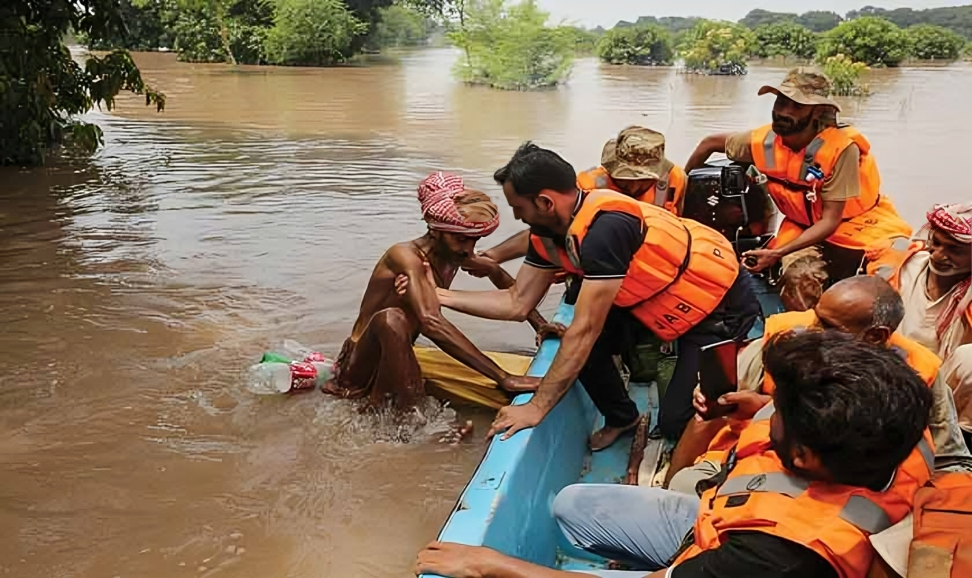
balochistan flood resilience
|

Balochistan flood resilience project faces delays despite housing support progress

QUETTA: Implementation of a major World Bank-backed flood resilience programme in Balochistan is facing significant delays, with slow progress on infrastructure, climate services and housing reconstruction raising concerns about the project’s ability to meet its targets before the scheduled completion date.

The Integrated Flood Resilience and Adaptation Project (P180323), launched in the aftermath of the devastating 2022 floods, has seen mixed results. While more than 74,000 affected households have received the first tranche of financial assistance for housing reconstruction, several key components of the project remain substantially behind schedule.

According to the World Bank’s latest Implementation Status and Results Report, overall implementation progress has been downgraded to “Moderately Unsatisfactory”, while the project’s development objective continues to carry a “Moderately Satisfactory” rating.

The overall risk associated with the project remains high.

The programme was approved in May 2023 with the broader objective of helping flood-affected communities restore livelihoods, regain access to essential services and strengthen their ability to withstand future climate-related disasters.

Infrastructure work gains momentum

The project includes several major components covering community infrastructure, resilient housing, hydro-meteorological and climate services, as well as institutional strengthening and project management.

The World Bank reported some improvement in the community infrastructure component following the appointment of a dedicated project director and the strengthening of the Project Implementation Unit.

Detailed engineering designs and bidding documents are now close to completion, while procurement activities have begun.

Despite these developments, the project has yet to achieve any of the three development-objective-linked output indicators associated with the component.

The gap reflects the difference between preparatory work and actual delivery of infrastructure on the ground, with authorities still required to translate procurement and planning progress into completed projects for flood-affected communities.

Climate services remain behind schedule

Progress has also been reported in the climate-services component following the appointment of a new deputy project director and the award of a contract for Automatic Weather Stations (AWS).

However, several critical steps remain outstanding.

The onboarding of the system integrator has yet to be completed, while a number of important procurement activities are still pending.

The project aims to strengthen Balochistan’s ability to monitor weather conditions and provide timely warnings to communities exposed to floods and other climate-related hazards.

Under the programme, the authorities are targeting the installation of 110 Automatic Weather Stations and the operationalisation of four weather radars.

As of July 2026, none of the targeted weather radars had become operational.

One positive development has been the establishment of a hydrological modelling-based early warning system for hill torrents in Balochistan, which could improve preparedness in areas vulnerable to sudden flooding.

Housing component performs better

The strongest performance has been recorded under the resilient housing component.

More than 74,000 households have received the first tranche of housing assistance, providing financial support to families whose homes were damaged or destroyed by the 2022 floods.

However, the World Bank has identified several risks that could affect further progress.

These include a decision by the Project Steering Committee to limit beneficiary coverage, a funding shortfall affecting other eligible households, unresolved complaints and grievances, and communication difficulties with beneficiaries.

The World Bank warned that these issues could undermine confidence in the programme and affect its ability to reach the intended beneficiaries.

The physical reconstruction figures also show that considerable work remains.

By July 2026, only 30,226 housing units had been restored or reconstructed against the project’s target of 97,000 homes by December 2028.

This means authorities will need to significantly accelerate reconstruction during the remaining implementation period if the target is to be achieved.

Essential services target remains distant

The project also aims to restore access to essential services for flood-affected communities.

By July 2026, around 214,217 people had regained access to at least one essential service.

However, the eventual target is 1.5 million people, indicating a substantial gap between current achievements and the programme’s planned outcome.

Similarly, the project has yet to register progress against its target of improving climate resilience for 1.8 million people.

The figures suggest that while financial assistance and preparatory activities have moved forward, the broader resilience-building objectives are yet to translate into measurable results on the required scale.

Irrigation and flood protection work yet to deliver

The restoration of flood-damaged irrigation systems is another major area where implementation remains slow.

The project has a target of restoring irrigation infrastructure covering approximately 50,000 hectares.

A similar target has been set for improving flood-protection infrastructure over an area of 50,000 hectares.

However, as of July 2026, no achievement had been recorded against either target.

The lack of progress is particularly significant given the importance of irrigation to livelihoods in Balochistan, where agriculture and livestock remain major sources of income for many communities.

Restoring damaged irrigation networks is also critical to rebuilding economic activity in areas affected by the 2022 floods.

Financing constraints add pressure

Financial challenges are adding another layer of difficulty to implementation.

The project has a revised allocation of approximately $214.03 million under the IDA-73330 facility.

Of this amount, around $113.97 million, equivalent to 62.61%, has been disbursed, while approximately $68.05 million remains undisbursed.

In addition, a separate $32 million IDA-78980 facility remains completely undisbursed.

The financing position means authorities have both resources and time constraints to manage as they seek to accelerate implementation.

Bridging funding gaps for eligible beneficiaries and ensuring timely utilisation of available financing will be crucial to maintaining momentum during the remaining project period.

Grievances and communication concerns

The World Bank has also highlighted unresolved grievances and communication shortcomings as risks to the housing component.

For a project involving thousands of flood-affected households, effective communication is essential to ensure beneficiaries understand eligibility criteria, payment arrangements, construction requirements and complaint-resolution procedures.

Unresolved grievances could not only delay implementation but also create dissatisfaction among communities that expected assistance following the 2022 floods.

Authorities will therefore need to strengthen communication channels and grievance mechanisms alongside accelerating physical reconstruction.

Limited time remains

The Integrated Flood Resilience and Adaptation Project is scheduled to close on December 31, 2028.

With roughly two years remaining, the authorities face a demanding implementation schedule.

They will need to speed up procurement, complete pending technical work, address financing constraints, resolve beneficiary complaints and translate planned interventions into completed infrastructure.

The World Bank’s latest assessment indicates that the project has made some progress, particularly in housing assistance and preparatory work for community infrastructure and climate services. However, major gaps remain in achieving its core resilience targets.

The coming months will therefore be critical for determining whether the programme can move from planning and financial assistance towards large-scale physical implementation.

For Balochistan, which remains highly vulnerable to floods, extreme weather and climate-related risks, timely completion of the project is important not only for rebuilding infrastructure damaged in 2022 but also for strengthening the province’s ability to withstand future disasters.

Similar Posts

  • |

    Kim Yo Jong warns Japan over expanding military power

    North Korea has issued a fresh warning to Japan, saying it could adopt new military measures in response to Tokyo’s growing defence capabilities. The statement came after Japan conducted a test of a US-made Tomahawk cruise missile, a move Pyongyang described as a serious security threat. Kim Yo Jong, the influential sister of North Korean leader Kim Jong Un, accused Japan of abandoning its traditional defensive military posture and moving toward offensive capabilities. In a statement released through North Korea’s state media, she claimed Tokyo is developing the ability to carry out pre-emptive strikes and military operations beyond its borders. She pointed to Japan’s recent Tomahawk missile launch from the Aegis destroyer Chokai in the Pacific Ocean, along with other missile tests and its participation in joint military exercises led by the United States in the Philippines earlier this year. Kim warned that North Korea would take additional military steps if Japan continued strengthening its armed forces. Although she did not specify what actions Pyongyang might take, she said Japan would face greater security risks as a consequence of its military expansion. The North Korean official also blamed the United States for supporting Japan’s military modernisation. She accused Washington of supplying Tomahawk missiles, upgrading Japanese naval vessels to operate the weapons, and backing missile tests, arguing that the US is encouraging policies that increase tensions in the region. According to Kim, Japan’s acquisition of long-range strike capabilities places North Korea and other neighbouring countries within potential missile range, raising concerns over regional stability. The latest remarks are part of a broader campaign by Pyongyang against growing security cooperation between the United States, Japan and South Korea. North Korean state media has repeatedly criticised joint military exercises and defence partnerships, describing them as provocative and a threat to peace on the Korean Peninsula. Regional analysts believe the statement is aimed at portraying Japan’s military modernisation as justification for North Korea’s continued weapons development. Experts also suggest the rhetoric could signal preparations for future military demonstrations, including missile launches or other strategic weapons tests, as Pyongyang seeks to reinforce its deterrence strategy amid rising regional tensions.

  • |

    Mohammad Amir questions Babar Azam’s Test captaincy return

    LAHORE: Former Pakistan fast bowler Mohammad Amir has questioned the Pakistan Cricket Board’s decision to reappoint Babar Azam as the national Test captain, saying the star batter should have been allowed to focus entirely on his batting rather than taking on the added responsibility of leadership. Babar recently returned as Pakistan’s Test skipper after replacing Shan Masood, whose tenure ended after 16 matches, during which Pakistan recorded four wins and suffered 12 defeats. The appointment marks Babar’s second stint as Test captain, having previously led the national side from 2020 to 2023. The PCB’s decision has generated considerable discussion among former players and cricket analysts, with opinions divided over whether the move will strengthen the team’s performance. Speaking during an interview with Wisden, Amir said he was not convinced that handing the captaincy back to Babar was the right decision, especially at a time when the batter had only recently regained his form after a prolonged lean patch. According to Amir, Babar’s improved performances with the bat should have been the team’s primary priority, rather than placing additional expectations on him through captaincy. “He has only just started performing well again after a long period. He’s finally looking in good rhythm,” Amir said, suggesting that leadership duties could once again distract him from maintaining consistency with the bat. The former left-arm pacer also highlighted the intense scrutiny faced by Pakistan’s captains, noting that media attention and public expectations make the role particularly demanding. He argued that every decision taken by the captain is closely examined, creating constant pressure both on and off the field. In his view, such an environment could affect a player’s confidence and performance if they are already carrying the responsibility of being the team’s leading batter. Amir, who represented Pakistan in 36 Tests, 61 One-Day Internationals and 62 T20 Internationals, described Babar as the country’s finest batter and said his greatest contribution comes through scoring runs. “I believe Babar should have played as a player with a free mind and less pressure because he is the best player Pakistan has right now,” he said. While stressing that his remarks reflected his personal opinion, Amir concluded that reappointing Babar as Test captain was not the ideal solution for Pakistan cricket. He added that protecting the team’s premier batter from additional pressure would have been a better long-term strategy as Pakistan looks to rebuild its Test fortunes.

  • | |

    Saudi Arabia names new envoy to Pakistan

    Saudi Arabia has appointed Dr Rajeh bin Tami Al-Baqami as its new ambassador to Pakistan, replacing Nawaf bin Said Al-Malki. The appointment comes as Pakistan and Saudi Arabia continue to strengthen their longstanding partnership in defence, investment, trade and regional security. The Saudi Ministry of Foreign Affairs said Al-Baqami was among eight newly appointed ambassadors who recently took the oath of office. The ministry shared photographs of the newly appointed envoys and said they had been sworn in on behalf of the Saudi leadership. Al-Baqami brings both military and diplomatic experience to his new position. He previously served as a major general in the Saudi armed forces before joining the Foreign Ministry at ambassadorial rank. He holds a doctorate in Human Resource Management from Brunel University London. His appointment comes at a time when Islamabad and Riyadh are expanding their strategic cooperation. The two countries recently formalised their defence partnership through a Strategic Mutual Defence Agreement. Under the agreement, aggression against either country is considered an attack on both, further strengthening their long-standing military relationship. Economic cooperation has also become an important part of bilateral ties. Saudi Arabia has pledged major investments in Pakistan under Crown Prince Mohammed bin Salman’s Vision 2030 programme. Riyadh has also provided financial assistance to Pakistan during periods of economic and balance-of-payments pressure. Saudi Arabia remains an important source of oil supplies for Pakistan, including arrangements involving deferred payments. The kingdom has also supported Pakistan’s foreign exchange position through deposits with the State Bank of Pakistan. Relations between the two countries have gained further momentum amid changing regional security dynamics. Islamabad and Riyadh have maintained close consultations on regional developments, including tensions involving Iran. Pakistan has also provided military support to Saudi Arabia during periods of heightened security concerns in the region. Al-Baqami succeeds Al-Malki, who served as Saudi ambassador during a period of expanding political, defence and economic cooperation between the two countries. His arrival is expected to provide further momentum to bilateral engagement and strengthen coordination between Islamabad and Riyadh.

  • |

    Wildfires force 43,000 to flee in France

    More than 43,000 people have been evacuated from southwestern France as massive wildfires continue to spread across several regions, threatening residential areas, forests and popular tourist destinations. French authorities have launched one of the country’s largest emergency operations of the year as firefighters work around the clock to contain the rapidly advancing flames. The worst-affected area is located near Arcachon Bay and the Cap Ferret peninsula in the Gironde region. The wildfire has already burned through more than 8,700 hectares of land and continues to spread because of strong winds, dry vegetation and extremely high temperatures. Authorities ordered the complete evacuation of the Cap Ferret peninsula, a major holiday destination on France’s Atlantic coast that attracts thousands of visitors every summer. Residents, tourists and campers were instructed to leave immediately as emergency services expanded evacuation operations. To speed up the evacuation, authorities arranged transport by both road and sea. Special boats were deployed from several coastal villages while vehicles used the peninsula’s only highway leading to the mainland. Emergency officials urged everyone in the affected areas to leave without delay for their own safety. French Interior Minister Laurent Nunez described the Gironde wildfire as the largest fire of the current season. He said around 80 homes have been damaged, including nearly 50 houses that were completely destroyed by the flames. More than 1,000 firefighters, supported by helicopters, military engineering units and civil security teams, are working to control the blaze in Gironde. Hundreds of police officers and emergency personnel have also been deployed to help with evacuations, traffic management and public safety. A second major wildfire is burning near Biscarrosse in the neighbouring Landes region. The fire has destroyed more than 2,500 hectares of forest and forced the evacuation of over 23,000 residents, tourists and campers. Local authorities said the blaze remains out of control after continuing to spread overnight. French President Emmanuel Macron has requested international assistance through the European Union Civil Protection Mechanism. Several European countries have agreed to send additional firefighting aircraft and helicopters to help French authorities contain the fires. Croatia is sending Canadair water-bombing aircraft, while Portugal will provide specialised firefighting planes. The Czech Republic and Slovakia are also deploying heavy helicopters to assist emergency crews. Emergency officials said there have been no confirmed fatalities in the Gironde wildfire so far. However, they warned that weather conditions remain highly dangerous and could make firefighting efforts even more difficult in the coming days. Fire experts say the blazes are spreading unusually quickly because of prolonged heatwaves, severe drought and strong winds. These conditions have left forests and vegetation extremely dry, allowing fires to expand rapidly across large areas. Authorities estimate that nearly 50,000 hectares of land have burned across France since the beginning of this year’s wildfire season, making it one of the country’s most destructive fire seasons in recent years.

  • | | | |

    Trump reportedly left Türkiye on secret flight amid Iran threat

    US President Donald Trump reportedly left Türkiye on a military aircraft during a covert security operation last month. The move was allegedly made because of an Iranian assassination threat. According to a report citing US officials and people familiar with the operation, Trump initially boarded the older Air Force One aircraft in Ankara. Television cameras were present as he departed. Minutes later, however, Trump was reportedly moved to a smaller Air Force C-32A aircraft. The transfer was allegedly carried out using an airport catering truck. The unusual operation was designed to keep Trump’s actual location hidden. The report said the information was not shared publicly. Some journalists and even members of the White House staff were also reportedly unaware of the change. Trump had travelled to Ankara for a NATO summit held on July 7 and 8. The reported security threat emerged during his visit. The operation reportedly took place shortly after US forces resumed strikes against Iran. The strikes followed the collapse of negotiations between Washington and Tehran. White House Communications Director Steven Cheung defended the security arrangements. He said the aircraft being used as Air Force One had been equipped with advanced security measures. Cheung said the president faced threats from several enemies of the United States. He added that the administration was using all available measures to protect him. The reported security operation comes as tensions between the United States and Iran remain high. Trump has continued to leave open the possibility of stronger military action against Tehran. Oil prices rise amid escalation fears Global oil prices also climbed sharply as markets reacted to Trump’s latest comments on Iran. Brent crude rose around 5% on Monday. It reached about $87.70 per barrel, its highest level in nearly two weeks. US West Texas Intermediate crude also gained around 5.1%. It reached approximately $82.20 per barrel. The rise came after Trump said the United States still had the option of taking stronger action against Iran. Trump told reporters that Washington had the capability to pursue a major escalation if it decided to do so. His comments increased uncertainty over efforts to end the conflict. They also raised concerns about the future of shipping through the Strait of Hormuz. Trump has claimed that the strategic waterway is open and fully under US control. However, he acknowledged that Iran could still attempt to interfere with maritime traffic. Iran has taken a different position. Tehran has reportedly demanded that the US lift its blockade before it agrees to fully restore the waterway’s operations. The Strait of Hormuz is one of the world’s most important energy routes. Large volumes of crude oil and liquefied natural gas pass through the waterway. Any prolonged disruption could therefore put further pressure on global energy prices. Oil prices were also supported by reports of attacks involving energy infrastructure in Saudi Arabia and a tanker operated by Abu Dhabi National Oil Company. Meanwhile, US crude reserves remained under pressure. Stocks in the Strategic Petroleum Reserve fell below 300 million barrels last week. The reserve was reported at around 298.7 million barrels. It was the lowest level recorded since 1983.

  • |

    Weekly inflation rises 0.15% in second week of August

    ISLAMABAD: Weekly inflation increased by 0.15% during the second week of August 2026, pushing the year-on-year inflation rate to 9.11%, according to the latest data released by the Pakistan Bureau of Statistics (PBS). The weekly Sensitive Price Indicator (SPI), which tracks changes in the prices of essential consumer goods, showed a mixed trend during the week. Prices of several food and household items increased, while consumers received some relief from lower prices of petroleum products and selected food commodities. According to the PBS report, prices of 20 out of 51 essential commodities increased during the week under review, while prices of nine items declined. The prices of the remaining 22 commodities remained unchanged. Onion prices surge sharply Among the major price increases, onions recorded the most significant weekly jump, becoming 24.68% more expensive compared with the previous week. The increase is likely to add further pressure on household food budgets, particularly for low-income consumers who are more exposed to fluctuations in basic food prices. The price of gram pulse increased by 3.35%, while chicken became 2.45% more expensive during the week. LPG prices also edged up by 0.67%. Other commodities that recorded weekly price increases included tea, mustard oil, yoghurt and masoor pulse, adding to the overall upward movement in the weekly inflation indicator. Petroleum prices provide some relief The weekly inflation reading was partly offset by declines in the prices of petroleum and several food items. Petrol prices decreased by 2.35% during the week, providing some relief to consumers and transport users. Tomato prices fell by 1.26%, while potatoes became 0.73% cheaper. Diesel prices also declined, though marginally, by 0.29%. Prices of bananas, moong pulse, eggs and sugar also recorded weekly decreases. Despite these reductions, the increase in the prices of several essential food items, particularly onions, pulses and chicken, kept overall weekly inflation in positive territory. Food prices remain major source of annual pressure The year-on-year comparison presents a more pronounced picture of price pressures in several essential commodities. Tomatoes recorded the largest annual increase, with prices rising by 143.77% compared with the same period last year. Onion prices were 125.75% higher, while wheat flour became 77.41% more expensive. LPG prices increased by 55.41% on an annual basis, while diesel recorded a 34.05% increase. Petrol prices were also 23.02% higher than a year earlier. The sharp annual increases in basic food items indicate that consumers continue to face significant pressure in meeting everyday household expenses, even though some commodities have become cheaper compared with last year. Several commodities become cheaper annually The annual data also showed declines in the prices of a number of commodities. Potato prices dropped by 30% compared with a year earlier, marking the largest annual decline among the commodities listed in the report. Sugar prices fell by 17.93%, while chicken became 17.45% cheaper on an annual basis. Gram pulse, eggs and moong pulse also recorded year-on-year declines. The contrasting movements highlight the uneven nature of inflation, with some essential commodities witnessing substantial annual increases while others have recorded notable reductions. The latest PBS figures suggest that although overall inflation remains elevated, price movements continue to vary considerably across different categories. Food, energy and other essential commodities remain key factors influencing household expenditure and the broader cost-of-living situation.

Leave a Reply

Your email address will not be published. Required fields are marked *