कारोबार

  • |

    PSX plunges over 1,300 points amid global market sell-off

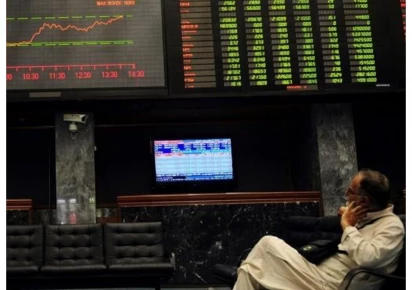
    The Pakistan Stock Exchange (PSX) came under heavy selling pressure on Wednesday. The benchmark KSE-100 Index fell sharply during the trading session. The index dropped 1,339.73 points, or 0.75%, to reach 176,284.15 by 1:04pm. The decline came as regional markets also faced pressure and oil prices continued to rise. The KSE-100 had already fallen 1,297.67 points, or 0.73%, earlier in the session. At 9:34am, the index was trading at 176,326.21. The market remained volatile throughout the session. The KSE-100 recorded an intraday high of 176,935.03 and a low of 175,631.74. Trading activity remained significant. Around 120.55 million shares changed hands during the session. The total traded value stood at Rs10.69 billion. The previous close of the KSE-100 Index was 177,623.88. The latest decline therefore reflected a clear shift in investor sentiment. The pressure on the local market came amid a wider sell-off across Asian stock markets. Investors have become increasingly cautious about global economic conditions. Concerns surrounding heavy investment in artificial intelligence-related companies have also affected market sentiment. Investors are assessing whether valuations in some technology sectors have risen too quickly. The rise in international oil prices added another source of uncertainty. Oil prices increased after fresh attacks were reported in the Middle East. The developments have raised concerns about possible disruptions to global oil supplies. Higher energy prices could also increase inflationary pressures in several economies. Investors are also watching the potential impact of higher oil prices on interest rates. A prolonged rise in energy costs could complicate efforts to control inflation. Geopolitical tensions in the Middle East have further increased uncertainty in global financial markets. The latest developments have encouraged investors to adopt a more cautious approach. The negative trend in Asian equities also affected sentiment at the PSX. Local investors remained under pressure as the benchmark index continued to trade in negative territory.

  • | |

    Japan PM’s market woes deepen as support slides

    Japanese Prime Minister Sanae Takaichi is facing mounting political and economic pressure as falling public support makes it harder for her government to balance tax cuts, economic stimulus and financial stability. Takaichi’s approval rating fell sharply in July, reaching its lowest level since she became prime minister last year. Rising inflation has increased pressure on households and weakened public confidence in the government. Higher import costs linked to a weaker yen have contributed to price increases. The impact of inflation is now becoming a major political challenge for Takaichi. The prime minister has continued to support higher government spending and large-scale investment. She has also criticised excessive monetary and fiscal tightening. However, investors are increasingly worried that the government’s expansionary policies could worsen Japan’s already difficult fiscal position. Those concerns have pushed Japanese government bond yields higher. Rising yields indicate that investors are demanding greater returns to hold Japanese debt. The market pressure has also complicated government efforts to support the yen. Officials have repeatedly warned currency traders against excessive speculation, but their comments have had limited impact. Government sources said the effectiveness of such verbal intervention was weakening as investors became more concerned about Japan’s fiscal outlook. One source warned that financial markets were gaining greater influence over fiscal management, creating a situation Japan had not experienced on this scale for decades. Takaichi is caught between two competing objectives. She wants to stimulate economic growth and reduce the burden of rising living costs. At the same time, she needs to convince investors that Japan remains committed to fiscal discipline. Her government’s spending plans have already contributed to market concerns. Japanese government bond yields climbed to their highest level in about three decades in July as investors assessed the potential impact of increased spending and borrowing. Takaichi has acknowledged the importance of rebuilding confidence among investors. She recently said that communication with financial markets would become increasingly important. However, she has shown little intention of abandoning her expansionary economic strategy. The prime minister has reiterated her goal of ending what she calls excessive fiscal tightening. She wants to promote growth through increased investment and tax reductions. That position has created a political dilemma. Reducing or delaying her planned measures could weaken her popularity. But continuing with them could further unsettle financial markets. The pressure could intensify in the coming months. Takaichi is expected to proceed with a proposal to reduce an 8% consumption tax on food for two years. Japanese media have reported that the government intends to move ahead despite reservations within the ruling party. The plan could provide relief to households struggling with higher prices. However, analysts say uncertainty over how the tax reduction would be financed could create additional pressure in the bond market. The government is also considering changes to its budget-making process. Under the proposed system, spending requests for key growth sectors would not be subject to strict ceilings. That could lead to higher government expenditure and increased debt issuance in the next fiscal year. Economists have warned that such measures may make it more difficult for the government to reassure investors about its commitment to fiscal responsibility. Japan’s currency is also facing significant pressure.

  • | | |

    PM Shehbaz orders scientific system to assess tax …

    Prime Minister Shehbaz Sharif has directed the Federal Board of Revenue (FBR) to develop a scientific and comprehensive method to assess tax potential in different sectors of the economy. The new system is aimed at improving tax collection. It will also help identify sectors with untapped revenue potential. The government wants to strengthen tax administration and reduce tax evasion. The prime minister issued the directives during a meeting on FBR reforms in Islamabad on Wednesday. He directed the FBR to work with the power sector to identify businesses and individuals involved in the informal economy. Authorities will also identify those suspected of avoiding taxes. Shehbaz instructed officials to take legal action against people and businesses found involved in tax evasion. The prime minister said improvements in the FBR’s monitoring system were already producing results. He pointed out that sugar production data had matched FBR records for the first time in Pakistan’s history. He described the development as an important sign of improved monitoring and tracking. Shehbaz praised FBR Chairman Rashid Mahmood Langrial and his team for their efforts. He also appreciated taxpayers and businesses that were following tax laws. The prime minister said the government had provided maximum possible support to export-oriented and domestic industries. He said the government would continue facilitating businesses while ensuring compliance with tax regulations. He directed the FBR chairman and senior officials to spend the first week of every month in Karachi. They will meet business representatives and address their concerns. Shehbaz also ordered the expansion of digital production monitoring. He directed officials to make tracking systems operational in the textile, beverages, steel, poultry, edible oil and ghee, and tyre sectors by December. He also stressed that appointments and transfers within the FBR must be made strictly on merit. The prime minister praised the new system for evaluating officers. He said merit and transparency must remain central to FBR reforms. He directed authorities to prepare a list of high-performing officers. The best-performing officials will be considered for awards on Independence Day. Shehbaz also ordered an immediate third-party audit of customs bonded warehouses. The audit will examine the warehouses and identify possible irregularities. Officials will then be required to take corrective measures where necessary. The meeting was informed about progress on production tracking systems and human resource reforms. Officials said tracking systems were already fully operational in the sugar, cement, tobacco, tiles and fertiliser sectors. Work in five additional sectors was also nearing completion. These sectors have an estimated tax potential of more than Rs700 billion. Officials said tracking systems were also being developed for nine other production sectors. These sectors are estimated to have an additional tax potential of around Rs560 billion. The prime minister directed authorities to complete indirect tax tracking across the production sector by the end of the year. The meeting also reviewed reforms in the FBR’s workforce. Newly recruited officers are receiving specialised training. Existing officers are also undergoing training. The programmes have been designed around merit and performance. Officials said the training modules were aligned with international standards and Pakistan’s tax requirements. A new performance evaluation system has also been introduced. Under the system, high-performing officers can receive recognition. Officials who fail to meet performance standards can face penalties. The government has also appointed 957 third-party auditors. The move is intended to improve transparency and strengthen tax-related processes. Recruitment of 280 goods evaluators is also under way. The evaluators will work under the customs faceless assessment system. The meeting also discussed measures to reduce unnecessary tax disputes. A Case Scrutiny Committee is being established for this purpose. The committee will determine whether tax cases should proceed based on their merits. Officials also provided an update on Alternative Dispute Resolution Committees. By June 2026, 152 out of 377 applications had been resolved within 90 days. The process resulted in the recovery of Rs54 billion in tax revenue. Digital reforms also reviewed Prime Minister Shehbaz Sharif separately reviewed progress on the national digital vision. He ordered immediate measures to make the newly established Sky47 AI national central data centre available to federal government institutions. The prime minister said the initiative would help modernise government services. He said citizens would eventually be able to use a single digital identity to access multiple public services. These services could include government document verification, banking, healthcare and transfers. The prime minister said a central national data centre would bring information from federal institutions together. He said this would reduce the need for separate data centres. It could also help save public resources. Shehbaz said the national digital vision was important for building a more integrated society. He highlighted three key areas of the programme. These include the digital economy, digital citizen services and digital government services. He directed authorities to initially focus on health, agriculture, utilities, housing and small and medium-sized enterprises. The aim is to ensure that citizens begin receiving improved digital services as quickly as possible. Officials said digital implementation was already under way in agriculture, food, health, energy, housing and SMEs. Work has also started in 14 additional priority sectors. The housing component will introduce a central identification number for public and private properties. The SME component will create an integrated system of unique legal identities for businesses. The government believes these measures can improve transparency and economic activity. Shehbaz also ordered an early meeting of the National Digital Commission. The meeting will include key stakeholders. Provincial governments will also be consulted. The commission was established under the Digital Nation Pakistan Act 2025. It is chaired by the prime minister and includes the chief ministers of all provinces. The prime minister said consultation with federal and provincial institutions was essential for effective implementation. He also stressed the importance of international standards and global best practices.

  • | | |

    Saudi Arabia rolls over $5bn Pakistan deposit

    Pakistan’s external financing pressure has eased after Saudi Arabia extended a $5 billion deposit for another three years, State Bank of Pakistan Governor Jameel Ahmad said on Wednesday. The rollover will give Pakistan additional breathing space as it manages its external debt obligations and works to strengthen its foreign exchange position. According to the governor, the Saudi deposit has been extended until December 2028. The development has reduced Pakistan’s gross external financing requirement for the current fiscal year to around $21.5 billion. Pakistan has received a total of $8 billion in deposits from Saudi Arabia. This includes $3 billion received in April this year. The remaining $5 billion had previously been rolled over annually. The latest arrangement provides Pakistan with a longer repayment period and reduces immediate pressure on its external account. Ahmad said lower interest costs on foreign debt had also helped reduce Pakistan’s financing requirements. He estimated the reduction at nearly $500 million. Pakistan continues to rely significantly on external financing to meet debt repayments and cover external account needs. The government is seeking to increase exports, attract investment and improve other sources of foreign exchange. The governor said the International Monetary Fund has projected Pakistan’s external financing requirements at around $30 billion for the next fiscal year. However, he said the estimate could be revised downward if the government succeeds in securing additional longer-term financing and improving external inflows. According to Ahmad, Pakistan’s $21.5 billion financing requirement includes around $7.3 billion in cash deposits and approximately $3.5 billion in foreign commercial loans maturing during the year. Pakistan also owes around $250 million to Kuwait through a long-standing cash deposit arrangement. The governor did not comment on reports concerning Pakistan’s request for a $10 billion credit facility from the United States. He said the federal government would be in a better position to respond to the matter. Pakistan also repaid a $1.3 billion Chinese commercial loan during July. The repayment temporarily reduced the country’s foreign exchange reserves to around $17.3 billion as of July 17. Ahmad said China was expected to refinance the amount, with the funds potentially arriving next month. Of Pakistan’s total external financing needs, around $7.5 billion represents net debt repayments. The country had already repaid approximately $2.2 billion during July, reducing the pressure for the remaining months of the fiscal year. The central bank governor also revealed that the State Bank had purchased around $9 billion from the local foreign exchange market during the previous fiscal year. The purchases were aimed at strengthening the country’s foreign exchange reserves. Over the past three years, the central bank’s total purchases from the market have reached around $28 billion. The State Bank expects workers’ remittances to continue supporting Pakistan’s external position. Remittances are projected to help finance a significant portion of the expected trade deficit. The central bank has also set a target of increasing foreign exchange reserves to $20.20 billion by the end of December 2026. Meanwhile, Ahmad told the Senate Standing Committee on Finance that the federal government had not allocated a subsidy for remittance transfers. He said commercial banks would now bear the cost of transferring workers’ remittances. Overseas Pakistanis sending money home would not be charged additional transfer fees. The committee also reviewed banking charges and services, including SMS alerts and card transactions.

  • | | |

    CM Punjab approves 800 mini dams for Potohar water…

    POTOHAR: Punjab Chief Minister Maryam Nawaz Sharif has approved an ambitious plan to construct 800 mini dams across the Potohar region over the next three years, marking one of the province’s largest initiatives aimed at improving rainwater storage and tackling water scarcity. The decision was taken during a high-level meeting on water conservation and groundwater management, where officials briefed the Chief Minister on ongoing efforts to protect Punjab’s water resources. Authorities informed the meeting that 110 mini dams have already been completed across the province, contributing to improved water preservation. The new project is expected to add storage capacity of approximately 32,000 acre-feet of rainwater, strengthening water security for agriculture and local communities. Maryam Nawaz also directed officials to prepare a comprehensive strategy for developing natural and artificial water bodies while calling for stronger legislation to regulate groundwater use. To improve oversight, dedicated personnel will be assigned to monitor water conservation initiatives. The chief minister instructed the agriculture, irrigation, housing and local government departments to work together to ensure the effective implementation of water-saving measures. Officials presented photographic evidence of recently completed mini dams in Attock, Talagang, Gujar Khan and Rawalpindi, highlighting progress already made in the region. During the briefing, authorities revealed that Punjab has developed a strategy to minimise water losses, which currently stand at around 30 per cent during distribution and 25 per cent during consumption. They also reported that the lining of 2,600 watercourses covering nearly 7,000 kilometres has already delivered significant water savings. Over the next three years, another 4,500 watercourses stretching 11,500 kilometres will be upgraded. The meeting was informed that high-efficiency irrigation systems have already conserved around 18,000 acre-feet of water while boosting crop productivity by nearly 50 per cent. The government now plans to extend modern drip and sprinkler irrigation systems to an additional 30,000 acres. Officials further stated that 100 groundwater recharge wells are already operational in the Gujranwala, Gujrat and Lahore divisions, with another 300 nearing completion to strengthen groundwater reserves. The chief minister also reviewed the availability of fertilisers across Punjab and approved the provision of 1,000 new laser land levellers to farmers at a 50 per cent subsidy during the current financial year to promote efficient farming practices. In a separate meeting on law and order, Maryam Nawaz directed authorities to adopt a zero-tolerance approach against rape, child abuse and corruption. She was also informed that the Safe City Project has now been implemented in all 43 districts of Punjab and is expected to be inaugurated soon, further enhancing public safety and surveillance across the province.

  • | | |

    China donates $2m health supplies to Pakistan

    ISLAMABAD: China, in partnership with the United Nations Population Fund (UNFPA), has provided Pakistan with reproductive health and family planning supplies and medical equipment valued at $2 million to improve maternal and newborn healthcare services across the country. The assistance was formally handed over to the Ministry of National Health Services, Regulations and Coordination during a ceremony held at the Rural Health Centre (RHC) Tarlai in Islamabad. The donation is aimed at expanding access to essential reproductive health services and family planning facilities in 10 underserved districts, where healthcare resources remain limited. The initiative is expected to enhance the availability of critical medical supplies, improve maternal and infant health outcomes, and strengthen Pakistan’s healthcare system by supporting vulnerable communities. Officials described the collaboration between China and UNFPA as an important step towards improving reproductive healthcare and ensuring greater access to quality medical services for women and families in underserved regions.

  • | | | |

    Pakistan repays $1.4bn China loan

    Pakistan has repaid a $1.4 billion commercial loan to China, with refinancing expected within the next few weeks, State Bank of Pakistan (SBP) Governor Jameel Ahmad said on Wednesday. Speaking to reporters after attending a meeting of the Senate Standing Committee on Finance at Parliament House, the SBP governor said the country had made external debt repayments worth $2.2 billion during July 2026. The repayments included the $1.4 billion commercial loan to Chinese banks, while the remaining $800 million was used to settle other external liabilities. Ahmad said the refinancing from Chinese banks had not yet been received but was expected shortly, adding that the funds would be made available to Pakistan after a brief delay. The central bank governor also revealed that the SBP had purchased $28 billion over the past three years to strengthen the country’s foreign exchange reserves. He said Pakistan’s external debt repayment requirement had declined from $26.5 billion to $21.5 billion, easing pressure on the country’s finances during the current fiscal year. According to Ahmad, around $3.5 billion of the remaining repayments will be used to service interest obligations. He said the government would continue its strategy of increasing foreign exchange reserves while maintaining external financial stability. The SBP governor further noted that Pakistan would require the rollover of nearly $12 billion in deposits from Saudi Arabia and China to support its external financing position. He expressed confidence that the country’s debt repayment burden would remain lower this year compared with previous years, helping improve Pakistan’s overall economic outlook.

  • | | |

    Oil prices slip despite Gulf tensions as markets f…

    LONDON: Global oil prices edged lower on Thursday as investors shifted their attention from escalating military tensions in the Gulf to the resilience of energy supplies flowing through the region’s critical shipping routes. Brent crude futures fell 96 cents, or 1.06%, to $89.78 per barrel, while US West Texas Intermediate (WTI) crude declined 64 cents, or 0.76%, to $83.82 per barrel. The retreat came just a day after both benchmarks posted sharp gains, reflecting the market’s growing tendency to react briefly to geopolitical developments before refocusing on supply fundamentals. Oil markets had surged on Wednesday after US President Donald Trump warned Iran of a forceful response following an alleged Iranian missile strike on a US military base in Jordan. The rally was further fuelled by fresh US military operations against Iranian targets and joint US-Saudi strikes on Iran-backed armed groups in Iraq, heightening fears of wider regional instability. Despite the renewed military activity, analysts said traders are increasingly assessing whether the conflict will significantly disrupt global oil exports. Market participants remain closely focused on the Strait of Hormuz, a strategic waterway that traditionally carries nearly one-fifth of the world’s oil and gas shipments. According to energy consultancy Rystad Energy, around 13 million barrels of Gulf oil per day are still reaching international markets despite severe disruptions and restrictions in the region. Analysts noted that alternative shipping routes and logistical adjustments have helped prevent a complete supply shock. Lin Ye, Vice President of Commodity Markets at Rystad Energy, said geopolitical headlines continue to trigger rapid price spikes, but such rallies often fade as investors evaluate actual supply conditions and ongoing diplomatic efforts. Meanwhile, shipping challenges persist after Iran’s closure of the Strait of Hormuz and the Iran-aligned Houthi movement’s naval blockade in the Red Sea. Even so, some cargoes, particularly those linked to Chinese buyers, continue to move through alternative channels. IG market analyst Tony Sycamore said the longer alternative export routes remain operational, the weaker Iran’s leverage over the Strait of Hormuz becomes. He added that markets are increasingly adapting to prolonged disruptions, reducing the lasting impact of geopolitical shocks on crude prices. Although volatility remains elevated, traders are now placing greater emphasis on uninterrupted oil flows rather than military rhetoric, suggesting that supply resilience could continue to shape global energy markets in the weeks ahead.

  • | | |

    SBP to study daily fuel price impact on inflation

    ISLAMABAD: The federal government has directed the State Bank of Pakistan (SBP) to conduct a comprehensive study on how the daily revision of petroleum prices affects inflation, as authorities seek new measures to protect consumers from rising living costs and volatile global energy markets. The decision was taken during a meeting of the National Price Monitoring Committee (NPMC), which reviewed the country’s inflation outlook and discussed ways to minimise the impact of fluctuating fuel prices on households and businesses. According to officials, the SBP has been asked to prepare a detailed action plan within 15 days to evaluate the inflationary effects of daily adjustments in petrol and high-speed diesel (HSD) prices, following international best practices. The central bank is expected to recommend policy options that could help maintain price stability while supporting economic growth. The committee was informed that the SBP’s primary responsibility is to ensure price stability through effective monetary policy, including the use of interest rates to manage inflation expectations and regulate money supply. Alongside the SBP study, the NPMC instructed provincial governments, Azad Jammu and Kashmir, Gilgit-Baltistan and the Islamabad Capital Territory to strengthen market monitoring and prevent unjustified increases in the prices of essential commodities whenever fuel prices are revised. The committee also expressed concern over excessive pricing of liquefied petroleum gas (LPG), noting that consumers in many areas were paying significantly more than the official rates notified by the Oil and Gas Regulatory Authority (OGRA). Authorities have been directed to intensify monitoring and narrow the gap between notified and market prices. Officials said the recent regional conflict involving Iran had disrupted energy markets, contributing to higher LPG prices despite regulatory efforts. The meeting also focused on the prices of key food items, including tomatoes, chicken, wheat flour and edible oil. Representatives from the Ministry of National Food Security attributed the surge in tomato prices to seasonal shortages, explaining that Pakistan was importing tomatoes from Iran and Afghanistan to meet domestic demand. However, following the closure of the Afghanistan border, officials said additional tomato imports would now be sourced from Romania to prevent supply shortages and stabilise prices. To improve food quality and consumer protection, the Ministry of Science and Technology will work with the Pakistan Bureau of Statistics (PBS) and provincial authorities to develop testing standards for loose milk, dairy products, edible oil and ghee. Accredited laboratories will conduct regular testing, with quarterly reports submitted to the NPMC. The committee also urged authorities to reduce wholesale and retail price disparities across different cities, improve the supply chain for essential goods and work more closely with the private sector to arrange timely imports before seasonal shortages trigger sharp price increases. Officials expressed hope that stronger coordination, tighter market oversight and evidence-based policymaking would help ease inflationary pressures and provide greater stability for consumers in the coming months.

  • | | |

    PSX drops over 1,000 points

    The Pakistan Stock Exchange (PSX) remained under pressure on Thursday as the benchmark KSE-100 Index fell by more than 1,000 points during intraday trading, reflecting cautious investor sentiment amid rising geopolitical tensions and uncertainty in global financial markets. By late morning, the KSE-100 Index had dropped to around 174,994 points, losing over 1,049 points, or approximately 0.6%, from the previous session. Selling pressure was witnessed across several major sectors, including automobile assemblers, cement, fertiliser, oil and gas exploration, oil marketing companies, power generation and refineries. Heavyweight stocks also traded in negative territory, contributing to the market’s decline. The latest downturn follows a sharp fall in the previous trading session, when the benchmark index lost nearly 1,581 points. Analysts attributed the continued weakness to escalating tensions in the Middle East, which have fuelled concerns over global economic stability and pushed international oil prices higher. Global market uncertainty also weighed on investor confidence. Asian stock markets showed mixed performance as investors assessed the US Federal Reserve’s decision to keep interest rates unchanged. The central bank’s policy stance left markets uncertain about the future direction of interest rates, while rising US Treasury yields added to concerns. Meanwhile, international oil prices remained volatile. Brent crude slipped below $90 per barrel after surging sharply a day earlier as conflict in the Middle East intensified. Despite the heightened tensions, reports indicated that commercial shipping through the region continued. Regional equity markets also experienced fluctuations, with technology shares remaining under pressure following recent losses linked to concerns over heavy investment in artificial intelligence and slowing returns.