تازہ ترین

  • | |

    PPL strikes 1st-ever Chiltan formation gas find in…

    KARACHI: Pakistan Petroleum Limited (PPL) has announced a significant hydrocarbon discovery at its operated Sarani Block in Sindh’s Sujawal district, opening fresh prospects for exploration in the country’s shallow offshore and swampy onshore regions. The discovery was made at the Dolphin X-1 exploratory well, where PPL identified hydrocarbons in the Chiltan Formation of the Lower Indus Basin. The company described it as the first reported hydrocarbon discovery from the Jurassic-age Chiltan Formation in the basin. PPL said the find could expand exploration opportunities in adjoining shallow offshore areas and strengthen the hydrocarbon potential of Pakistan’s low-depth marine zones. The region had remained largely unexplored for years because of its challenging geological and geographical conditions. Drilling of Dolphin X-1 began on April 17, 2026, with the well reaching a measured depth of 3,850 metres to evaluate the hydrocarbon potential of the Chiltan Formation. Analysis of drilling results and wireline logs subsequently identified a hydrocarbon-bearing zone. During testing, the well produced gas from the Chiltan Formation at a rate of 0.942 million standard cubic feet per day. The gas recorded a heating value of 1,000 British thermal units per standard cubic foot, with a wellhead flowing pressure of 211 pounds per square inch gauge through a 64/32-inch choke. PPL holds a 75 per cent working interest in the Sarani Block and serves as its operator, while Government Holdings (Private) Limited owns the remaining 25 per cent stake. The company said the well was drilled and tested using the expertise of its technical teams. The results have led to the identification of a new hydrocarbon play within the Chiltan Limestone, potentially providing a foundation for further exploration in the surrounding onshore and shallow offshore areas.

  • | |

    Rana Sanaullah says PML-N set to secure two-thirds…

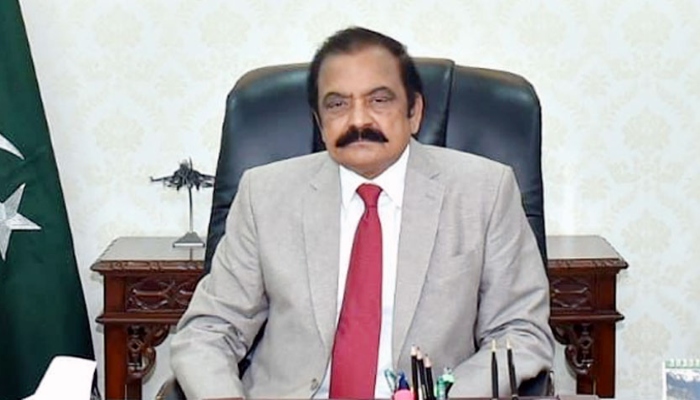
      ISLAMABAD: Adviser to Prime Minister Rana Sanaullah has said that the Pakistan Muslim League-Nawaz (PML-N) is expected to secure a two-thirds majority in the Azad Jammu and Kashmir (AJK) Legislative Assembly after elections for the reserved seats. Speaking about the political situation in Azad Kashmir, Rana Sanaullah said that PML-N would form its government in the region with a clear majority. He stated that the party had secured victory on 25 seats and would achieve a two-thirds majority once the elections for reserved seats were completed. The prime minister’s adviser also expressed his appreciation for Sajid Iqbal, who was elected from LA-14. He thanked the newly elected lawmaker for deciding to support PML-N and said that Sajid Iqbal would work alongside the party for the development and improvement of Azad Kashmir. Rana Sanaullah said that the people of Azad Kashmir had given PML-N a mandate to improve the situation in the region and address the issues faced by its people. He emphasized that the party would fulfill the commitments it had made during the election campaign and would work to bring positive changes to the lives of citizens. He further said that the AJK Legislative Assembly would be allowed to function with its full constitutional powers. According to him, the new government would focus on governance, development and resolving the problems of the people instead of engaging in political confrontation. Commenting on the ongoing protests and sit-ins in Azad Kashmir, Rana Sanaullah said that the citizens participating in the demonstrations were their brothers and should not be viewed as opponents. He stressed that the people of Azad Kashmir were as much owners of Pakistan as citizens living in other parts of the country. However, he claimed that only a very small portion of the protesters, estimated at around one to one-and-a-half percent, might be influenced by elements attempting to create unrest or provoke violence. He maintained that the majority of the people participating in the protests were ordinary citizens expressing their concerns. Rana Sanaullah’s remarks come amid heightened political activity in Azad Kashmir following the recent elections. The expected formation of a PML-N government, along with the possibility of the party securing a two-thirds majority through reserved seats, could significantly strengthen its position in the AJK Legislative Assembly. The PML-N leadership has indicated that its priority will be to address governance and development-related challenges in Azad Kashmir. Rana Sanaullah reiterated that the party would honor its election commitments and work toward improving the region’s overall situation. He also emphasized the importance of maintaining unity between Azad Kashmir and Pakistan, saying that the people of the region have an equal stake in the country. His comments appeared aimed at reassuring protesting citizens while also distinguishing them from what he described as a small number of potentially disruptive elements. With the reserved-seat elections still to be completed, the final composition of the AJK Assembly will determine whether PML-N achieves the two-thirds majority claimed by the prime minister’s adviser. The party is nevertheless confident that it has secured sufficient political support to form the government and pursue its legislative and development agenda in Azad Kashmir.

  • | |

    Hepatitis screening made mandatory for Islamabad e…

    The federal government has decided to launch mandatory hepatitis screening for all government employees in Islamabad. Employees working in federal ministries will also be required to undergo screening. The move is part of the government’s efforts to detect hepatitis cases at an early stage and provide timely treatment. According to sources in the Ministry of Health, the screening will be conducted under the Prime Minister’s Hepatitis Programme. The programme aims to identify people infected with hepatitis and connect them with free diagnostic and treatment facilities. Employees who test positive during the initial screening will be referred for a PCR test. The PCR test will be provided free of cost under the programme. The government will also provide free medicines to patients after completion of the PCR testing process. The initiative is intended to reduce the financial burden on patients and ensure that those diagnosed with hepatitis receive proper treatment. The Prime Minister’s Hepatitis Programme has a total allocation of Rs67 billion. The funds will be used for screening, diagnostic tests, treatment and other measures aimed at controlling the spread of hepatitis. Free hepatitis screening is already being conducted at different locations across Islamabad. The government plans to expand the screening process to federal government employees as part of the wider programme. Sources said more than 50,000 hepatitis screening kits have already been purchased. The kits will be used to screen employees and identify suspected cases. Machinery for PCR testing has also been installed at the National Institutes of Health in Islamabad. The facility will help process tests for people who are found positive during the initial screening. Health authorities are focusing on early diagnosis because many hepatitis patients may not show clear symptoms in the initial stages. Regular screening can help identify infections before they cause serious health complications. The mandatory screening of government employees is therefore being seen as an important step in strengthening hepatitis prevention and treatment efforts in the federal capital.

  • | |

    Iran says US-Israel attacks damaged 100 commercial aircraft

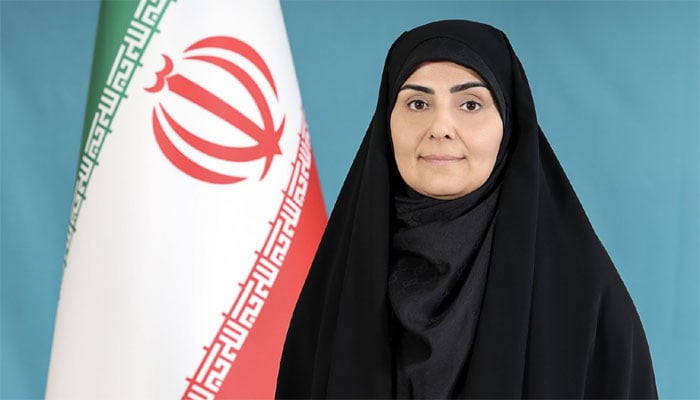
    Iranian Minister of Roads and Urban Development Farzaneh Sadegh has claimed that Iran lost around 100 commercial aircraft during the US-Israeli attacks on the country. She made the remarks during a press conference in Tehran, according to Iranian media. Sadegh said the aviation sector suffered major losses during the conflict. She said airports and other important infrastructure were targeted during the attacks. She added that Iran Air continued operating Hajj flights despite the difficult circumstances. According to the minister, the airline used eight aircraft to operate the flights during the conflict. Sadegh said the damage was not limited to the aviation sector. She claimed that electricity and water facilities were also targeted. Several other key infrastructure installations were reportedly affected. Despite the attacks, transport services continued to operate in several parts of the country. The minister said railway services remained active during the conflict. Road transport also continued. Port operations were also maintained despite the security situation. Sadegh further claimed that the United States and Israel attacked around 400 cities across 25 Iranian provinces. She said the attacks caused extensive damage to civilian and commercial infrastructure. According to her, around 100,000 commercial and residential units were damaged during the conflicts imposed on Iran. The Iranian minister described the damage as extensive. She said the country’s transport infrastructure faced serious pressure during the fighting. The aviation sector was among the areas affected by the conflict. Damage to aircraft and airport infrastructure created additional challenges for domestic and international air travel. Despite these difficulties, Iranian authorities said essential transport operations continued. Railway networks, roads and ports remained operational during the conflict. The Iranian government has repeatedly accused the United States and Israel of targeting civilian infrastructure. Washington and Tel Aviv have presented their own justifications for military operations against Iran.

  • | |

    Complete story emerges after body of Karachi busin…

      KARACHI: Details have emerged surrounding the discovery of the body of young Karachi businessman Mir Raza, with investigative sources revealing several alleged delays and irregularities in the initial response to the incident. According to investigative sources, information about Mir Raza’s body was received at around 12:36 p.m. on July 29. The body reportedly remained at the scene until approximately 1:45 p.m., before rescue personnel shifted it to Jinnah Hospital shortly before 2 p.m. The sources said that the Crime Scene Unit did not reach the location on the day the body was discovered. Instead, the unit reportedly received information about the body through social media at around 3:11 p.m. According to the initial investigation, the Crime Scene Unit had allegedly been instructed not to visit the location on the day of the incident. The team eventually arrived at the scene the following day. Investigators have raised questions over the delay, particularly because preserving a crime scene is crucial for collecting physical evidence and determining what may have happened. The delay in reaching the location could have affected the availability or condition of potential evidence. Sources further said that personnel responsible for tracking or searching for the device associated with the case were informed approximately 15 minutes after the discovery of the body. However, they reportedly did not reach the location at that time either. The Crime Scene Unit has since visited the site five times as part of the ongoing investigation. Investigators are examining the circumstances surrounding the discovery of the body and attempting to establish a clear timeline of events. The investigation has also revealed another development concerning the police response before the body was discovered. According to investigative sources, police had received information about a robbery in Gulistan-e-Johar before receiving information regarding the body. Sources said that instead of being directed toward the location where the body was eventually found, police personnel were instructed to remain at the reported robbery site in Gulistan-e-Johar Block 7. The initial investigation suggests that the absence of local police personnel at the location where Mir Raza’s body was found may have contributed to the loss or disturbance of important evidence. Investigators are now examining whether the police response and the delay in the arrival of relevant units affected the collection of forensic material. The sequence of events has raised questions about the handling of the case during the crucial early hours. The period immediately following the discovery of a body is particularly important because physical evidence can be disturbed, removed or contaminated if the area is not properly secured. Authorities are continuing to investigate the circumstances surrounding Mir Raza’s death. Investigators are also working to determine why the Crime Scene Unit was not present at the scene on the day the body was found and why the relevant personnel allegedly failed to reach the location after being informed. The repeated visits by the Crime Scene Unit indicate that investigators are continuing their efforts to gather evidence and reconstruct the events surrounding the case. Meanwhile, questions surrounding the police response and the alleged delays remain an important part of the investigation. Officials will need to establish the reasons behind the instructions given to various teams and determine whether any procedural failures contributed to the loss or disturbance of evidence. The final cause of Mir Raza’s death and the circumstances leading to it will depend on the findings of the ongoing investigation, forensic examination and other available evidence.

  • | |

    Iran rejects 60-day deadline for talks with US

    The 60-day deadline set under the memorandum of understanding between the United States and Iran for negotiations has expired. Iran has rejected the existence of any such deadline, saying the memorandum did not include a condition requiring Tehran to conclude negotiations within 60 days. Iranian Foreign Ministry spokesman Esmail Baghaei said Iran does not make decisions under pressure from deadlines or ultimatums. Baghaei said the 60-day period mentioned in the Islamabad memorandum was related to negotiations on lifting sanctions and resolving the nuclear issue. He further said talks did not even begin because the United States violated the memorandum. The Iranian spokesman also said Pakistan and Qatar were continuing efforts to reduce tensions between Iran and the United States. He said there were no other mediators involved in the process. Baghaei blamed what he described as illegal US actions for insecurity in the Strait of Hormuz. He added that Iran was working with Oman on mechanisms to ensure safe navigation and shipping through the strategic waterway. The remarks come as tensions between Tehran and Washington remain high, with diplomatic efforts continuing to prevent further escalation in the region.

  • | |

    Senate debates Imran Khan’s health after opposit…

    The Senate held a detailed discussion on the health of PTI founder Imran Khan. The discussion was held after a demand by Opposition Leader Allama Raja Nasir Abbas. The Senate proceedings were also suspended to take up the issue. Speaking in the Senate, Raja Nasir Abbas said Imran Khan was facing punishment for crimes he had not committed. He described the former prime minister’s health as a highly sensitive matter. The opposition leader urged the government to show restraint. He said political differences should not lead to anyone being subjected to unnecessary suffering. Raja Nasir Abbas said the government should focus on resolving the country’s problems instead of pursuing political revenge. He also questioned whether the priority was to fix the system or settle political scores. He demanded that Imran Khan be allowed to meet his personal doctors. He said access to proper medical care was essential, particularly because of concerns about the PTI founder’s health. The opposition leader also called for Imran Khan to be shifted to a hospital if necessary. He demanded that a meeting with him should be allowed. Raja Nasir Abbas said such measures could help prevent a serious situation in the future. He stressed that the authorities should take the health concerns seriously. He also called for politicians to be given an opportunity to run the country. He said political issues should be resolved through political means. The opposition leader also raised the issue of PTI women who are currently in prison. He called for greater attention to their situation. During the debate, Raja Nasir Abbas addressed PML-N Senator Rana Sanaullah. He said Rana Sanaullah knew that the cases against him had not been filed by politicians. Rana Sanaullah responded by asking Raja Nasir Abbas who had filed the case against him. The exchange highlighted the political tensions between the government and opposition benches in the Senate. The debate also brought renewed attention to Imran Khan’s health and the opposition’s demand for greater access to medical care and personal doctors. Opposition lawmakers have continued to raise concerns about the PTI founder’s condition and have called for his medical needs to be addressed without political considerations.

  • | |

    Pakistan’s civil awards triple in nine years…

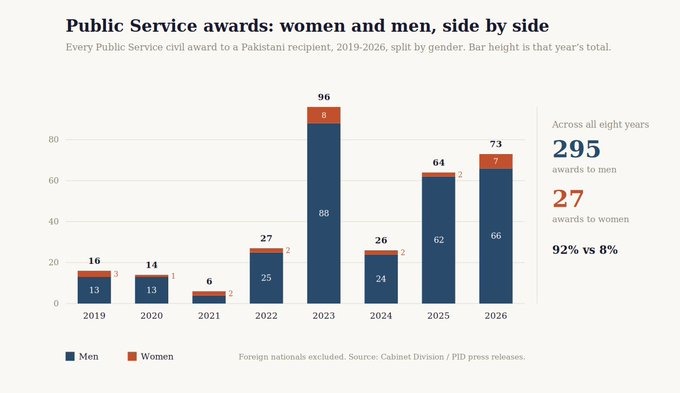
    ISLAMABAD: The number of people receiving Pakistan’s civil awards has increased sharply over the past nine years, but the share of women among the recipients has remained almost unchanged, according to an analysis by economist Zehra Farooq. Farooq, who has analysed civil award lists from 2018 to 2026, said she compiled all 2,209 awards announced during the nine-year period and examined each award by field, gender, level of award and nationality. Her analysis shows that the number of award recipients increased more than three times during the period, rising from 73 people in 2018 to 372 in 2026. However, the share of women receiving the awards did not show a similar increase. Women made up between roughly 10% and 16% of civil award recipients in each year from 2018 to 2026. Ms Farooq said the figures show that while the size of the annual awards lists changed greatly, the share of women remained within almost the same range. The lowest share was around 10% in 2023, while the highest was 16% in 2018 and 2021. The share stood at 15% in 2024 before falling to 12% in 2025 and 11% in 2026. Her analysis also looked at the figures after excluding gallantry awards. Gallantry awards were kept separate because they mainly relate to military and police roles. Even after removing these awards, the overall share of women increased only from around 12% to 14%, according to the analysis. This suggests that the low share of women is not limited to gallantry awards. Farooq said the same pattern can also be seen in civilian awards. Public service awards show a wider gap The Public Service category is the largest civilian category in the dataset and shows a particularly large difference between men and women. Among Pakistani recipients of Public Service awards, 295 were men and only 27 were women. This means men received about 92% of these awards, while women received only around 8%. Farooq noted that in several years, the entire Public Service list included only one or two women. The figures raise questions about how women are represented among people being recognised for public service. The analysis does not, however, establish why the gap exists. Farooq suggested that one possibility worth examining is whether the awards reflect the existing structure of Pakistan’s civil bureaucracy. She noted that the quota for women in the civil bureaucracy is around 10%, while the share of awards going to women remains below or around that level. This raises a question about whether the civil awards are reflecting the existing gender structure in public institutions rather than creating a separate pattern of their own. Major changes in fields The analysis also found major changes in the fields represented in the civil award lists. Science and engineering together accounted for close to one-third of the 2021 list. However, by 2025 and 2026, the two fields together made up less than 2% of the list. At the same time, some new categories appeared. Information technology appeared as a category for the first time in 2021, while climate appeared in 2025. Farooq said these changes raise questions about how the state decides which areas deserve recognition. She asked whether the decline in science and engineering awards reflects fewer major contributions in these fields, fewer people entering these professions, or a change in the areas where the state looks for achievement. The appearance of IT and climate-related awards also raises another question: whether official recognition is beginning to follow changes in the areas where Pakistan’s talent and work are growing. Women receive fewer top-level awards The analysis also examined the civil awards according to their level. The awards are divided into different levels, with Nishan and Hilal at the senior end, followed by Sitara and Tamgha. Ms Farooq found that the share of women becomes smaller as the level of the award becomes higher. At the two highest levels, women account for less than 5% of recipients. At the more common lower levels, the share of women is higher, generally ranging between 11% and 14%. This means that the overall percentage of women receiving civil awards does not tell the full story. Women may represent around 10% to 16% of all recipients in a year, but their representation becomes much smaller when only the highest-level honours are considered. The findings therefore point to two separate issues: the overall number of women receiving civil awards and the level of recognition they receive. Nine years provide a wider picture Ms Farooq said looking at the awards over several years gives a clearer picture than looking at a single annual list. The civil awards are announced every August, and each year’s list can show changes in the number and type of recipients. But when the lists are combined over nine years, longer-term patterns become visible. The biggest pattern in the data is the contrast between the rapidly growing number of awards and the almost unchanged share of women. From 73 recipients in 2018, the annual list reached 372 in 2026. Yet women remained within roughly the same 10% to 16% range throughout the period. The analysis also shows that the composition of the awards has changed in other ways, including the fields being recognised and the introduction of new categories. She said the data does not provide all the answers, but it raises questions that can be examined further.

  • | |

    Sharmila Faruqui warns of growing PPP-PML-N tensio…

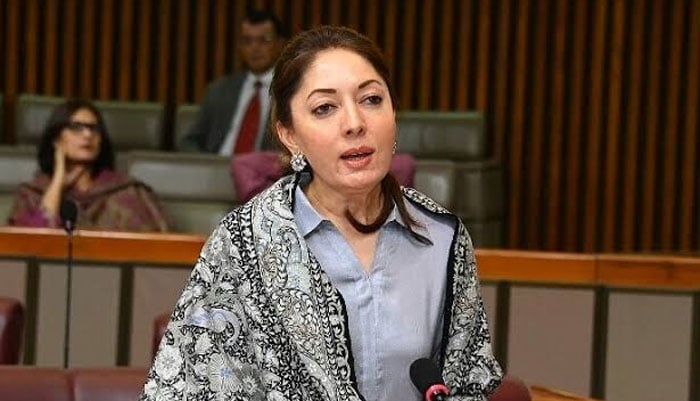
    Pakistan Peoples Party (PPP) lawmaker Sharmila Faruqui has warned that relations between the PPP and Pakistan Muslim League-Nawaz (PML-N) have become increasingly tense following the Azad Jammu and Kashmir (AJK) elections. Speaking to journalists outside Parliament, Faruqui said the situation between the two coalition partners was currently strained. She added that it was difficult to predict how the political situation would develop in the coming days. Her remarks came amid discussions over the political relationship between the PPP and PML-N and growing differences on several issues. Faruqui said the issue of creating new administrative units should be handled through Parliament. She opposed turning the matter into a debate primarily conducted through television channels. She said any proposal to create new administrative units should be formally brought before the National Assembly and the Senate. According to her, Parliament is the appropriate forum for discussing matters that could have major constitutional and administrative implications. The PPP leader stressed that such issues require detailed debate and consultation. She said lawmakers should have the opportunity to examine the proposals and discuss their possible political, administrative and constitutional consequences. Faruqui also highlighted the impact of the AJK elections on relations between the PPP and PML-N. She said the situation between the two parties had become “very tense” after the elections. She warned that the political developments could take different turns. Her comments indicate that differences between the coalition partners may become more prominent if the issues are not addressed through dialogue. The PPP and PML-N have remained key political partners at the federal level. However, differences between the two parties have surfaced on various political and administrative matters. Faruqui’s comments come at a time when the question of new administrative units has also generated political debate. The proposal has attracted attention because any major change in the administrative structure could have wider political and constitutional implications. The PPP lawmaker maintained that such a sensitive issue should not be settled through media discussions. She called for the matter to be brought before both houses of Parliament for a proper debate. Her statement also reflects the growing political uncertainty following the AJK elections, with questions emerging over the future course of relations between the PPP and PML-N.

  • | |

    New provinces needed to improve governance: speake…

    Speakers at a seminar on the creation of new provinces in Pakistan have said that establishing new administrative units could directly benefit the public. The seminar was organised by the Sustainable Development Policy Institute (SDPI) in Islamabad. MQM leader Mustafa Kamal, PPP leader Qamar Zaman Kaira and PTI Secretary General Salman Akram Raja addressed the gathering. The speakers described the creation of new provinces as necessary to address public problems. They also stressed the need for a strong and empowered local government system. The participants said Pakistan needs new administrative units to improve governance and ensure that resources are distributed at the grassroots level. Mustafa Kamal said the existing system had failed to ensure effective accountability of governments. He added that even if new provinces were created, a strong local government system would remain necessary. PPP leader Qamar Zaman Kaira suggested that the debate over creating new provinces should take place within the constitutional framework. He also called for strengthening the local government system. PTI Secretary General Salman Akram Raja said that even after the creation of new provinces, some provinces would still have populations running into millions. The speakers agreed that administrative reforms were necessary to improve governance and ensure a more effective distribution of resources among the people.