chinas change7 moon
|

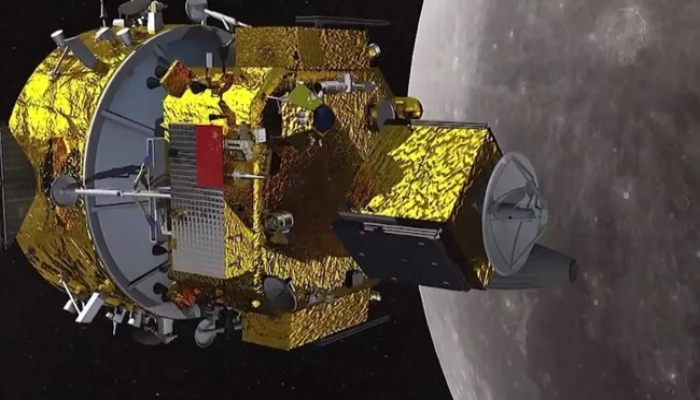
China’s Chang’e-7 Moon mission to launch on August 24

China is preparing to launch a complex, multi-spacecraft mission to the Moon. The mission will land near the Moon’s south pole and search for evidence of water and ice. The mission is scheduled to launch on August 24 from the Wenchang Satellite Launch Center on China’s Hainan Island.

According to a statement issued by the China Manned Space Agency, the Chang’e-7 mission will be launched aboard a Long March 5 rocket. The mission will focus on the Moon’s south pole and attempt to determine whether water and ice are present inside the craters as well as their quantity and other related details.

Water vapour has previously been detected in this region of the Moon through remote sensing but scientists have not yet been able to measure it directly or obtain samples. Chang’e-7 will also help lay the technological groundwork for China’s crewed lunar mission planned for 2030.

The mission will consist of an orbiter, lander, rover and hopper spacecraft. Five days after launch, the spacecraft is expected to enter lunar orbit. The orbiter will then identify and determine the target landing area.

Chinese authorities have not yet announced the exact landing date and the landing is expected to take place several months after launch. The hopper spacecraft will make multiple flights over the permanently dark craters near the Moon’s south pole.

It will also be equipped with landing legs to allow it to land and analyze the surface of the selected locations. The mission will also carry scientific payloads from several countries.

China’s Chang’e-5 mission in 2020 and Chang’e-6 mission in 2024 successfully collected lunar samples and returned them to Earth.

Similar Posts

  • MIT robot can fly and swim

    Researchers at the Massachusetts Institute of Technology (MIT) have created a unique robot that can both fly through the air and swim underwater just like diving birds. The lightweight robot costs around $300 and was designed by MIT’s AeroAquatic Robotics team.  Scientists believe it could one day help monitor oceans study marine life and support environmental protection. The robot was inspired by diving birds which use the same wings to fly in the air and move through water.  While scientists have studied these birds for years building a robot that can perform both tasks efficiently has been a major challenge. To solve this the MIT team carefully studied how diving birds move and used those findings to design the new machine. The robot called the Flapping Aerial Aquatic Vehicle weighs only 250 grams.  It runs on a battery powered motor and has nylon wings and a tail coated with water resistant nanoparticles to protect them from moisture. According to the researchers the robot is programmed to flap its wings at a specific frequency allowing it to move smoothly in both air and water without changing its basic movement. It can fly at speeds of up to 13.4 miles per hour and swim at about 2.2 miles per hour. On a single battery charge it is designed to fly as far as 6 kilometers or swim up to 2 kilometers. The robot was tested for about one year first in a water tank in Massachusetts and later in Lake Geneva Switzerland where researchers evaluated its performance in real world conditions.

  • | |

    Documentary film on the struggle for Joint Elector…

    By Yassar Talib Aiman Zameer Lahore: The Centre for Social Justice (CSJ) held a screening of its documentary film, A Separation Refused, highlighting the Movement for the Restoration of the Joint Electorate in Pakistan, at a local hotel in Lahore. The 20-minute documentary film, by the award-winning the producer and director, CSJ and Dawood Akhtar Murad, traces the culmination of the world unique Separate Electorate system in Pakistan’s history and the movement for the restoration of the Joint Electorate in Pakistan especially during the 1990s to 2001. The film chronicles the efforts of civil society organizations, political leaders, faith communities, and human rights advocates who campaigned for equal citizenship and inclusive democratic participation for religious minorities. Using historical accounts and personal testimonies, the film illustrates how sustained advocacy contributed to democratic reforms and continues to inspire efforts towards equality, pluralism, social cohesion, and the protection of constitutional rights. Featuring over a dozen interviews, it brings together insights from Hina Jilani, Cardinal Joseph Coutts, Dr. Charles Amjad Ali, Dr. Yaqoob Bangash, and other prominent voices offering diverse perspectives youth, clergy and a parliamentarian. The even also premiered a song Hum Juda Nahein (We Are Not Separate) that expressed the The screenings were followed by an interactive panel discussion explored the progress made towards equal citizenship and the continuing challenges to the democratic participation of religious minorities in Pakistan. The panelists, Wajahat Masood a public intellectual and Peter Jacob, answered the questions while the academic Faaria Khan moderated the discussion. While addressing the participants, Wajahat Masood, said that democracy is based on the principle of equal citizenship and that the categorization of citizens into majorities and minorities reflects a constitutional anomaly. Referring to the Separate Electorate system, he noted that institutionalizing such divisions weakened democratic systems and undermined the principle of equal political participation. In response to a question on the rationale behind the documentary, Peter Jacob, Executive Director CSJ, said that the importance of the movement warranted a careful reading of the history. He noted that the film was developed to preserve authentic accounts of the struggle for the restoration of the Joint Electorate and to address competing interpretations of history and misunderstandings. He also emphasized the need for constitutional reforms to strengthen equal citizenship. He called for a review of Articles 41 and 91 of the Constitution, to remove precondition of religious affiliation for the offices of the President and Prime Minister. Moreover, implementation of Article 22(1) of the constitution of Pakistan that guarantees unbiased education. In the open discussion, participants emphasized that the message of documentary film highlighting constitutional rights, democratic inclusion, should be screened more widely through universities, arts councils, mainstream media, and other public platforms to encourage informed dialogue and greater public awareness. They further stressed that equal citizenship is not solely the concern of religious minorities but a shared national responsibility, and called for greater participation and support from the majority community in future advocacy and dialogue. At the end the participants reaffirmed a shared commitment to advancing constitutional rights, equal citizenship, participatory democracy, and peaceful coexistence through collective action.

  • | |

    Iran rejects Hormuz plan as US intercepts missiles

    WASHINGTON: Regional tensions intensified on Wednesday after Iran rejected Oman’s proposal for jointly managed shipping routes in the Strait of Hormuz, while the United States said it intercepted multiple Iranian ballistic missiles allegedly launched towards American forces in the Middle East. Iranian Deputy Foreign Minister Kazem Gharibabadi said Muscat had proposed dividing the Strait of Hormuz transit route equally between Iranian and Omani territorial waters. However, Tehran instead suggested that shipping passing through Iranian waters should remain under its control, while Oman would oversee only part of the route on its side. He warned that if Oman declined the proposal, the strategic waterway would remain closed. The Strait of Hormuz is one of the world’s busiest maritime corridors and a vital route for global energy exports, making any disruption a significant concern for international trade and regional security. Meanwhile, the US Central Command announced that its forces had intercepted several ballistic missiles launched by Iran in what Washington described as an attempted surprise attack on US military personnel stationed in the Middle East. Although the exact target was not disclosed, Iranian state media reported that the Islamic Revolutionary Guard Corps (IRGC) had fired missiles at a US military base and a Central Command facility in Jordan, claiming the strikes were retaliation for recent American actions against Iranian interests. US President Donald Trump said diplomatic contacts with Tehran had shown positive signs but warned that military action could resume if negotiations failed to produce results. Iran, however, denied reports suggesting it was preparing to restart direct talks with Washington. The conflict has also spilled into neighbouring countries. Jordan confirmed that its air defence systems intercepted five missiles entering its airspace early Wednesday, marking the third consecutive day of aerial threats against the kingdom. No casualties or property damage were reported. In response to the escalating crisis, Gulf nations intensified diplomatic coordination. Saudi Foreign Minister Prince Faisal bin Farhan held separate discussions with his counterparts from Qatar, Kuwait and Bahrain, with all sides stressing the importance of reducing regional tensions and ensuring freedom of navigation through the Strait of Hormuz and the Bab al-Mandeb Strait. The ministers also condemned attacks attributed to Iran and its allied armed groups. The Gulf Cooperation Council (GCC) strongly criticised repeated attacks on Saudi Arabia, describing them as a serious violation of the kingdom’s sovereignty and a threat to regional stability. GCC Secretary-General Jasem Mohamed AlBudaiwi reaffirmed the bloc’s full support for Saudi Arabia and urged stronger regional cooperation to prevent further escalation. The European Union also expressed concern over the deteriorating security situation. EU foreign policy chief Kaja Kallas discussed Gulf tensions with Iranian Foreign Minister Abbas Araghchi, calling for renewed diplomacy while also raising concerns over Iran’s military support for Russia and the temporary detention of two French diplomats in Tehran. China appealed for restraint, urging all parties to resolve disputes through dialogue while safeguarding freedom of navigation in international waterways. Beijing reiterated its support for peaceful solutions and respect for the sovereignty of regional states. Separately, Iran’s IRGC Navy announced that it had intercepted and halted three oil tankers in the Strait of Hormuz after the vessels allegedly ignored official warnings. Iranian authorities did not disclose the ships’ identities or provide further details regarding the alleged violations. Iran also rejected accusations linking it to projectiles fired at targets inside Saudi Arabia from other countries, insisting that attributing every attack on US interests in the region to Tehran was a serious miscalculation. The latest developments highlight growing instability across the Gulf, with military confrontations, diplomatic efforts and concerns over maritime security continuing to shape one of the world’s most sensitive geopolitical flashpoints.

  • | |

    World Cup conspiracies weaponised as Javier Milei blames foreign leftists for online backlash

    Following Argentina’s defeat by Spain in the World Cup final, President Javier Milei has alleged that a coordinated, foreign-funded anti-Argentina campaign was launched to undermine his nation and its football team. The far-right libertarian president claimed during a radio interview that the US Democratic party, alongside the governments of Mexico and Brazil, financed widespread online hostility, fan racism accusations, and rumours of favorable treatment towards Lionel Messi’s squad. Milei specifically targeted Brazilian President Luiz Inácio Lula da Silva, alleging that Brazil provided the largest share of funding for these attacks, a statement he reiterated while attending a campaign launch for far-right senator Flávio Bolsonaro in São Paulo. The president’s claims come amidst online friction and high-profile international criticism, including an Instagram post by actor Samuel L. Jackson urging fans not to support Argentina due to historical racism in the country. Whilst digital communications researchers acknowledge a genuine surge of transnational hostility online, experts note there is no public evidence supporting Milei’s claims of an organised international funding plot. Instead, political analysts view the narrative as a calculated tactic to stoke culture wars and divert public attention away from domestic corruption scandals, rising unemployment, and the severe impact of his austerity measures, which have pushed the administration’s popularity to its lowest level since taking office.

  • How to get six pack Abs naturally

    Getting six-pack abs is a popular goal for many fitness lovers. However doing hard workouts alone is not enough.  A healthy diet regular physical activity proper sleep and a balanced lifestyle are also important. Reduce belly fat One of the most important steps to getting visible abs is reducing extra body fat. Your abdominal muscles may already be strong but they can remain hidden under a layer of fat. Eating a healthy diet and maintaining a balanced calorie intake can help reduce overall body fat over time. Eat more protein Protein helps the body build and repair muscles. Include protein rich foods such as eggs chicken fish beans and lentils in your diet.  A balanced diet with enough protein can support muscle growth and strength. If your goal is to lose body fat you may need to consume fewer calories than your body uses.  However extreme dieting or skipping meals is not a healthy way to lose weight. Limit unhealthy foods Try to reduce foods and drinks that are high in added sugar unhealthy fats and calories. This includes soft drinks fast food sweets and deep fried foods. Choosing fresh and nutritious foods can make it easier to manage your weight. Drink enough water Staying hydrated is also important during your fitness journey.  Drink water regularly throughout the day. The amount you need can vary depending on your age activity level weather and overall health so there is no fixed amount that everyone must drink. Exercises for stronger Abs Some useful exercises for strengthening the abdominal and core muscles include. •Planks •Crunches •Leg raises •Bicycle crunches Planks can help strengthen the core while crunches work the abdominal muscles.  Leg raises and bicycle crunches can also improve core strength. However doing only abdominal exercises cannot remove fat from the stomach area alone.  To reduce overall body fat combine strength training other physical activities and  a healthy diet. Stay consistent You do not need to spend every day at the gym to work toward six pack abs.  A workout routine that you can follow consistently for a long time is more important than exercising extremely hard for a short period. Good sleep enough rest healthy food and regular exercise all work together to help you become fitter and stronger. Most importantly focus on steady progress rather than expecting quick results.

Leave a Reply

Your email address will not be published. Required fields are marked *