fatima zahra secures
| | |

Fatima Zahra secures Pakistan’s first Commonweal…


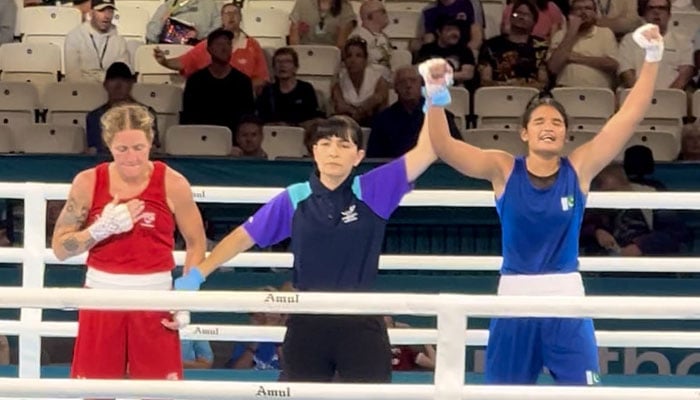
Pakistan received its first major success at the Commonwealth Games as national boxer Fatima Zahra secured a place in the women’s boxing semifinals, guaranteeing the country’s first medal of the tournament.

Competing in the women’s 60kg weight category, Fatima Zahra delivered a dominant performance in the quarterfinals, defeating New Zealand’s Jordan Wilson by a unanimous 5-0 decision. With the victory, the Pakistani boxer advanced to the semifinals and ensured at least a bronze medal for her country under the competition’s boxing format.

The quarterfinal bout took place at the SEC Hall Five in Glasgow, where Fatima Zahra displayed confidence, composure, and technical superiority throughout the contest. She controlled all three rounds with disciplined boxing, combining effective footwork, accurate punches, and strong defensive skills to keep her opponent under pressure from the opening bell until the final round.

Her impressive display left no room for doubt among the judges. All five judges scored the contest in her favor, awarding her a comprehensive unanimous decision victory over Jordan Wilson. The result marked one of Pakistan’s most significant achievements at the ongoing Commonwealth Games and provided an early boost to the country’s medal hopes.

According to the boxing competition rules, every athlete who reaches the semifinals is guaranteed at least a bronze medal, as there is no third-place playoff. By advancing to the last four, Fatima Zahra officially secured Pakistan’s first medal of the Games, regardless of the outcome of her semifinal contest.

The achievement is another milestone in Fatima Zahra’s growing international career. She has consistently represented Pakistan on the global stage and has already established herself as one of the country’s leading female boxers. Her latest success reflects both her dedication and the steady progress she has made through years of hard work and international competition.

This is not the first time Fatima Zahra has won a medal for Pakistan at a major sporting event. She previously claimed a bronze medal at the Islamic Solidarity Games, where her performances earned widespread praise and highlighted her potential to compete against some of the best boxers in the region. That experience has helped strengthen her confidence and prepared her for bigger challenges on the international stage.

Following her convincing victory in the quarterfinals, Fatima Zahra has now set her sights on the semifinal, where she will aim to continue her winning run and secure a place in the gold medal match. A victory in the next round would guarantee Pakistan either a silver or gold medal, making it one of the country’s most notable boxing achievements in recent years.

Her qualification for the semifinals has been welcomed as an encouraging moment for Pakistan’s sporting community, particularly for women’s boxing, which continues to grow despite facing limited resources and opportunities. Fatima Zahra’s success is expected to inspire aspiring female athletes across the country and demonstrate that Pakistani women can compete successfully at the highest levels of international sport.

With a guaranteed bronze medal already secured, all eyes will now be on Fatima Zahra as she prepares for the semifinal showdown. Pakistani fans will be hoping she can maintain her outstanding form, overcome her next opponent, and move one step closer to winning the Commonwealth Games title, adding another memorable chapter to Pakistan’s sporting history.

Similar Posts

  • | | | | |

    Crystal Meth and Meth Tablets Found in Phuket Courier Packages Valued at 25 Million Baht

    Phuket – On July 22nd, 2026, the Customs Department, through the Regional Customs Office 5, carried out a targeted inspection at a private courier company in Phuket. The operation was to prevent the spread of illegal substances in one of Thailand’s most prominent tourist destinations. Using X-ray screening and random checks on suspicious parcels, officers […]

  • | |

    LHC sets judges’ schedule from August 10

    The Lahore High Court (LHC) has issued the judges’ roster for the sixth week of its summer vacation. The new roster will come into effect from August 10. It will cover proceedings at the principal seat in Lahore and the court’s regional benches. According to the roster, two division benches at the Lahore Principal Seat will hear appeals from Monday. Four judges will also work as single benches and hear cases of different categories. A two-member division bench headed by Chief Justice Aalia Neelum will hear appeals of all types. Another two-member division bench headed by Justice Sadiq Mahmood Khurram will also hear appeals in different categories. Chief Justice Aalia Neelum will also hear petitions as a single bench. She will deal with applications and petitions of various kinds during the week. Justice Shahid Karim will hear civil matters. Justice Sadiq Mahmood Khurram will deal with criminal petitions. Justice Syed Ahsan Raza Kazmi will hear civil petitions of different categories. The arrangement has been made to ensure that important cases continue to be heard during the summer recess. The roster also includes arrangements for the LHC’s regional benches. Justice Ahmad Nadeem Arshad will hear cases as a single bench at the Bahawalpur Bench. Justice Khalid Ishaq will perform the same role at the Multan Bench. At the Rawalpindi Bench, Justice Sadaqat Ali Khan will hear cases as a single bench. The issuance of the roster will allow the high court to continue judicial proceedings during the sixth week of summer vacations. The scheduled benches will hear appeals, petitions and other cases according to their assigned jurisdictions.

  • |

    Buleha” faces suspension as Senate demands name change and removal of Bulleh Shah dialogue

    Islamabad: A controversy over the Pakistani film “Buleha” after a Senate committee questioned whether the movie damaged the image of legendary Sufi poet Baba Bulleh Shah by showing a character connected with violence, weapons and personal justice. During a heated discussion, Senator Pervaiz Rashid questioned how a film carrying the name of a famous symbol of peace and love was approved despite scenes and dialogues that critics said were opposite to Bulleh Shah’s teachings. The controversy intensified when members of the Censor Board admitted that some important points were overlooked during the approval process. Dr. Sultan Azam Taimuri, a senior member of the board, accepted responsibility and said the concerns raised about the connection between the fictional character and Baba Bulleh Shah should have been discussed more carefully. The committee argued that Baba Bulleh Shah was known for promoting peace, humanity and love, while the film appeared to show a character using force and weapons to fight criminals. Members questioned whether such a portrayal could create confusion among young viewers about the real message and personality of one of Punjab’s most respected Sufi poets. The debate became intense when a Senator Pervaiz Rashid asked if a film about another respected poet, such as Khushal Khan Khattak or Ghalib, showed that personality in a completely opposite way, would the Censor Board approve it. A censor board member admitted that such a film would not be acceptable and said it would be wrong to show a historical personality against their actual beliefs. The committee then questioned why the same standard was not applied to “Buleha.” The Censor Board defended its decision by saying the movie was not a biography of Baba Bulleh Shah. Officials explained that the character in the film was fictional and had no direct connection with the real life of the Sufi poet. They said the board considered the movie a fictional story and believed the name alone was not enough reason to stop its release because Bulleh Shah himself used the word “Bullah” in his poetry. However, the committee pointed out that the board’s explanation created confusion. Members questioned how the film could have no connection with Bulleh Shah but still use a name and dialogue strongly linked with him. The discussion became more serious when Dr. Sultan admitted that the committee’s concerns had a point. He said the board did not discuss this angle properly at the time of approval and accepted responsibility. He also admitted that a dialogue in the film where the character compares himself with Bulleh Shah could be controversial. Another Censor Board member, Syed Farooq Hassan, also accepted that the board overlooked this perspective. He said the board knew Baba Bulleh Shah’s teachings were completely different from the violence shown in the film, but members believed the character was fictional and not based on the actual life of Bulleh Shah. The board members also explained that Pakistan’s film industry was already struggling, and they wanted to support local movies within acceptable limits. They said promoting cinema was also one reason behind their decision. The committee, however, questioned whether supporting the film industry should come before protecting the image of respected cultural and historical figures. During the meeting, criticism was also directed at the writer of the film. Members questioned whether being a successful film writer was enough qualification to handle the story of a major historical and spiritual personality. They argued that the writer’s fame came mainly from action based films and said success in commercial cinema does not automatically mean expertise in history, culture or the lives of national figures. One committee member strongly criticised the idea of approving a film simply because it was written by a famous writer. He said the writer was known for introducing violent action elements in films but was not known as an expert on Sufi personalities or Pakistan’s cultural traditions. The committee also rejected the argument that other provincial censor boards had already approved the film. Officials said Punjab and Sindh censor boards had approved the movie without cuts, and it had also been aired on Local TV. However, committee members said approval by other boards did not remove the responsibility of reviewing the film’s impact. The discussion also raised questions about the knowledge and background of Censor Board members. Members suggested that people approving films about major personalities should have knowledge of history, literature, culture and society. They said the selection criteria for board members should ensure they understand how films can influence children and families. The committee argued that showing respected personalities incorrectly could affect how younger generations understand their history. At the end of the meeting, the committee made a strong recommendation regarding the film. The committee suggested that the film name should be changed and the dialogue in which the character calls himself Bulleh Shah should be removed. It further recommended that the film’s exhibition licence should remain suspended until these changes are made and that online versions should also be removed if available. The Senate Standing Committee on Information and Broadcasting has also included the film “Buleha” issue in its upcoming agenda, calling Censor Board members and producers to explain the certification process and the discussions behind the film’s approval.

  • | | |

    Uganda backs sending troops to planned Gaza peace …

    Uganda’s Parliament has approved a government proposal to deploy troops to a planned international peace and stabilisation force for Gaza, marking the country’s first commitment to the proposed multinational mission. The resolution was introduced by Uganda’s Minister of Defence and received parliamentary approval following debate among lawmakers. With the decision, Uganda joins Morocco, which has also announced its willingness to contribute troops to the proposed force. The Ugandan government has not publicly disclosed the diplomatic discussions or political considerations behind its decision. However, the move sparked debate in Parliament, with opposition members expressing concerns about the potential implications for Uganda’s foreign policy and regional relationships. Opposition lawmaker Hassan Kiromera questioned the mission’s objectives, asking which parties Ugandan troops would ultimately be expected to confront if deployed. He argued that the government should provide greater clarity regarding the mandate of the proposed force before committing military personnel. Defence Minister Jacob Oboth-Oboth defended the proposal, stating that the Uganda People’s Defence Forces (UPDF) possess extensive experience in international peacekeeping operations, including missions in Somalia and other conflict zones. He said that this experience would enable Ugandan troops to contribute effectively to efforts aimed at restoring peace and stability in Gaza. According to the report, the proposed Gaza International Stabilisation Force is expected to consist of approximately 20,000 personnel from multiple countries. The force is reportedly planned under a proposal associated with US President Donald Trump’s Board of Peace and would be commanded by US Major General Jasper Jeffers. The mission is intended to help maintain law and order in Gaza following the end of hostilities between Israel and Hamas. Reports indicate that the proposal was first introduced earlier this year as part of broader discussions on post-conflict governance and security arrangements in the territory. The development follows recent announcements regarding a reported agreement under which Hamas would disarm and Israel would gradually withdraw its military forces from Gaza. Under the reported framework, the international stabilisation force would be deployed after the phased Israeli withdrawal. However, uncertainty remains over the implementation of the proposed arrangement. Israeli officials have reportedly expressed serious security concerns after reviewing the reported agreement, arguing that certain provisions could pose risks to national security. As a result, questions remain about the timeline and conditions for the deployment of the multinational peace force despite Uganda’s parliamentary approval.

  • |

    British funeral director sentenced to 20 years in prison for fraud and desecration of remains

    Former funeral director Robert Bush, 48, has been jailed for 20 years at Hull Crown Court after pleading guilty to 67 criminal charges. The charges include preventing a lawful and decent burial, fraud by false representation, fraudulent trading, and theft, spanning a period of nearly 12 years at Legacy Independent Funeral Directors in Hull, East Yorkshire. The police investigation, launched in March 2024 following a report from a casual worker, uncovered 35 decomposing bodies left uncovered and un-cremated at the business’s Hessle Road premises. Investigators revealed that Bush had repeatedly provided grieving relatives with ashes belonging to strangers, including delivering young adult remains to the parents of a stillborn baby whose body was discovered stored in a paper bag on site. Bush also stole thousands of pounds in charitable donations collected from mourners at memorial services. Presiding Judge Nicholas Hilliard described Bush’s actions as “heartless” and motivated by greed, noting that his crimes caused pain and anguish on an incomprehensible scale. Alongside the 20-year custodial sentence, Bush has been banned from acting as a company director for 14 years. The severe failure has prompted renewed demands across the United Kingdom for stricter statutory regulation of the funeral industry.

  • |

    Trump’s Board of Peace plan draws global attention and criticism

    United States President Donald Trump has announced that his Board of Peace has secured an agreement aimed at the complete disarmament of Hamas and other armed groups in Gaza, along with the gradual withdrawal of Israeli forces from the territory. Trump described the agreement as a historic breakthrough and said it would be carried out in stages, with Israeli troops leaving Gaza as disarmament progresses. The Board of Peace was first proposed by Trump in September last year as part of his plan to end the war in Gaza. He later expanded the initiative, saying it would also work to address conflicts in other parts of the world. The board is intended to coordinate peace efforts and oversee reconstruction projects, a role that has traditionally been led by the United Nations. According to its charter, countries joining the board normally serve three year terms. However, nations that contribute one billion dollars toward its activities are eligible for permanent membership. Trump serves as chairman of the initiative and has broad executive authority, including the power to veto decisions and remove members under certain conditions. The White House named Secretary of State Marco Rubio, special envoy Steve Witkoff, former British Prime Minister Tony Blair and presidential adviser Jared Kushner as members of the board’s founding executive team. More than two dozen countries have joined the initiative. Alongside the United States, members include Israel, Saudi Arabia, Egypt and Qatar, all of which have played important roles in recent Middle East diplomacy. Other participating countries include Bahrain, Jordan, Kuwait, Morocco, Turkey and the United Arab Emirates. Outside the region, Albania, Argentina, Armenia, Azerbaijan, Belarus, Bulgaria, Cambodia, El Salvador, Hungary, Indonesia, Kazakhstan, Kosovo, Mongolia, Pakistan, Paraguay, Uzbekistan and Vietnam have also joined. Several major countries and international partners have declined to participate. Britain, France, Germany, Norway, Sweden and the European Union have all decided not to join the initiative. Brazil, Mexico, India and South Africa have also remained outside the board, while China and Russia have chosen not to participate. The Vatican has argued that responsibility for handling international conflicts should remain with the United Nations. Canada also lost its invitation after a diplomatic disagreement between Trump and Prime Minister Mark Carney earlier this year. The Board of Peace received international recognition after the United Nations Security Council approved a United States drafted resolution acknowledging its temporary role in Gaza. Under the resolution, the board will coordinate funding for reconstruction and oversee a temporary international stabilisation force in Gaza through 2027. It must also report its progress to the Security Council every six months. China and Russia abstained from the vote, saying the resolution did not clearly define the United Nations’ role in Gaza’s future administration. Despite official backing, the initiative has attracted widespread criticism from human rights organisations and political observers. Critics argue that the board resembles a colonial style governing structure because it is designed to supervise Gaza without including Palestinian representatives. They have also questioned the inclusion of Tony Blair because of his role in the Iraq war and criticised the participation of countries with poor human rights records. The decision to include Israel on a body responsible for overseeing Gaza has generated additional controversy. Opponents argue that Israel’s ongoing military campaign has left much of Gaza destroyed and displaced its population. Israel maintains that its military actions were carried out in self defence following the Hamas attack in 2023 that killed around 1,200 people and resulted in more than 250 hostages being taken. Since its launch, the Board of Peace has focused mainly on plans for rebuilding Gaza. Trump said member countries have already pledged around seven billion dollars toward reconstruction, although experts estimate that restoring the territory after more than two years of conflict could cost as much as 70 billion dollars. The board has also reportedly held discussions with international companies on future infrastructure and supply chain projects as planning for Gaza’s recovery continues.

Leave a Reply

Your email address will not be published. Required fields are marked *