field marshal asim
| |

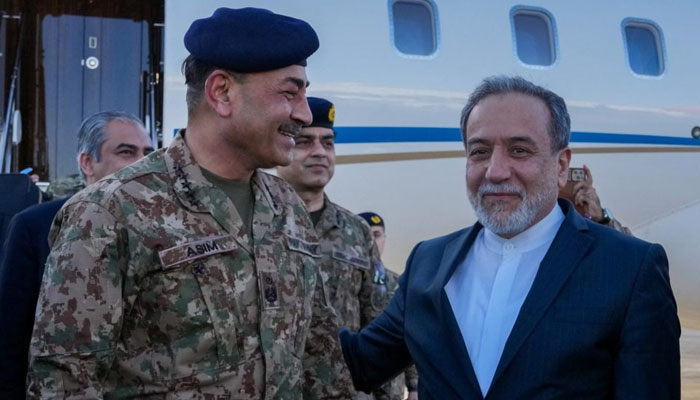
Field Marshal Asim Munir, Iranian foreign minister…

Pakistan’s Chief of Defence Forces, Field Marshal Asim Munir, held a telephone conversation with Iranian Foreign Minister Abbas Araghchi, during which the two officials discussed the evolving situation in the region.

According to Iranian media, the conversation took place a day earlier and focused on regional developments and matters of mutual interest.

Meanwhile, Iranian Foreign Ministry spokesperson Esmail Baghaei said that Field Marshal Asim Munir is scheduled to visit Iran on Monday.

Baghaei described the visit as part of Pakistan’s continued efforts to promote peace and stability in the region. He said the visit would also provide an opportunity to further strengthen relations between Pakistan and Iran.

During his visit, the Pakistani Chief of Defence Forces is expected to meet senior Iranian officials and hold discussions on bilateral ties as well as regional developments.

The upcoming visit comes amid heightened regional tensions and growing diplomatic efforts by countries in the region to promote dialogue and stability.

The telephone conversation between Field Marshal Munir and Araghchi ahead of the visit is expected to provide further momentum to bilateral engagement between Islamabad and Tehran.

Pakistan and Iran share close geographical, economic and security ties, with both countries regularly discussing border security, regional developments and broader cooperation.

Similar Posts

  • | |

    China leans on AI forecasting tools as Typhoon Dol…

    China has ramped up investment in artificial intelligence powered weather forecasting as the country works to track a rising number of natural disasters and predict extreme weather events such as powerful typhoons, intense rainfall and prolonged heatwaves tied to climate change. The country has positioned itself as a leading force in data driven meteorology, increasingly running AI systems alongside traditional forecasting methods rather than replacing them outright. As meteorologists monitored Typhoon Dolphin’s approach toward China in recent days, a newer generation of AI weather models operated in parallel with conventional forecasting systems, underscoring China’s expanding role in the broader push to improve storm prediction. Unlike standard numerical weather models, which depend on powerful supercomputers to simulate the physics of the atmosphere, AI based systems instead learn from decades of historical weather data. That approach lets them generate forecasts within seconds or minutes while using only a small fraction of the computing power traditional methods require. According to a state affiliated newspaper, some of China’s most prominent AI forecasting tools include Fengwu, built by the Shanghai AI Laboratory, Huawei’s Pangu Weather system, and Fuxi, developed at Fudan University. These models are increasingly being put through real world testing during East Asia’s intense typhoon season, a period when even modest improvements in tracking a storm’s path can help authorities plan flood responses, coordinate evacuations and manage disruptions to transportation networks. Fengwu in particular has shown strong results in predicting storm trajectories, with researchers noting that AI based systems can produce forecasts far faster than conventional models while matching or, in some cases, surpassing them on certain accuracy measures. The rapid progress in AI driven weather forecasting has sparked growing competition among technology firms, research institutions and national meteorological agencies worldwide, with China establishing itself as one of the sector’s most active players. Even so, meteorologists caution that AI tools currently serve as a complement to physics based forecasting rather than a full replacement. These systems still struggle to accurately capture sudden shifts in storm intensity, and they remain largely untested when it comes to long term climate modeling. As a result, traditional forecasting methods are expected to remain a core part of weather prediction for the foreseeable future, even as AI tools continue to mature and take on a larger role alongside them. The push toward AI assisted forecasting fits into a broader global trend, as governments and research institutions increasingly explore machine learning as a tool for anticipating the growing frequency and intensity of extreme weather linked to a changing climate.

  • | |

    Pakistan exports rise 13.1% to $3.94 billion in Ju…

    ISLAMABAD: Pakistan’s exports of goods and services rose by 13.1 percent year-on-year to $3.94 billion in July 2026, providing an encouraging start to the new fiscal year and signalling continued improvement in the country’s external sector. Federal Minister for Planning, Development and Special Initiatives Ahsan Iqbal shared the figures on Saturday while presenting the Monthly Development Update for August 2026. He said exports stood at $3.48 billion in July 2025, meaning the latest increase reflects stronger performance across several major export categories. According to the minister, merchandise exports increased by 9.4 percent to around $3 billion in July 2026 from $2.8 billion a year earlier. When services exports are included, the combined figure reached approximately $3.9 billion, compared with $3.5 billion in July last year. Key export sectors show growth Ahsan Iqbal said the improvement in exports was supported by higher shipments across several important sectors. Surgical goods recorded the strongest growth among the highlighted export groups, increasing by 16.3 percent. Food exports rose by 8 percent, while leather goods registered growth of 7.8 percent. Textile exports, one of Pakistan’s largest sources of foreign exchange, also increased by 3.9 percent during the month. The minister said the figures indicated that Pakistan’s external sector had started the new fiscal year on a positive trajectory, although maintaining this momentum would require continued reforms, improved competitiveness and greater diversification of export products and markets. Manufacturing sector stages strong recovery The positive external-sector performance coincided with a broad-based recovery in domestic industrial activity. According to Ahsan, Large-Scale Manufacturing (LSM) expanded by 5 percent during fiscal year 2025-26, reversing a 0.74 percent contraction recorded in the preceding fiscal year. He said the recovery was spread across the industrial sector, with 16 of the 22 LSM sectors registering positive growth. The automobile sector posted the highest increase at 57.8 percent, followed by transport equipment at 42.4 percent. Electrical equipment production grew by 14.3 percent, tobacco by 12.6 percent and food manufacturing by 7 percent. The figures, he said, reflected an improvement in industrial activity and could provide support to investment, employment and overall economic growth if the recovery remains sustained. FBR collection, remittances improve The government also reported improvement in tax revenues at the beginning of FY2026-27. Federal Board of Revenue tax collection increased by 8.4 percent to Rs820.9 billion in July 2026, according to the minister. He said stronger revenue mobilisation, together with fiscal discipline, was helping improve the country’s overall financial position. Workers’ remittances also remained a major source of support for Pakistan’s external account. Remittance inflows reached $3.63 billion in July 2026, up 13 percent from approximately $3.2 billion in the same month of 2025. Ahsan said the latest increase followed record remittances of $41.6 billion received during the previous fiscal year. He noted that remittances not only strengthened Pakistan’s foreign exchange position but also provided direct financial support to millions of households across the country. Current account deficit remains contained Despite continued pressure on the external account, the current account deficit remained relatively contained. The deficit stood at $328 million in July 2026, compared with $529 million during the same month of the previous year. The minister described the development as another indication of improved external-sector stability. He also highlighted the growing contribution of Pakistan’s technology sector. Information and Communication Technology exports reached $417 million in July 2026, underlining the increasing role of digital services in generating foreign exchange. The government has been seeking to expand technology exports as part of a broader strategy to diversify Pakistan’s sources of external earnings beyond traditional sectors such as textiles and agricultural products. Inflation moderates Ahsan Iqbal also pointed to a moderation in consumer price pressures at the start of the new fiscal year. Consumer Price Index inflation eased to 9.2 percent in July 2026, compared with 11.7 percent in May 2026. The minister said the decline suggested that inflationary pressures were beginning to moderate. He added that changes in the year-on-year inflation rate were also influenced by base effects as well as the impact of international food and energy prices. The government is aiming to maintain price stability while supporting economic activity and protecting the purchasing power of households. Fiscal position strengthens The planning minister said Pakistan’s fiscal position had also improved significantly during FY2025-26. The fiscal deficit narrowed to 2.6 percent of GDP from 5.4 percent in FY2024-25. According to Ahsan, this represented the lowest fiscal deficit recorded in two decades. He said stronger fiscal management would remain essential during FY2026-27 as the government seeks to maintain macroeconomic stability while creating room for development spending and economic expansion. Development spending and job creation Public investment is another major component of the government’s economic strategy. Projects approved during July 2026 are expected to create around 7,851 direct jobs and 14,053 indirect employment opportunities across different sectors. The minister said employment generation would remain an important objective of development planning, particularly as the country seeks to create greater opportunities for its young population. He said Pakistan had undergone a difficult period of economic adjustment and that the stability achieved in recent years had required significant effort. Under the government’s URAAN Pakistan initiative, the next phase would focus on converting macroeconomic stability into long-term economic transformation, with exports positioned as a key driver of growth. According to Ahsan, higher exports could help generate employment, increase household incomes, expand opportunities for young people and improve living standards. Rs211.3 billion authorised for development projects The Ministry of Planning authorised Rs211.327 billion, equivalent to 21.1 percent of the relevant allocation, during July 2026 to facilitate timely financing for priority development projects. The minister said the move was aimed at ensuring that strategically important schemes received funding without unnecessary delays. During July, the Central Development Working Party (CDWP) also reviewed a number of development proposals. It approved nine projects, three position papers and one concept clearance proposal, while nine projects were recommended for consideration by the Executive Committee of the National Economic Council (ECNEC). Three projects were deferred, while

  • Thai PM Anutin Suspends Gun Purchase Licences After School Shooting

    BANGKOK, Thailand – Prime Minister Anutin Charnvirakul on Tuesday suspended the issuance of permits to buy firearms and said existing licences would be reviewed, days after a 14-year-old gunman killed nine people in a school shooting in Nonthaburi. Eight Dead and At Least 22 Injured in Nonthaburi School Shooting, Grandparents Killed Mr Anutin directed Deputy […]

  • | |

    Rs4.21bn collected, thousands await housing

    Islamabad: The Senate Standing Committee on Housing and Works raised serious concerns over delays in major federal housing projects, where thousands of allottees have waited years for possession of their plots and apartments despite making payments. The committee decided to summon the Chairman of the National Accountability Bureau (NAB) in its next meeting to brief it on investigations, inquiries and legal issues related to delayed housing projects managed by the Federal Government Employees Housing Authority (FGEHA). The decision came after lawmakers expressed frustration over the long delays in the Green Enclave I project in Bara Kahu, Islamabad, where some allottees have reportedly waited years for possession after making payments for many years. The Senate committee, chaired by Senator Nasir Mehmood, reviewed the progress of several housing schemes and questioned why projects launched for public sector employees and other members had remained incomplete for such a long period. During the briefing, officials informed the committee about the status of housing schemes managed by FGEHA and the PHA Foundation. While reviewing the Green Enclave I project in Bara Kahu, the committee learned that land acquisition started in 2009 and the project covers around 3,375 kanals. Members expressed concern that despite a construction agreement being signed in 2019, physical development work remains suspended due to disputes related to contracts, work execution and security requirements. The committee was told that many allottees had been making payments since 2008 but had still not received physical possession of their plots. Lawmakers questioned how citizens could continue waiting for years after fulfilling their financial responsibilities. Housing officials informed the committee that development work could restart after approval from the relevant board once contractual disputes are resolved. However, members expressed dissatisfaction over the continued delay and decided to seek answers from NAB regarding the matter. The committee also reviewed the Green Enclave II or Sky Garden Housing Scheme located in Mauza Kathar and Mauza Mangal. Officials informed the committee that the project covers around 7,300 kanals and that more than 2,455 consent notices have been issued. The committee was informed that over Rs4.21 billion had been collected from members under different categories. Officials said land related issues in Mauza Kathar had been resolved, while the court decided legal disputes regarding Mauza Mangal in favour of FGEHA in April 2026. The committee reviewed the expected development timeline and was informed that block wise plot handovers are planned between December 2026 and March 2027. To remove administrative delays, the committee decided to call the Deputy Commissioner Rawalpindi for a detailed briefing in the next meeting. The committee also examined the EHFPRO Lifestyle Residency Apartments project in Sector G 13, Islamabad. Officials informed lawmakers that around 70 percent of the physical work had been completed, but the project faced serious problems due to rising construction costs after COVID 19, financial difficulties and the death of the private contractor. Following repeated violations, the joint venture agreement was terminated and FGEHA took control of the project. Officials said they are now trying to restart the project through a Public Private Partnership model to avoid placing additional financial pressure on allottees. The committee was informed that the project’s planning approval has been completed and the process to select a new partner is underway. Members directed the ministry to provide regular updates on the progress of the project. The Senate committee also reviewed the PHA F Residencia Project on Kuchlak Road, Quetta, and other government housing facilities. Officials informed the committee that the Quetta project has achieved around 50 percent physical progress. They said construction work has progressed on houses and apartment blocks, while additional units are being processed through new tendering. The committee also reviewed maintenance work at Federal Lodges and noted improvements in cleaning, repairs, and electrical work. Members discussed issues faced by residents, including water supply, drainage and basic facilities at some housing schemes. Officials informed the committee that discussions were ongoing between housing authorities and residents’ representatives to solve these problems. The committee also reminded residents that any unauthorised changes in buildings must be regularised through the Capital Development Authority. Senator Nasir Mehmood stressed that housing projects involving public money must be completed on time and that the rights of allottees must be protected. The committee said delays in public housing schemes create financial and emotional difficulties for citizens and directed relevant departments to improve transparency and speed up development work.

  • | | |

    Trump cuts military drills with South Korea over I…

    WASHINGTON: US President Donald Trump has expressed frustration with South Korea after Seoul declined to join Washington’s campaign against Iran, ordering the Pentagon to reduce joint military exercises with Seoul. Trump said he recently asked South Korea’s president whether the country wanted to participate in efforts to denuclearise Iran, but received a blunt response: “No, thank you.” The US president said he instructed Defence Secretary Pete Hegseth to cut back the military exercises with South Korea. Although the drills had already begun, Trump said it was too late to cancel them completely and criticised the decision to proceed with exercises he considers costly. The Ulchi Freedom Shield exercise began on Monday and is scheduled to continue through Aug 27. About 18,000 South Korean troops are taking part, with training focused on cyber and drone threats. Trump also argued that the exercises send an “inappropriate and hostile” message to North Korea. He pointed to his relationship with North Korean leader Kim Jong Un, saying Pyongyang had not posed a threat to the United States during his presidency and had maintained a respectful attitude. The decision has raised questions about the future of the US-South Korea alliance. Washington and Seoul regard joint military exercises as a crucial part of maintaining readiness and deterring North Korean aggression. Trump’s latest comments suggest the alliance could face pressure as his administration reshapes US military commitments and seeks stronger allied support for its Middle East policies. South Korea has proceeded with the scheduled exercises, while the move to scale them back could fuel debate over regional security and Washington’s long-term commitment to the Korean peninsula.

  • |

    TTP-linked suspect arrested in Karachi joint operation, weapons and explosives recovered

    KARACHI: Pakistan Rangers (Sindh), in coordination with the Counter Terrorism Department (CTD), have arrested a suspected militant allegedly affiliated with the Tehreek-e-Taliban Pakistan (TTP) during an intelligence-based operation in Karachi, according to the Rangers spokesperson. The security agencies also recovered weapons and explosives from the suspect, who was allegedly involved in collecting funds for a TTP-linked faction and transferring money to its leadership, the spokesperson said on Sunday. The suspect was identified as Shahzad alias Dunger and was taken into custody during a joint operation conducted in the Jacob Lines area of Jamshed Town. Suspect allegedly joined TTP-linked group in 2025 According to the Rangers, Shahzad became associated with the Mansoor group of the TTP in 2025 after allegedly being influenced by the group’s leader, Mansoor. Investigators believe that the suspect was subsequently assigned the task of generating financial resources for the organisation in Karachi. The Rangers spokesperson said Shahzad allegedly approached individuals in the Manghopir area and persuaded them to make regular monthly payments to the militant group. The collected funds were then allegedly transferred to Waziristan through Easypaisa accounts provided by Din Muhammad, an alleged associate of Mansoor who was based in Tank. During interrogation, Shahzad reportedly told investigators that the money was ultimately transferred to Mansoor and used to support the group’s militant activities. Alleged meetings with militant leader The Rangers said the suspect had travelled to Waziristan several times and held clandestine meetings with Mansoor. According to the investigation, Shahzad allegedly met Mansoor in Birmal in June 2026, where he was instructed to expand and strengthen the group’s network in Karachi. The alleged objectives included carrying out terrorist activities and raising money through extortion, the Rangers said. Following the meeting, Mansoor allegedly arranged for weapons and explosives to be delivered to Shahzad through another unidentified associate. Security officials said the recovered material was allegedly intended for use in planned attacks against sensitive installations and locations in Karachi. Raids launched to trace other suspects The Rangers said further investigations were underway and raids were being conducted at different locations to identify and arrest other members of the suspected network. The operation comes amid continued efforts by law-enforcement and security agencies to disrupt militant financing, recruitment and operational networks in Karachi. Officials have increasingly focused on financial channels used by militant organisations, as investigators seek to prevent funds from reaching groups involved in terrorism. Karachi has witnessed several major security incidents The latest arrest comes against the backdrop of a series of major terrorist and militant attacks in Karachi in recent years. On June 28, security forces foiled an attempted attack on a Pakistan Rangers (Sindh) camp in the city. Three Rangers personnel were killed and four others were injured in the incident. According to the military’s media wing, the assault was carried out by militants described as “Khwarij belonging to Indian proxy, Jamaat-ul-Ahrar”. The attackers reportedly detonated an explosive at the main gate of the Rangers camp before attempting to penetrate the security perimeter. Security personnel resisted the assault, killing three attackers and capturing another militant in an injured condition. The captured suspect was identified as an Afghan national. The incident was described as one of the most serious attacks targeting security personnel in Karachi in recent years. Previous attacks raised security concerns Karachi has experienced several significant security incidents over the past few years, highlighting the continuing challenges faced by law-enforcement agencies in the country’s largest city. In April 2022, a suicide bombing outside Karachi University’s Confucius Institute killed several people, including Chinese nationals. The attack was claimed by the Baloch Liberation Army (BLA). In February 2023, militants launched an assault on the Karachi Police Office, leading to a prolonged security operation before the attackers were neutralised. Another major incident occurred in October 2024, when a bombing near Karachi Airport targeted a convoy and killed several people, including Chinese engineers. The incident further intensified concerns over the security of foreign nationals and critical infrastructure in the city. Against this backdrop, security agencies have continued intelligence-based operations aimed at dismantling militant networks before they can carry out attacks.

Leave a Reply

Your email address will not be published. Required fields are marked *