‘Floating’ money: Did the Dutertes use manager’s checks to hide wealth off bank balances?
A mischievously simple theory put forward by the prosecution: Could you move tens of millions of pesos out of a bank account through manager’s checks before year-end, leave the checks unused, and make the account balance look smaller without actually letting go of your wealth?
That is why P96 million in “floating” manager’s checks drew so much attention during the lengthy examination of Bank of the Philippine Islands (BPI) records involving Vice President Sara Duterte and her father, former president Rodrigo Duterte, on Wednesday, October 7.
BPI division head for central Metro Manila branches Marwin Galvez confirmed that two joint time deposits worth around P41 million and P55 million were later converted into manager’s checks.
“A similar time deposit that became a manager’s check in the amount of P55 million was also running during the same years, simultaneously with this P41 million. It’s a total of P96 million,” private prosecutor James Bryan Ibrahim Alih said.

Manager’s checks for ‘reverse window dressing’
A quick refresher on how manager’s checks (MCs) work. Once a manager’s check is issued, the amount is taken out of the customer’s deposit account and moved to the bank’s settlement account to ensure the check is funded. While that check remains outstanding, the money won’t be reflected in the customer’s bank balance anymore. If it goes unused, the purchaser may later return the unutilized check and get the money back.
Alih called the money “floating,” and when asked by Senator-judge Panfilo Lacson if the prosection was trying to establish a “pattern aimed at proving concealment,” Alih said yes.
Senator-judge Tito Sotto even had a more colorful name for the financial sleight of hand. Citing a banker friend, he said the supposed scheme was called “tinikling” a Philippine folk dance where a dancer goes in and out of moving bamboo poles, although the BPI division head himself said he had never heard the term used in banking.

The prosecution’s forensic financial expert, former PwC Philippines chairman Alexander Cabrera, later put the same label on what he saw in the records. He described the movement of the P41-million and P55-million amounts as money “nagtitinikling,” or a variation of check kiting.
Cabrera said the manager’s checks were made payable to the depositor but were not deposited. Instead, according to his analysis, they were allowed to become stale so the cash could eventually flow back into the account.
The result was that the money could be there during the year, disappear from the ending balance, then come back later.
“Kaya ako po ginamit po yung word na tinikling is hindi po naiipit sa year-end yung pera. Lumalabas po siya at bumabalik,” Cabrera said on Friday, October 9. “Pero lagi po wala siya sa year-end balances po.”
(The reason why they call it tinikling is because the money doesn’t get caught at the year-end. It goes in and out, but it’s always not in the year-end balances.)

Cabrera also emphasized that manager’s checks do not earn interest. The PwC Philippines chairman emeritus questioned why tens of millions of pesos would be pulled out in that way instead of being kept in an interest-earning placement, especially since the same amounts had previously been placed in time deposits.
But is it actually normal for wealthy clients to buy large manager’s checks and then leave them unused?
Red flags
Rappler asked a senior executive in the wealth management sector about the practice generally. The executive said clients have different reasons for getting manager’s checks, but “usually it’s deposited or paid immediately.”
Rappler has also asked a high-ranking Bangko Sentral ng Pilipinas official about safeguards for manager’s checks that remain outstanding for long periods. The official said they were willing to comment, but Rappler had not received a response as of writing.
Global tax policy expert Mon Abrea was even clearer.
“No, it is not common practice. Manager’s checks are generally issued for specific payments, not to temporarily park funds,” he told Rappler.
From an accounting perspective, if an outstanding check has not actually paid anyone and the purchaser still retains ownership or a recoverable claim, Abrea said the amount remains an asset even though the deposit account has already been debited.
“Repeatedly issuing and cancelling manager’s checks around year-end could therefore raise red flags of reverse window dressing, making bank balances appear smaller without actually reducing wealth,” he said.
If a manager’s check paid a loan, it should reflect in the reduced amount of liability. If it bought an investment, the asset changes form. So what happens if a manager’s check remains unencashed?
“Substance over form – it is still cash to be added back to bank balance so sa (in the) total cash, it should still be there,” he told Rappler.
All this goes back to the discussion of the Vice President’s Statements of Assets, Liabilities and Net Worth (SALN).
Senate President Sherwin Gatchalian said he checked Sara Duterte’s 2010 and 2011 SALNs – back when she was still vice mayor and then mayor of Davao City – and could not find the P96 million in joint time deposits reflected there.
Cabrera likewise testified that his review found no proportionate declaration in Duterte’s 2010 SALN corresponding to the P41-million and P55-million time deposits. He also said that the amounts seemed to “unwind” in 2014, with around P80 million eventually going into four P20-million insurance payments, while roughly P16.4 million to P16.5 million remained in the account, according to his analysis.
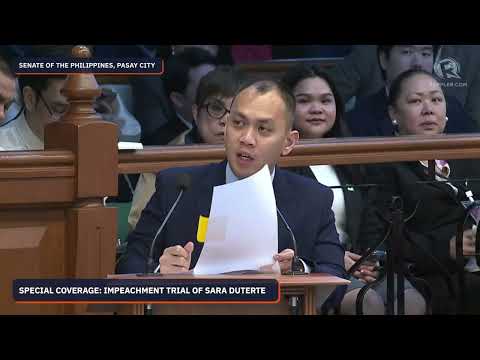
The defense, however, stressed that the documents presented in court carried Rodrigo Duterte’s signature, not Sara’s. Her lawyer Michael Poa said the Vice President did not recall the account, while BPI testimony showed her father could transact on the joint account without her participation. (READ: Is Sara Duterte unaware of BPI accounts with father Rodrigo?)
This was actually not the first time manager’s checks came up in the BPI money trail. Several MCs also appeared in records tied to a separate controversy involving BPI’s request for the Anti-Money Laundering Council (AMLC) to delete 13 transaction reports after what the bank called a “system bug” inflated transaction records involving Sara Duterte’s husband, Manases Carpio. The inaccurate amounts triggered covered transaction reports. – Rappler.com