senate questions 387
|

Senate questions $387 million ADB water project allocation

Islamabad: The Senate Standing Committee on Economic Affairs raised serious concerns over inequities in the allocation of foreign funded development projects across Khyber Pakhtunkhwa, revealing that flood affected districts have been largely bypassed while relatively unaffected areas received more infrastructure funding.

The meeting, chaired by Senator Saifullah Abro, highlighted discrepancies in road and irrigation project implementation, questioned external pressures from international lenders, and warned that mismanagement could exacerbate Pakistan’s mounting national debt, which has soared from Rs40 trillion in 2022 to approximately Rs90 trillion today.

During the session, committee members expressed alarm that districts most devastated by floods, including Upper Dir, Lower Dir, and Chitral, received fewer road reconstruction projects compared to Mardan, which saw 16 roads built despite experiencing minimal flood damage. In Dir, only 12 kilometres of road were reconstructed despite extensive damage.

Similarly, nine roads were completed in Peshawar, a city that did not face flood related destruction. Senator Rubina Khalid termed this “inequitable allocation” and warned that such disparities hinder balanced regional development, while Senator Waqar Mehdi questioned whether donor agencies were being misled about project priorities.

The committee also scrutinized the financial management of foreign funded schemes. Officials reported that 770 kilometres of roads were constructed at a total cost of Rs69 billion, with an additional Rs43 billion spent on bridges and related infrastructure. Each kilometre of road cost approximately Rs70 million.

The Asian Development Bank supported KP Road Rehabilitation and Upgradation Project, covering 249.5 kilometres, was completed ahead of schedule at a cost of $146.2 million. Similarly, $387 million in ADB funded water projects and $295 million from the World Bank are being implemented in irrigation and flood protection schemes across Khyber Pakhtunkhwa.

While project completion rates were impressive, reaching 100 percent for most schemes, the committee raised concerns about undue interference by external entities. Chairman Saifullah Abro questioned the role of the World Bank’s local representative in the Sindh Water and Agriculture Transmission Project, noting that the lender should only finance and recover loans, not dictate project execution. He estimated that resisting unnecessary external pressures could save Sindh around Rs14 billion and cited previous instances where committee intervention prevented $890 million in unwarranted costs on the Peshawar Torkham project.

The committee underscored the need for transparency, calling for a clear distinction between grants and loans and insisting that provincial authorities ensure funds are spent only for their approved purposes. Senator Hidayatullah stressed that provinces receiving loans must allocate them to the intended projects to benefit local populations, while Senator Kamil Ali Agha urged planning for infrastructure that accounts for emerging climatic challenges, including improved stormwater drainage systems.

Senator Abro also criticized the concentration of contracts among a few large construction firms in Khyber Pakhtunkhwa, directing officials to provide detailed information on the Notice Inviting Tender process to ensure competitive bidding. While district road projects were reportedly nearing completion across Swat, Peshawar, Mardan, and Nowshera, the committee emphasized that project selection criteria and equitable distribution remained critical issues.

The meeting concluded with a clear warning that Pakistan’s growing reliance on foreign loans, coupled with misallocated resources, could have serious economic repercussions. Senator Abro noted that while international assistance is vital, the country must maintain ownership and control over project execution to ensure accountability, prevent cost escalation, and deliver tangible benefits to the communities most in need.

Similar Posts

  • | |

    Fatima Jinnah remembered for inspiring legacy on b…

    SIALKOT: Government College Women University Sialkot (GCWUS) commemorated the birth anniversary of Madar-e-Millat Fatima Jinnah, honouring her remarkable role in Pakistan’s independence movement, her commitment to women’s empowerment, and her lasting contributions to nation-building. In a statement issued on Friday, the university described Fatima Jinnah as one of the country’s most influential national figures. Born in Karachi on July 31, 1893, she remained a steadfast supporter of her brother, Quaid-e-Azam Muhammad Ali Jinnah, and played a pivotal role in encouraging Muslim women to actively participate in the struggle for an independent homeland. The university also highlighted her leadership in establishing the All India Muslim League Women’s Committee in 1937, an initiative that helped spread the message of the Pakistan Movement among women across the subcontinent and strengthened their political participation. Paying tribute to her humanitarian efforts, GCWUS noted that Fatima Jinnah also devoted herself to the rehabilitation of refugees and the provision of medical assistance following the creation of Pakistan. The university said her vision, courage, and dedication continue to inspire generations, reaffirming her enduring place in the country’s history as a symbol of patriotism, resilience, and public service.

  • | |

    Mufti Muneeb-ur-Rehman criticizes Pakistan’s…

      Renowned Islamic scholar Mufti Muneeb-ur-Rehman has strongly criticized Pakistan’s judicial and economic systems, stating that a justice system that fails to deliver justice even after forty years cannot be considered a true system of justice but rather a system of oppression. He made these remarks while addressing a public ceremony in Karachi, where he spoke about the country’s pressing legal and economic challenges. During his speech, Mufti Muneeb-ur-Rehman expressed concern over the prolonged delays in the judicial process. He argued that when people have to wait decades for justice, the very purpose of the legal system is defeated. According to him, justice delayed for such an extended period effectively becomes justice denied, leaving citizens frustrated and deprived of their fundamental rights. He emphasized that a judicial system should provide timely and fair decisions so that public confidence in the rule of law remains intact. The scholar also urged those in positions of authority to focus on resolving Pakistan’s domestic problems instead of concentrating solely on international issues. He remarked that while government leaders often discuss and engage with global affairs, the country’s internal challenges require immediate attention. He specifically called upon policymakers and those holding power to prioritize the welfare of the people by addressing the nation’s economic difficulties. One of the major issues highlighted by Mufti Muneeb-ur-Rehman was the problem of Independent Power Producers (IPPs). He appealed to the government to find a practical and sustainable solution to the IPP issue, which has been widely debated due to its impact on electricity prices and the country’s financial stability. According to him, resolving this matter would help reduce the economic burden on both the government and ordinary citizens. Speaking about the national economy, Mufti Muneeb-ur-Rehman painted a concerning picture of Pakistan’s financial condition. He stated that after distributing the constitutionally allocated shares to the provinces and making payments on interest obligations, the federal government is left with very limited financial resources. This situation, he suggested, reflects the severity of the country’s fiscal challenges and highlights the urgent need for comprehensive economic reforms. He stressed that policymakers should adopt measures that promote financial stability, reduce unnecessary expenditures, and improve revenue generation without placing excessive burdens on the public. The event also featured an address by Maulana Bashir Farooqi, who criticized the government’s approach toward eliminating the interest-based financial system. He argued that the authorities are not demonstrating sufficient seriousness in transitioning toward an Islamic banking framework. According to him, meaningful reforms require not only policy changes but also practical steps to prepare financial institutions for such a transformation. Maulana Bashir Farooqi announced that his organization is willing to provide training for approximately 100,000 employees working in conventional banks. He explained that this initiative aims to equip banking professionals with the knowledge and skills necessary to operate within an interest-free Islamic banking system if the government decides to pursue such reforms. He maintained that the availability of trained professionals would facilitate a smoother transition and strengthen the implementation of Islamic financial principles in the country’s banking sector. The speeches delivered at the Karachi ceremony underscored concerns regarding Pakistan’s judicial efficiency, economic management, and financial policies. Both religious leaders called on the government to prioritize domestic reforms, strengthen public institutions, address long-standing economic challenges, and work toward a system that better serves the interests of the people.

  • | |

    Pakistan exports rise 13.1% to $3.94 billion in Ju…

    ISLAMABAD: Pakistan’s exports of goods and services rose by 13.1 percent year-on-year to $3.94 billion in July 2026, providing an encouraging start to the new fiscal year and signalling continued improvement in the country’s external sector. Federal Minister for Planning, Development and Special Initiatives Ahsan Iqbal shared the figures on Saturday while presenting the Monthly Development Update for August 2026. He said exports stood at $3.48 billion in July 2025, meaning the latest increase reflects stronger performance across several major export categories. According to the minister, merchandise exports increased by 9.4 percent to around $3 billion in July 2026 from $2.8 billion a year earlier. When services exports are included, the combined figure reached approximately $3.9 billion, compared with $3.5 billion in July last year. Key export sectors show growth Ahsan Iqbal said the improvement in exports was supported by higher shipments across several important sectors. Surgical goods recorded the strongest growth among the highlighted export groups, increasing by 16.3 percent. Food exports rose by 8 percent, while leather goods registered growth of 7.8 percent. Textile exports, one of Pakistan’s largest sources of foreign exchange, also increased by 3.9 percent during the month. The minister said the figures indicated that Pakistan’s external sector had started the new fiscal year on a positive trajectory, although maintaining this momentum would require continued reforms, improved competitiveness and greater diversification of export products and markets. Manufacturing sector stages strong recovery The positive external-sector performance coincided with a broad-based recovery in domestic industrial activity. According to Ahsan, Large-Scale Manufacturing (LSM) expanded by 5 percent during fiscal year 2025-26, reversing a 0.74 percent contraction recorded in the preceding fiscal year. He said the recovery was spread across the industrial sector, with 16 of the 22 LSM sectors registering positive growth. The automobile sector posted the highest increase at 57.8 percent, followed by transport equipment at 42.4 percent. Electrical equipment production grew by 14.3 percent, tobacco by 12.6 percent and food manufacturing by 7 percent. The figures, he said, reflected an improvement in industrial activity and could provide support to investment, employment and overall economic growth if the recovery remains sustained. FBR collection, remittances improve The government also reported improvement in tax revenues at the beginning of FY2026-27. Federal Board of Revenue tax collection increased by 8.4 percent to Rs820.9 billion in July 2026, according to the minister. He said stronger revenue mobilisation, together with fiscal discipline, was helping improve the country’s overall financial position. Workers’ remittances also remained a major source of support for Pakistan’s external account. Remittance inflows reached $3.63 billion in July 2026, up 13 percent from approximately $3.2 billion in the same month of 2025. Ahsan said the latest increase followed record remittances of $41.6 billion received during the previous fiscal year. He noted that remittances not only strengthened Pakistan’s foreign exchange position but also provided direct financial support to millions of households across the country. Current account deficit remains contained Despite continued pressure on the external account, the current account deficit remained relatively contained. The deficit stood at $328 million in July 2026, compared with $529 million during the same month of the previous year. The minister described the development as another indication of improved external-sector stability. He also highlighted the growing contribution of Pakistan’s technology sector. Information and Communication Technology exports reached $417 million in July 2026, underlining the increasing role of digital services in generating foreign exchange. The government has been seeking to expand technology exports as part of a broader strategy to diversify Pakistan’s sources of external earnings beyond traditional sectors such as textiles and agricultural products. Inflation moderates Ahsan Iqbal also pointed to a moderation in consumer price pressures at the start of the new fiscal year. Consumer Price Index inflation eased to 9.2 percent in July 2026, compared with 11.7 percent in May 2026. The minister said the decline suggested that inflationary pressures were beginning to moderate. He added that changes in the year-on-year inflation rate were also influenced by base effects as well as the impact of international food and energy prices. The government is aiming to maintain price stability while supporting economic activity and protecting the purchasing power of households. Fiscal position strengthens The planning minister said Pakistan’s fiscal position had also improved significantly during FY2025-26. The fiscal deficit narrowed to 2.6 percent of GDP from 5.4 percent in FY2024-25. According to Ahsan, this represented the lowest fiscal deficit recorded in two decades. He said stronger fiscal management would remain essential during FY2026-27 as the government seeks to maintain macroeconomic stability while creating room for development spending and economic expansion. Development spending and job creation Public investment is another major component of the government’s economic strategy. Projects approved during July 2026 are expected to create around 7,851 direct jobs and 14,053 indirect employment opportunities across different sectors. The minister said employment generation would remain an important objective of development planning, particularly as the country seeks to create greater opportunities for its young population. He said Pakistan had undergone a difficult period of economic adjustment and that the stability achieved in recent years had required significant effort. Under the government’s URAAN Pakistan initiative, the next phase would focus on converting macroeconomic stability into long-term economic transformation, with exports positioned as a key driver of growth. According to Ahsan, higher exports could help generate employment, increase household incomes, expand opportunities for young people and improve living standards. Rs211.3 billion authorised for development projects The Ministry of Planning authorised Rs211.327 billion, equivalent to 21.1 percent of the relevant allocation, during July 2026 to facilitate timely financing for priority development projects. The minister said the move was aimed at ensuring that strategically important schemes received funding without unnecessary delays. During July, the Central Development Working Party (CDWP) also reviewed a number of development proposals. It approved nine projects, three position papers and one concept clearance proposal, while nine projects were recommended for consideration by the Executive Committee of the National Economic Council (ECNEC). Three projects were deferred, while

  • | |

    Pakistan unveils four-year Hajj policy

    The government has introduced a four-year Hajj policy covering arrangements from 2027 to 2030. Federal Minister for Religious Affairs Sardar Muhammad Yousaf presented the policy on Wednesday. He described it as a major step toward improving and modernising Hajj arrangements in Pakistan. Speaking at a briefing, the minister said this was the first time the government had introduced a four-year Hajj policy. He said the initiative would provide a long-term framework for organising the pilgrimage. Yousaf said the policy had been prepared under the guidance of Prime Minister Shehbaz Sharif. It focuses on technology, transparency and improved services for pilgrims. According to the minister, the new framework aims to bring Pakistan’s Hajj arrangements closer to international standards. It will also introduce several new facilities for pilgrims. For the first time, applicants will have access to a registration and waiting-list system. The government expects the system to make the process more organised and transparent. The minister said the government and private Hajj schemes would retain their existing quota division. Sixty per cent of the quota will remain with the government scheme, while private operators will receive 40 per cent. The Ministry of Religious Affairs will continue to oversee and regulate Hajj arrangements. It will also monitor the performance of private Hajj companies. Under the new policy, applicants will be able to enter the pilgrims’ list after paying 10 per cent of the required amount. The government has also planned greater transparency in procurement. Purchases made in Pakistan and Saudi Arabia will be carried out through transparent procedures. Yousaf said any money remaining after meeting the required expenses would be returned to the pilgrims. The measure is aimed at improving financial transparency and protecting the interests of Hajj applicants. The government also plans to change the way private Hajj companies are monitored. Their registration and oversight will not depend only on the quota allocated to them. Instead, their performance will be an important factor in determining their registration and continued participation in the Hajj programme. A digital complaint-resolution system is also being introduced. Pilgrims will be able to submit complaints and seek quick action through the new system. An appeal mechanism will also be established. This will provide pilgrims with another channel to challenge decisions or seek resolution of their complaints. The minister said the government would also improve training programmes for Hajj pilgrims. The aim is to prepare pilgrims more effectively before their departure for Saudi Arabia. The Hajj Muhafiz Scheme will continue under the new policy. The government considers the scheme an important part of its arrangements for pilgrims. Yousaf said the new policy had been developed in line with Saudi Arabia’s Vision 2030. The framework is intended to improve coordination and service delivery during the pilgrimage. The minister said the government’s objective was not limited to managing logistical arrangements. It also wanted to ensure that Pakistani pilgrims received a dignified and comfortable Hajj experience. The estimated cost of the government Hajj package is expected to remain between Rs1.2 million and Rs1.3 million. However, the final cost may depend on various arrangements and expenses associated with the pilgrimage. Yousaf also clarified that any increase or decrease in Pakistan’s Hajj quota would require a decision from the federal cabinet. He said Pakistan had received recognition and awards for its Hajj arrangements in the past. The government now wants to further improve the system through long-term planning and greater use of technology. The four-year policy is expected to provide greater continuity in Hajj preparations. Officials believe the long-term framework will also make planning easier for both the government and pilgrims.

  • | |

    PM orders aid for rain and flood victims

    LAHORE: Prime Minister Shehbaz Sharif has ordered the immediate provision of financial assistance to families affected by recent monsoon rains and floods across Pakistan, while directing authorities to speed up relief and rehabilitation efforts. Chairing a meeting in Lahore on Saturday to review the ongoing response, the prime minister instructed that compensation be provided to families who lost loved ones and to owners of houses that were completely or partially damaged by the severe weather. Shehbaz also called for the swift restoration of electricity transmission networks and roads in affected areas. Federal ministers and senior officials were directed to personally visit impacted regions, assess the damage and oversee rehabilitation work. The prime minister further ordered authorities to accelerate the delivery of food and other essential relief supplies to areas that remain difficult to access. The National Disaster Management Authority (NDMA) and provincial disaster management authorities were told to maintain full preparedness as more rain and flooding are forecast. Officials briefed the meeting that around 615 tonnes of relief supplies had already been dispatched to monsoon-hit areas, with additional consignments being arranged. Authorities also reported that flood-affected residents had been moved to safer locations across all affected areas. Restoration efforts are underway in Punjab, Sindh, Balochistan, Khyber Pakhtunkhwa, Gilgit-Baltistan and Azad Jammu and Kashmir, while disaster management teams remain on standby for any further emergencies. The meeting was also informed that early warning systems in the northern areas are operational and have helped authorities evacuate residents to safer locations ahead of potential flooding.

  • | |

    Fourth International Punjabi Conference to be held…

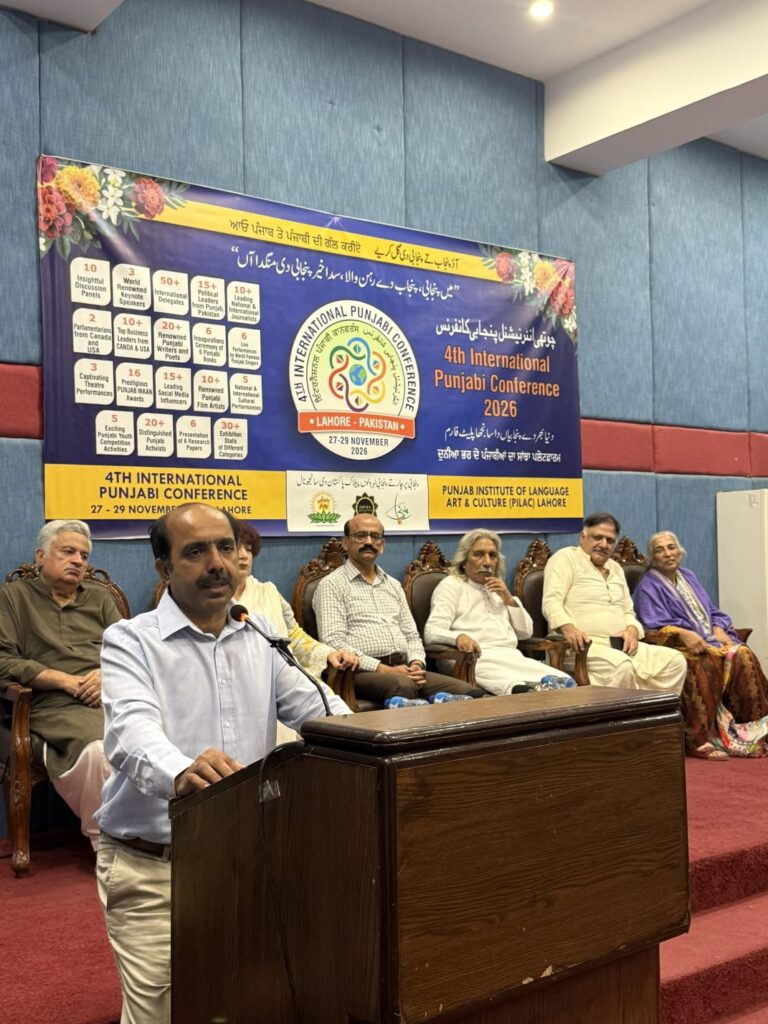
    LAHORE: The fourth International Punjabi Conference will be held in Lahore from Nov 27 to 29, bringing together writers, academics, artists and other professionals from Pakistan and abroad, organisers announced at a press conference. The event is being organised by the Punjabi Parchar Organisation in collaboration with Punjabi Lehar and the Punjab Institute of Language, Art and Culture (PILAC), where the three-day conference will take place. Chief organiser Ahmed Raza Punjabi said the event would be held on a large scale, following the three previous editions of the conference. According to the organisers, thousands of participants from Pakistani Punjab and more than 50 foreign delegates from nine countries are expected to attend. The international participants will include writers, intellectuals, politicians, scientists, journalists, film artists, businesspeople and farmers. Mr Ahmed said the conference aimed to promote Punjabi language and literature while providing a platform to discuss issues facing Punjab and Punjabi communities around the world. He said prominent figures from Pakistani Punjab and successful members of the Punjabi diaspora would be invited to discuss those challenges and propose possible solutions. Conference focal person Dr Zaheer Wattoo said 10 panel discussions would be organised on Punjabi language and literature, the environment, agriculture, politics, sports, film and Punjabi nationalism. Academics from leading universities around the world would also present research papers during the three-day event, he added. Dr Wattoo said separate committees had been formed for different fields. These committees would select speakers from Pakistan and abroad for the panel discussions. The programme will also feature Punjabi cultural performances, live music and theatre. According to the organisers, nine Punjabi singers from different countries will perform during the conference. Several competitions aimed at connecting Punjabi with younger generations will also be held. These will cover public speaking, modern technology, short films, social media reels, singing, poetry and scientific innovation. Two Punjabi books will be launched on each day of the conference, including works by authors from Pakistan, the United States and Canada. On the final day, 16 awards across eight categories will be presented to individuals for their contributions to Punjab and Punjabi culture. Eight recipients will be from Pakistani Punjab, while the remaining awards will go to Punjabi personalities from the United States, Canada, Australia, the United Kingdom and New Zealand. A number of Punjabi literary and cultural figures from Lahore attended the announcement and presented suggestions regarding the conference programme.

Leave a Reply

Your email address will not be published. Required fields are marked *