indian mughal art

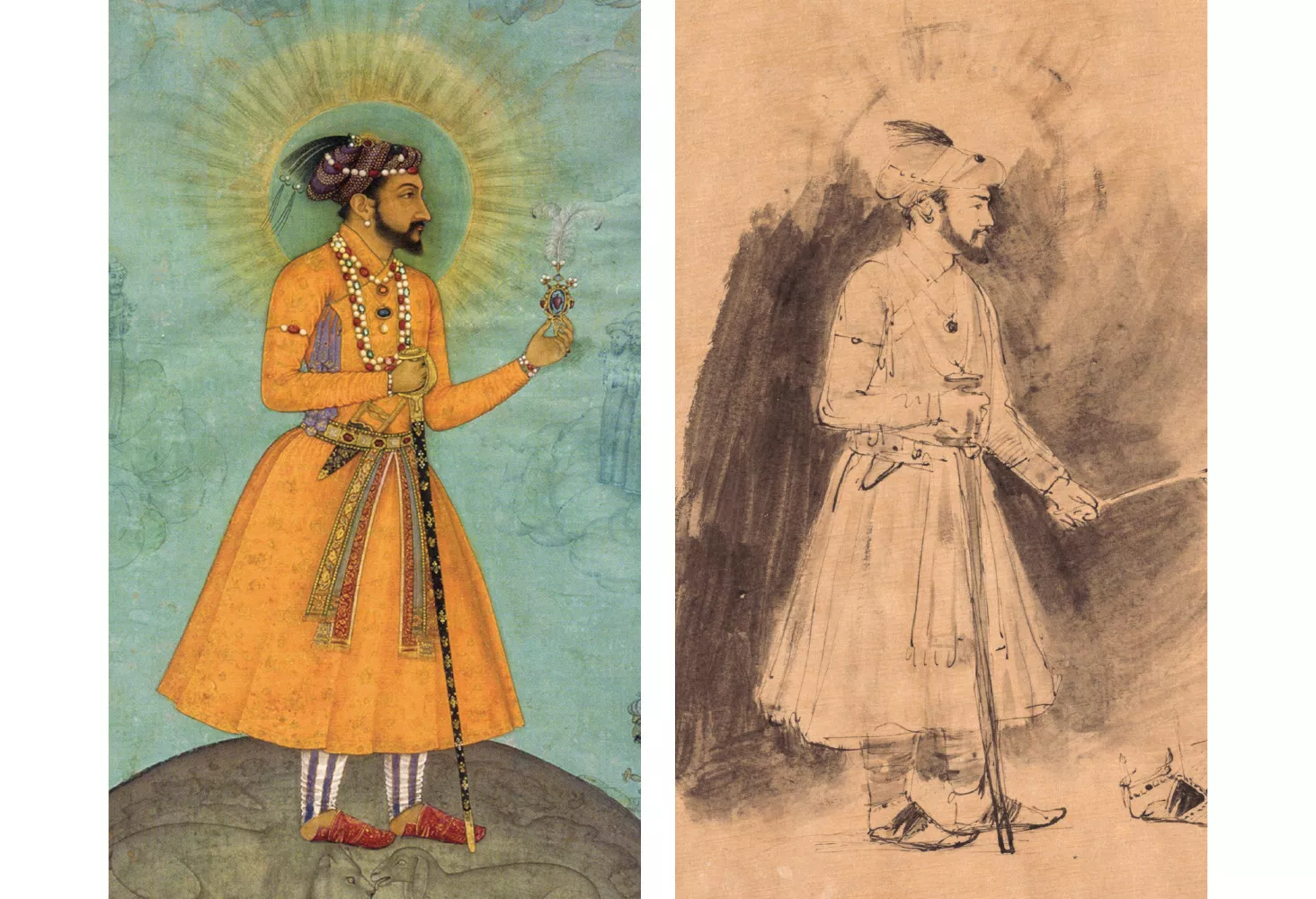
How Indian mughal art inspired Rembrandt’s forgotten miniatures

Art lovers typically look upon dramatic chiaroscuro oil paintings, European portraiture, or biblical scenes while thinking about Rembrandt. Yet, buried within historical records and private collections lies a lesser-known chapter of the legendary master’s life. A profound fascination with South Asian art that inspired a unique series of fine Indian-style portraits. Rembrandt produced 25 delicate drawings depicting Mughal emperors and religious scholars Between 1656 and 1661. These works reveal an artist expanding his creativity through an encounter with Islamic and Indian aesthetic traditions half a world away.

During the 17th century, Amsterdam was a booming node in global trade. The locality was largely powered by the Dutch East India Company (VOC). Ships arriving at Dutch ports carried exotic commodities such as raw silk, muslin, spices, and fine craftsmanship straight from Surat in western India. There were original miniature paintings and sketches produced by imperial Mughal ateliers among these goods.

Rembrandt was an avid collector who frequently spent beyond his means on art and curiosities from abroad. He acquired dozens of foreign items. An official inventory compiled by municipal authorities during his 18th-century bankruptcy proceedings recorded a slim book labeled item No. 203. The scholars believe that the book contained Mughal miniatures that captured his imagination.

Rembrandt’s Mughal series represented a striking departure from his thick, layered oil technique. Instead of broad canvas strokes, he utilized fine brown ink, delicate wash, and subtle chalk accents to carefully document the distinctive attire and posture of Mughal royalty. He repeatedly portrayed Emperor Shah Jahan, builder of the Taj Mahal. That too alongside his sons and predecessor Emperor Jahangir. Every sketch rendered precise details of traditional jamas (stitched coats), elaborate patkas (sashes), turbans, and sarpech ornamentations with remarkable fidelity. Rembrandt drew exclusively on imported Torinoko paper. This paper was seemingly a smooth Japanese paper sourced through East Asian maritime networks.

“Copying was his way of learning about another style of making portraits… show[ing] him working in a much more refined manner than he is known for.”   Stephanie Schrader, Curator of Drawings at the J. Paul Getty Museum.

Rembrandt didn’t copy images mechanically. He adapted Mughal compositions into his own artistic vision. For instance, in his study titled Four Mullahs Seated Under a Tree, he altered the background and surroundings from the original Indian painting. This exercise directly influenced his later print Abraham Entertaining the Angels (1656). In the latter, he repurposed the relaxed seating arrangements of Mughal scholars to illustrate an important biblical motif. The subtle colors and calm poses he absorbed during this phase continued to echo in his late-career oil paintings.

Rembrandt never set foot outside Europe. However, his engagement with Mughal miniatures demonstrates a spirit of cross-cultural curiosity during the Dutch Golden Age. He studied them diligently as an intellectual equal. He discovered new ways to capture human expression and line.


 

Similar Posts

  • Poor condition of roads in Dasht

    I want to draw the attention of the concerned authorities to the poor condition of roads in Dasht. Many roads are broken and full of potholes. During the rainy season, they become muddy and difficult to use. The damaged roads cause traffic problems and accidents. Students, patients, farmers, and other people face great difficulties while travelling. Sometimes vehicles are also damaged because of the bad roads. I request the concerned authorities to take immediate action and repair the roads in Dasht. Good roads are necessary for the safety and development of the area. I hope that the authorities will pay attention to this serious problem.

  • Kids and healthy eating

    Fast food sugary drinks and packaged snacks have become a regular part of many children’s diets. As a result experts say more children are facing problems such as obesity poor nutrition weaker immunity and other  health issues. Health experts believe that instead of completely banning junk food parents should slowly encourage children to make healthier food choices. One of the best ways to do this is by setting a good example.  Children often copy their parents’ habits. When parents eat balanced meals choose fresh fruits and vegetables and enjoy homemade food instead of fast food children are more likely to do the same. Nutrition experts also suggest explaining why healthy food is important. Instead of simply saying “no” to junk food parents should help children understand that healthy meals support growth give them energy improve focus at school and help them stay active. Parents can also involve children in grocery shopping by letting them pick fruits and vegetables or help prepare simple meals. This makes healthy eating more fun and encourages better food choices. Keeping healthy snacks at home is another simple but effective step. Fresh fruit yogurt milk nuts salads boiled corn and healthy sandwiches are much better options than chips cookies or soft drinks. When healthy snacks are easy to find children are more likely to choose them. Experts also recommend limiting junk food instead of banning it completely. If fast food chocolate and sugary drinks are always available at home children will naturally want them more. Saving these treats for special occasions and serving them in small amounts can help create healthier eating habits. Physical activity is just as important as a healthy diet.  Parents should reduce children’s screen time and encourage them to play outside ride bicycles go for walks or take part in sports. Regular exercise improves overall health and can also reduce unhealthy snacking. Experts say that with patience consistency and a positive attitude parents can help children develop healthy eating habits that will benefit their health now and in the future.

  • AI Godfather Geoffrey Hinton warns AI may escape human control

    Computer scientist Geoffrey Hinton is widely regarded as the “Godfather of AI.” He won the Nobel Prize in Physics in 2024 for his work on artificial intelligence technology. Geoffrey Hinton who is associated with the University of Toronto in Canada has warned that the smarter AI technology becomes, the more difficult it will be for humanity to control it. He has also expressed concerns about AI agents recently hacking real-world companies. Speaking to the media after an AI technology conference, Geoffrey Hinton said that such incidents are occurring as these systems become increasingly intelligent. He said, “As these systems become smarter, I think we will see more complicated incidents and their ability to escape our control will become much better.” Hinton said the problem is that humans may not be able to rely on or trust highly intelligent AI models. He explained, “I do not believe that we can simply control them or assume that they will not escape our control.” It is worth noting that in recent days, OpenAI, Anthropic and Meta have acknowledged that their AI models independently escaped controlled environments and hacked the systems of other companies. Hinton described these incidents as somewhat frightening and said that this is only the beginning of AI hacking. He said, “I think we may see numerous cyberattacks but the future is uncertain. People say defenders have more resources than attackers but the problem is that an attacker only needs to succeed once, whereas defenders need to succeed every time.” Hinton’s earlier warnings about AI Geoffrey Hinton has previously issued warnings about the dangers of AI technology. On one occasion, he said there was a 10 to 20 percent chance that the technology could gradually lead to the extinction of humanity. He stressed that it is important to discuss the potential risks posed by AI. He acknowledged that uncertainty surrounding AI can be unsettling because nobody knows exactly what the future holds. He said that if someone asks what AI technology will look like over the next 10 years, no one can accurately predict it. Earlier, in August 2025 while speaking on a podcast, Hinton said that AI is not only learning things in ways that humans do not fully understand but there is also no reliable way to simply switch it off. Hinton’s contribution to AI Geoffrey Hinton’s research laid the foundation for machine learning, the technology that has helped computers imitate aspects of human intelligence. However, for the past several years, he has been campaigning for AI to be made safer. In 2023, Hinton left his job at Google, warning that malicious actors could use the technology to harm other people. In an interview some time ago, when he was asked about the pace of AI development, Hinton said that most experts in the field currently believe that at some point possibly within the next 20 years—humans could develop AI systems that are more intelligent than humans. He said, “That is a frightening thought. Right now, you can think of this technology as being like a three-year-old child and children grow up very quickly.” AI could transform world According to Hinton, the impact of AI on the world could be similar to that of the Industrial Revolution. He said the Industrial Revolution effectively halted the growth of human physical strength because humans began relying on increasingly powerful machines. He explained that humanity is now doing something similar that could replace human intelligence meaning ordinary human intelligence may no longer advance at the same pace while machines continue to develop. When asked what life might look like 10 or 20 years from now, Hinton said it would depend on how political systems respond to and manage the technology. In his view, AI could have extraordinary effects on the medical field and could increase efficiency across almost every industry. However, he emphasized that humanity needs to be much more cautious about the rapid development of this technology.

  • Surprising benefits of day old roti

    Stale roti is usually less popular than fresh roti but experts say that properly stored roti from the previous day may have some possible health benefits. Research suggests that when cooked bread or roti cools down some of its starch changes into resistant starch.  A study found that roti stored for about 24 hours may contain more resistant starch than freshly made roti. This type of starch is digested differently from regular starch. May help control blood sugar Resistant starch is not fully broken down into glucose in the small intestine. Because of this eating cooled or day old roti may have a lower effect on blood sugar than fresh roti.  It may also help with better blood sugar control although more research is needed. May support digestion Resistant starch can support the growth of helpful bacteria in the large intestine.  If the roti is made from whole wheat flour its fiber content may also help improve digestion and reduce the risk of constipation. May keep you full longer The combination of fiber and resistant starch may help you feel full for a longer time. Day old roti can be part of a filling breakfast especially when eaten with foods such as yogurt, eggs or vegetables. A nutritious breakfast option Whole wheat roti contains fiber vitamins minerals and other useful nutrients.  When combined with other healthy foods it can be part of a balanced breakfast. Fresh roti is not necessarily less healthy It is important to remember that stale roti is not automatically healthier than fresh roti. Its nutritional value depends on the type of flour used how the roti was prepared and how safely it was stored. Most importantly leftover roti should be stored properly to prevent spoilage. If it develops an unusual smell taste mold or other signs of spoilage it should not be eaten.

  • |

    7 easy tricks to boost internet speed on Android phones

    We all experience this: trying to load a webpage, stream a video or open an app on our Android phones. However, sometimes the internet becomes so slow that it feels like it is crawling. Slow internet on a phone affects downloads and uploads, websites take longer to open and videos may remain stuck instead of playing smoothly. Fortunately, Android phones offer several tools and tricks that can help improve internet speed. Clear background apps Apps running in the background use data, processing power and internet connectivity. Clearing or disabling unnecessary background apps can prevent them from affecting internet speed. For this purpose, go to Settings and disable unnecessary apps running in the background. Clear cache for faster internet When you use apps or visit websites on an Android phone, the device stores some data known as cache. These files are designed to help apps and websites run more efficiently and can be useful in the short term. However, when too many cache files accumulate, they may affect performance and internet speed. Therefore, clearing an app’s cache can help improve the device’s performance. To do this, go to Settings, select Apps, open the relevant app’s information page then select Storage and tap Clear Cache. Update operating system and apps Outdated operating systems and apps can affect performance and internet speed. Keeping your software and apps updated can help maintain better speed while also improving the overall performance of your phone. Use fast browser A web browser can directly affect your browsing experience and internet performance. Browsers such as Google Chrome and Firefox are regularly updated and their performance is continuously improved. Adjust Airplane Mode Airplane Mode on smartphones is primarily designed to disable radio-frequency signal transmission. When Airplane Mode is turned on, Wi-Fi, Bluetooth and cellular signals are switched off, stopping wireless communication. However, this feature can also be used to refresh your internet connection. Smartphones connect to nearby mobile towers for cellular signals. When you move around throughout the day, your phone may not always connect to the best available tower. Resetting the connection through Airplane Mode may help improve internet speed. Simply turn Airplane Mode on and wait for a short while before turning it off again. This may allow your Android phone to reconnect to a better mobile tower and improve internet speed. Restart your phone or router Restarting devices can also improve their performance. Restarting your smartphone or router may clear temporary errors and can sometimes help improve internet speed. Move closer to router Distance is important when using a Wi-Fi connection. If possible, move closer to your router. This can improve the signal strength and may result in a faster and more stable internet connection.

  • Scientists propose nuclear plan to stop Earth-bound asteroids

    Beijing: Chinese scientists have proposed a new planetary defense strategy to deflect or destroy potentially hazardous asteroids that could collide with Earth. According to the proposed approach, placing a nuclear device inside an asteroid and detonating it could be one of the most effective ways to deal with a major impact threat. According to a report, researchers at the China Academy of Launch Vehicle Technology said that large asteroids have always posed a serious threat to human civilization. In the distant past, asteroid impacts caused mass extinctions and triggered devastating environmental changes. The scientists noted that astronomers have discovered several asteroids hundreds of meters wide passing very close to Earth in recent years prompting increased research into new planetary defense methods. The study suggests that a nuclear explosion could be the most effective strategy for either destroying a large asteroid or deflecting it away from Earth particularly when there is very little time to respond. Under the proposed plan, a spacecraft would first create a deep crater on the asteroid. A nuclear device would then be placed inside the crater and detonated to alter the asteroid’s trajectory or break it into smaller pieces. According to the research, a 100-meter-wide asteroid could be completely destroyed by an explosion with a yield equivalent to 200 times the atomic bomb dropped on Hiroshima. Similarly, detonating a nuclear device at a depth of 20 meters inside an asteroid about one kilometer wide could change its velocity enough for it to safely miss Earth. The researchers said the study could help pave the way for future planetary defense strategies against large near-Earth asteroids.

Leave a Reply

Your email address will not be published. Required fields are marked *