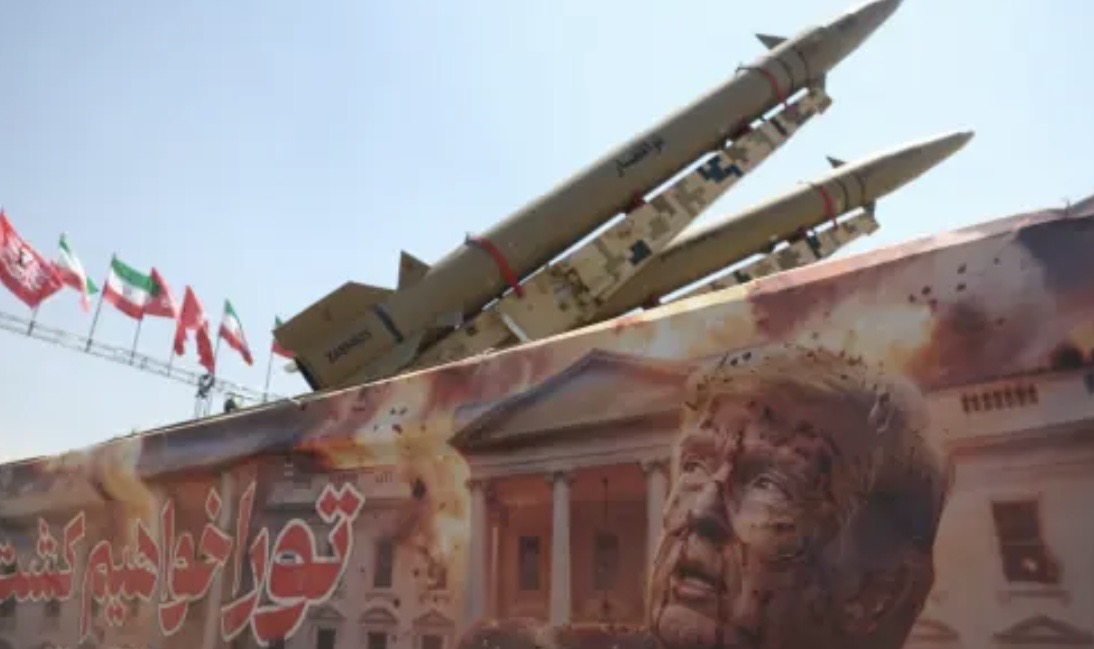
iran8217s top commander
|

Iran’s Top Commander issues harsh warning to US forces : ‘their coffins are a part of their equipment’

The commander of Iran’s Khatam Al-Anbiya Central Headquarters, Major General Ali Abdollahi, has issued a stark warning to US forces, declaring that “their coffins are a part of their equipment” in the region.

“Today, the Americans and their mercenaries have realised to the very core of their being that their coffins are part of their equipment in the region,” Abdollahi said, according to the Fars news agency. The warning comes amid heightened tensions between Tehran and Washington, following recent hostilities in the Persian Gulf.

The statement also comes as US Senate Republicans blocked a resolution to halt the Iran war, signaling continued congressional support for the administration’s military stance. Meanwhile, Egypt’s president has warned of “escalation” after a port strike, adding to regional instability.

Abdollahi’s remarks reflect Iran’s continued defiance in the face of US military pressure and its determination to maintain its position in the ongoing conflict. The rhetoric is likely to further complicate diplomatic efforts, including those being mediated by Pakistan and Qatar, as both sides remain locked in a bitter standoff.

Similar Posts

  • | |

    Irish Football association withdraws support for FIFA President Gianni Infantino

      The Irish Football Association (FAI) has formally confirmed that it has withdrawn its support for FIFA President Gianni Infantino, delivering another setback to his bid to secure a fourth term as the head of world football’s governing body. According to international media reports, the FAI informed Infantino of its decision through a formal letter. The association said that recent developments had raised serious concerns regarding governance, transparency and consultation within FIFA. The decision reflects growing unease among football organisations over the way important matters have been handled under Infantino’s leadership. The withdrawal of support from Ireland adds to increasing pressure on Infantino as he prepares to seek another term as FIFA president. Infantino has led FIFA since 2016 and was re-elected in 2019 and again in 2023. A fourth term would extend his leadership of the organisation, but recent disagreements with several football bodies could make the process more challenging. European football’s governing body UEFA, along with CONCACAF and the Asian Football Confederation, have already expressed serious concerns about Infantino’s leadership. These organisations have accused him of undermining trust and have raised questions about governance and communication. The FAI’s decision is particularly significant because Ireland is one of the associations within the British Isles football community, where several national football bodies have recently reconsidered their positions regarding Infantino. The Football Association of Wales became the first of the four British home nations to withdraw its support for Infantino. The English Football Association has also stepped back from supporting the FIFA president. The latest decision by the Irish association further increases the number of football bodies distancing themselves from Infantino. Meanwhile, the Northern Ireland Football Association has also expressed support for UEFA’s position. Although the four home nations operate independently in international football, their positions can carry political and symbolic importance within the wider European football structure. The growing disagreement centres largely on concerns about FIFA’s governance practices and the level of consultation with national and regional football organisations. Critics believe that major decisions affecting international football should involve greater communication and consultation with the organisations directly responsible for the sport in their respective regions. The FAI’s letter is therefore being viewed as another indication of the growing divisions between FIFA leadership and some of its member associations. While withdrawing support does not automatically prevent Infantino from seeking another term, it demonstrates that his leadership is facing opposition from several influential football organisations. Infantino has previously defended FIFA’s approach and has promoted reforms aimed at expanding football’s global reach and increasing opportunities for national associations. Under his presidency, FIFA has also pursued major changes to international competitions and commercial strategies. However, disagreements over governance and transparency have increasingly become a source of tension between FIFA and some football confederations. With the Irish Football Association now joining other organisations in withdrawing or reconsidering their support, Infantino’s campaign for a fourth presidential term faces a growing political challenge. The developments are likely to increase pressure on FIFA to address concerns about transparency, consultation and trust before the next presidential election. The extent to which other national football associations follow Ireland, Wales and England could play an important role in determining the strength of Infantino’s bid for another term. For now, the FAI’s decision represents another significant warning for the FIFA president as opposition to his leadership continues to grow across parts of the international football community.

  • | | |

    IRGC targets key US military bases in Kuwait

    Iran’s Islamic Revolutionary Guard Corps (IRGC) has claimed responsibility for launching another round of attacks on US military facilities in Kuwait, saying the strikes targeted key military infrastructure used by American forces in the Gulf region. In an official statement, the IRGC said the operation targeted the Ali Al Salem Air Base, where US military personnel and equipment are stationed. According to the statement, the attack struck a large military equipment warehouse, a Patriot air defence missile system, and a hangar used to house US MQ-9 Reaper drones. The IRGC claimed the strikes caused significant damage to military assets at the base. However, the extent of the reported damage has not been independently verified. The statement also said Iranian forces targeted Al Udairi Barracks, another military facility used by US forces in Kuwait. The IRGC claimed the attack hit accommodation areas used by American troops as well as two helicopter hangars, resulting in heavy damage to helicopters and unmanned aerial vehicles. Iran further claimed that a telecommunications tower was also struck during the operation. According to the IRGC, the attack was carried out in retaliation for what it described as previous US attacks on communication infrastructure inside Iran. The latest announcement comes amid heightened military tensions between Iran and the United States following recent exchanges of attacks in the region. Both countries have accused each other of escalating the conflict through military operations targeting strategic installations. There has been no immediate confirmation from the US Department of Defense or the Kuwaiti government regarding the IRGC’s claims. American and Kuwaiti officials have not publicly commented on whether the reported attacks caused casualties or damage to military facilities. Independent verification of the IRGC’s claims remains unavailable, and the exact impact of the reported strikes has not yet been confirmed. The reported attacks are likely to further increase tensions in the Gulf region, where US military bases play a central role in regional security and military operations. Observers say any further escalation could have significant implications for stability in the Middle East as diplomatic efforts to ease tensions continue.

  • |

    Israel approves entry of International Stabilizati…

    The Israeli security cabinet has voted to approve the entry of the International Stabilization Force (ISF) into Gaza, advancing a key component of the US-backed peace plan for the enclave despite opposition from a far-right minister . The decision, announced on Sunday, paves the way for the deployment of a multinational force under the Board of Peace (BoP) plan, which was endorsed by the UN Security Council in November 2025 . The ISF is intended to oversee security and support reconstruction efforts in the war-torn territory . National Security Minister Itamar Ben-Gvir was the sole dissenting voice in the cabinet vote . According to Israeli media, Ben-Gvir argued that Hamas has failed to meet its commitments to demilitarize and disarm, meaning Israel is not obligated to proceed with the plan . He reportedly advocated for encouraging the migration of Palestinians out of Gaza as an alternative solution . Following the approval, a senior Israeli official outlined key conditions for the ISF’s operation. The force will receive legal immunity under Israeli law and will operate in “full coordination” with the Israeli military in areas outside the military’s control zones . Stringent conditions have also been placed on which nations can contribute troops. The security cabinet decided that only countries that maintain diplomatic relations with Israel and do not act against it in international forums will be eligible to participate . This clause reportedly excludes nations like Indonesia, which had previously shown interest . The initial force is expected to comprise approximately 200 personnel from “friendly” nations such as Uganda and Morocco . Israeli officials have further stressed that the military will continue to hold the “yellow line” demarcating its controlled areas in Gaza and will not withdraw further unless Hamas is fully disarmed and the Strip is demilitarized . The ISF deployment is part of a scaled-back pilot project initially focused on a humanitarian zone near Rafah in southern Gaza .

  • |

    Indonesia earthquake, 38 dead as rescue teams race…

    JAKARTA: At least 38 people have died after a powerful magnitude-7.7 earthquake struck eastern Indonesia on Saturday, sending residents fleeing from homes, damaging buildings and triggering a brief tsunami warning, officials said. The shallow offshore earthquake was followed by dozens of aftershocks, complicating rescue efforts across East Nusa Tenggara province. Authorities said tsunami waves measuring less than one metre were recorded in several areas before the warning was lifted about three hours after the main tremor. Suharyanto, head of Indonesia’s National Disaster Management Agency (BNPB), said 38 people had died, while two were seriously injured and 11 suffered minor injuries. About 2,000 residents were evacuated to safer areas as authorities assessed the damage. Maumere, the main town in Sikka Regency on Flores Island, was among the worst-hit locations. Rescue officials reported finding 20 bodies there, while several people were injured and others remained trapped beneath collapsed structures. The disaster also struck Nagekeo, the area closest to the earthquake’s epicentre. Rescue teams faced major difficulties reaching the region because landslides blocked roads and communication signals were disrupted. Authorities said around 2,000 residents in Nagekeo had moved to safer locations, while houses, warehouses and government facilities were damaged. Officials said power outages and traffic congestion were reported in parts of the affected region. In some locations, residents rushed outdoors as buildings shook violently. Hospitals also moved patients outside as a precaution against further tremors. A resident of Talibura described the shaking as extremely powerful, saying her family ran from their home after the earthquake struck. Her account reflected the panic felt across communities as the ground continued to shake. The Indonesian geophysics agency said the initial earthquake occurred at a depth of about 15 kilometres and was followed by multiple aftershocks. Rescue workers are continuing to search damaged buildings and isolated communities for survivors. Officials said emergency crews were using boats and other routes where roads remained blocked by landslides and debris. Indonesia is particularly vulnerable to earthquakes because it lies along the Pacific Ring of Fire, a highly active seismic zone where tectonic plates meet. The region has suffered devastating earthquakes before, including a magnitude-7.5 quake in 1992 that caused extensive destruction. Authorities warned that the situation remains fluid as rescue teams work to reach isolated areas, determine the full scale of damage and provide assistance to displaced residents. The death toll could rise as search operations continue.

  • | | |

    Two Israeli soldiers killed in southern Lebanon bl…

    Beirut: The Israeli military has confirmed that two of its soldiers were killed during operations in southern Lebanon, underscoring the continued volatility along the Israel-Lebanon border as cross-border hostilities show little sign of easing. In a statement issued on Wednesday, the Israel Defense Forces (IDF) identified the slain personnel as Major Harel Baron Stock, 34, a commander, and Sergeant Major Tamir Vaknin, 33. The military said both were killed in an explosion that occurred in the Lebanese town of Majdal Zoun, near the border. The IDF added that four other soldiers were seriously wounded in the same incident. The injured personnel were evacuated to nearby hospitals, where they are receiving medical treatment. Israeli authorities did not immediately provide further details on the nature of the explosion or whether it was caused by an explosive device or another form of attack. The incident comes amid continuing Israeli military operations across southern Lebanon, where strikes have intensified in recent months. The border region has witnessed repeated exchanges of fire, increasing fears of a broader escalation that could further destabilize the Middle East. Lebanese media have reported extensive damage in several southern districts following ongoing Israeli attacks. Large numbers of residents have been displaced, although many families have recently begun returning to their homes despite widespread destruction in affected areas. Security analysts say the latest casualties highlight the dangers faced by troops operating in the tense border zone, where military activity and intermittent clashes continue to pose risks to both soldiers and civilians. The deaths of the two Israeli soldiers are likely to renew attention on the fragile security situation along the Israel-Lebanon frontier, as diplomatic efforts to reduce tensions remain limited. With military operations continuing on both sides, concerns persist that any major incident could trigger a wider regional confrontation, further complicating an already volatile conflict.

  • | |

    Austria opens police station at house where Hitler…

    Austria has opened a police station inside the house in Braunau am Inn where Adolf Hitler was born, closing out years of debate over how to handle the building’s dark history. The 17th century structure once operated as an inn and served as the birthplace of the Nazi dictator in April 1889. Authorities have now completed a substantial renovation that changed the building’s facade, though managing the site has posed a persistent challenge for Austrian officials determined to prevent it from turning into a destination for neo Nazi pilgrimage. Hitler lived in the building, located at Salzburger Vorstadt 15, for only a few weeks before his family relocated to another address in Braunau. The family left the town permanently when Hitler was three years old. He briefly returned to Braunau in 1938 while traveling to Vienna after annexing Austria into Nazi Germany. Interior Minister Gerhard Karner attended the opening ceremony alongside other local officials, which featured police musicians performing on tuba and other brass instruments. Karner said Austria is taking responsibility for what he called the terrible legacy of the past, adding that although deciding the building’s fate proved difficult, he believes the new police station represents a fresh chapter for the site. He said the building will now stand as a place representing democracy, the rule of law, security, freedom and human dignity. A Catholic police chaplain then blessed two crosses that will hang inside the new station. For decades, Austria’s interior ministry rented the building from its former owner, a local woman named Gerlinde Pommer, paying her generous rent in an effort to keep the property from becoming a site for far right tourism. A local charity used the building for years as a day center and workshop for people with special needs, but the organization had to vacate in 2011 after Pommer blocked planned renovations. She also repeatedly declined to sell the property to the government, leaving the building empty for several years while she and authorities disputed terms. In 2016, Austria’s parliament passed legislation allowing the government to seize the property from Pommer, paying her compensation of 812,000 euros. She later challenged the amount in court, arguing it was too low, but ultimately lost the case. Wolfgang Sobotka, who served as interior minister at the time, suggested the building should be demolished and replaced with a new structure altogether, echoing an earlier proposal from a Russian lawmaker who had offered to purchase the house and destroy it. Both ideas drew significant criticism, with opponents arguing that tearing down the building would amount to denying Austria’s Nazi era history. In 2019, the government unveiled plans to convert the building into a police station and launched an EU wide competition inviting architects to submit design proposals. Officials subsequently spent millions of euros renovating the structure, transforming its appearance dramatically from its earlier state. The building, now painted white both inside and out, features extensive oak woodwork throughout, while an original winding staircase and arched entrance hall have been preserved from the earlier structure. The transformation marks a stark contrast to the building’s condition decades ago, when the Lebenshilfe charity operated a small shop in one of its front rooms. Police Chief Inspector Ludwig Heise said he feels fortunate to work in such a modern facility, noting the additional space compared to previous quarters, though he added that beyond its size, the station functions just like any other police facility in Austria. The reopening marks the culmination of a long and often contentious effort by Austrian authorities to neutralize the symbolic weight of Hitler’s birthplace, transforming a site once feared as a potential magnet for extremist sympathizers into a functioning symbol of the democratic institutions Austria has built in the decades since the Second World War.

Leave a Reply

Your email address will not be published. Required fields are marked *