
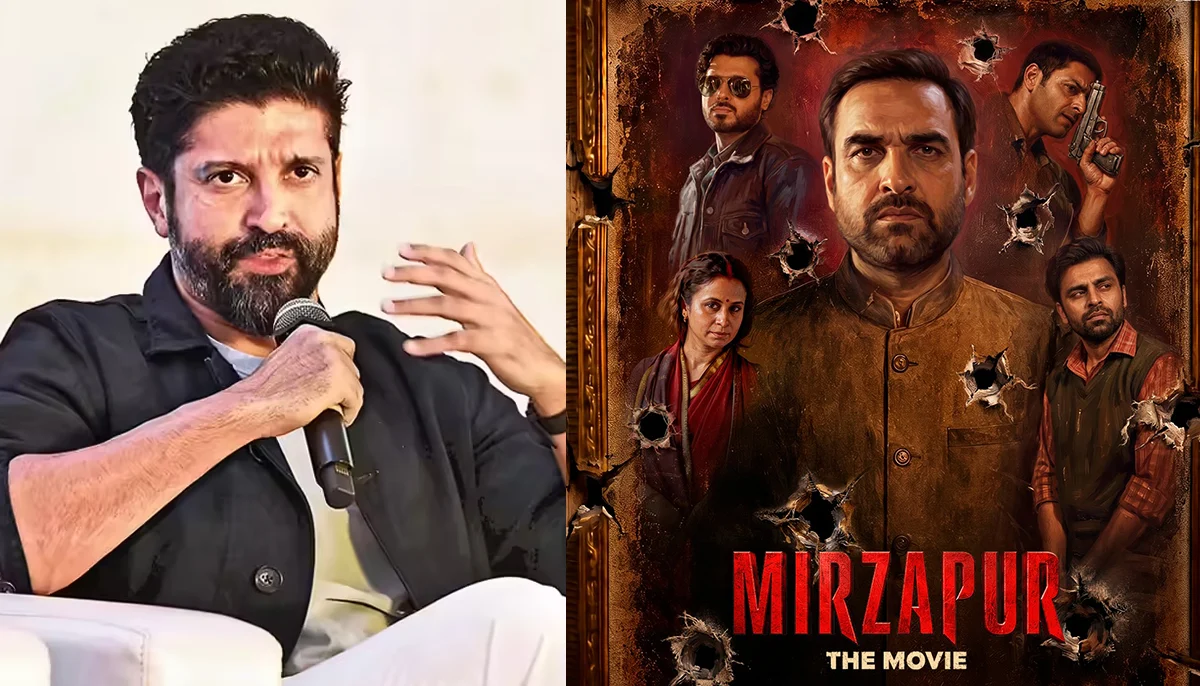
mirzapur movie trailer
|

Mirzapur movie trailer sparks excitement among fans worldwide

The trailer for Mirzapur: The Movie was released on Tuesday, immediately creating a buzz among fans who have been waiting for years to see the popular crime drama make its way to the big screen.

The highly anticipated film brings back several familiar faces from the original series while introducing new characters and expanding the story beyond the world audiences have previously seen. The trailer launch also offered insight into how the movie came to life, with producer and filmmaker Farhan Akhtar crediting the show’s passionate fan base for playing a major role in turning the idea into reality.

According to Akhtar, the popularity of Mirzapur continued to grow after its debut, with fans across different parts of the world constantly asking when the next installment would arrive. The demand became even stronger after the movie was officially announced, as viewers began asking about its release date and eagerly following every update.

Akhtar expressed his gratitude toward the audience for their continued support, saying that the movie was ultimately a result of the love and enthusiasm shown by fans over the years. He also praised the original cast as well as the new additions for helping bring the cinematic version to life.

The filmmaker also recalled the unusual beginnings of the franchise. He revealed that when writer Puneet Krishna first presented the story, his initial reaction was so surprised that he jokingly thought the writer might need to see a brain specialist. However, the team eventually recognized the potential of the idea and decided to develop it into a series. Akhtar credited Krishna and director Gurmmeet Singh as key figures behind the success of the franchise.

The movie’s trailer appears to continue the story established in the series, bringing back some of its most recognizable characters. Pankaj Tripathi returns as Kaleen Bhaiya, while Ali Fazal reprises his role as Guddu Pandit. Divyendu and Rasika Dugal are also part of the returning cast.

One of the major changes is the addition of Jitendra Kumar, who takes over the role of Bablu Pandit, a character previously played by Vikrant Massey. His inclusion adds another interesting element to the film and has already attracted attention from viewers familiar with the original series.

The struggle for power also appears to become much larger in the movie. While the previous storylines focused heavily on the Purvanchal region, the new chapter promises to take the rivalry into unfamiliar territory, including desert landscapes.

The trailer hints at an intense battle involving Kaleen Bhaiya, Munna Tripathi and Guddu Pandit, with political figures and rival gangs becoming increasingly involved in the conflict. As alliances shift and the fight for control grows more dangerous, the movie appears set to deliver the violence, drama and suspense that made Mirzapur a fan favorite.

With its original stars, new additions and a much bigger setting, Mirzapur: The Movie is shaping up to be one of the most anticipated adaptations of the popular Indian web series.
Similar Posts

  • |

    Armenian church leader stands trial in standoff with government

    The trial of Catholicos Karekin II, head of the Armenian Apostolic Church, and six senior clerics has commenced in Armenia over accusations of defying a civil court order. The proceedings were halted almost immediately when the presiding judge recused himself due to a conflict of interest involving defence counsel. The case marks an unprecedented legal challenge to the church leadership, stemming from a civil order to temporarily reinstate a defrocked bishop who aligned with Prime Minister Nikol Pashinyan. Pashinyan has repeatedly called for the resignation of Karekin II and accused the church of acting as a proxy for foreign powers, specifically Russia. Church officials and human rights advocates argue the prosecution is politically motivated and violates the constitutional separation of church and state.

  • | | | |

    Iran rules out US talks until demands are met

    Iran has ruled out direct negotiations with the United States for now, saying Washington must first comply with the terms of an interim agreement reached in June. Iranian Foreign Minister Abbas Araghchi said on Sunday that Tehran and Washington were not holding direct talks. He said messages were still being exchanged through intermediaries. Araghchi also reiterated Iran’s position on the Strait of Hormuz. He said the strategic waterway would not reopen simply because Iran and Oman reached an agreement on shipping arrangements. According to Iranian reports, Tehran and Muscat are close to finalising an understanding on a temporary shipping route. However, Iran says the route can only be used after other conditions are met. The Strait of Hormuz has remained at the centre of the wider conflict. Iran has repeatedly linked its reopening to demands directed at Washington. Iranian officials have called for an end to US threats and military action. They have also demanded the lifting of sanctions and blockades and the release of Iranian assets. Iran’s Revolutionary Guard has separately warned that the strait will remain closed until Tehran’s conditions are accepted. The force accused its opponents of shifting their focus toward reopening the vital waterway. The strait is one of the world’s most important energy routes. A significant share of global oil and gas shipments normally passes through it. Oman, meanwhile, said discussions with Iran over arrangements for shipping through the waterway had been positive and constructive. Muscat also urged all sides to avoid actions that could undermine the negotiations. Iranian President Masoud Pezeshkian has suggested that the current situation could provide an opportunity for an agreement. He said Iran remained united and strong despite the ongoing conflict. The diplomatic uncertainty comes as tensions continue to affect commercial shipping in the region. The United Arab Emirates said Iran had attacked a vessel linked to its state-owned oil company while it was travelling through the Strait of Hormuz. No injuries were reported. The United Kingdom Maritime Trade Operations agency also reported that a vessel caught fire after being struck by an unidentified projectile. The fire was later brought under control, with no environmental damage reported. Iranian authorities have not immediately commented on the individual incident. Saudi Arabia reports fires at energy facilities Tensions have also spread across the Gulf. Saudi Arabia said firefighters had extinguished a blaze at an Aramco facility in Jizan. The Saudi Energy Ministry said there were no fatalities. Yemen’s Houthi movement claimed responsibility for an attack on the site, saying it had used a drone in response to alleged Saudi strikes in Yemen. A separate explosion was also reported in the industrial area of Jubail. Regional sources said gas facilities were targeted and that a fire broke out. The exact cause remained unclear. It was not immediately established whether the incidents in Jizan and Jubail were connected. US defence industry ordered to increase weapons production Meanwhile, the United States has asked its defence industry to accelerate weapons production amid shortages linked to the war with Iran. US Deputy Defence Secretary Steve Feinberg reportedly instructed defence companies to submit plans aimed at speeding up deliveries and increasing production of critical military equipment. The demand comes amid reports of pressure on US ammunition supplies, including stocks of Patriot missile interceptors. The Trump administration has maintained that the United States has substantial weapons reserves and that additional supplies are being manufactured and delivered. The conflict has also triggered threats from armed groups in the region. The leader of Iraq’s Harakat Hezbollah al-Nujaba, Akram al-Kaabi, has threatened retaliation for US-Saudi strikes on sites belonging to Iraq’s Popular Mobilisation Forces. The group has warned that further military action could lead to a response. Iranian military officials, meanwhile, have claimed that the United States and Israel failed to achieve their objectives against Iran. They have praised the country’s military preparedness and vowed to continue resisting pressure. With the Strait of Hormuz still closed and negotiations remaining indirect, the prospect of restoring normal shipping remains uncertain. Iran insists that reopening the waterway depends on Washington accepting its conditions. The United States, meanwhile, has linked the lifting of its blockade to Iran fulfilling commitments under any future agreement.

  • | |

    Sindh extends Section 144 for one more month

    The Sindh government has extended Section 144 across the province for another month, keeping several restrictions in place to maintain law and order. According to a notification issued by the Sindh Home Department in Karachi, the renewed restrictions will come into effect on August 1 and will remain enforced for the next month. The notification states that wall chalking, public rallies, demonstrations and the display of weapons in public places will continue to remain prohibited throughout the province. The government said the measures have been taken as part of efforts to preserve public peace and prevent any activities that could disrupt law and order. Authorities have directed law enforcement agencies to ensure strict implementation of the restrictions. Officials said action will be taken against anyone found violating the provisions of Section 144 during the enforcement period. The notification also clarified that only security guards employed by registered private security companies will be permitted to carry weapons while performing their official duties. No other individuals will be allowed to display or carry weapons in public unless authorised under the law. Section 144 is a legal provision that empowers district administrations to impose temporary restrictions on public gatherings and certain activities in the interest of public safety. It is often enforced during periods of heightened security concerns or to prevent possible disturbances.

  • |

    US delegation walks out of UN Security Council after dispute with France

    The United States walked out of a United Nations Security Council meeting on Monday during remarks by France’s ambassador, escalating a diplomatic dispute between the two allies over human rights and the leadership of the UN’s top human rights office. The disagreement began after a recent vote on extending the term of Volker Turk as the United Nations High Commissioner for Human Rights. The United States joined Russia and North Korea in opposing his reappointment, placing Washington on the same side as two countries it has frequently criticized over human rights issues. Following the vote, France’s mission to the United Nations strongly criticized the US position on social media, saying Washington had once been a global symbol of human rights but no longer deserved that reputation. The statement drew a sharp response from American officials and set the stage for the diplomatic confrontation that followed. The latest tension unfolded during an emergency Security Council meeting on Russia’s war in Ukraine. As France’s UN Ambassador Jerome Bonnafont began speaking, members of the US delegation left the chamber in protest. US Ambassador Dan Negrea later said the walkout was a direct response to what he described as France’s disrespectful and condescending language toward the United States. He warned that similar protests would continue unless France changed its approach and withdrew its criticism. Earlier, US Ambassador Mike Waltz defended Washington’s opposition to Turk’s second term. He argued that the human rights chief had unfairly criticized democratic countries while failing to take a strong enough stance against governments with poor human rights records. Waltz did not identify specific examples to support his criticism. During his time in office, Turk has repeatedly condemned Russia’s invasion of Ukraine and has also raised concerns about Israel’s military operations in Gaza. Despite US objections, his second term was approved by a large majority of UN member states, with 144 countries voting in favor, 10 voting against and 13 abstaining. The dispute reflects broader tensions between the United States and the United Nations under President Donald Trump’s administration. In recent years, Washington has reduced financial support for several UN agencies and withdrawn from a number of UN bodies as part of a wider review of its international commitments. After the vote on Turk’s reappointment, US Ambassador Jeff Bartos warned that the United States would reconsider its participation, engagement and funding for UN institutions. He accused the organization of allowing procedural abuses and political deals to influence key appointments. France, however, strongly defended Turk’s leadership. Ambassador Bonnafont described him as a principled and impartial official who had carried out his responsibilities with integrity during his first term. France argued that his reappointment reflected the confidence of the overwhelming majority of UN member states. A spokesperson for the United Nations declined to comment directly on the American walkout but said the organization expects all member countries to respect decisions made through its established voting process. The incident has added to growing friction between Washington and the UN at a time when international cooperation is already under pressure from several global conflicts.

  • | |

    Five Nepali climbers’ bodies reach Islamabad

    The bodies of five Nepali climbers who died in an avalanche on Broad Peak have been brought to Islamabad. According to Deputy Commissioner Hamza Murad, the bodies were transported to Islamabad by air and have been placed in the morgue at the Pakistan Institute of Medical Sciences (PIMS). He said the bodies would be sent to Nepal once the necessary travel documents had been completed. The avalanche struck Broad Peak about a week ago, leaving 10 climbers missing. According to the deputy commissioner, the bodies of eight climbers, including renowned Nepali mountaineer Nirmal Purja, have so far been recovered. The search for two missing climbers is still underway. They include Pakistani mountaineer Sohail Sakhi and a foreign female climber. Authorities are continuing efforts to locate the remaining climbers while arrangements are being made to repatriate the recovered bodies to their respective countries.

  • | |

    China voices concern over new US trade curbs

    BEIJING: China has raised strong concerns over the latest US trade restrictions, urging Washington to strengthen dialogue and maintain stable economic relations as both countries continue efforts to manage trade tensions. Chinese Vice Premier He Lifeng expressed Beijing’s concerns during a video conference with US Treasury Secretary Scott Bessent and US Trade Representative Jamieson Greer, according to Chinese state media. During the talks, both sides held detailed discussions on implementing the agreements reached by the leaders of the two countries. The officials also exchanged views on maintaining stable economic and trade ties, expanding practical cooperation and addressing each other’s concerns through continued engagement. Beijing criticized the latest US trade measures, including the recently announced 12.5% tariff on Chinese imports, describing them as a source of concern for bilateral economic relations. Despite the differences, both sides agreed to continue using the China-US economic and trade consultation mechanism to improve communication, strengthen mutual trust and reduce misunderstandings. They also pledged to expand cooperation and support the stable development of bilateral trade relations. The discussions come ahead of Chinese President Xi Jinping’s expected visit to the United States later this year, a meeting widely seen as an opportunity to ease tensions between the world’s two largest economies. Earlier agreements between Beijing and Washington included China’s commitment to address US concerns over the supply of rare earth minerals and related processing technologies. China also agreed to increase purchases of US agricultural products through 2028 as part of broader efforts to stabilize trade relations. The latest talks indicate that while differences remain over tariffs and trade policies, both governments continue to pursue diplomatic engagement to prevent further escalation in economic disputes.

Leave a Reply

Your email address will not be published. Required fields are marked *