octopus clings fishermans

Octopus clings to fisherman’s face

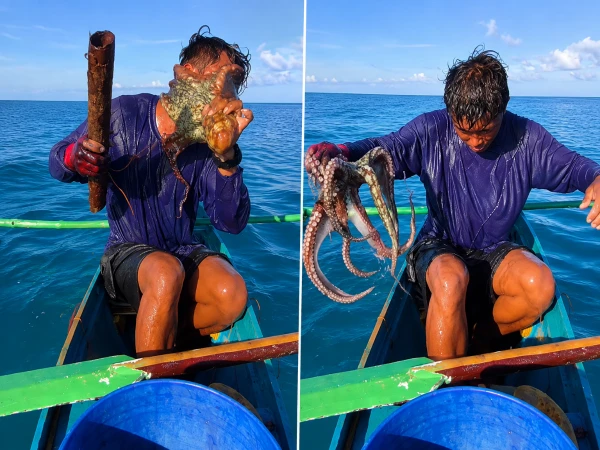
A surprising video from the Philippines is going viral on social media after an octopus was seen clinging tightly to a fisherman’s face.

In the video the octopus has wrapped several of its arms around the man’s face.

https://www.instagram.com/reel/Db8hqV-jCoX/?igsh=MWFoNmNucmlzNW1ucQ==

The fisherman can be seen struggling to remove it from his face. He tries several times to pull the octopus away but its strong suction cups make it difficult to free himself.

After several attempts he slowly loosens the octopus’s grip and finally removes it.

The fisherman then releases the octopus back into the water. Experts explain that an octopus has hundreds of suction cups on its eight arms. These help it hold onto different surfaces and objects firmly.

The octopus may have reacted defensively because of the unusual situation and tried to protect itself by holding on tightly.

Similar Posts

  • |

    “The Ark” in an era of ecological reckoning

    In summer 2026, the power plant “Batcave” opened a group exhibition The Ark curated by renowned painter Eric Fischl alongside Powerhouse Arts President Eric Shiner. Bringing together roughly 90 animal sculptures by a multigenerational line-up of international artists. The exhibition uses the ancient narrative of the Great Flood as a mirror for modern ecological and cultural turmoil. The concept behind The Ark draws directly from the myth of the Deluge, an archetypal narrative found across diverse world traditions where catastrophic waters sweep away the old world to test human stewardship and resilience. Yet rather than adopting a purely apocalyptic or alarmist tone, the exhibition framing focuses on empathy, kinship, and survival. Co-curator Eric Fischl notes that animal sculpture offers a unique vehicle for exploring profound existential truths. Animal sculpture also captures raw instinct and sublime wonder through physical form. By placing non-human creatures at the center of the narrative, the exhibition encourages viewers to rethink their place within the broader web of life.  From Historic Whaling Port to Post-Industrial Sanctuary The journey of The Ark mirrors its thematic concern with changing environments. An earlier, smaller iteration of the show debuted at The Church in Sag Harbor, Long Island. A historic coastal town deeply tied to the 19th-century whaling industry. In that seaside context, the sculptures called to mind maritime history and marine life under threat. When relocated and expanded for Powerhouse Arts in Brooklyn, the narrative shifted dramatically toward urban ecology and environmental remediation. Displaying ninety animal figures inside a rehabilitated power plant adjacent to heavily polluted urban waters creates a poignant visual tension. The physical site itself acts as a metaphor: an industrial relic turned creative sanctuary, witnessing the slow process of ecological recovery alongside the artistic preservation of animal life. Masterpieces of Instinct and Form The roster of participating artists spans decades and stylistic movements, uniting legendary figures of contemporary art with bold emerging voices. Pioneering Figures: Works by artists such as Maurizio Cattelan, Kiki Smith, Bruce Nauman, Sarah Lucas, and Jim Dine showcase how animals have long served as psychological stand-ins for human vulnerability, angst, and desire. Expanded Roster for Brooklyn: Newly added works by artists including Wangechi Mutu, Cannupa Hanska Luger, François-Xavier Lalanne, Nohemí Pérez, and Nari Ward introduce critical perspectives on Indigenous land sovereignty, post-colonial environments, and urban material reuse. Craft and Material Labor: Because Powerhouse Arts functions primarily as a fabrication facility, the exhibition doubles as a tribute to artistic craftsmanship. Visitors encounter bronze beasts, woven totems, carved wood, and reassembled found materials, celebrating the tactile labor behind each creation.   By encouraging close physical encounters with these sculpted beasts, The Ark bridges the gap between artistic tradition and ecological activism. It asks visitors to consider what merits saving when tides rise. It is suggesting that compassion for vulnerable creatures may well be our most essential anchor in turbulent times.

  • “A Glimpse After Twenty-One Days”

    By Amar Qawi If, someday, the entire sky were covered in darkness—without a moon, without stars, without even the faintest sparkle—would a lover whose heart glows like moonlight still be able to live beneath such a sky? That day, I sat on the rooftop of my house searching for the moon. But fate had something else in store. Instead of appearing in the heavens, the moon descended into the street below to grant me a glimpse after twenty-one long days. I did not dwell much on that radiance because something similar had happened to me earlier, on the fifteenth of July. Therefore, I took it as nothing more than an unfulfilled dream rather than believing that the moon belonged to me. In truth, even considering someone as one’s possession is itself a form of poverty. Since childhood, society has taught us that air, fire, and water are the necessities of life. Yet I feel sorry for those teachers who remain unaware of a deeper truth: human beings do not survive by air, fire, and water alone. Love, inspiration, and moonlight are equally essential for the soul to remain alive. A person may survive in this highly technical age amidst bombs and weapons, but without the sight of the beloved, the soul can never truly live. Just as air, fire, and water are essential to human existence, so too is the vision of the beloved. The truth is, I was not sitting on the rooftop in search of the moon in the sky. I was waiting for that moon from whom my moonbird-like heart had been separated for what felt like centuries. And yet, even when I found that moon, it was only within my dreams. Twenty-one days after the fifteenth of July, as I walked through that familiar street, she passed by me just as a shadow silently slips along a wall in the darkness. She is my shadow, and I am her reflection. She is my reflection, and I am her moonbird. She is the full moon to me. Whenever she shines like the full moon, my heart, like a restless chakor bird, longs to fly toward her and kiss her beauty. But alas, those delicate butterfly-like wings eventually grow weary from endless flights inspired by love. When I saw her in that street after twenty-one days, the fallen Taj Mahal of my imagination began to rebuild itself. The shy poet hidden within me blossomed with the spirit of Sheikh Ayaz’s immortal lines: “O moon! Who has stolen your sleep? Surely the chakor birds have enchanted you.” Just as Sheikh Ayaz expressed, something similar happened to me. When I first met her, I had no intention of falling in love. Yet I vividly remember that when we parted, dryness had settled upon our lips while tears embraced our eyes. It was as though the Urdu poet had written about our separation: “When we parted, my poem remained within her eyes— A poem that had never yet been recited to anyone.” When she passed beside me after twenty-one days, my eyes swore by the little golden nose ornament she wore and silently recalled the beautiful verse of Shah Abdul Latif: “Who says, my beloved, that you should walk gently? Place your feet upon my eyelashes without hesitation. Leave behind all fear of causing pain, For your passage itself is my greatest joy.” When even her tongue could not gather the courage to speak to me, my own eyes, too, denied themselves the permission of truly beholding her after those twenty-one days. Love is not dependent upon union; it longs for the meeting of souls. Therefore, for a lover like me, a glimpse after twenty-one days carries no real meaning if the beloved merely passes by like a silent shadow in the darkness. In the end, I wish to encourage the young people of our society who lose their dreams and their future while chasing someone who does not value their love. As an Urdu poet beautifully said: “If you have changed, then so be it. If not you, then someone else. And if not someone else, then another.” Thus, that glimpse after twenty-one days holds no value for me if it is wrapped in deception, falsehood, and unfaithfulness. To me, that meeting means nothing if pride and arrogance overshadow love. She merely appeared in the street and passed by like a shadow. Yet even today, I continue to wait for her, because my heart still loves that moon-like beloved with the devotion of a chakor bird. Even after twenty-one days, she remains steadfast in her pride. Still, the beloved’s pride is a matter of honor for the lover, for the beloved herself is both the lover’s pride and the most precious treasure he possesses. He can be reached at alikareemshaikh123@gmail.com

  • Why does food make your mouth water

    Have you ever seen your favorite food smelled it or simply thought about it and suddenly felt your mouth watering? This can happen even when you are not very hungry. Just seeing or smelling food can make your body prepare for eating. Experts call this the “cephalic phase of digestion.” In simple words it means your body can start preparing for digestion before food even reaches your mouth. Your brain prepares your body When you see, smell or think about a favorite food your brain gets a signal that food may be coming.  It then sends signals to different parts of the digestive system. One of the first things that happens is that your mouth produces more saliva.  Saliva makes food softer and easier to chew and swallow. It also helps start the digestion process. That is why seeing hot pizza, biryani, jalebi or another favorite dish can make your mouth water.  Your body is already getting ready to eat. It is not always about hunger Mouth watering does not always mean you are very hungry.  You may even feel full and still have a strong reaction to your favorite food. Food cravings can be affected by its smell appearance memories and past experiences. For example, the smell of a homemade dish from childhood may bring back old memories and make you want to eat it again. Smells can trigger strong reactions Sometimes you do not even need to see food. A delicious smell from the kitchen can make you feel hungry within seconds. But the opposite can also happen. A bad smell unpleasant sight or negative memory can make you feel sick or lose your appetite. For example if you once became sick after eating a certain food, your brain may connect that food with the bad experience. Later even its smell may make you feel nauseous. •Your body has a protective system These reactions are part of the close connection between the brain and the digestive system.  Your brain does not only help you notice food you like it can also help protect you from food that may be harmful. A bad smell or unpleasant appearance can make you avoid certain food. In some cases it may even cause nausea or reduce your appetite. So the next time your mouth waters when you see your favorite dish remember that your body may already be preparing for the meal before you take your first bite.

  • Can you solve this tricky fruit math puzzle? 

    At first glance this looks like a simple math question for children. However the way it is designed makes it surprisingly difficult and many people end up with the wrong answer. In the puzzle each type of fruit has a different value. Your challenge is to figure out the value of each fruit and then calculate the final equation. The last line asks you to add one cherry one apple and three bananas. To solve it correctly you need to carefully work out the value of each fruit from the previous equations. For example the first equation shows three apples adding up to 30, so each apple is worth 10. The other equations reveal that each banana is worth 4 and each cherry is worth 1. Using these values: Apple = 10 Banana = 4 Cherry = 1 Final calculation: 10 + (3 × 4) + 1 = 23 Correct Answer: 23 Note If the original puzzle counts each banana as 1 because it changes from a bunch to a single banana or uses a different image in the last row the answer may change. The answer depends on the exact picture shown. The text you provided says 14 but based only on the values stated in the text (apple = 10, banana = 4, cherry = 1) the total is 23.

  • My life and my struggle 

    I have been suffering from this mental illness for so many years, and I don’t know what to do. Sixty-five percent of my life has been spent suffering from obsessive compulsive disorder and schizophrenia. My mother is Mahrukh Butt, and she is with me here in Lahore. I don’t know when these sufferings will end. It has crossed the limits, you know. I am in Lahore, Pakistan right now. The day before yesterday I was so unwell. I was in Lahore at my home, and I heard voices for more than five hours, and I was getting a severe headache, and I was going through hell, and I still am. I don’t know what to do. The sufferings have no intention of stopping. We are born into this world with no fault of our own, and there is only misery in this life. I hear voices almost every day for hours, and as you know, I have been having compulsions for more than fifteen years now, and that is not a joke. They tell me that if I don’t do the compulsions, then something bad will happen to me. I want to go to Karachi with my friend Alina Mehmood, who is six years older than me and used to come to our house in Islamabad when my father was alive, when we used to have parties at our house in Khudadad Heights. The party used to start at ten at night and go on till four in the morning, and the music was playing, and everything was rocking. I will go to Karachi by plane, and that will cost over forty thousand rupees, and I will go to Dolmen Mall and also to Liberty Books, though it is very expensive. The music in the background reminds me of London and Bangkok. My relative Hassan Raza Sherazi has gone to England, and I will go straight to Islamabad when he comes back, as a matter of fact. The thing I love to do is travel by plane. I love going to Thailand, and also writing books and articles. We went to New York City twice, to my father’s friend’s house in the suburb of Millburn. I love to write articles for Pakistani newspapers, although I get no money for doing so, as a matter of fact. A few months ago, I was in my bedroom here in Lahore, and I was waiting for the aliens to come and abduct me, but no one came. They had to take me to their planet or to the moon, although the American government is actually covering up aliens and these sorts of conspiracy theories, and they do not want the public to know the reality and the truth behind aliens. But I know that they exist. I am in Lahore, Pakistan right now. I spent twenty-five days in Islamabad, Pakistan, and now I have shifted into my house in Cantt. I really want to go to Karachi, Pakistan, as I need a break.

  • Why Women’s mental health matters

    Senior Pakistani actress and film maker Rubina Ashraf has spoken about postpartum depression and the emotional challenges women may face during pregnancy and after giving birth. Rubina Ashraf recently appeared as a guest on the television show Good Morning Pakistan where she discussed women’s mental health and the importance of emotional support during pregnancy and motherhood. She said that in the past, mental health problems linked to pregnancy and childbirth were often not taken seriously.  Society usually treated childbirth as a normal responsibility of every woman without fully understanding how difficult the experience could be for some mothers. The actress explained that pregnancy brings many physical changes to a woman’s body including changes in the skin weight and overall health. Along with happiness these changes can sometimes cause stress anxiety and emotional pressure. She added that a lack of proper care and support during this period may make a woman more vulnerable to serious emotional difficulties including postpartum depression. Rubina also highlighted the importance of a husband’s love care and understanding during pregnancy and after childbirth. She said that managing physical changes household responsibilities  and caring for a newborn can be challenging so emotional and practical support from a partner can make a big difference. Her comments also highlight the need to take women’s mental health seriously and ensure that new mothers receive proper care understanding and support.

Leave a Reply

Your email address will not be published. Required fields are marked *