punjab cnf arrests

Punjab CNF arrests smuggler with cocaine worth Rs43.2 million

The Major operation by the Punjab Counter Narcotics Force (CNF) took place in Rawalpindi in which smuggler Shahidullah Khan is arrested. The accused was allegedly involved in smuggling narcotics to Saudi Arabia; he was apprehended with 108 cocaine capsules in a suspicious vehicle at the Fateh Jang-Tarnol Interchange.

The vehicle used for smuggling and the cocaine have been seized. The estimated value of the recovered narcotics is PKR 43.2 million.

The scope of operations against drug dealers is being expanded.

The Punjab CNF has achieved a major success in protecting the youth by foiling the shipment of a large consignment of narcotics.

The net is being tightened around drug dealers and their facilitators.
Joint efforts will be undertaken.

Punjab CNF is committed to curb the menace of drugs collectively with the help of the society.

Similar Posts

  • | | |

    Weak bureaucracy lies at heart of governance crisi…

    Recent remarks by Interior Minister Mohsin Naqvi, who said that Pakistan’s governance system has “collapsed,” have once again sparked debate over the country’s administrative failures. However, the real issue goes far beyond the number of provinces or administrative units and cannot be attributed solely to a lack of political will at the highest level. The core problem, according to the analysis, is the gradual weakening of Pakistan’s civil administrative structure, which has steadily lost its ability to govern effectively over the past several decades. Instead of identifying this institutional failure, the minister’s comments appear to focus on the symptoms of the crisis rather than its root causes. The repeated reliance on extraordinary measures, task forces, and parallel administrative structures itself reflects the inability of the regular civil bureaucracy to perform its responsibilities efficiently. Under the leadership of Army Staff Field Marshal Asim Munir,the military leadership has consistently emphasized economic revival, action against organized mafias, and restoring investor confidence. The establishment of the Special Investment Facilitation Council (SIFC) also emerged as a response to the inability of the civil bureaucracy to deliver timely economic solutions. However, such initiatives cannot permanently replace an efficient civilian administrative system. The governance crisis stems from the persistent decline in the effectiveness of Pakistan’s civil bureaucracy across the federation, provinces, divisions, and districts. Political interference, weak accountability, and poor human resource management have significantly undermined its performance. Punjab is often cited as a partial exception, where relatively limited political interference in routine administration has enabled the bureaucracy to function more effectively. This reinforces the argument that sustainable governance depends on institutional autonomy and merit-based administration rather than temporary or emergency arrangements. Governance experts have long advocated restoring the Establishment Division at the federal level and the Services and General Administration Departments (S&GADs) in the provinces to their original role as independent institutions responsible for managing human resources. Their objective is to ensure that appointments, promotions, and career planning remain protected from political influence and external pressure. The analysis further argues that Pakistan’s civil service should adopt a structured personnel management system similar to the military’s Military Secretary Branch at General Headquarters (GHQ), where recruitment, promotions, training, and career progression are managed through institutional discipline based on merit and performance rather than political considerations. The military’s internal human resource management system is often regarded as organized, merit-based, and largely insulated from political interference. In contrast, the civil Establishment Division is frequently viewed as a bureaucratic office where transfers and appointments are influenced by political lobbying, personal connections, and pressure from powerful groups instead of institutional needs. These practices have produced long-term consequences. Civil servants are often assigned to positions unrelated to their expertise, career planning remains weak or absent, and accountability mechanisms continue to be inconsistent and ineffective. As a result, governance across various sectors has suffered. The report notes that these shortcomings have been identified repeatedly over the years. More than 20 commissions and reform committees have reviewed Pakistan’s civil service structure during the country’s history. Between 1996 and 2008 alone, at least six major studies highlighted the same concerns, including politicization of the bureaucracy, the absence of merit-based appointments, and weak institutional management of human resources. Despite these findings, most recommendations were never implemented. Successive governments, whether civilian or military, have shown little willingness to reduce their influence over administrative appointments and transfers. Consequently, repeated attempts at civil service reform have failed to produce lasting institutional change. The analysis concludes that Pakistan’s governance crisis is not the result of a failure to identify the problem but rather a lack of political commitment to implementing meaningful institutional reforms. In this context, Mohsin Naqvi’s recent remarks do not fully address the deeper structural weaknesses within the state. The central issue is not merely that the system has collapsed, but that the country’s primary administrative engine—the civil bureaucracy—has been allowed to deteriorate without comprehensive reform. The proposed solution is not the creation of additional provinces but the rebuilding of the civil administrative system on the principles of merit, protection from political interference, and professional career management comparable to the military’s administrative framework.


  • | |

    Information Ministry accuses Al Jazeera of biased …

    The Ministry of Information and Broadcasting has accused international broadcaster Al Jazeera of presenting a misleading picture of the recently held Azad Jammu and Kashmir (AJK) Legislative Assembly elections, alleging that its coverage selectively portrayed the electoral process. In an official statement, the ministry said the broadcaster reported from selected polling stations in Muzaffarabad and relied on carefully chosen interviews and timings that did not accurately reflect the overall conduct of the elections. It claimed the reporting created a distorted impression of the voting process and failed to represent the broader electoral environment. The ministry further alleged that such coverage appeared aimed at undermining the credibility of the elections and ignoring what it described as the democratic will expressed by voters across the region. It maintained that the people of AJK had exercised their right to vote despite political tensions. Alongside its criticism of the coverage, the ministry reminded foreign media organisations operating in Pakistan that reporting assignments outside Islamabad, Lahore and Karachi require prior approval under the country’s External Publicity Guidelines. It urged all foreign correspondents to comply with the regulations governing reporting in other parts of the country. The AJK elections, however, remained under intense scrutiny after allegations of irregularities and isolated incidents of violence emerged during polling. Opposition parties accused authorities of interfering in the electoral process, while the ruling coalition exchanged allegations of rigging and misuse of state resources. Human rights organisations also expressed concern over reports of deaths and injuries linked to election-related unrest. They called for transparent and independent investigations into the incidents and stressed that maintaining public order should not come at the expense of fundamental rights, including peaceful assembly and freedom of expression. The elections were held against the backdrop of political unrest that has continued in AJK since last year’s protests over governance reforms and constitutional issues. The controversy surrounding reserved refugee seats in the AJK Legislative Assembly also remained a major political issue during the campaign.

  • Tarar links AJK unrest to foreign funded agenda

    Information Minister Attaullah Tarar said on Tuesday that the recent protests by the banned Joint Awami Action Committee in Azad Jammu and Kashmir were not peaceful. He alleged that militant groups pursuing a foreign agenda, backed by funding from India, were involved in the unrest. Earlier the same day, AJK Information Secretary Muhammad Rashid Hanif said many protesters taking part in the JAAC demonstrations were linked to Fitna Al Khawarij. This is the term Pakistani authorities use for militants belonging to the banned Tehreek-i-Taliban Pakistan. Speaking at a press conference, Hanif said illegal and violent acts had taken place in AJK, aimed at disrupting the ongoing phases of the region’s elections. He said maintaining law and order and protecting the democratic process remains the state’s core duty, and the state is capable of doing so. Hanif said the JAAC protests were not made up of ordinary citizens alone. He played a video showing masked gunmen standing on a rooftop as evidence. He said common protesters were fewer in number, while armed militants linked to Fitna Al Khawarij were present in significant numbers. He urged people to distance themselves from these elements and said the government would issue public appeals soon. He also alleged that anti-state groups were using women and children as human shields, and that misleading videos calling this a human rights movement were being spread on social media. AJK police spokesperson DIG Irfan Kashfi said these armed individuals would be treated as militants, not peaceful protesters, given their possession of automatic weapons, M-4 rifles, AK-47s, and reportedly sniper rifles. He said one police official was killed and five others injured in recent clashes. One suspect, described as a foreign national acting as a sniper, was arrested in Rawalakot with a military-grade weapon in his possession. Kashfi said security forces were acting purely in self-defence and to protect the public, and assured citizens that militants would not be allowed to capture Rawalakot or any other area. AJK Prime Minister Faisal Mumtaz Rathore said the unrest had been planned for weeks and described the march toward Muzaffarabad during the elections as a scheme to trigger mass unrest. He appealed to the public to stay away from the protesters, alleging they were using civilians as human shields. The JAAC was declared a banned organisation on June 5 after weeks of protests demanding the abolition of 12 reserved refugee seats in the AJK assembly. Authorities have since arrested many of its leaders and placed 147 activists under anti-terrorism watch.

  • | | |

    Pakistan stock exchange slides over 1,100 points 

      KARACHI: The Pakistan Stock Exchange (PSX) experienced a volatile trading session on Tuesday as strong gains recorded in early trading quickly disappeared, with the benchmark KSE-100 Index ending the day more than 1,100 points lower. Widespread profit-taking in major sectors, combined with cautious investor sentiment influenced by global market uncertainty, weighed heavily on the market. The benchmark KSE-100 Index initially climbed to an intraday high of 178,768.83 points, reflecting optimism among investors during the opening hours. However, the momentum proved short-lived as selling pressure gradually intensified across the market. By the close of trading, the index had fallen to 177,083.22 points, registering a decline of 1,116.80 points, or 0.63%, after touching an intraday low of 177,043.10 points. Market participants attributed the sharp reversal to extensive profit-booking in several heavyweight sectors. Commercial banks, oil and gas exploration companies, cement manufacturers, investment firms, and fertiliser stocks all came under significant selling pressure, dragging the benchmark index into negative territory despite its promising start. Investor confidence also remained subdued due to mixed developments in international financial markets. Asian stock markets traded without a clear direction as investors balanced encouraging corporate earnings from the United States against continuing geopolitical tensions. At the same time, international oil prices climbed by more than two percent as uncertainty surrounding diplomatic efforts to ease tensions between the United States and Iran persisted. Concerns over potential disruptions to global oil supplies through major shipping routes also contributed to market caution. Commenting on the day’s performance, Ahmed Sheraz, an equity trader at KTrade Securities, said the KSE-100 Index remained under pressure throughout the session because the market lacked fresh positive catalysts capable of sustaining its recent upward momentum. According to him, the absence of encouraging economic or corporate developments prompted investors to lock in profits after recent gains. Sheraz noted that selling activity was widespread across key sectors, particularly banking, oil and gas, cement, investment companies, and fertilisers. He added that despite Brent crude oil trading between $84 and $86 per barrel, investors largely preferred to stay on the sidelines while waiting for stronger economic indicators and corporate earnings announcements before making new investment decisions. Looking ahead, Sheraz believes the stock market is likely to remain highly sensitive to news flow. Upcoming corporate earnings reports, macroeconomic indicators, and foreign investment activity are expected to play a decisive role in shaping market sentiment over the coming weeks. He also identified the 176,500 to 177,000-point range as an important technical support level for the benchmark index, suggesting that maintaining this level could help stabilise the market. Trading activity slowed compared with the previous session. Total market volume declined to 711.2 million shares, down from 785.3 million shares recorded on Monday. Meanwhile, the total value of traded shares stood at Rs25.8 billion. A total of 495 companiesparticipated in trading during the session. Among them, 161 stocks closed higher, 295 stocks ended in negative territory, while 39 stocks remained unchanged. Pakistan International Bulk Terminal emerged as the session’s most actively traded stock, with approximately 89.8 million shares changing hands. The company’s share price declined by Rs0.34, closing the session at Rs16.74.

  • | |

    Terrorism case registered after clash at MQM-P hea…

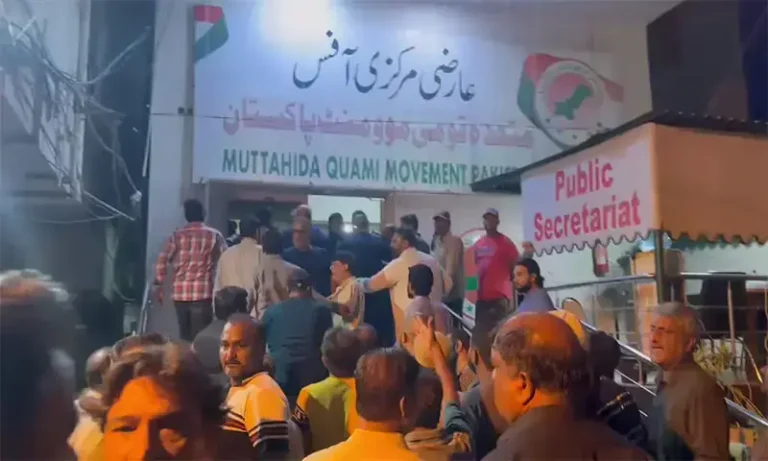
    Karachi police have registered a case under the Anti-Terrorism Act following a violent clash between rival groups at the Muttahida Qaumi Movement-Pakistan (MQM-P) headquarters in Bahadurabad that left several people injured and spread panic in the surrounding area. According to the First Information Report (FIR), the case has been registered by the state at New Town Police Station under multiple sections of the Pakistan Penal Code, including rioting, attempted murder, causing injuries and unlawful assembly, along with Section 7 of the Anti-Terrorism Act. Police have nominated two suspects, identified as Azhar alias Lumba and Zeeshan Habib, while 20 to 25 unidentified individuals have also been named in the case. Investigators said police received reports on the evening of August 2 that two groups had clashed near Choti Market in Bahadurabad. During the violence, a man identified as Amir sustained a bullet injury to his arm, while two others, Asad and Kashir Ali, were also injured. All three were shifted to Abbasi Shaheed Hospital for treatment. The FIR states that both groups allegedly exchanged gunfire and fired into the air, creating fear among residents and disrupting public order. Authorities also noted that Section 144 was in force at the time, prohibiting the display of weapons and public disorder. Police said the suspects fled the scene before law enforcement personnel arrived. The incident reportedly occurred during a party meeting at MQM-P’s central office. According to police, tensions escalated after the meeting ended, leading to a confrontation between supporters of different party factions. Officials said workers belonging to one faction allegedly assaulted members of the rival group and forced them out of the party headquarters. Heavy gunfire was also reported from inside the premises, causing alarm among nearby residents.

  • | |

    Rashid Latif urges PCB chairman to utilize Younis …

    Former Pakistan Test captain and wicketkeeper-batter Rashid Latif has called on Pakistan Cricket Board (PCB) Chairman Mohsin Naqvi to make better use of former captain Younis Khan’s expertise for the growth and development of cricket in the country. Latif believes that experienced former players like Younis Khan can play a significant role in nurturing young talent and strengthening Pakistan’s cricket structure. Speaking at the inauguration ceremony of the Younis Khan Cricket Academy at KHA Legend Arena in Karachi’s Gulshan-e-Iqbal, Rashid Latif stressed the need to put Pakistan cricket on the right path by involving accomplished cricketers in the development process. He said Younis Khan’s vast experience and commitment to the game make him one of the best individuals to guide the next generation of players. Latif also reflected on Karachi’s rich cricketing history, noting that there was a time when the Pakistan national team featured a large number of players from the city. However, he said the situation has changed over the years, and Karachi no longer contributes players at the same level as it once did. Highlighting the importance of Karachi’s Malir district, Rashid Latif said the area has produced several outstanding cricketers, including Saeed Anwar, Khurram Manzoor, Asim Kamal, Younis Khan, and himself. According to him, the region has long been a breeding ground for cricketing talent and deserves continued investment in player development. The former captain also pointed out that while many of Younis Khan’s contemporaries are seeking positions within the Pakistan Cricket Board, Younis has remained focused on serving the game by working directly with aspiring cricketers. Latif praised this dedication, saying it reflects Younis Khan’s genuine passion for Pakistan cricket. Rashid Latif expressed confidence that the Younis Khan Cricket Academy will help revive grassroots cricket in Karachi by providing young players with quality coaching and professional guidance. He emphasized that similar initiatives can strengthen the country’s cricketing future if supported by the PCB and other stakeholders. Concluding his remarks, Latif paid tribute to Younis Khan’s remarkable achievements, describing his record of more than 10,000 Test runs and 34 Test centuries as an extraordinary milestone. He said cricketers of Younis Khan’s caliber are produced only once in a generation, making it essential for Pakistan cricket to benefit from his experience and leadership.

Leave a Reply

Your email address will not be published. Required fields are marked *