river encroachments raise

River encroachments raise flood risks across Pakistan

Islamabad: Encroachments on rivers, nullahs and other natural waterways are increasing flood risks across Pakistan, a parliamentary committee warned, calling for strict action to clear blocked water channels. The committee also expressed displeasure over the absence of the Sindh Irrigation Secretary and warned that the matter could be sent to the Privileges Committee.

The Senate Standing Committee on Water Resources, chaired by Senator Jam Saifullah Khan, reviewed the flood situation, disaster preparedness, water storage and coordination between federal and provincial authorities.

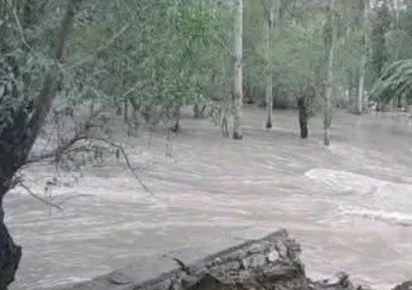
The meeting was held at the National Disaster Management Authority headquarters. Members expressed serious concern over illegal construction and other encroachments along natural waterways, including the Ravi River and nullahs in different parts of the country.

The committee said natural water channels must remain open so floodwater can move safely during heavy rainfall and monsoon emergencies. It called for strict measures to remove encroachments and prevent further occupation of rivers, drains and other water bodies.

The Secretary of the Ministry of Water Resources informed members that a draft Flood Plain Regulations Act had already been shared with provincial governments. Chairman Jam Saifullah Khan directed the ministry to follow up with the provinces and strengthen joint efforts for flood prevention and management.

The committee also expressed displeasure over the absence of the Secretary Irrigation of the Sindh government. Members indicated that continued non-attendance could lead to referring the matter to the Privileges Committee.

The chairman directed the Sindh Irrigation Secretary to personally attend the next meeting. Another sensitive issue discussed was water distribution between provinces. The committee said any solution must be based on consensus, particularly because lower riparian provinces have concerns about water sharing.

Members called for a wider national debate on water security and Pakistan’s long term water problems. The chairman said water security was directly connected with food security and the future of coming generations.

He said all stakeholders should be part of an open national discussion so disagreements could be addressed through broader agreement. The committee was also briefed on the current monsoon situation and the government’s emergency response arrangements.

Members were informed that the Prime Minister had formed an Emergency Response Committee headed by a senior federal minister. The committee is responsible for coordinating with all concerned authorities, including district administrations, during the monsoon emergency.

Senator Jam Saifullah Khan said such coordination should not remain active only during floods or disasters. He said the system should operate throughout the year so institutions remain prepared before emergencies begin.

The parliamentary delegation was received by the Chairman of NDMA at the National Emergencies Operations Centre. Members received a briefing on the technology used for disaster monitoring and decision making.

NDMA officials explained the use of Global and National Portals, Hydro Analytics and the Water Equation system. The committee was also briefed on Disaster Lens 2026. Officials described it as an integrated technology based system designed to improve disaster risk assessment, preparedness and government decision making.

The committee appreciated NDMA’s use of advanced technology, data analysis and risk information for disaster management and water planning. Water storage was another major subject discussed during the meeting. Members said Pakistan needed stronger water storage capacity to manage both shortages and excess floodwater.

The committee discussed better water monitoring, planning based on reliable data and more efficient use of available water resources. It also discussed technology based solutions to improve national water security and reduce risks linked to climate change.

Members were briefed on the possible use of smaller local water storage facilities. The committee was told that such facilities could be used alongside large dams to store extra floodwater. This could help reduce flood damage while also saving water for future use.

The growing pressure from population growth and climate change was also discussed. The committee said increasing demand for water made modern irrigation systems more important.

It called for new irrigation technologies that could produce more crops while using less water. Members said such measures were important not only for water conservation but also for Pakistan’s food security.

The Ministry of Water Resources told the committee that research had been conducted comparing high efficiency crop production methods with existing farming practices. The chairman directed officials to present the full findings at the committee’s next meeting.

Mechanized agriculture was also discussed as a possible way to increase agricultural production. Members observed that tax incentives for higher horsepower tractors could help farmers modernize agricultural operations.

The committee said better machinery, modern irrigation and improved water management could help increase farm production while reducing waste. The meeting also focused on stronger cooperation between the federal government, provinces, district administrations and disaster management authorities.

Members stressed that floods and water shortages cannot be managed effectively if different institutions work separately. The committee said better data sharing, early warnings and clear responsibility among institutions were essential for protecting communities.

After the meeting, committee members visited several NDMA facilities. These facilities included the Centre of Excellence, the Logistics and Humanitarian Hub, and the Disaster Resilient Infrastructure Models centre.

Officials briefed the delegation on emergency preparations, logistics, disaster response and technology being used during crises. The committee said its visit helped improve coordination between Parliament and NDMA.

It called for stronger early warning systems, better water management, modern technology and long term planning to protect Pakistan against floods, water shortages and climate related disasters. The committee made clear that Pakistan’s water challenge is no longer limited to building dams or distributing river water.
Similar Posts

  • | | |

    Source rejects Imran deal, Shehbaz-Asim rift repor…

    An informed source familiar with political and government developments has categorically rejected speculation about any possible “deal or relief” for former Prime Minister Imran Khan, as well as reports of differences between Prime Minister Shehbaz Sharif and Chief of Army Staff Field Marshal Asim Munir. The source described the possibility of both developments as “zero,” amid intense speculation following the Supreme Court’s order concerning Imran Khan’s medical treatment. It had been expected that Imran Khan would be shifted to Shifa International Hospital for treatment. However, instead of being taken to Shifa International, he was transferred to the Pakistan Institute of Medical Sciences (PIMS) and later returned to Adiala Jail. The development triggered speculation in political circles about whether the issue was linked to a possible deal or some form of relief for the Pakistan Tehreek-e-Insaf founder. When specifically asked whether there was any possibility of a deal or concession for Imran Khan, the informed source gave a clear one-word response: “Zero.” The source was also asked about reports and speculation regarding differences between Prime Minister Shehbaz Sharif and Field Marshal Asim Munir. The response was again: “Zero.” According to the source, such speculation is not unusual in Pakistan. Political developments involving the civilian and military leadership have historically been interpreted through the lens of possible deals, concessions or disagreements between the civilian government and the military establishment. The source said that whenever an unusual political development takes place, speculation immediately emerges that a behind-the-scenes deal may be under discussion or that differences have developed between the civilian and military leadership. However, the source stressed that the current political and institutional arrangement should not be viewed through the lens of Pakistan’s past political experiences. Referring to the political setup that took shape around three to four years ago, the source said the relationship between the civilian government under Shehbaz Sharif and the military leadership was “completely different” from arrangements witnessed in the past. The source also suggested that many reports currently circulating may reflect the wishes or expectations of certain individuals rather than the actual situation on the ground.

  • | |

    Iran cannot be subdued, people are forcing enemies…

    TEHRAN: Iranian Parliament Speaker Mohammad Baqer Qalibaf has said that Iran cannot be subdued, claiming that the country’s people are standing united against external pressure and forcing their opponents to retreat. Qalibaf made the remarks while congratulating General Mohsen Rezaei on his appointment to the Supreme National Security Council. He described Rezaei’s inclusion in the council as evidence of the confidence placed in him by Iran’s Supreme Leader. According to Qalibaf, Iran is currently passing through one of the most sensitive periods in its history. He said recent developments had demonstrated to the international community that attempts to bring Iran under pressure would not succeed. The Iranian parliament speaker said national unity remained strong across the country, with the public, military and diplomatic institutions standing together under the leadership of Supreme Leader Mojtaba Khamenei. Qalibaf further claimed that the Iranian people were demonstrating resilience in the face of their adversaries and were now putting pressure on the opposing side to back down. His comments come amid heightened tensions surrounding Iran and the United States, with disagreements over regional security, military threats and the strategic Strait of Hormuz continuing to dominate international attention.

  • 10 police personnel martyred in Hangu terror attack laid to rest

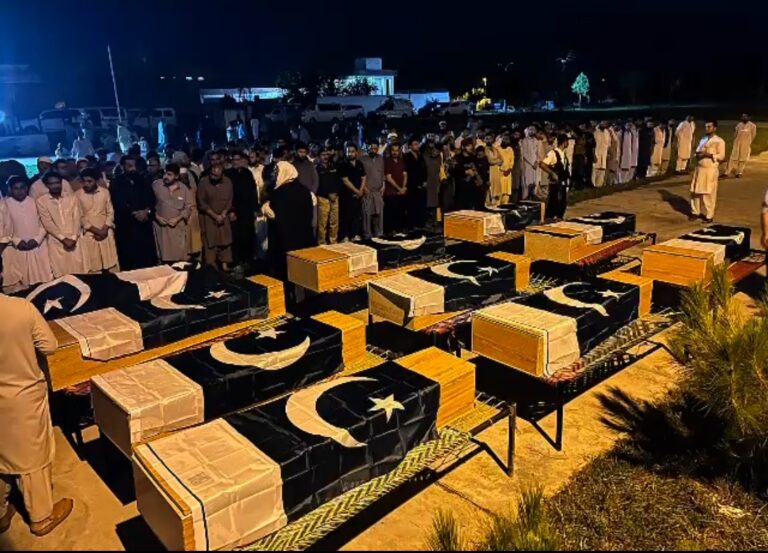
    HANGU: Ten police personnel, including DSP City Diyar Khan, who embraced martyrdom in the terrorist attack on the Khazina Banda Check Post in Hangu, were laid to rest with full state honours on Wednesday. The funeral prayers were offered at the Police Lines, Hangu, where senior police officers, government officials, fellow policemen and local dignitaries paid tribute to the fallen heroes. Commandant Police Training College Hangu, Shaukat Abbas, Deputy Commissioner Basir Ali Rehman, senior police officials and a large number of citizens attended the funeral. Floral wreaths were laid on the coffins of the martyrs in recognition of their supreme sacrifice. After the funeral, the bodies were dispatched to their native towns for burial with full official honours. According to police officials, terrorists belonging to the banned Fitna Al-Khawarij launched a coordinated assault on the Khazina Banda Check Post late Tuesday night. The attackers reportedly used quadcopters before laying siege to the check post. Police personnel stationed at the post resisted the assault bravely and continued fighting until the last moment. Upon receiving information about the attack, DSP City Diyar Khan led a reinforcement party comprising personnel from the Elite Force, RRF and Al-Barq Force. However, the police convoy was ambushed near the Khazina Banda Bridge, where heavily armed militants had already taken positions. Despite the surprise attack, the police fought courageously in defence of the country. The attack claimed the lives of 10 police personnel, including DSP Diyar Khan, while around 30 others were injured. Police officials said that during the exchange of fire, 12 to 15 terrorists were killed or wounded, and their accomplices reportedly carried the casualties towards the Zargari area. Following the incident, police and security forces launched a large scale search operation in the area. Funeral prayers for the martyrs were also held in their respective hometowns. Police Constable Nadeem was laid to rest in Sheikhan, while Constable Sanaullah was buried in Lachi, both with full state honours. Smartly turned out police contingents presented ceremonial salutes, and senior police officers, political leaders, social figures and hundreds of residents attended the funerals. Similarly, the funeral prayer of martyred police constable Abdul Saeed, a resident of Lower Dir, was offered in his native village Katan Pyan. District Police Officer Lower Dir Syed Talal Ahmad Shah and other police officers attended the ceremony and paid tribute to the martyr, assuring his family that the sacrifices of police personnel would never be forgotten. Meanwhile, Khyber Pakhtunkhwa Chief Minister Sohail Afridi paid a brief visit to Hangu and stayed at the Police Club, where he offered prayers for the departed souls of the martyrs and the early recovery of the injured personnel. However, the Chief Minister left Hangu without visiting the injured policemen undergoing treatment in hospital. His decision not to meet the wounded officers has drawn criticism and raised questions in various circles, as several injured personnel remain admitted to hospitals following the attack. In contrast, Additional IG Elite Force Muhammad Ali Gandapur visited the hospital to inquire about the health of the injured policemen. He was accompanied by Regional Commander Elite Hafiz Nazir and DSP CTD Imranuddin. Inspector General of Police Zulfiqar Hameed, Chief Secretary Shahab Ali Shah, and Special Assistant to the Chief Minister Tariq Saeed Marwat also visited the hospital and met the injured officers. Speaking to the media, IG Zulfiqar Hameed said the police fought the terrorists with exceptional courage for several hours despite facing drone attacks. He stated that 12 to 14 terrorists were killed during the operation and confirmed that all injured policemen were in stable condition and receiving the best available medical treatment. The IG announced that recommendations would be forwarded for gallantry awards, including the Tamgha-e-Shujaat, for the martyrs and other officers who displayed extraordinary bravery during the operation. He vowed that those responsible for the attack would be brought to justice. Chief Secretary Shahab Ali Shah praised the courage of the police force, saying their sacrifice demonstrated their unwavering commitment to protecting the people despite grave danger. He also appreciated the district administration and hospital management for ensuring timely medical treatment for the injured. Special Assistant Tariq Saeed Marwat reaffirmed the provincial government’s commitment to supporting the police force financially and administratively. He said the nature of terrorism had evolved with the use of drones, adding that the government was working to equip the police with anti drone technology and other modern capabilities to effectively counter emerging security threats.

  • |

    August 12 total solar eclipse, will it be visible in Pakistan?

    Islamabad – A rare total solar eclipse will occur on August 12, 2026 attracting the attention of astronomy enthusiasts around the world. However, will it be visible in Pakistan? The solar eclipse will not be visible in Pakistan as it will be nighttime in the country during the key phases of the eclipse. According to Pakistan Standard Time, the partial eclipse will begin at 8:34 PM on August 12 while the total eclipse will begin at 9:58 PM. The eclipse will reach its peak at 10:46 PM and the total eclipse will end at 11:34 PM. Where will solar eclipse be visible? On August 12, the Moon will pass between the Earth and the Sun causing a total solar eclipse to be visible in Greenland, Iceland, northern Russia and parts of Spain and Portugal. A partial solar eclipse will be visible across various parts of North America, Canada, most of Europe and northwestern Africa. According to NASA, the Sun will set during the eclipse in western parts of Europe and Africa creating a unique spectacle in which the solar eclipse will coincide with sunset. How can solar eclipse be watched live? NASA will also provide an online live broadcast of this astronomical event which can be watched online from Pakistan on the night of August 12. Astronomers have warned people in areas where the eclipse will be visible never to look directly at the Sun without specially designed solar-viewing glasses as doing so can cause severe damage to the eyes.

  • | |

    PTI leader Abdullah Tahir murder case: Police unco…

        LAHORE – In a significant development in the high-profile murder case of Pakistan Tehreek-e-Insaf (PTI) leader Abdullah Tahir, the police investigation has uncovered shocking details involving a sophisticated honey-trap operation and the use of drone cameras for surveillance. Abdullah Tahir, a prominent political figure, was gunned down in the upscale Gulberg area of Lahore just a few days ago, sending shockwaves through the political landscape and prompting widespread calls for a swift and transparent investigation. According to official police sources and investigative reports, the murder was not a random act of violence but a meticulously planned assassination that leveraged technology and human manipulation to track the victim’s movements. The breakthrough in the case came when investigators zeroed in on the victim’s personal driver, who has become a pivotal figure in the unfolding narrative. Police interrogation and digital forensics have revealed that the driver was systematically honey-trapped by a female accomplice working in tandem with the primary suspects. The investigation has established that the female suspect initiated contact with Abdullah Tahir’s driver through a popular social media application. Over a period of several days, she allegedly cultivated a rapport with the driver, gaining his trust and extracting crucial information about his employer’s daily routines, security arrangements, and travel schedules. The use of social media as a tool for reconnaissance highlights the increasing sophistication of criminal networks in Pakistan, which are now exploiting digital platforms to orchestrate targeted killings. The most damning evidence, however, emerged from the timeline of the day of the murder. Police sources confirm that on the fateful day, after the driver had accompanied Abdullah Tahir to his clinic, a video call was placed between the driver and the female suspect. During this call, the suspects are believed to have instructed the driver to confirm the victim’s presence at the clinic in real-time. The video call effectively served as a live verification mechanism, allowing the hitmen to ensure that their target was indeed on the premises before they moved in to execute the attack. This revelation underscores the calculated and cold-blooded nature of the conspiracy. Furthermore, the investigative team has uncovered evidence that the suspects deployed a drone camera to conduct aerial surveillance of the clinic and its surroundings prior to the assassination. The drone was reportedly used to map out the location, identify potential escape routes, and monitor the movement of security personnel or any other individuals who could interfere with the operation. The use of drone technology in this case represents a disturbing new trend in criminal activity, indicating that the perpetrators had access to advanced equipment and technical expertise, possibly hinting at a larger network behind the killing. The recovery of digital data from the driver’s mobile phone, including chat logs, call records, and multimedia files, has been instrumental in piecing together the conspiracy. The police have also detained the female suspect for interrogation, and efforts are underway to trace the other accomplices who participated in the planning and execution of the murder. Preliminary investigations suggest that the suspects operated with a high degree of coordination, using encrypted communication methods to avoid detection.   Abdullah Tahir’s murder has already become a politically charged issue, with his party, the PTI, demanding a high-level judicial inquiry and condemning what they describe as a failure of state institutions to protect their leaders. The party has also alleged that the killing may be linked to political vendettas, though the police have so far refrained from assigning a political motive to the crime, stating that all angles are being explored. As the investigation continues, the focus remains on capturing the masterminds and executing the attack. The police have assured the public and the political leadership that no effort will be spared in bringing the culprits to justice. The use of honey-trapping and drone surveillance in this case has not only complicated the investigation but has also raised serious questions about the safety of public figures in an era of rapidly evolving technological threats. The authorities are now reviewing security protocols for VIPs and considering stricter regulations on the use of drones and surveillance equipment to prevent similar incidents in the future.

  • | |

    Azma Bukhari hits back at Sharjeel Memon over AJK …

    Punjab Information Minister Azma Bukhari has strongly criticised Sindh Minister Sharjeel Memon over his remarks about the Azad Jammu and Kashmir (AJK) elections. Azma Bukhari told Memon to “drink cold water and pour some on his head,” saying the election was over and the people of AJK had already delivered their verdict. She said the election results had proved the Pakistan Peoples Party’s (PPP) calculations wrong and dismissed its allegations regarding pre-poll rigging. Bukhari claimed that a PML-N candidate had recovered bags containing ballot papers from the residence of a PPP candidate one night before polling. Taking a sharp jibe at the PPP, she said its “arrow had disappeared in the valleys of Kashmir,” while the PML-N’s “lion” was roaring across the region. She said AJK voters had given their verdict in favour of PML-N leader Nawaz Sharif during the first phase of the elections. Bukhari urged the PPP to learn to accept defeat instead of raising allegations whenever it loses an election. She said political parties should celebrate victories but also show maturity in defeat. She further questioned the PPP’s position on elections in Gilgit-Baltistan. Bukhari asked whether the party considered those elections transparent because it had formed the government there. She said it was unfair to describe an election as transparent when a party wins and allege rigging when it loses.

Leave a Reply

Your email address will not be published. Required fields are marked *