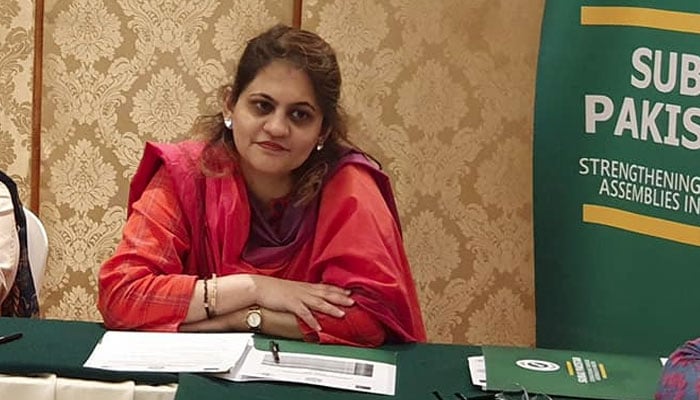
sindh government spokesperson
| |

Sindh government spokesperson accuses Hafiz Naeem …


Sindh government spokesperson Sadia Javed has accused Jamaat-e-Islami Pakistan Emir Hafiz Naeem ur Rehman of distorting the context of what she described as sincere national agreements reached in the past.

In a statement issued from Karachi, Sadia Javed said that Hafiz Naeem was presenting previous national agreements in a misleading manner. She criticised the Jamaat-e-Islami leader for allegedly attempting to portray past understandings between political stakeholders in a way that did not reflect their original spirit or context.

She questioned Hafiz Naeem’s position on electricity generated from Thar coal, asking why he remained silent about what she described as some of the cheapest electricity being produced through the country’s indigenous coal resources.

“Why is Hafiz Naeem silent on the inexpensive electricity generated from Thar coal?” she questioned, while responding to his criticism of the Sindh government and the Pakistan Peoples Party (PPP).

Sadia Javed also strongly rejected what she described as allegations against the Sindh government, saying that Hafiz Naeem had no justification for issuing what she termed “mafia certificates” to others.

She challenged the Jamaat-e-Islami leader to examine his own political record before making accusations against others. According to her, political leaders should first reflect on their own actions and positions before questioning the credibility or performance of others.

The Sindh government spokesperson further defended the provincial government’s policies and highlighted the importance of Thar coal in meeting Pakistan’s energy requirements. She suggested that criticism of the provincial government should be based on facts and a complete understanding of the agreements and projects under discussion.

Another Sindh government spokesperson, Ghanhor Khan, also criticised Jamaat-e-Islami and Hafiz Naeem, accusing them of making allegations based on what he described as political hypocrisy.

Ghanhor Khan said that making accusations against the PPP over the issue of Independent Power Producers (IPPs) was part of what he called Jamaat-e-Islami’s unsuccessful political strategy. He argued that the party was attempting to use the controversial issue of IPPs to create political pressure against the PPP and the Sindh government.

The dispute comes amid renewed political debate over Pakistan’s electricity sector, particularly the cost of power generation, agreements with IPPs and the role of domestic energy resources. Political parties have frequently criticised successive governments over electricity prices, power-sector contracts and energy policies.

The Sindh government has continued to highlight Thar coal as an important component of its energy strategy, while its political opponents have raised questions about governance, transparency and the broader impact of energy-sector agreements.

The exchange between the Sindh government and Jamaat-e-Islami reflects growing political tensions over energy policy and the interpretation of past agreements. While Hafiz Naeem has criticised the government’s handling of the power sector, Sindh government representatives have rejected his allegations and questioned the consistency of his political position.

Both sides have continued to defend their respective positions, with the Sindh government emphasising its energy initiatives and Jamaat-e-Islami maintaining its criticism of the power-sector policies.

Similar Posts

  • |

    Fawad Blames PML-N, PPP for political deadlock

    Former federal minister Fawad Chaudhry said Pakistan cannot move forward politically or economically as long as the country’s two major ruling parties, the Pakistan Muslim League-Nawaz (PML-N) and the Pakistan Peoples Party (PPP), continue to dominate national politics. Speaking to reporters in Islamabad, Fawad criticized former president Asif Ali Zardari and former prime minister Nawaz Sharif, arguing that their continued influence has prevented the country from making meaningful progress. He said Pakistan would struggle to achieve stability and development unless it moved beyond what he described as the traditional political leadership. Fawad also took aim at Prime Minister Shehbaz Sharif’s economic record. He noted that Shehbaz has presented a total of 17 budgets during his political career, including 12 as chief minister of Punjab and five at the federal level. He questioned what new solutions the prime minister could still offer after overseeing so many budgets. Commenting on constitutional reforms, Fawad said he supports the transfer of administrative powers, adding that decentralization could strengthen governance if implemented effectively. Addressing the broader political situation, he stressed that any genuine national dialogue must include the founder of Pakistan Tehreek-e-Insaf (PTI), who remains in prison. Fawad said the PTI founder is the country’s most influential political leader and should be engaged in talks as a Pakistani citizen. He added that he shares a long political association with the PTI founder and believes meaningful negotiations cannot succeed without his participation. Former Sindh governor Imran Ismail, who was also present during the media interaction, said he has submitted a request to meet the PTI founder. According to Ismail, he intends to discuss proposals related to the creation of new provinces and seek his opinion on the issue before moving forward with any political discussions.

  • | |

    Pakistani celebrities call for peace and justice amid unrest in AJK

    Several Pakistani celebrities have spoken out over the recent unrest in Azad Jammu and Kashmir (AJK), using their social media platforms to express solidarity with residents while urging peace, justice and accountability. Among the first to react was actor Durefishan Saleem, who shared a lengthy Instagram post explaining why she believes speaking about political and social issues is a responsibility rather than a choice. “You’re too political. Of course I am. How could I not be when everything happening around me is connected to the lives we live?” she wrote. The actor added that the decisions made by those in power affect every aspect of daily life. “The prices we pay, the education we receive, the opportunities we get, and the future we are slowly building are all affected by the choices made by people in power. I speak up because I pay attention.” She concluded her message by saying she did not want to remain silent until issues directly affected her. “I don’t want to be the person who only starts caring when an issue finally reaches my doorstep.” Ending the post, she wrote, “Yes, I am political. Because how can I not be, when this is the country I call home.” Several other celebrities, including Hania Aamir, Mahira Khan, Osman Khalid Butt, Minal Khan, Komal Meer, Nadia Afgan, Kinza Hashmi and Hina Afridi, also shared posts highlighting the situation and expressing support for the people of AJK. Television host Anoushey Ashraf voiced concern over reports that Gaza-based activist Mushtaq Ahmed had allegedly been prevented from entering Kashmir while attempting to express solidarity with residents. Sharing her thoughts on Instagram Stories, she wrote, “They behave like they’ve given us such amazing lives that we stop trusting our own people and trust them? Trust your brothers in Pakistan. They’re our families and our sisters. Our children. Not anyone else’s agents.” Actor Mashal Khan also addressed the violence through an emotional video, captioning it, “Human life is HUMAN LIFE.” In the video, she questioned the growing loss of human compassion. “What is happening in the world? Every day on Instagram, there is something happening somewhere. This many people have died, that many people have died. We’ve made human lives worthless, as if the lives of mothers and children are worth money. Sometimes Kashmir, sometimes Iran.” Comedian Tabish Hashmi also shared a video expressing his concerns. “I don’t know what the consequences will be for speaking out about this in this country, but what I have been seeing on social media is very disheartening,” he said. He added, “There is not much I can do besides make this video and share my voice, hoping that it can help bring about change.” Actor Mishi Khan urged more members of Pakistan’s entertainment industry to publicly address the issue instead of remaining silent. “In showbiz, there have been many Gen Z protests that were talked about in India, and now when it comes to Pakistan, Azad Kashmir and Balochistan, why are we not raising our voices?” she asked. She continued, “I am not saying to take up arms or go out onto the streets, but as citizens of Pakistan, it is our right to raise our voices on social media, speak out against what is wrong, and stand with the people of Kashmir.” Actors Samar Jafri and Bilal Qureshi also joined the growing calls for solidarity. Jafri shared an Instagram Story that read, “Sad to see what’s happening in our country. My heart goes out to the people of Azad Kashmir.” Meanwhile, Qureshi criticised the entertainment industry for overlooking the issue. “Disrespect happens in the industry every day. Please, for God’s sake, talk about the national issue affecting our brothers and sisters and raise your voices for them. Kashmir bleeds!” he wrote. As videos and reports from AJK continue to circulate online, public figures across Pakistan’s entertainment industry have increasingly used their platforms to call for peace, justice and support for those affected.

  • | | |

    Uganda backs sending troops to planned Gaza peace …

    Uganda’s Parliament has approved a government proposal to deploy troops to a planned international peace and stabilisation force for Gaza, marking the country’s first commitment to the proposed multinational mission. The resolution was introduced by Uganda’s Minister of Defence and received parliamentary approval following debate among lawmakers. With the decision, Uganda joins Morocco, which has also announced its willingness to contribute troops to the proposed force. The Ugandan government has not publicly disclosed the diplomatic discussions or political considerations behind its decision. However, the move sparked debate in Parliament, with opposition members expressing concerns about the potential implications for Uganda’s foreign policy and regional relationships. Opposition lawmaker Hassan Kiromera questioned the mission’s objectives, asking which parties Ugandan troops would ultimately be expected to confront if deployed. He argued that the government should provide greater clarity regarding the mandate of the proposed force before committing military personnel. Defence Minister Jacob Oboth-Oboth defended the proposal, stating that the Uganda People’s Defence Forces (UPDF) possess extensive experience in international peacekeeping operations, including missions in Somalia and other conflict zones. He said that this experience would enable Ugandan troops to contribute effectively to efforts aimed at restoring peace and stability in Gaza. According to the report, the proposed Gaza International Stabilisation Force is expected to consist of approximately 20,000 personnel from multiple countries. The force is reportedly planned under a proposal associated with US President Donald Trump’s Board of Peace and would be commanded by US Major General Jasper Jeffers. The mission is intended to help maintain law and order in Gaza following the end of hostilities between Israel and Hamas. Reports indicate that the proposal was first introduced earlier this year as part of broader discussions on post-conflict governance and security arrangements in the territory. The development follows recent announcements regarding a reported agreement under which Hamas would disarm and Israel would gradually withdraw its military forces from Gaza. Under the reported framework, the international stabilisation force would be deployed after the phased Israeli withdrawal. However, uncertainty remains over the implementation of the proposed arrangement. Israeli officials have reportedly expressed serious security concerns after reviewing the reported agreement, arguing that certain provisions could pose risks to national security. As a result, questions remain about the timeline and conditions for the deployment of the multinational peace force despite Uganda’s parliamentary approval.

  • | |

    Javed Akhtar says internet discourages originality

    Javed Akhtar has been writing words that endure for more than five decades, and in a candid conversation with Vogue India, he turned his gaze toward what he believes is happening to creativity in the digital age. What he found does not reassure him. The veteran lyricist and screenwriter argued that the internet and its algorithms have created a culture of creative fear, one in which people are no longer willing to take the risk of doing something that has not already been done before. “The echo chambers created by the internet have made most people afraid to do something for the first time,” he said. “Once someone else does it, they’re fine to follow in their footsteps.” He extended that observation into a broader concern about how people engage with ideas and the world around them. “People no longer want to pause, think, analyse or sit with an idea. They are living happily, so why would they bother to think about this universe or the vastness of nature? For them, it is a waste of time.” For Akhtar, this impatience is incompatible with the kind of work that lasts. “Meaningful creation requires time, discomfort and reflection,” he said, adding that his own willingness to question dominant voices and widely accepted ideologies has always come from exactly that kind of sustained engagement with ideas. He was particularly pointed about the music industry and the way commercial priorities have pushed the role of lyrics to the margins. “Today, words have become less important because the marketing team has decided that slow music won’t trend,” he said. The result, in his view, is an industry that remixes old material with inferior new writing rather than producing something genuinely fresh. “But then they take those same songs, edit the mukhras and remix them with some inferiorly written antaras. There was a time when writers had more space. Today, other forces dictate what music gets made. And yet, songs that are decades old still endure, while many recent ones have a short shelf life.” His advice to young writers was direct and unglamorous. Read more. Not only classical literature and celebrated authors, but light reading too. “The real loss is not in reading something trivial but in not reading at all,” he said. On the creative process itself, Akhtar drew a distinction that cuts to the heart of what separates craft from genuine art. “All arts can be divided into two parts. On one hand, there’s imagination, passion, fantasy and romance, and on the other, there is craft. You can learn the craft in a crash course. But imagining, fantasising and romanticising cannot be learned. There are no courses for yearning.” He closed with a lesson passed down from his father that has stayed with him throughout his career. “It is very easy to write in difficult language, but very difficult to write in easy language. When you write simply, there is no space for your idea to hide behind big words. Only if you are totally convinced of what you are writing can you afford to use transparent language.” It is a principle that has shaped some of Hindi cinema’s most enduring words, and one that no algorithm is likely to teach.

  • | | |

    AJK Election Commission officially notifies poll r…

    The Azad Jammu and Kashmir Election Commission has officially notified the results of the first phase of the Legislative Assembly elections. The notification confirms a strong performance by the Pakistan Muslim League-Nawaz (PML-N) in the Mirpur Division. The PML-N won nine of the 13 seats contested in the first phase. The Pakistan Peoples Party (PPP) secured the remaining four seats. The official notification formally declared all successful candidates elected. It also included their parentage, political affiliation and constituencies. In Mirpur district, four assembly seats were contested. The PML-N won two seats. Azhar Sadiq and Chaudhry Rukhsar Ahmed were declared successful. The PPP also won two seats in the district. Qasim Majid and Chaudhry Yasir Sultan secured victories for the party. The PML-N delivered its strongest performance in Bhimber district. The party won all three constituencies in the district. Colonel (retd) Waqar Ahmed Noor, Chaudhry Abdul Razzaq and Chaudhry Tariq Farooq were declared winners. Kotli district had six constituencies. The PML-N secured four of them. Umair Naeem, Raja Muhammad Asif, Raja Riasat Khan and Raja Ayaz Ahmed won their respective constituencies. The PPP captured two seats in Kotli. Malik Zafar Iqbal and Chaudhry Muhammad Yasin were declared successful. With the notification, the election authority has formally confirmed all 13 members elected from the Mirpur Division. The results give the PML-N an early advantage in the three-phase AJK election. The party now enters the next stage with nine seats from the first phase. The PPP has four seats and remains a key political force in the division. Attention has now shifted towards the second phase of polling. The second phase is scheduled for August 2. Voting will take place across the Muzaffarabad Division. The phase will include nine general constituencies in Muzaffarabad, Jhelum Valley and Neelum Valley. It will also include 12 reserved seats for refugees from Indian Illegally Occupied Jammu and Kashmir residing in Pakistan. The third and final phase will be held in the Rawalakot Division. The final phase will cover constituencies in Rawalakot, Sudhnoti, Bagh and Haveli. Political parties are expected to intensify their campaigns ahead of the remaining phases. The PML-N’s strong opening performance has increased pressure on rival parties. The upcoming rounds will determine whether the party can maintain its momentum across other divisions.

  • |

    Shubman Gill returns to No.1 in ICC ODI batting rankings

    India captain Shubman Gill has reclaimed the No.1 position in the ICC Men’s ODI batting rankings after an outstanding run of form in the recently concluded three-match ODI series against England. The right-handed opener produced another impressive performance with the bat, scoring a total of 188 runs across the series. His consistency at the top of the order helped him climb back to the summit of the rankings, marking the third time in his international career that he has occupied the top spot among ODI batters. Gill’s return to the top was also influenced by New Zealand batter Daryl Mitchell, who missed the final two matches of his team’s ODI series against the West Indies because of injury. Mitchell’s absence prevented him from adding to his ranking points, allowing Gill to move ahead in the latest ICC update. The latest rankings also featured significant movements in both the batting and bowling charts across ODI and T20I cricket. Namibia spinner Bernard Scholtz emerged as one of the biggest gainers in the ODI bowling rankings. The experienced left-arm spinner climbed five places to seventh after delivering a series of impressive performances during Namibia’s ICC Men’s Cricket World Cup League 2 tri-series campaign in Utrecht against Nepal and the Netherlands. His consistent wicket-taking ability played a crucial role in Namibia’s successful campaign and earned him a place among the world’s leading ODI bowlers. Meanwhile, India’s teenage batting sensation Vaibhav Sooryavanshi continued his remarkable rise on the international stage. The youngster was named Player of the Series after a brilliant display in India’s T20I series against Zimbabwe. He scored 151 runs in just three innings while maintaining a stunning strike rate of 196.10, underlining his aggressive approach at the crease. Having played only six T20 internationals so far, Sooryavanshi made one of the biggest jumps in the latest rankings, soaring 230 places to reach 48th in the ICC Men’s T20I batting rankings. His rapid progress highlights his growing reputation as one of India’s most exciting young talents. India also enjoyed success elsewhere in the T20I batting rankings. Tilak Varma moved up two places to sixth after continuing his consistent performances in the shortest format, while Shreyas Iyer climbed seven positions to reach 24th following a productive series. The bowling rankings also witnessed notable changes. Zimbabwe fast bowler Blessing Muzarabani gained 10 places to move into 26th position after delivering impactful performances with the new ball. India leg-spinner Ravi Bishnoi also registered one of the biggest improvements of the week, jumping 31 places to claim the 41st spot in the T20I bowling rankings. The latest ICC rankings reflect recent performances across international cricket, with several players making significant progress through consistent displays. While Gill’s return to the top of the ODI batting rankings remains the biggest headline, the rise of emerging talents such as Sooryavanshi and the continued progress of bowlers like Scholtz, Muzarabani and Bishnoi highlight the growing competition across all formats of the game.

Leave a Reply

Your email address will not be published. Required fields are marked *