trump says controls
| | |

Trump says US controls Strait of Hormuz

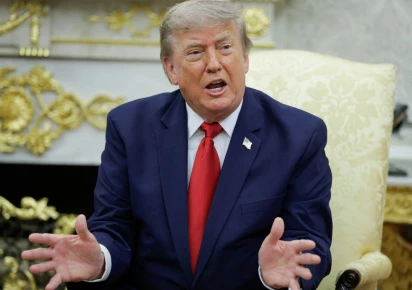
US President Donald Trump has claimed that the United States is now controlling the Strait of Hormuz.

Trump said the US Navy had cleared the entire waterway of naval mines. He made the remarks while speaking to reporters at the Oval Office.

The Strait of Hormuz is a major international shipping route. It is also an important passage for global energy supplies. Any disruption in the area can affect international trade and energy markets.

Trump was asked about the next steps following recent talks with Iran. However, he declined to provide details about what the United States would do next.

The US president also indicated that Washington could increase pressure on Iran. He did not give specific details about what further action could be taken.

Trump has also announced plans to seek compensation from Iran. The demand is linked to Americans who were killed or injured in various conflicts involving Iran.

He had earlier said that Iran should provide compensation to the families of those killed aboard the US Navy destroyer USS Cole.

Trump said his administration was seeking compensation for people who had been killed or wounded in different conflicts. He argued that Iran should be held responsible for the losses.

According to Trump, Iran had not previously demanded compensation during earlier negotiations or discussions at different levels. He said Tehran had now unexpectedly raised such a demand.

Trump said his decision to seek compensation from Iran would be made in response to the Iranian demand.

The latest statements come as tensions between Washington and Tehran remain high. Trump has continued to signal that the United States is prepared to take further action if necessary.

However, he did not reveal whether the US would pursue additional military or diplomatic measures.

Similar Posts

  • | | | |

    US strikes IRGC bases after Iran missile attack

    The Middle East moved a step closer to a broader regional conflict after the United States launched large-scale airstrikes against dozens of Islamic Revolutionary Guard Corps (IRGC) facilities across Iran in retaliation for Tehran’s ballistic missile attack targeting American forces stationed in the region. According to the US Central Command (CENTCOM), the operation targeted military command centers, drone infrastructure, weapons depots and other strategic IRGC installations during a coordinated two-hour campaign. US officials said the strikes were intended to weaken Iran’s ability to threaten American troops, commercial shipping lanes and allied Gulf nations. Iranian state media reported that at least three people were killed during strikes on Qeshm Island, while authorities vowed that the country would continue defending its territory against what it described as “American aggression.” The crisis quickly spread beyond Iran’s borders. Jordan announced that its air defence systems intercepted five missiles following Iran’s confirmed launch toward US military installations in the kingdom. Washington maintained that all missiles directed at American bases were successfully intercepted, preventing casualties among US personnel. In another major development, US and Saudi forces carried out coordinated strikes against Iran-backed armed groups operating in eastern Iraq after drone attacks launched from Iraqi territory targeted Saudi oil facilities. The joint operation marked the first publicly acknowledged military action conducted together by Washington and Riyadh against Iran-aligned militias. Regional instability deepened further after a fire broke out aboard a US-owned gas storage tanker at Egypt’s Mediterranean port of Damietta. Although maritime security experts suggested the blaze may have resulted from a drone strike, Egyptian officials confirmed only the fire and said investigations into its cause were continuing. The latest escalation comes against the backdrop of months of confrontation between Iran, the United States and Israel. Fighting resumed after disputes over the strategically important Strait of Hormuz ended a short-lived ceasefire reached in June. US President Donald Trump reiterated that America would respond decisively to attacks on its forces while insisting diplomatic efforts remained active. However, continued military exchanges around the Strait of Hormuz have complicated negotiations and increased concerns over global energy supplies. Iran has claimed it targeted three tankers attempting to pass through what it called an unauthorized route in the strait, while rejecting an Omani-backed proposal supported by Gulf states for joint management of the crucial waterway. The conflict has also rattled global energy markets, with Brent crude prices climbing above $90 per barrel before easing later in trading. Meanwhile, Iraq’s Iran-backed Popular Mobilisation Forces said at least 20 of their fighters were killed in the US-Saudi strikes, prompting Baghdad to condemn the attacks as a violation of its sovereignty while urging all armed groups to halt cross-border military operations. Saudi Arabia has also intensified diplomatic efforts, with Defence Minister Prince Khalid bin Salman meeting US Vice President JD Vance in Washington to urge restraint. Saudi officials reportedly warned that expanding military operations against Yemen’s Houthis and Iran-backed militias in Iraq could trigger unpredictable consequences across the Middle East, highlighting growing fears that the conflict could widen even further.

  • |

    Builders discover Gold hoard worth €9 million hidden inside Belgian house

      Construction workers renovating a property in Belgium have made an extraordinary discovery after uncovering a large collection of gold bars and coins estimated to be worth around €9 million, or approximately Rs2.89 billion. The valuable hoard was reportedly hidden inside the walls of a cellar at a house in East Flanders. According to Belgian media reports, the workers discovered the treasure earlier this week while carrying out renovation work on the property. They were drilling into the building as part of preparations to install new sewage pipes when they unexpectedly came across the hidden collection. The discovery immediately attracted attention because of its enormous value and raised an unusual legal question: who will eventually be entitled to the gold? Both the construction workers who found the treasure and the charity that owns the property could potentially have a claim, depending on the outcome of the investigation. Police have launched an inquiry into the discovery and have warned members of the public to stay away from the construction site. Authorities said the property had effectively been searched and disturbed after news of the discovery spread. The gold has since been removed from the building and placed in a secure location while officials investigate its origin and ownership. The workers reportedly found the treasure while carrying out work around the foundations of the house. Among those involved was an 18-year-old student named Kobe, who was working a summer job at the construction site. Speaking to Belgian public broadcaster . He described the moment as one of disbelief and excitement. He initially thought some of the objects they had uncovered might simply be ordinary €1 coins. However, when the workers noticed what appeared to be a gold nugget among the items, they realised they had discovered something far more valuable. The workers quickly contacted police rather than attempting to take the treasure for themselves. Site manager Mario explained that the sheer quantity of gold made it impossible to secretly keep the discovery. He also acknowledged that taking it would amount to theft. Kobe similarly said that an amount worth around €9 million could not realistically be hidden. The property is currently owned by CAW Oost-Vlaanderen, an organisation that provides welfare and social support in the Dendermonde area, a Flemish community with a population of around 47,000 people. CAW Oost-Vlaanderen director Geert Hillaert said the organisation was shocked and amazed by the discovery. He expressed hope that, if the charity eventually receives part of the treasure, the money could be used to help people in need and support its welfare programmes. Police have appealed to the public not to visit the site in search of additional valuables. Authorities said they hoped the unusual discovery would eventually be placed in the hands of the rightful owner or used in a way that could benefit society. Under Belgian law, a legitimate owner has up to five years to come forward and claim hidden treasure. Prosecutors are currently investigating the circumstances surrounding the hoard, including whether it could be connected to criminal activity. If no owner is identified, Belgian civil law may allow the treasure to be divided between the person who discovered it and the owner of the property. However, this rule applies only if authorities determine that the gold is not connected to a crime. For now, the builders and the charity must wait while investigators determine who has the legal right to the extraordinary fortune. If no rightful owner appears within the five-year period, the discovery could transform an ordinary renovation project into a life-changing event.

  • | |

    ATC extends Mushtaq Ahmad’s remand by four d…

    An Anti-Terrorism Court (ATC) in Islamabad has extended the physical remand of former Jamaat-e-Islami senator Mushtaq Ahmad and his co-accused, Daniyal, by four more days in connection with a case linked to a protest over the situation in Azad Jammu and Kashmir (AJK). The two accused were produced before the court after completing an earlier three-day physical remand. During the hearing, the prosecution sought a 30-day remand, arguing that investigators still needed additional time to recover a vehicle and weapons allegedly connected to the case. According to prosecutors, the investigation remains incomplete because the alleged recoveries have not yet been made. They requested extended custody to continue the inquiry. After hearing arguments from both sides, the court rejected the request for a 30-day remand and instead approved a four-day extension in police custody. The case was registered at Islamabad’s Shalimar Police Station under charges related to a protest concerning recent unrest in Azad Jammu and Kashmir. Mushtaq Ahmad’s legal team has previously claimed that he was detained after attempting to enter AJK to express solidarity with people affected by recent violence in the region. They alleged he was stopped by security personnel at Azad Pattan Bridge, denied entry into AJK and later taken into custody by Punjab Police while returning to Islamabad. Following his release from the earlier detention, Mushtaq Ahmad announced plans to organise a peaceful gathering in Islamabad to express solidarity with the people of Kashmir. He invited political activists, students, journalists and members of the Kashmiri community to participate in the event. The case comes amid heightened political tensions following recent protests in Azad Jammu and Kashmir, where clashes reportedly resulted in casualties and injuries, drawing criticism from several political parties and human rights groups.

  • |

    Pakistan will respond if India threatens water rights: PM Shehbaz

    ISLAMABAD: Prime Minister Shehbaz Sharif has warned that Pakistan will not compromise on its water rights, describing every drop of the country’s water as a “red line” and cautioning India against any move that threatens Pakistan’s sovereignty, security or access to water. Addressing a ceremony in Islamabad following the inauguration of a monument commemorating Pakistan’s recent military success, the prime minister said India had demonstrated its disregard for regional peace by unilaterally suspending the Indus Waters Treaty. He said Pakistan desired peace and stability in the region but would not interpret its commitment to peace as a sign of weakness. “Pakistan stands for peace with honour and dignity,” the prime minister said, adding that the country had emerged as a factor of stability in the region. Referring to the military confrontation with India in May 2025, Shehbaz Sharif praised the armed forces for their role and said the country’s response had demonstrated Pakistan’s determination to defend its territorial integrity and national interests. The prime minister specifically commended Field Marshal Syed Asim Munir for his leadership, while also highlighting the contributions of the Pakistan Air Force and Pakistan Navy under their respective chiefs. He said the performance of the armed forces during the conflict had become a lasting part of the country’s history and represented a victory not only for the military but for the entire Pakistani nation. “This victory belongs to the people of Pakistan and its armed forces,” he said, describing the achievement as a source of national pride. Shehbaz Sharif maintained that Pakistan did not seek confrontation with any country. However, he stressed that Islamabad would respond firmly if its sovereignty or security were challenged in the future. He said the events of May 2025 had sent a clear message to the international community about Pakistan’s military capabilities and national resolve. According to the prime minister, the conflict had significantly strengthened Pakistan’s standing and demonstrated that any attempt to undermine the country’s sovereignty would carry serious consequences. Turning specifically to the water dispute, Shehbaz Sharif criticised India’s decision to suspend the Indus Waters Treaty, calling the move unilateral and unlawful. He warned that Pakistan’s water resources could not be treated as a bargaining tool and said Islamabad would defend its water interests. “Every drop of Pakistan’s water is a red line,” the prime minister declared, warning that if India failed to reconsider its position, Pakistan would respond directly. The prime minister’s remarks come amid heightened tensions between the two nuclear-armed neighbours, with water rights emerging as a particularly sensitive issue alongside longstanding disputes over security and regional stability. Shehbaz Sharif reiterated that Pakistan preferred dialogue and peace but would remain prepared to protect its national interests. He said the country’s policy was based on maintaining peace without compromising dignity, sovereignty or security. He further said the lessons of the May 2025 confrontation should not be forgotten and warned that any future miscalculation against Pakistan would invite a stronger response.

  • | |

    Rubio and Bessent stayed aboard decoy jet as Trump…

    Two members of President Donald Trump’s cabinet remained aboard a decoy aircraft after Trump quietly departed the plane and boarded a different flight while in Turkey last month, according to a US television network report. Secretary of State Marco Rubio and Treasury Secretary Scott Bessent stayed on what was widely believed to be Air Force One and did not join the alternate flight arranged for Trump due to security concerns tied to Iran. Trump boarded Air Force One on July 8 alongside both officials as well as members of the traveling press before slipping away via a catering truck, which transported him discreetly to a separate military aircraft. Because the designation “Air Force One” applies to whichever plane the president occupies, the original aircraft retained the call sign even after Trump had already left it, effectively turning it into the decoy. According to the report, Rubio and Bessent remained on the first aircraft in order to preserve the presidential line of succession in case anything happened to Trump during the flight. Under that line of succession, Vice President JD Vance would assume power if the president died or became incapacitated, followed by the Speaker of the House and the President Pro Tempore of the Senate. The Secretary of State ranks next in the order, followed by the Treasury Secretary. Others who stayed aboard the original aircraft designated as Air Force One included White House Deputy Chief of Staff Stephen Miller and White House communications director Steven Cheung. The second aircraft that carried Trump out of Ankara also included Defense Secretary Pete Hegseth, according to separate US media reports. Speaking to reporters Monday night, Trump said the decision to carry out the plane switch came from the US military and the Secret Service, who he said wanted him to travel on a different aircraft. He did not provide specifics about the nature of the security threat, saying only that he regularly receives numerous threats and that any consequential president faces the same. A request for comment sent to the White House had not been answered as of publication.

Leave a Reply

Your email address will not be published. Required fields are marked *