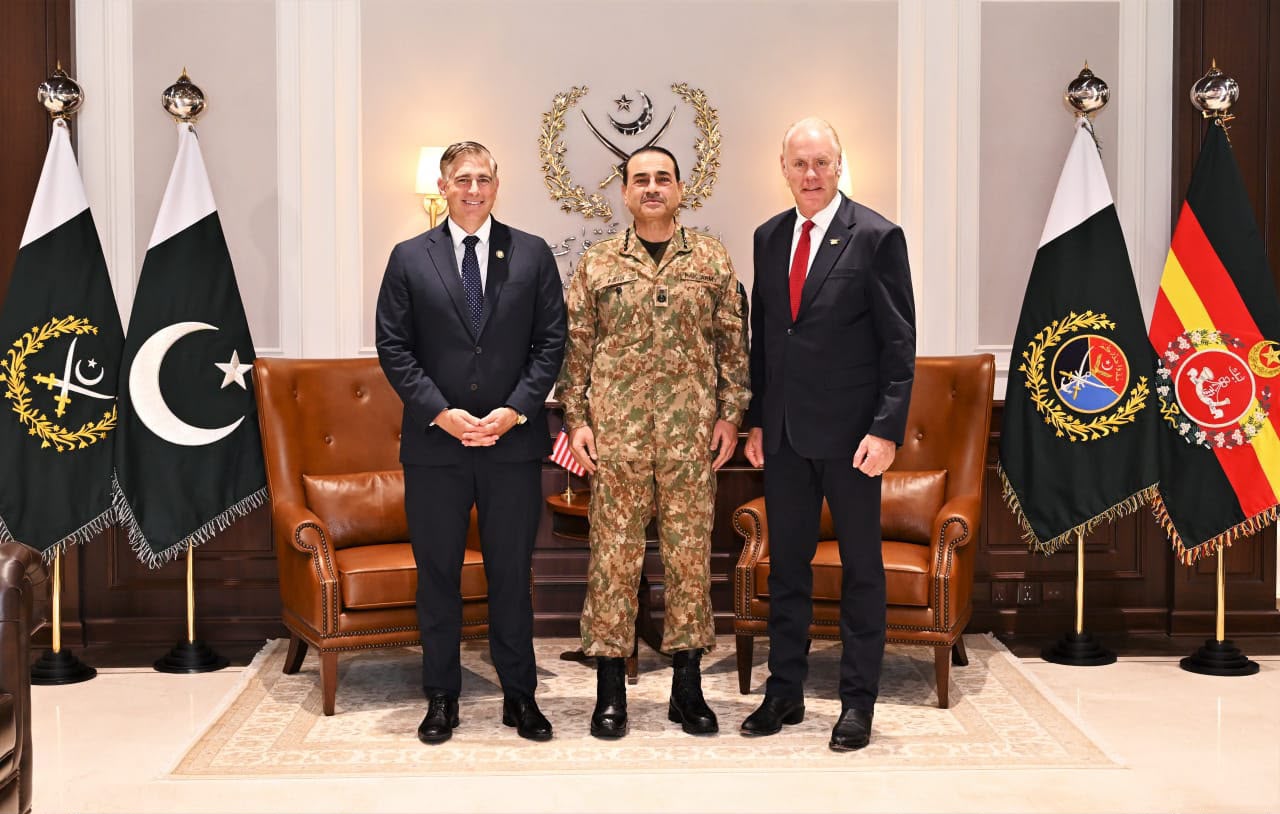
lawmakers hold key
| |

US lawmakers hold key talks with Field Marshal Asi…

Two US lawmakers met Pakistan’s Chief of Army Staff and Chief of Defence Forces Field Marshal Syed Asim Munir at General Headquarters (GHQ) in Rawalpindi on Monday.

Ryan Keith Zinke, a member of the US House of Representatives from Montana, and Michael James, a member of the House of Representatives from Washington state, held talks with the military leadership.

The meeting covered several areas of mutual interest. Regional security, defence cooperation and economic ties between Pakistan and the United States were also discussed.

The talks focused on ways to strengthen bilateral relations. Both sides explored opportunities for closer cooperation in the defence and economic sectors.

Field Marshal Asim Munir highlighted Pakistan’s economic potential during the meeting. He said long-term regional stability depends heavily on economic growth, increased trade and stronger regional connectivity.

The army chief also briefed the visiting lawmakers on Pakistan’s ongoing economic reforms. He said the reforms are aimed at creating a business-friendly environment and encouraging foreign investment.

The Pakistani military leadership also stressed the importance of expanding economic cooperation. Greater trade and stronger links between the private sectors of both countries were discussed as potential areas for future collaboration.

The US delegation acknowledged Pakistan’s importance in maintaining regional stability. The lawmakers also recognised the country’s role in promoting economic resilience in the region.

Both sides discussed opportunities for increasing bilateral trade. They also considered greater private-sector partnerships and broader economic engagement between Pakistan and the United States.

The visiting lawmakers thanked Pakistan’s military leadership for the hospitality extended to them during their visit.

The meeting concluded with a shared emphasis on strengthening relations between the two countries. Both sides expressed interest in developing deeper economic, commercial and institutional links.

The discussions come as Pakistan continues efforts to attract foreign investment and expand international trade. Strengthening economic cooperation with the United States could provide further opportunities for businesses and investors in both countries


Similar Posts

  • | |

    Father challenges medical report in Mir Raza case

    The mystery surrounding the death of young businessman Mir Raza Ali Khan remains unresolved as investigators continue to examine evidence, while the victim’s family insists he was murdered and has raised questions about the findings of the preliminary medical report. Mir Raza’s father, Hussain Raza, has rejected the possibility of suicide. He claimed his son was killed and alleged that attempts were being made to present the case as a suicide. He expressed concern over the medical report, saying it mentioned only the gunshot injury and did not describe what he believes were signs of physical violence on his son’s body. According to the father, Mir Raza had injuries on his face, hands and other parts of his body. He also claimed his son was shot from behind and questioned why the report did not include details of the alleged injuries. He further asked investigators to explain what happened during the period between his son’s disappearance on July 28 and the recovery of his body the following day. He said Mir Raza had spoken to his sister before leaving home and appeared to be in good spirits. The taxi driver who transported him also reportedly told investigators that Mir Raza seemed relaxed and was listening to music during the journey. The family has appealed to senior authorities for a transparent and impartial investigation. The investigation has made further progress with the recovery of another CCTV recording showing Mir Raza’s movements before his death. The footage reportedly captures him taking his mobile phone out of his pocket and throwing it away. Investigators are conducting forensic and technical analysis of the video to determine its significance. Police said the preliminary medical examination found that Mir Raza died from a gunshot wound to the chest. However, the firearm used in the incident and the spent bullet casing have not yet been recovered, leaving investigators without key physical evidence. As part of the ongoing investigation, police are also looking into Mir Raza’s financial dealings. Initial inquiries suggest he had borrowed money from several individuals. Authorities are preparing a list of those people and are questioning them to determine whether any financial dispute may have contributed to the incident. Investigators have so far included 12 individuals in the inquiry and recorded statements from 15 people connected to the case. Earlier CCTV footage showed Mir Raza leaving his shop in Bahadurabad during the early hours after taking a security guard’s pistol from a drawer. He later returned home, where he left behind his car, smartwatch, house keys and Rs39,000 before booking an online taxi. Further footage showed him traveling alone to Gulistan-e-Jauhar. Investigators believe he switched off his mobile phone near Johar Mor before reaching Block 2, where he was last traced.

  • | |

    Ishaq Dar arrives in Manila for ASEAN Forum

    Deputy Prime Minister and Foreign Minister Ishaq Dar arrived in Manila, Philippines, on Wednesday to attend the 33rd ASEAN Regional Forum (ARF) Ministerial Meeting. The visit reflects Pakistan’s continued engagement with regional and international partners on key political, economic, and security issues. Dar reached Manila with a high-level delegation. During his visit, he will participate in the ARF plenary session and hold several bilateral meetings with foreign ministers and senior officials from participating countries. These meetings are expected to focus on strengthening diplomatic ties, expanding economic cooperation, and discussing regional developments. Upon his arrival, Dar was welcomed by senior officials of the Philippine Department of Foreign Affairs, Pakistan’s Ambassador to the Philippines Asima Rabbani, and officials of the Pakistani Embassy. The ASEAN Regional Forum is one of the region’s most important diplomatic gatherings. It brings together foreign ministers and senior representatives from ASEAN member states and partner countries to discuss peace, security, and regional cooperation. This year’s meeting will focus on several pressing international issues. Participants will exchange views on growing geopolitical tensions, regional security challenges, energy security, food supply concerns, trade cooperation, and the impact of ongoing global conflicts. The situation in Myanmar will also be high on the agenda. Leaders are expected to review efforts to implement ASEAN’s Five-Point Consensus and discuss ways to support peace and stability in the country. The continuing tensions between the United States and Iran are also expected to feature prominently during discussions. Delegates will assess the impact of the conflict on regional security, global energy markets, and international trade. Senior diplomats from major world powers are attending the forum. These include representatives from the United States, China, India, Japan, Australia, South Korea, Russia, the United Kingdom, and the European Union. The meeting provides an opportunity for bilateral engagements and dialogue on shared global challenges. ASEAN countries are also expected to discuss measures to strengthen regional energy cooperation. Member states are exploring ways to improve oil-sharing mechanisms to reduce the impact of possible disruptions in global energy supplies.

  • Pakistan’s imports from Iran hit record $1.395 b…

    ISLAMABAD: Pakistan’s imports from Iran surged to a record level during the fiscal year 2025-26, highlighting the growing importance of bilateral trade despite heightened geopolitical tensions in the region. According to sources, Pakistan imported goods worth around $1.395 billion from Iran during FY2025-26, marking a significant increase compared with the previous fiscal year. The data shows that imports from Iran grew by approximately 12% year-on-year during the latest fiscal year. The increase reflects a continuing upward trend in Pakistan’s purchases from its western neighbour, with the import bill rising steadily over the past several years. The growth became particularly pronounced in June 2026. Pakistan’s imports from Iran reached approximately $119 million during the month, representing a 47% increase compared with June 2025, according to the sources. On a month-on-month basis, imports also showed notable growth. Pakistan imported around $100 million worth of goods from Iran in March 2026, while the June figure stood significantly higher. Imports show long-term upward trend The latest figures indicate that Pakistan’s reliance on Iranian imports has expanded considerably over the years. In FY2024-25, Pakistan’s imports from Iran stood at approximately $1.241 billion, compared with $1.395 billion in FY2025-26. The import value was even higher in FY2023-24, when Pakistan purchased goods worth around $1.37 billion from Iran. Despite fluctuations from year to year, the overall trend has remained substantially higher than the levels recorded several years ago. In FY2022-23, imports from Iran amounted to approximately $880 million, while the figure stood at around $773.8 million in FY2021-22. Pakistan’s imports from Iran were recorded at approximately $518.6 million in FY2020-21, showing how sharply bilateral import activity has expanded compared with earlier years. The import bill stood at around $440 million in FY2019-20, meaning the latest figure of $1.395 billion represents more than three times the level recorded six years earlier. Growing trade despite regional tensions The continued rise in imports underscores the importance of cross-border economic activity between Pakistan and Iran. The two neighbouring countries share a long border and have historically maintained trade links involving energy, food products and other commodities. The latest increase also comes amid a challenging regional environment, with geopolitical tensions affecting trade routes, commodity markets and economic activity across the region. For Pakistan, trade with neighbouring countries remains strategically important as the country seeks to manage its import requirements, diversify supply sources and strengthen economic links within the region.

  • |

    Israel’s influence in Washington weakens under Trump says former envoy

    Former Israeli ambassador to the United States Mike Herzog has said Israel’s ability to influence decisions in Washington has declined significantly during President Donald Trump’s current administration. He also warned that support for Israel among the American public has been steadily weakening, creating long term challenges for the country’s relationship with its closest ally. Speaking in an interview with Israeli radio station 103FM, Herzog said the close personal bond that once existed between Israeli Prime Minister Benjamin Netanyahu and Trump no longer appears as strong as before. While Netanyahu recently described his latest meeting with Trump at the White House as one of their best meetings, Herzog argued that the event should be viewed more carefully. In his opinion, the meeting lacked the warmth and personal interaction that previously defined the relationship between the two leaders. Herzog said one positive outcome for Netanyahu was that Trump avoided publicly criticising Israel or placing any visible demands on the Israeli government during the meeting. He suggested that this helped Netanyahu present the visit as a diplomatic success, particularly as Israel moves closer to national elections. According to Herzog, the prime minister had a political interest in showing that his ties with Trump remain strong despite growing speculation that relations between the two leaders have cooled. The former ambassador also pointed to several details surrounding the visit that, in his view, reflected a more distant relationship. Netanyahu entered the White House through a side entrance instead of receiving a more prominent arrival. There was no private one on one meeting between the leaders and media attention surrounding the visit remained limited. Herzog said these diplomatic signals suggested the White House wanted to avoid creating the impression that Trump was closely aligned with Netanyahu. He linked this cautious approach to political concerns in the United States following the conflict with Iran. Herzog said many Americans believe Israel played a major role in drawing the United States into the confrontation. Since the conflict has been unpopular with parts of the American public, he believes Trump is careful not to appear as though he acted under pressure from the Israeli leadership. Even so, Herzog said there are currently no major disagreements between Washington and Tel Aviv over Iran, although the relationship is no longer as close as it once was. Beyond the immediate political situation, Herzog warned that Israel’s overall standing in the United States has suffered lasting damage. He said changes in American society, political shifts, economic developments, international campaigns against Israel and policy decisions made by successive Israeli governments have all contributed to a steady decline in public support. He also acknowledged that the actions of Israel’s current government and the ongoing military campaign in Gaza have negatively affected how many Americans view the country. Netanyahu himself recently admitted that support for Israel has weakened in the United States, arguing that social media has played a major role in shaping public opinion. His comments came as recent polling showed a noticeable increase in negative attitudes toward both the Israeli government and the Israeli people. A survey conducted by the Pew Research Center found that public opinion has shifted over the past several years. The percentage of Americans holding unfavourable views of the Israeli people rose from 28 percent in 2019 to 42 percent in 2026. During the same period, favourable views of the Israeli government fell from 41 percent to 32 percent. International criticism of Israel has also intensified since the war in Gaza began in October 2023. In November 2024, the International Criminal Court issued arrest warrants for Prime Minister Netanyahu and former Defence Minister Yoav Gallant on allegations of war crimes and crimes against humanity linked to Israel’s military operations in Gaza. According to reported figures, more than 73,000 people have been killed during the conflict, which has continued despite a truce agreement reached in October 2025.

  • |

    Russian missile strike kills 15 in Kyiv

    At least 15 people were killed and 27 others injured after Russia launched a large-scale missile and drone attack on Ukraine’s capital, Kyiv, officials said. The attack triggered more than 30 explosions across the city, with air raid sirens sounding throughout Kyiv and surrounding areas as residents sought shelter. The strikes caused widespread damage, and a major fire broke out in one part of the capital following the bombardment. According to Ukrainian authorities, search and rescue teams are continuing operations at the site of a destroyed warehouse, where several people are feared trapped beneath the rubble. Ukraine’s Air Force said Russia launched 28 high-speed missiles, including ballistic missiles, along with 115 drones during the overnight assault. Officials stated that none of the missiles were intercepted by Ukraine’s air defence systems, making it one of the most significant attacks on the capital in recent months. The missile and drone barrage targeted multiple locations in Kyiv, causing extensive destruction to buildings and infrastructure. Emergency responders remained at affected sites to extinguish fires, search for survivors and assist the injured. The latest strike comes as fighting between Russia and Ukraine continues to intensify after more than four years of war. Both sides have increased the frequency and scale of long-range attacks in recent months. Just days earlier, a separate exchange of strikes between the two countries left at least 14 people dead, including nine in Russia and five in Ukraine, highlighting the continued escalation of the conflict despite ongoing international efforts to reduce hostilities.

  • | |

    Adani group weighs entry into Indian aviation mark…

    Indian billionaire Gautam Adani’s conglomerate is exploring a possible entry into the airline business, a move that could disrupt an Indian aviation market currently controlled by just two major carriers, according to two people familiar with the discussions. The consideration marks a potential shift in direction for the group, which runs eight airports across India, including two serving Mumbai, and is midway through an expansion plan worth 11 billion dollars. The group had previously indicated it had no plans to enter the airline sector. According to one of the sources, who spoke on condition of anonymity because they were not authorized to discuss the matter publicly, no final decision has been reached and the idea remains under internal review, partly because the airline business is widely seen as difficult to run profitably. The source said Indian officials have privately encouraged large business groups, including Adani’s, to consider launching a carrier following heightened scrutiny of Air India after a fatal crash in Ahmedabad last year, along with operational breakdowns at market leader IndiGo that disrupted air travel nationwide in December. The source characterized Adani’s interest as motivated partly by a sense of national interest, noting that the government has grown concerned that the country needs another major airline given the troubles at both existing carriers. Shares of Adani Enterprises fell more than 3 percent on Thursday following the report. Internal talks about a possible airline venture remain in early stages, and the group has not set a timeline for a decision. Adani ranks as Asia’s second wealthiest individual, with a net worth of roughly 89 billion dollars, though entering the airline industry would represent one of the riskier moves of his business career. Several Indian carriers, including Kingfisher, Jet Airways and Go First, have collapsed into bankruptcy over the past fifteen years amid high taxes, intense competition and supply chain problems. While Adani has aggressively expanded his footprint in ports and airports, he has also spent time since 2024 contending with United States allegations that he paid bribes to secure a solar energy project. Those charges were dropped by American prosecutors earlier this month. India remains one of the fastest growing aviation markets in the world, but the sector has faced persistent concern over its lack of competition. IndiGo currently holds about 65.4 percent of the domestic market, while Air India controls roughly 25 percent, leaving little room for smaller players. The Indian government has said it wants to expand the country’s airport network to between 350 and 400 facilities by 2047, up from 74 in 2014, as passenger traffic climbs and airlines place record aircraft orders with Boeing and Airbus. Rajan Mehra, the former India head of Qatar Airways, said an Adani led entry into aviation could reshape the sector, though he added that regulators would need to ensure strong safeguards and a level playing field for all carriers going forward. One option under consideration is acquiring a stake in an existing airline rather than building a new one from scratch, according to the second source, who said the group is keeping all possibilities open. The government’s push for new entrants comes after it warned IndiGo in December that it could face regulatory action following a wave of flight cancellations triggered by a pilot shortage. That crisis stranded thousands of passengers and prompted officials to intervene to curb a sharp spike in airfares. The broader push toward breaking up India’s aviation duopoly reflects a pattern seen in other fast growing emerging markets, where regulators and governments have historically encouraged new entrants once dominant carriers show signs of strain, though such efforts have a mixed record of success given the industry’s notoriously thin margins and high capital requirements.

Leave a Reply

Your email address will not be published. Required fields are marked *