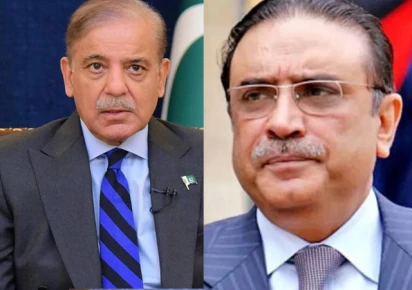
zardari shehbaz stress
| | |

Zardari, Shehbaz stress youth empowerment on World…

ISLAMABAD: President Asif Ali Zardari and Prime Minister Shehbaz Sharif have highlighted the importance of empowering young people for Pakistan’s future.

In their separate messages on World Youth Day, both leaders described the country’s youth as a valuable national asset. They stressed the need to provide young people with education, employment, skills and opportunities to contribute to national development.

President Zardari said empowering young people was an investment in Pakistan’s future. He said the energy, creativity and determination of the country’s youth were among Pakistan’s most valuable assets.

He said quality education, decent employment and innovation were among the common aspirations of young people.

According to the president, around 67% of Pakistan’s population is below the age of 30. He said this made young people the country’s largest human resource.

Zardari also highlighted the role of young women in national development. He said their potential and leadership were essential for Pakistan’s social and economic progress.

The president said the Prime Minister’s Youth Programme was providing young people with opportunities in education, skills development, employment and entrepreneurship.

He urged young people to adopt values of honesty, compassion and tolerance. He said empowering them to play an active role in national development was an urgent need.

Zardari added that a strong, inclusive and prosperous Pakistan could be built through the meaningful participation of young people.

Prime Minister Shehbaz Sharif also described the country’s youth as an invaluable asset.

In his message on World Youth Day, the prime minister said this year’s theme was “Different circumstances, shared aspirations.”

He said young people around the world live under different circumstances. However, their dreams, ambitions and hopes for a better future remain similar.

Shehbaz said Pakistani youth were the architects of the country’s bright future. He noted that young Pakistanis had brought recognition to the country in different fields at both national and international levels.

The prime minister said their abilities and full potential were essential for building a prosperous, peaceful and strong Pakistan.

He added that the government’s priorities included using all available national resources to support the mental, physical, intellectual and academic development of young people.

Similar Posts

  • | | |

    Survival Stories Describe Chaos and Narrow Escapes After Bangkok Pub Fire Claims 27 Lives, Injures Over 60 Others

    Bangkok, Thailand Survivors of the deadly fire at Rong Beer Na Lat Phrao pub in Bangkok’s Chatuchak district on the night of July 12th, 2026, have described scenes of sudden panic, thick smoke, and desperate attempts to flee as the blaze rapidly engulfed the popular entertainment venue, killing at least 27 people and injuring over […]

  • | | |

    Pakistan imposes new restrictions on foreign media

    Pakistani authorities have exposed regulatory measures governing foreign media operations in the country. The strategy has triggered an alarm among press freedom advocates, legal observers, and media personnel. Under the newly issued Foreign Media Facilitation Guidelines, journalists representing international organizations will no longer be permitted to travel or cover news events outside three major metropolitan hubs without explicit prior authorization from the government. The regulations come at a delicate juncture marked by escalating political instability, public demonstrations, and security crackdowns across key regions including recent demonstrations connected to heightened tensions in Kashmir and subsequent enforcement actions in urban centers like Lahore. Critics argue that by constraining the scope of international newsgathering precisely when accurate coverage is most vital, the state risks deepening information voids and exacerbating the spread of unverified claims. Key Requirements of the New Media Framework Administered through the External Publicity Wing of Pakistan’s Ministry of Information, the updated regulatory policy establishes procedural hurdles for international news agencies. Foreign correspondents, local staff, contributors, and freelance journalists working for international outlets must secure an official No Objection Certificate (NOC) before traveling to conduct reporting assignments outside Islamabad, Karachi, and Lahore. Regions requiring prior approval now explicitly cover all provincial territories, sensitive border zones, and Pakistan-administered Kashmir. The framework provides no defined processing timeframe for NOC applications, leaving reporting teams facing unpredictable delays and potential administrative holds. The Ministry reserves the authority to suspend or revoke official media accreditation if reporting is judged to run counter to the country’s national sovereignty, ideology, or public safety phrasing that legal analysts describe as intentionally open-ended. Backlash from Analysts and Rights Groups The enactment of these guidelines has drawn sharp rebuke from political commentators, civil society organizations, and international press watchdogs, who view the move as part of a systematic contraction of independent journalism within the country. Former senator and political commentator Mustafa Nawaz Khokhar highlighted the grave consequences of curtailing foreign news organizations, warning that restricting legitimate press operations ultimately undermines public trust. These guidelines are tantamount to choking international media in an increasingly shrinking space, Khokhar noted, emphasizing the vital role global news outlets play when local media environments face structural pressure. The public looks at the international media for independent reporting. Placing restrictions simply creates more room for disinformation and the spread of fake news.   Rights groups including the Pakistan Federal Union of Journalists (PFUJ) and international watchdogs have echoed these concerns. They’re pointing out that advance the requirement of government permission for routine reporting effectively grants authorities veto power over what news reaches the global audience. Broader Context of Press Freedom in Pakistan Pakistan’s media environment has historically operated in a complex space balancing constitutional guarantees of free speech against national security laws. However, media analysts note that state oversight of both traditional print/broadcast journalism and online digital spaces has tightened significantly in recent years. The introduction of the new foreign media guidelines coincides with broader legislative shifts aimed at regulating online speech and social media platforms. Observers express concern that administrative barriers, combined with strict digital laws, could leave remote or politically sensitive areas completely cut off from independent news coverage. By limiting foreign journalists’ mobility primarily to the capital and two largest economic centers, field reporting from rural regions, border zones, and conflict-affected territories will become exceptionally difficult to conduct legally. Implications for International Coverage As international newsrooms adapt to the new framework, news gathering strategies across South Asia are likely to face operational friction. Bureau chiefs and correspondents report that unpredictable NOC processing times make time-sensitive breaking news coverage outside major cities nearly impossible to guarantee.   Without direct on-the-ground access for independent journalists, global news consumers may increasingly have to rely on official statements or unverified social media updates during crises. For a country navigating complex domestic politics and delicate international relations, press freedom advocates warn that restricting the lens through which the world views Pakistan could backfire, isolating the nation’s political discourse and fostering an environment where misinformation thrives unchecked.

  • | |

    UN condemns Swat blast as Pakistan warns of Afghan…

    UNITED NATIONS: The United Nations Security Council has strongly condemned the deadly suicide bombing in Swat, describing the attack as “heinous and cowardly” as Pakistan renewed its warning that terrorist groups continue to operate from alleged safe havens inside Afghanistan. The attack took place outside a police station in Kabal, Swat, on August 2, killing at least 16 Pakistani nationals, mostly civilians, and leaving dozens injured, according to the UN statement cited by Pakistan’s Dawn. The Tehreek-i-Taliban Pakistan (TTP) claimed responsibility for the bombing. In a statement issued through the office of the UN secretary general’s spokesperson, Security Council members expressed deep sympathy to the families of those killed and wished the injured a speedy recovery. The council also stressed that those behind the attack must be held accountable, calling for perpetrators, organisers, financiers and sponsors of terrorism to be brought to justice. The UN body reiterated its longstanding position that terrorism, regardless of its motivation, location or perpetrators, remains a serious threat to international peace and security. It also urged member states to cooperate with Pakistan in accordance with international law and relevant Security Council resolutions. Pakistan Raises Alarm Over Afghan Sanctuaries The condemnation came shortly after Pakistan raised concerns at a UNSC briefing over what it described as the growing threat from terrorist organisations operating from Afghan territory. Pakistan’s Permanent Representative to the UN, Ambassador Asim Iftikhar, said several groups continue to maintain safe havens inside Afghanistan and pose an increasing threat to Pakistan and regional security. He specifically named the banned TTP, Balochistan Liberation Army (BLA) and its Majeed Brigade, Islamic State Khorasan (IS-K), East Turkistan Islamic Movement (ETIM), and Al Qaeda affiliates. Pakistan urged the international community to ensure that Afghan soil is not used to launch terrorist attacks against neighbouring countries, while calling for stronger international cooperation to counter cross-border terrorism. The latest developments have added fresh pressure to an already sensitive security relationship between Pakistan and Afghanistan. They also came after the fourth US-Pakistan Counterterrorism Dialogue in Washington, where officials from both countries reaffirmed their commitment to combating terrorist organisations. For Pakistan, the UNSC condemnation provides international recognition of the seriousness of the Swat attack, while Islamabad continues to push for stronger action against militant networks it says operate across its western border.

  • |

    NA Secretariat reports Rs8.6bn savings

    The National Assembly (NA) Secretariat expects significant savings from its Rs17 billion budget for the current fiscal year after implementing administrative and financial reforms over the past two years. According to a briefing by the NA Secretariat, the reforms have already generated Rs8.6 billion in savings against a combined allocation of Rs29 billion for the 2024-25 and 2025-26 fiscal years. The secretariat also abolished 302 posts, reducing its overall workforce by nearly 20%. A senior official said the secretariat expects further substantial savings from this year’s Rs17 billion allocation. The reforms have also changed the appointment process. The secretariat has replaced discretionary hiring powers with service procedures based on laws and rules. Officials say the move will improve transparency and reduce political pressure on the speaker when making appointments. The NA Secretariat’s progress comes as the federal government continues efforts to reduce the size of the civil service and control administrative spending. However, the government’s rightsizing drive has so far focused largely on gradual and limited measures. On Monday, Finance Minister Muhammad Aurangzeb chaired a meeting of the sub-committee on rightsizing to review progress and discuss ways to speed up the implementation of approved reforms. According to the Finance Ministry, Waves 1 to 4 of the rightsizing exercise have largely moved forward following cabinet approval. Recommendations for Waves 5 and 6 have also been prepared and shared with relevant authorities, while work on Waves 7 and 8 is underway.

  • | |

    Israel rejects Trump’s 15-point Gaza plan

    Israeli Prime Minister Benjamin Netanyahu has rejected US President Donald Trump’s proposed 15-point plan for Gaza, insisting that Israel will not withdraw its forces until Hamas is fully and genuinely disarmed. Netanyahu made the statement during a cabinet meeting on Sunday. He said Israel would not accept any arrangement that allows Hamas to retain its weapons while Israeli troops are required to leave Gaza. “Israel rejects the 15-point document,” Netanyahu said, adding that the Israeli military would continue operating against threats to its forces and citizens. The dispute has created another obstacle for Trump’s efforts to establish a lasting ceasefire and political settlement in Gaza. Trump’s Board of Peace had previously announced that an agreement had been reached on the complete disarmament of Hamas and other armed groups operating in the territory. Hamas, however, has linked the handover of its heavy weapons to wider conditions. The group has demanded an end to Israeli military operations and a withdrawal of Israeli forces from Gaza. Netanyahu said disarmament must take place before any Israeli military withdrawal. He rejected the possibility of what he described as a symbolic or “fictitious” disarmament process. The Israeli premier said his government was discussing the next steps with US officials. He indicated that some American proposals were acceptable to Israel, while others remained unacceptable. “We know how to stand our ground on these matters,” Netanyahu said. The disagreement represents a major challenge for Trump’s Gaza initiative, which was presented as a framework for ending the conflict and creating conditions for reconstruction. The proposed plan includes the disarmament of Hamas, a phased Israeli military withdrawal and the rebuilding of Gaza. It also envisages the creation of an international Board of Peace to oversee implementation of the agreement. Hamas had previously signalled support for aspects of the disarmament framework. However, the group has maintained that weapons cannot simply be surrendered while Israeli forces remain in Gaza and military operations continue. Israel, meanwhile, has continued military strikes in Gaza despite the initial ceasefire agreement reached last October. Netanyahu is also facing political pressure at home. His far-right coalition partners have strongly opposed concessions that could allow Hamas to remain armed or secure a significant Israeli withdrawal. National Security Minister Itamar Ben Gvir has rejected the proposed framework and called it unacceptable. With Israeli elections approaching, Netanyahu faces pressure from both domestic allies and international partners. Any major concession on Gaza could create tensions within his governing coalition. The latest rejection therefore puts Trump’s peace initiative under renewed pressure. The central disagreement remains over the sequence of events: Hamas wants Israeli forces to withdraw and military action to end before completing disarmament, while Israel insists that Hamas must first surrender its weapons.

  • Authorities Track Down Blaze Setters After Field Fires Smother Bangkok in Haze

    NAKHON NAYOK – Authorities are searching for those responsible for illegally setting fire to rice fields in central Thailand, after a blaze burned over 10,000 rai (4,000 acres) and sent a thick plume of toxic smoke toward Bangkok and neighboring provinces. Pollution Control Department introduces management of burning via Burn Check app The fire broke […]

Leave a Reply

Your email address will not be published. Required fields are marked *