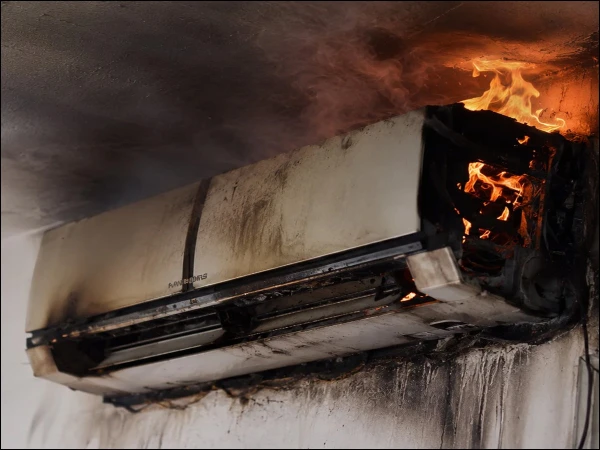
danger signs your

Danger signs your air conditioner needs repair

As temperatures rise many people buy old or low cost air conditioners to save money.

However experts warn that aging AC units can become dangerous if problems are ignored.  Small faults may turn into serious issues including electrical short circuits fires or costly damage.

According to experts older air conditioners often develop worn out wiring damaged electrical parts faulty motors and overheating.

These problems may seem minor at first but can become dangerous if they are not repaired in time.

One of the biggest warning signs is a burning smell or the odor of melted plastic when the AC is switched on.  Experts say this could mean the internal wiring motor or insulation has been damaged increasing the risk of fire.

If this happens turn off the unit immediately and have it checked by a qualified technician. Unusual sounds such as rattling grinding or loud noises are also signs that something is wrong.

These noises may be caused by a loose part a damaged fan or a compressor problem.  Ignoring them could lead to a complete system failure.

If the air conditioner becomes unusually hot while running it may indicate an electrical fault inside the unit.  Overheating can increase the risk of a short circuit or fire

making immediate inspection and repair important. Experts also advise not to ignore weak cooling.

Reduced cooling may be caused by low refrigerant a faulty compressor or a clogged air filter.  These issues usually mean the AC needs servicing or repairs.

Another serious warning sign is seeing sparks near the voltage stabilizer or electrical wires.

This may indicate loose connections or damaged wiring, which can quickly become a fire hazard if not fixed.

Experts recommend turning off the air conditioner immediately if you notice any of these warning signs and contacting a qualified technician for a full inspection.  Timely repairs can help prevent bigger damage and keep your home and family safe.

They also advise that if an air conditioner keeps breaking down and needs frequent repairs replacing it with a newer safer and more energy efficient model may be a smarter and more cost effective choice.

Similar Posts

  • Water during meals may increase food intake

    A new study suggests that drinking water again and again while eating may not help with weight loss. Instead it could actually make people eat more food. Many people believe that taking sips of water during a meal helps them feel full faster leading them to eat less. However the new research challenges that common belief. Researchers at Cornell University found that for every extra 100 milliliters of water people drank during a meal they ate about 40 grams more food on average. This equals roughly 50 extra calories. The study also found that people who frequently switched between eating and drinking water consumed more food overall than those who did not. Earlier studies have also shown that people with obesity are more likely to drink water for longer periods during meals drink it more quickly and take frequent sips throughout the meal. Researchers say these findings suggest that the relationship between drinking water during meals and the amount of food people eat may be different from what was previously believed. However they stress that more research is needed before any firm conclusions can be made.

  • Poor sitting habits may harm your spine

    If you often suffer from back pain or muscle stiffness your sitting posture may be the hidden cause. The good news is that a few simple lifestyle changes can help improve your posture and reduce discomfort. •Why does poor posture happen? In today’s world many people spend hours using laptops computers and smartphones.  Sitting for long periods without moving can make muscles tight weak and unbalanced. Doctors say that constantly looking down at a phone or computer screen puts extra pressure on the neck and upper back. Over time this can lead to poor posture muscle weakness and pain. Poor posture can also develop because of injuries certain medical conditions genetics or jobs that require standing for long hours. •How poor posture affects your health Bad posture does more than cause temporary discomfort. It can lead to. •Neck shoulder and back pain •Muscle stiffness and tension •Reduced flexibility and movement •Weak muscles •Lower back pain •Extra pressure on the spine If ignored for a long time poor posture may increase the risk of spinal problems such as a herniated disc or sciatica. Simple ways to improve your posture The good news is that poor posture can often be corrected with regular practice and healthy habits. Stretch and exercise every day. •Avoid sitting for long hours without taking breaks. Limit unnecessary smartphone use especially if it makes you look down for long periods. Sit with your back straight and shoulders relaxed. Use a cushion to support your lower back while sitting. When standing keep your weight evenly balanced on both feet and avoid locking your knees. Lift heavy objects by bending your knees instead of your back. Choose a supportive pillow that keeps your neck and spine aligned during sleep. Sleep on a comfortable mattress that provides proper support. Adjust your car seat so you can comfortably reach the pedals while driving. On long drives stop every two hours to stretch your legs and move around. Making these small changes every day can improve your posture reduce pain and help protect your spine in the long run.

  • |

    Writers are embracing flaws to fight AI prose

    In an era where generative artificial intelligence can generate essays in seconds, the digital world is quietly witnessing a linguistic backlash. Readers are increasingly attuned to the invisible fingerprint of large language models. Perfectly balanced sentences, predictable three-item lists, flawless grammar and fondness for the em dash. In response, a movement of novelists, journalists, essayists, and even corporate creators are opting an anti-AI literary counterculture. These writers are actively reintroducing human idiosyncrasies ranging from unorthodox metaphors to intentional typos to declare that a human is behind the keyboard. The hallmark of standard AI-generated text is not necessarily bad grammar. In fact, it is often too clean. Text-generation algorithms default to statistically probable phrasing. It’s resulting in a distinctively smooth, neutral tone that rarely takes stylistic risks. Over the past few years, certain visual and structural patterns have become clear red flags for readers. Excessive dependence on em dashes. Relying on clinical or dramatic transitions like “In conclusion,” “Delve,” or “Navigating the landscape of…” Prose that seems lacking the natural rhythm, pauses, and unpredictable detours of spontaneous speech. To break free from these algorithmic habits, authors are adopting techniques anchored in absolute negation. Novelist Laura Brooke Robson, author of Love Is an Algorithm, noted that she actively altered her sentence structures to avoid robotic cadence. Instead of relying on conventional metaphors, she intentionally sought out unexpected punctuation. For creators, avoiding the default traps of language models has surprisingly made their writing more original and lively. This counterculture goes beyond simply avoiding specific punctuation marks. Writers are cultivating a distinct aesthetic centered on authenticity, vulnerability, and friction. After years of detached or objective styles, creators are leaning back into intimate first-person storytelling. Specific personal experiences, odd sensory details, and messy real-life observations serve as proof of lived experience. They prove to be something synthetic text generators cannot genuinely claim. Minor human flaws, casual slang and even subtle typos are being viewed as authentic signatures. Some digital platforms and creators have even experimented with tools that preserve raw keystrokes to signal genuine human origin. Instead of smoothing out every transition, writers are introducing erratic pacing, quirky similes, and inventive vocabulary. Authors create an experience that keeps the reader engaged. Deliberately reassuring them that the text wasn’t produced by an automated model. Can Artificial Intelligence Just Copy It? Skeptics of this trend point out an obvious paradox! If large language models are capable of processing complex prompts, they can just as easily be instructed to “write with typos,” “use casual grammar,” or “tell a quirky story in the first person.” From a purely technical perspective, intentional mistakes does not make prose impossible for a machine to imitate. However, proponents of the movement emphasize that outsmarting algorithms was never the primary goal. Instead, the anti-AI counterculture is an artistic statement about human craft and intention. Writing is fundamentally an act of personal communication between two minds. When readers engage with text, they are seeking the author’s unique perspective, effort, and creative voice. Ultimately, this movement signals how society values written communication. As machine-generated text becomes ubiquitous, hyper-polished prose is losing its premium status. What readers increasingly crave is not frictionless perfection, but the warmth and oddity of a human voice.  

  • Back to school tips every parent should know

    As the long summer vacation comes to an end, many parents wonder how to help their children get back into the school routine. After weeks of sleeping in playing and enjoying free time waking up early getting ready on time and returning to schoolwork can be difficult. Experts say that a few simple habits can make this change much easier. One of the most important steps is to fix your child’s sleep schedule. A few days before school starts encourage children to go to bed earlier and wake up at the same time they will on school days. Children aged 6 to 13 should get 9 to 11 hours of sleep each night while teenagers aged 13 to 17 need 8 to 10 hours. Good sleep helps improve both physical health and mental focus. Experts also recommend keeping children away from phones tablets computers and other electronic devices for at least one hour before bedtime. Instead parents can talk with them about their teachers classmates school activities and exciting things they can look forward to. Positive conversations can help reduce anxiety and build excitement. A healthy breakfast is another important part of a successful school day. Foods such as fruit milk eggs oatmeal whole grain bread and other balanced meals give children the energy they need and improve their focus memory and learning. Parents should also make time every day to ask their children about school.  Talking about lessons friends sports and classroom activities helps children feel supported and encourages them to share any concerns. Experts say parents should lead by example.  When the home follows a regular routine for sleeping eating and daily activities children are more likely to develop the same healthy habits. Most importantly school should be presented as a positive experience rather than something stressful. With encouragement patience and support children can adjust more easily and begin the new school year feeling happy and confident.

  • New drug treatment Center opens in Karachi

    Karachi: Sindh Health Minister Dr. Azra Fazal Pechuho has inaugurated a new Opioid Agonist Maintenance Therapy (OAMT) Center at Jinnah Hospital to help people recovering from drug addiction. Speaking to the media the minister said the center will support people in gradually overcoming addiction and returning to a healthy normal life. Patients will receive medical treatment regular health monitoring counseling and rehabilitation services under one roof. Dr. Pechuho said the facility will be staffed by experienced doctors and trained healthcare workers who will closely monitor patients throughout their recovery. She also stressed the need to speed up HIV screening so that more cases can be detected early and  treated without delay. Commenting on reports of a patient’s death at Jinnah Hospital the health minister said that every loss of life is deeply tragic. If negligence was involved she said a full and transparent investigation must be carried out to identify those responsible. She added that no patient’s death should ever be treated as unimportant and strongly condemned any remarks that appeared to downplay such incidents.

  • How far can you drive after low fuel light comes on?

    If you fail to keep an eye on your fuel level while driving, your car could eventually come to a stop. When a car is about to run out of fuel, a warning indicator commonly known as the low fuel light illuminates on the dashboard. But how far can you actually drive once this light comes on? The answer can be useful if there isn’t a fuel station nearby. However, there is no single answer as it depends on several factors including the car’s make and model, model year, driving habits, fuel efficiency and road conditions. According to experts, once the low fuel warning light turns on, the vehicle cannot travel very far. The good news, however, is that it can usually go farther than many people expect. Experts say the warning light typically comes on when the fuel tank has around 10 to 15 percent of its capacity remaining. On average, small cars can travel about 20 to 30 miles (32–48 km) after the light comes on while larger vehicles may cover up to 50 miles (80 km). However, if the vehicle is old or the road conditions are poor, the remaining driving range may be significantly shorter. Cold weather can also increase fuel consumption reducing the distance the car can travel after the warning light appears. Experts further caution that continuing to drive for an extended period after the low fuel light comes on may damage the engine although driving a few additional miles is generally unlikely to cause any harm.

Leave a Reply

Your email address will not be published. Required fields are marked *