monsoon may raise

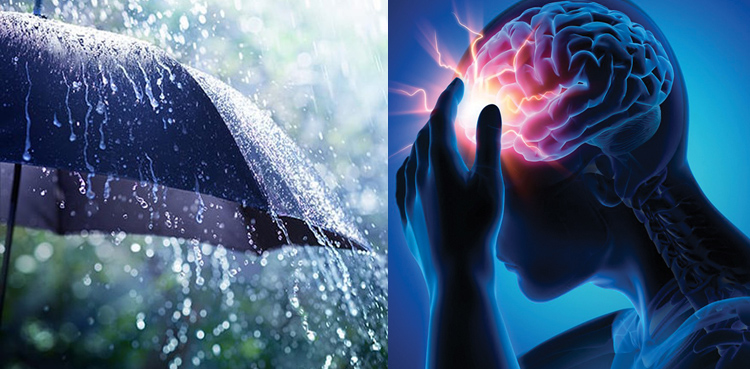
Monsoon may raise stroke risk

The rainy season brings relief from extreme heat and makes the weather pleasant but it can also create health challenges for some people.

Health experts say sudden weather changes high humidity and increased chances of infections during the monsoon season may be risky for people who already have conditions like high blood pressure diabetes high cholesterol or heart problems.

Neurology experts explain that changes in temperature and humidity can affect the body’s natural system and may cause blood pressure levels to become unstable.

This can increase the risk of stroke, especially among people with existing heart or blood vessel problems. During the rainy season cases of viral infections cold cough stomach problems and dehydration often increase.

These conditions can put extra stress on the body and disturb blood sugar and blood pressure control.

Reduced physical activity poor sleep and improper use of medicines can also increase health risks.

Doctors advise people to remember the BE FAST rule to identify early signs of stroke.

B – Balance:

Sudden loss of balance or coordination

E – Eyes:

Sudden vision problems

F – Face:

One side of the face becomes weak or droops

A – Arms:

Weakness in one arm or leg

S – Speech:

Difficulty speaking or understanding words

T – Time:

Get emergency medical help immediately

Experts say quick treatment can save lives and reduce the chances of long term disability.

Health professionals recommend that high risk people regularly check their blood pressure and blood sugar take medicines on time stay physically active eat a balanced diet reduce salt intake avoid smoking and drink enough water.

Experts also highlight that the monsoon season itself is not dangerous. The real risk comes from ignoring existing health conditions. Keeping blood pressure diabetes cholesterol and heart diseases under control throughout the year can greatly reduce the risk of stroke and other complications.

Similar Posts

  • |

    Kashmir is beyond a geographic location

    For centuries, Kashmir has occupied a singular space in the poetic imagination. It is a region defined by a paradox. On one hand, earthly paradise of pristine lakes, towering snow-capped peaks and crimson autumn chinars. On the opposite, centuries of political upheaval, exile and grief. In literature, Kashmir is beyond a geographic location. It is a metaphor for divine beauty, and a testament to human endurance. The poetic tradition of Kashmir took root in spiritual mysticism and poignant lyricism during the medieval period. In the 14th century, the mystic poet Lal Ded pioneered the Vakh: four-line spiritual verse couplets in the Kashmiri vernacular. Her poetry bridged Hinduism and Sufism. It’s essence was inner purity, liberation, and the transcendence of physical suffering. I searched for my Self until I grew weary, No one, I thought, could reach this hidden knowledge. I plunged into it, and there found the jar of nectar. Habba Khatoon was known as the Nightingale of Kashmir. The 16th-century peasant-turned-queen introduced the Lol: a short, melodic form of love lyric. Her husband, King Yousuf Shah Chak, was exiled by the Mughal Emperor Akbar. Then, her poetry transformed into immortal songs of separation and longing. The spring has come, but you have not returned; My heart bleeds like the red bloom of the pomegranate. During the Mughal and Persian era, Kashmir became synonymous with heavenly superiority. The iconic Persian couplet often attributed to Amir Khusrow or Mughal Emperor Jahangir summarized this adoration: Agar firdaus bar roo-e zameen ast, Hamin ast-o hamin ast-o hamin ast. (If there is a paradise on the face of the earth, it is this, it is this, it is this.) In the 20th century, Allama Iqbal, whose ancestors hailed from Kashmir, brought a nuanced perspective to this paradise. In works like Javid Nama, he celebrated Kashmir’s breath-taking landscape while lamenting the subjugation and suffering of its people. He reflected on the region’s immense dormant potential in Payam-e-Mashriq: ​Pani tere chashmon ka hai aab-e-hayat, Aur tere kohsar hain qasran-e-kibriya. ​The water of your natural springs is the elixir of life, And your mountain ranges are towering palaces of divine grandeur. Iqbal’s verse moved beyond aesthetic wonder, using poetry as a call to dignity, resilience, and self-realization for the Kashmiris. In modern poetry, Kashmir’s narrative shifted dramatically toward exile, memory, and war. No poet captured this transition more powerfully than Agha Shahid Ali (1949–2001). He wrote primarily in English while employing traditional Urdu ghazal forms. Ali gave voice to the tragedy of late 20th-century Kashmir. In his seminal collection, The Country Without a Post Office (1997), Kashmir becomes a landscape of ghost letters, curfews, and faded memories. I write on fallen leaves and floating petals, I write to you from a country without a post office. Ali’s verse knits together global literary influences from Mahmoud Darwish to James Merrill. His poetry creates a poignant eulogy for a lost homeland. Their memory is anything but green, an white-hot fire. They burn down Kashmir in my veins. From the ascetic reflections of Lal Ded to the haunting elegies of Agha Shahid Ali, poetry has served as Kashmir’s truest archive. A disputed land of changing maps, borders, and historical conflicts. It’s the poetry that preserves the living soul of the land. The verses anchor its beauty, its heartbreaks, and its unyielding hope. Kashmir remains forever intact. It is an eternal paradise written in ink, surviving through the memory and voices of its poets.  

  • Why does your nose block at Night?

    Do you breathe normally during the day but find it harder to breathe through your nose when you lie down at night? This is a common problem. A blocked nose can disturb sleep, force you to breathe through your mouth and leave you with a dry mouth or sore throat in the morning. Many people think a blocked nose is always caused by a cold or flu. However doctors say there can be several other reasons. Why does it happen at night? Dr. Subrata Das of Aster Whitefield Hospital says that natural changes in the body during sleep can make nasal blockage feel worse. One common reason is sleeping position. During the day when you sit or stand gravity helps mucus drain from the nose.  But when you lie down mucus can collect inside the nose, making breathing more difficult. Changes in hormones at night may also increase swelling inside the nose. People who already have allergies or nasal inflammation may notice the problem more strongly at bedtime. The nervous system can also affect the blood vessels and tissues inside the nose. Changes in nerve activity during the night may increase mucus and make the nose feel stuffy. Allergies may be the cause If your nose becomes blocked mainly after you get into bed allergies could be responsible. Dust dust mites in mattresses and pillows, carpets curtains and damp areas can trigger allergies.  Mold caused by moisture on walls can also lead to a blocked nose, sneezing and itching. Keeping the bedroom clean and dry may help reduce these problems. Acid reflux can also affect your nose Acid reflux is another possible cause. Eating a heavy meal and lying down soon afterward can allow stomach acid to move upward toward the throat. This may cause throat irritation and sometimes make nasal symptoms feel worse. If you also experience heartburn a sour taste in your mouth frequent throat clearing or a burning throat in the morning it is better to speak with a doctor. How can you get relief? The most important step is to find out what is causing the blockage. If allergies are responsible a doctor may recommend a nasal spray or other treatment. You can also try. •Keeping your bedroom free of dust •Washing bed sheets and pillow covers regularly •Cleaning mattresses and carpets •Removing mold and moisture •Avoiding meals just before bedtime •Using a safe saline nasal rinse if recommended •Warm salt water gargles may help if you have a sore or irritated throat. When should you see a doctor? Occasional nasal blockage is usually not a major concern. But if your nose is blocked every night your sleep is regularly disturbed or you have symptoms such as frequent sneezing facial pain headaches fever breathing problems or ongoing nasal discharge you should see a doctor.

  • Women’s heart attack signs often missed

    A heart attack is a serious medical emergency that can be life threatening.  It usually happens when the heart does not receive enough oxygen because blood flow to the heart is blocked. Doctors say that getting treatment quickly is very important.  The longer a heart attack goes untreated the more damage it can cause to the heart muscle making recovery more difficult. According to health experts most heart attacks occur when a blocked artery stops oxygen rich blood from reaching the heart. Without enough oxygen parts of the heart muscle begin to weaken and may become permanently damaged. Doctors also warn that heart attack symptoms in women are often less obvious than in men. Instead of severe chest pain women may experience unusual tiredness shortness of breath nausea dizziness pain in the back neck jaw or shoulders or mild chest discomfort. Because these symptoms can be mistaken for other health problems women may delay seeking medical care increasing the risk of serious complications. Experts advise anyone experiencing possible heart attack symptoms to seek emergency medical help immediately as early treatment can save lives and reduce damage to the heart.

  • Lack of Sports Facilities in Dasht Schools

    Through the columns of your esteemed newspaper, I would like to highlight the serious issue of lack of sports facilities in Dasht schools. Sports are essential for physical fitness, mental health and discipline. But in Dasht sub- division of Turbat, Balochistan there are no proper sports facilities in schools. Students do not have access to basic sports gear, kits and indoor activities items.   Moreover sports funds often fail to reach rural schools. Authorities mostly ignore sports because communities struggle with fundamental needs like classroom, clean water and teachers. As a result the physical and social skills are that taught through teams sports are being lost. The government and authorities should take action to provide sports facilities in Dasht schools.

  • | |

    Documentary film on the struggle for Joint Elector…

    By Yassar Talib Aiman Zameer Lahore: The Centre for Social Justice (CSJ) held a screening of its documentary film, A Separation Refused, highlighting the Movement for the Restoration of the Joint Electorate in Pakistan, at a local hotel in Lahore. The 20-minute documentary film, by the award-winning the producer and director, CSJ and Dawood Akhtar Murad, traces the culmination of the world unique Separate Electorate system in Pakistan’s history and the movement for the restoration of the Joint Electorate in Pakistan especially during the 1990s to 2001. The film chronicles the efforts of civil society organizations, political leaders, faith communities, and human rights advocates who campaigned for equal citizenship and inclusive democratic participation for religious minorities. Using historical accounts and personal testimonies, the film illustrates how sustained advocacy contributed to democratic reforms and continues to inspire efforts towards equality, pluralism, social cohesion, and the protection of constitutional rights. Featuring over a dozen interviews, it brings together insights from Hina Jilani, Cardinal Joseph Coutts, Dr. Charles Amjad Ali, Dr. Yaqoob Bangash, and other prominent voices offering diverse perspectives youth, clergy and a parliamentarian. The even also premiered a song Hum Juda Nahein (We Are Not Separate) that expressed the The screenings were followed by an interactive panel discussion explored the progress made towards equal citizenship and the continuing challenges to the democratic participation of religious minorities in Pakistan. The panelists, Wajahat Masood a public intellectual and Peter Jacob, answered the questions while the academic Faaria Khan moderated the discussion. While addressing the participants, Wajahat Masood, said that democracy is based on the principle of equal citizenship and that the categorization of citizens into majorities and minorities reflects a constitutional anomaly. Referring to the Separate Electorate system, he noted that institutionalizing such divisions weakened democratic systems and undermined the principle of equal political participation. In response to a question on the rationale behind the documentary, Peter Jacob, Executive Director CSJ, said that the importance of the movement warranted a careful reading of the history. He noted that the film was developed to preserve authentic accounts of the struggle for the restoration of the Joint Electorate and to address competing interpretations of history and misunderstandings. He also emphasized the need for constitutional reforms to strengthen equal citizenship. He called for a review of Articles 41 and 91 of the Constitution, to remove precondition of religious affiliation for the offices of the President and Prime Minister. Moreover, implementation of Article 22(1) of the constitution of Pakistan that guarantees unbiased education. In the open discussion, participants emphasized that the message of documentary film highlighting constitutional rights, democratic inclusion, should be screened more widely through universities, arts councils, mainstream media, and other public platforms to encourage informed dialogue and greater public awareness. They further stressed that equal citizenship is not solely the concern of religious minorities but a shared national responsibility, and called for greater participation and support from the majority community in future advocacy and dialogue. At the end the participants reaffirmed a shared commitment to advancing constitutional rights, equal citizenship, participatory democracy, and peaceful coexistence through collective action.

  • Humans may live up to 194 Years

    How long can a human live? No one knows the exact answer but scientists believe there is a natural limit to the human lifespan. According to a study a person could possibly live as long as 194 years although reaching that age would be extremely rare. Researchers say living forever is not possible. Even if science discovers new ways to slow aging the body cannot avoid the natural damage that builds up over time. The study published in the journal Nature looked at how our DNA and genes change throughout life. Scientists found that many genetic changes are harmless but some damage cells and reduce how well they work. Over time this damage increases the risk of age related diseases. The researchers explained that these genetic changes cannot be completely prevented.  They happen naturally when cells divide and can also be caused by viruses certain chemicals and ultraviolet (UV) rays from sunlight. To estimate the maximum human lifespan the team created a scientific model that included reversible signs of aging while keeping permanent genetic changes in place. The results suggested that even if future technology slows the aging process the longest a human could live would likely be between 146 and 194 years. Scientists also noted that some organs such as the skin and liver regularly replace old cells helping repair some damage. However the heart and brain do not replace most of their cells making genetic damage in these organs much harder to reverse. The researchers stressed that genetic changes are not always harmful but as they build up over time they may gradually shorten a person’s lifespan. They also believe that other biological processes may affect aging and more research is needed to better understand them. At present the longest confirmed human lifespan belongs to Jeanne Calment of France who died in 1997 at the age of 122 years making her the oldest verified person in recorded history.

Leave a Reply

Your email address will not be published. Required fields are marked *