javed akhtar says
| |

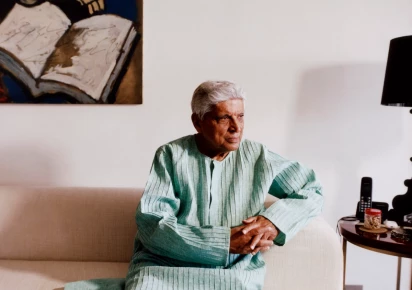
Javed Akhtar says internet discourages originality

Javed Akhtar has been writing words that endure for more than five decades, and in a candid conversation with Vogue India, he turned his gaze toward what he believes is happening to creativity in the digital age. What he found does not reassure him.
The veteran lyricist and screenwriter argued that the internet and its algorithms have created a culture of creative fear, one in which people are no longer willing to take the risk of doing something that has not already been done before. “The echo chambers created by the internet have made most people afraid to do something for the first time,” he said. “Once someone else does it, they’re fine to follow in their footsteps.”
He extended that observation into a broader concern about how people engage with ideas and the world around them. “People no longer want to pause, think, analyse or sit with an idea. They are living happily, so why would they bother to think about this universe or the vastness of nature? For them, it is a waste of time.”
For Akhtar, this impatience is incompatible with the kind of work that lasts. “Meaningful creation requires time, discomfort and reflection,” he said, adding that his own willingness to question dominant voices and widely accepted ideologies has always come from exactly that kind of sustained engagement with ideas.
He was particularly pointed about the music industry and the way commercial priorities have pushed the role of lyrics to the margins. “Today, words have become less important because the marketing team has decided that slow music won’t trend,” he said. The result, in his view, is an industry that remixes old material with inferior new writing rather than producing something genuinely fresh. “But then they take those same songs, edit the mukhras and remix them with some inferiorly written antaras. There was a time when writers had more space. Today, other forces dictate what music gets made. And yet, songs that are decades old still endure, while many recent ones have a short shelf life.”
His advice to young writers was direct and unglamorous. Read more. Not only classical literature and celebrated authors, but light reading too. “The real loss is not in reading something trivial but in not reading at all,” he said.
On the creative process itself, Akhtar drew a distinction that cuts to the heart of what separates craft from genuine art. “All arts can be divided into two parts. On one hand, there’s imagination, passion, fantasy and romance, and on the other, there is craft. You can learn the craft in a crash course. But imagining, fantasising and romanticising cannot be learned. There are no courses for yearning.”
He closed with a lesson passed down from his father that has stayed with him throughout his career. “It is very easy to write in difficult language, but very difficult to write in easy language. When you write simply, there is no space for your idea to hide behind big words. Only if you are totally convinced of what you are writing can you afford to use transparent language.” It is a principle that has shaped some of Hindi cinema’s most enduring words, and one that no algorithm is likely to teach.

Similar Posts

  • |

    Trump signs new executive orders seeking to restrict US birthright citizenship

    US President Donald Trump has signed two new executive orders aimed at restricting birthright citizenship, five weeks after a 6-3 Supreme Court decision rejected his administration’s broader attempt to end automatic citizenship for children of undocumented immigrants. The newly issued directives attempt a narrower approach by targeting specific exceptions under the Citizenship Clause of the 14th Amendment. The primary focus of the orders is a total ban on birth tourism, a practice where pregnant foreign nationals travel to the US to give birth so their children acquire automatic citizenship. The directives also place restrictions on children born in the US to foreign government employees, foreign combatants classified as alien enemies, and residents of US territories pending potential congressional legislation. Speaking alongside White House aides Stephen Miller and Commerce Secretary Howard Lutnick during an Oval Office ceremony, Trump criticised the high court’s prior 30 June ruling and argued that non-citizens were taking advantage of constitutional protections established following the Civil War. Legal experts and civil rights advocacy organisations, including the American Civil Liberties Union and UnidosUS, noted that the executive actions do not carry the authority of statutory law and will face immediate challenges in federal court for attempting to bypass constitutional precedent and Supreme Court authority.

  • |

    7.4-magnitude quake strikes Colombia

    A powerful earthquake struck Colombia and several other parts of Latin America on Monday, causing injuries, damaging buildings and forcing evacuations in the capital, Bogota. The earthquake was recorded at different magnitudes by geological agencies. Colombia’s geological service measured it at 6.6, while the United States Geological Survey estimated its magnitude at 7.4. The epicentre was located in western Colombia at a depth of around 100 kilometres. Strong tremors were felt across large areas of the country. The shaking was also reported in neighbouring Ecuador and as far north as Panama. In Bogota, residents rushed out of buildings as emergency sirens sounded. Some people were seen gathering in the streets after leaving their homes and workplaces. Authorities ordered evacuations from a number of buildings as a precaution while emergency teams assessed possible structural damage. The situation was particularly serious in the western parts of Colombia. The governor of Choco province reported injuries and significant damage to buildings in Quibdo, the provincial capital. Cali, one of Colombia’s largest cities, also suffered substantial damage. Mayor Alejandro Eder said at least 20 buildings had collapsed and that people were believed to be trapped inside some of the structures. Rescue operations were launched in the affected areas. Cali authorities requested additional emergency teams from Bogota and Medellin to assist with search and rescue efforts. Images broadcast by local media showed buildings with damaged facades and sections of structures affected by the powerful tremors. Emergency authorities continued to assess the extent of the destruction as rescue teams searched damaged buildings for survivors. Officials have not yet released a complete account of casualties or property losses. The number of injured people is expected to change as assessments continue. The depth and strength of the earthquake allowed tremors to be felt across a wide area, including outside Colombia. Authorities urged residents to remain cautious and follow instructions from emergency services, particularly in buildings that may have suffered structural damage. The earthquake comes as parts of northern South America remain vulnerable to major seismic activity. In June, two powerful earthquakes struck Venezuela, with reported magnitudes of 7.2 and 7.5, causing widespread destruction and thousands of deaths.

  • | |

    Umera Ahmed urges fans to avoid AI-generated content

    Renowned Urdu novelist Umera Ahmed has appealed to readers and content creators to stop producing and sharing AI-generated visuals based on her literary works, saying such content diminishes the emotional and spiritual depth of her stories. In a statement shared through her official Instagram page, Ahmed’s team thanked readers for their continued love and support but expressed concern over the growing number of AI-generated images, videos and reels portraying scenes, characters and dialogues from her novels. The statement urged fan pages and digital creators to refrain from using artificial intelligence to recreate her books. According to the team, literature offers every reader a unique and personal experience, while AI-generated visuals limit that imagination by presenting a fixed interpretation of characters and events. Special concern was raised over Ahmed’s acclaimed novel Peer-e-Kamil, which the team described as a deeply spiritual and emotionally sensitive work. They said its message, beauty and sanctity should not be diluted through artificial intelligence-generated content. While appreciating the passion and dedication of fan communities, the statement encouraged readers to experience and share the author’s work in its original form, allowing the stories to leave their intended emotional impact without technological alteration. The appeal comes as artificial intelligence continues to spark debate within Pakistan’s creative and entertainment industries. Concerns over the misuse of AI have grown in recent months, with artists and public figures warning about its impact on originality, artistic integrity and personal image rights. The discussion intensified after an AI-generated promotional music video released by the Ministry of Planning and Development drew widespread criticism. Separately, television personalities Tauseeq Haider and Farah Saadia were forced to deny false rumours after AI-created images depicting their alleged wedding circulated online. Actor Hira Tareen has also urged fellow performers to carefully review contract terms, warning that some agreements may allow studios to use an actor’s likeness for AI-generated productions without adequate safeguards.

  • | | |

    Pakistan seeks to revive Iran-US mediation efforts

    ISLAMABAD: Pakistan is making fresh diplomatic efforts to revive its role as a mediator between Iran and the United States. Interior Minister Mohsin Naqvi travelled to Tehran on Tuesday for talks with senior Iranian officials. During his visit, he met Iranian Foreign Minister Abbas Araghchi and President Masoud Pezeshkian. The visit is aimed at keeping Pakistan’s mediation channel active. Islamabad is seeking progress on the Islamabad Memorandum of Understanding (MoU), which emerged from earlier efforts to ease tensions between Iran and the United States. Naqvi was received in Tehran by Iranian Interior Minister Eskandar Momeni. He later held discussions with Araghchi on bilateral relations and regional developments. Pakistan’s diplomatic efforts had slowed after Oman became more directly involved in talks concerning arrangements for navigation through the Strait of Hormuz. However, recent contacts between Oman and Iran appear to have created an opportunity for Islamabad to renew its broader mediation initiative. A diplomatic source said Pakistan wants to follow up on the Islamabad MoU and encourage both sides to return to a wider diplomatic process. The situation around the Strait of Hormuz remains particularly sensitive. The waterway is vital for international energy and trade routes. Iran has maintained that the Islamabad MoU remains the key framework for resolving the wider dispute. Tehran has also linked the full reopening of the Strait of Hormuz to implementation of the commitments contained in the agreement. Iran and Oman have been discussing arrangements for safer passage through the strategic waterway. Their discussions include possible shipping routes and mechanisms for managing navigation. However, Tehran has indicated that any understanding with Oman would initially address technical matters. It would not necessarily represent a complete resolution of the wider dispute. Iran has also called for concrete assurances from Washington before moving towards the next stage of negotiations. Tehran wants guarantees that can be verified rather than verbal commitments. Pakistan has continued to encourage dialogue between the two sides. Defence Minister Khawaja Asif also indicated that Washington and Tehran could be moving closer to an understanding. He said recent signals suggested that the two countries were again moving towards a possible peace arrangement or deal. Meanwhile, Pakistan has invited Iranian Foreign Minister Araghchi and Iranian Parliament Speaker Bagher Ghalibaf to visit Islamabad. Iranian officials have said the visit would take place at an appropriate time. Naqvi’s trip to Tehran is therefore significant because Islamabad is maintaining direct engagement instead of waiting for the Iranian delegation to visit Pakistan. During his meeting with President Pezeshkian, Naqvi described Pakistan-Iran relations as strong and longstanding. He conveyed Islamabad’s intention to further strengthen ties with Tehran. Pezeshkian also stressed the importance of bilateral relations. He said stronger cooperation between Pakistan and Iran could serve their national interests and contribute to regional stability. The discussions come amid broader diplomatic and security developments in the region. Pakistan recently signed a trilateral defence agreement with Saudi Arabia and Turkiye. Islamabad has maintained that the arrangement is defensive and is not directed against any country. Deputy Prime Minister and Foreign Minister Ishaq Dar also discussed the agreement with his Iranian counterpart. He briefed Araghchi on its objectives and stressed its focus on strategic cooperation and regional peace. At the same time, US President Donald Trump has adopted a tougher tone towards Iran’s negotiating team. Trump described Iranian negotiators as difficult and accused them of making commitments privately and later presenting them differently in public. He also warned that Iran’s economic problems and inflation were becoming increasingly difficult to sustain. Trump said Washington could continue applying economic pressure on Tehran. He also suggested that the United States could take stronger measures if necessary. The contrasting positions underline the difficulties facing diplomatic efforts. Pakistan is now attempting to keep communication channels open with Tehran while encouraging a broader political process involving Iran and the United States.

  • | | | |

    US forces disable two ships amid rising tensions i…

    WASHINGTON: Tensions around the Strait of Hormuz have intensified after the United States said its forces had disabled two commercial vessels that failed to comply with orders linked to its naval blockade of Iranian ports. The US Central Command (CENTCOM) said American forces had redirected 12 commercial vessels attempting to breach the blockade as of July 25. Two ships that allegedly refused to comply were disabled, while two others were boarded to verify compliance. The latest development adds another layer of uncertainty to maritime traffic through one of the world’s most strategically important waterways, where any disruption can have consequences for global energy and shipping markets. CENTCOM said the Mozambique-flagged M/T Lavine was disabled in the Gulf of Oman on July 24 after its crew allegedly attempted several times to violate the blockade and ignored repeated warnings. According to the US military, the vessel had been heading towards Iran but is no longer travelling to an Iranian port. The US military also reported a separate operation involving the Comoros-flagged M/T Charminar in the Arabian Sea. American forces boarded the tanker on July 25 for verification. After the inspection, the vessel was allowed to continue its journey, according to CENTCOM. CENTCOM has described the naval blockade as remaining fully in effect, saying its forces are continuing to monitor commercial shipping and enforce restrictions on vessels travelling to or from Iranian ports. The confrontation comes amid heightened US-Iran tensions and growing concerns over the security of maritime routes around the Gulf of Oman and Strait of Hormuz. The waterway is a crucial passage for international trade and energy shipments, making military activity in the area particularly sensitive. The US claims its measures are aimed at preventing vessels from violating the blockade, while Iran has continued to challenge restrictions on shipping in the region. The latest incidents could further complicate efforts to maintain safe commercial navigation. With American forces increasing enforcement and vessels facing greater scrutiny, shipping companies operating near the region are likely to remain on high alert. For now, the Strait of Hormuz remains a major flashpoint, with every confrontation at sea carrying the risk of a broader escalation.

  • |

    Jawad Akhtar, Arsam Farooq elected Islamabad Cricket Association President

    ISLAMABAD: The Pakistan Cricket Board (PCB) has completed the election process for the Islamabad Regional Cricket Association (IRCA), with Mohammad Jawad Akhtar elected as president and Arsam Farooq Ahmed chosen as secretary for the next three years. According to an official notification issued by PCB Election Commissioner Mansoor Qadir on Thursday, both candidates were elected unopposed, allowing them to assume office immediately without a formal contest. The appointments mark another milestone in the PCB’s ongoing efforts to strengthen governance and improve the administrative framework of regional cricket across Pakistan. As office-bearers of one of the country’s key regional associations, Jawad Akhtar and Arsam Farooq Ahmed will be responsible for overseeing cricket development in Islamabad and implementing the PCB’s domestic cricket vision. The newly elected officials are expected to focus on expanding grassroots cricket, improving talent identification, and ensuring that promising young players receive better opportunities to progress through Pakistan’s domestic cricket system. Regional cricket associations serve as the backbone of the country’s cricket structure. They organise local tournaments, manage club and district competitions, coordinate coaching and development programmes, and create pathways for talented cricketers to reach the national domestic circuit. With Islamabad continuing to produce several promising players in recent years, expectations are high that the new leadership will further enhance the region’s cricketing infrastructure and provide stronger support for clubs, academies and emerging athletes. The PCB has repeatedly emphasised the importance of transparent administration and efficient regional governance as part of its long-term strategy to strengthen Pakistan’s domestic cricket. Stable leadership at the regional level is viewed as essential for nurturing future international stars and maintaining a competitive domestic structure. Jawad Akhtar and Arsam Farooq Ahmed now begin their three-year tenure with the responsibility of working closely with the PCB, local stakeholders and cricket clubs to promote the game throughout the federal capital. Their immediate priorities are expected to include improving player development programmes, supporting age-group competitions and ensuring effective coordination between regional and national cricket bodies. The successful completion of the Islamabad Regional Cricket Association elections reflects the PCB’s broader commitment to building a stronger, more organised domestic cricket system. With new leadership now in place, attention will turn to how the association translates administrative stability into meaningful progress for cricket in Islamabad and contributes to the continued growth of Pakistan’s talent pipeline.

Leave a Reply

Your email address will not be published. Required fields are marked *