javed akhtar says
| |

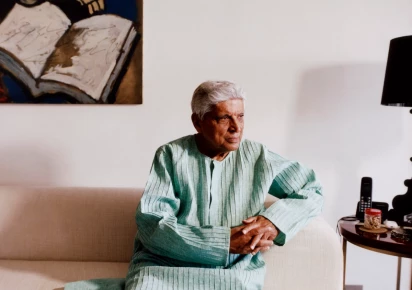
Javed Akhtar says internet discourages originality

Javed Akhtar has been writing words that endure for more than five decades, and in a candid conversation with Vogue India, he turned his gaze toward what he believes is happening to creativity in the digital age. What he found does not reassure him.
The veteran lyricist and screenwriter argued that the internet and its algorithms have created a culture of creative fear, one in which people are no longer willing to take the risk of doing something that has not already been done before. “The echo chambers created by the internet have made most people afraid to do something for the first time,” he said. “Once someone else does it, they’re fine to follow in their footsteps.”
He extended that observation into a broader concern about how people engage with ideas and the world around them. “People no longer want to pause, think, analyse or sit with an idea. They are living happily, so why would they bother to think about this universe or the vastness of nature? For them, it is a waste of time.”
For Akhtar, this impatience is incompatible with the kind of work that lasts. “Meaningful creation requires time, discomfort and reflection,” he said, adding that his own willingness to question dominant voices and widely accepted ideologies has always come from exactly that kind of sustained engagement with ideas.
He was particularly pointed about the music industry and the way commercial priorities have pushed the role of lyrics to the margins. “Today, words have become less important because the marketing team has decided that slow music won’t trend,” he said. The result, in his view, is an industry that remixes old material with inferior new writing rather than producing something genuinely fresh. “But then they take those same songs, edit the mukhras and remix them with some inferiorly written antaras. There was a time when writers had more space. Today, other forces dictate what music gets made. And yet, songs that are decades old still endure, while many recent ones have a short shelf life.”
His advice to young writers was direct and unglamorous. Read more. Not only classical literature and celebrated authors, but light reading too. “The real loss is not in reading something trivial but in not reading at all,” he said.
On the creative process itself, Akhtar drew a distinction that cuts to the heart of what separates craft from genuine art. “All arts can be divided into two parts. On one hand, there’s imagination, passion, fantasy and romance, and on the other, there is craft. You can learn the craft in a crash course. But imagining, fantasising and romanticising cannot be learned. There are no courses for yearning.”
He closed with a lesson passed down from his father that has stayed with him throughout his career. “It is very easy to write in difficult language, but very difficult to write in easy language. When you write simply, there is no space for your idea to hide behind big words. Only if you are totally convinced of what you are writing can you afford to use transparent language.” It is a principle that has shaped some of Hindi cinema’s most enduring words, and one that no algorithm is likely to teach.

Similar Posts

  • | | |

    Bilawal hails Makkah defence pact as historic mile…

    Pakistan Peoples Party (PPP) Chairman Bilawal Bhutto Zardari has welcomed the Makkah Joint Defence Agreement, describing it as a historic development that will further strengthen Pakistan’s defence capabilities. In a statement issued on Saturday, Bilawal said the agreement marked an important moment in Pakistan’s history and carried significance beyond the defence cooperation of the three participating countries. He said the pact would contribute to a stable and secure future for Pakistan, Saudi Arabia and Türkiye while also supporting broader efforts for peace and stability in the region and around the world. Bilawal praised Prime Minister Shehbaz Sharif and Chief of Defence Forces and Chief of Army Staff Field Marshal Asim Munir for their role in facilitating the agreement. He described their contribution to the agreement as commendable and said the pact represented an important step toward strengthening collective security and defence cooperation among the three countries. The agreement was signed in Makkah by Pakistan, Saudi Arabia and Türkiye, amid heightened regional tensions and growing concerns over security and stability in the Middle East. The three countries have described the agreement as a defensive arrangement aimed at enhancing cooperation and deterrence, with an attack against one member to be treated as an attack against all. Bilawal’s remarks underline the PPP’s support for the agreement and its potential role in strengthening Pakistan’s strategic and defence partnerships while promoting regional stability.

  • | | |

    Pakistan set to begin $2.5bn ML-1 Railway upgrade …

    LAHORE: Pakistan Railways is moving ahead with preparations for the first phase of the $2.5 billion Main Line-1 (ML-1) project, with civil works expected to begin in January 2027 under the government’s accelerated implementation plan. The first phase will focus on the 480-kilometre Karachi-Rohri railway corridor, where new tracks will be constructed alongside safety fencing to prevent unauthorised access. The project is expected to take around two-and-a-half to three years to complete. Railways Minister Hanif Abbasi said the department was making every effort to meet the January deadline set by Prime Minister Shehbaz Sharif. He noted that consultations with contractors and consultants, international tendering, bidding, shortlisting and contract awards could take four to five months, but the government was determined to keep the project on schedule. Pakistan Railways has scheduled an online market engagement session for September 8 with local and international contractors, consultants and other stakeholders. The discussions will focus on project readiness, procurement, technical requirements, contract packages, qualification criteria, risk allocation and construction while railway operations continue. The Karachi-Rohri section has been prioritised because it carries a major share of the country’s railway traffic and includes stretches affected by deteriorating infrastructure and frequent accidents. Once upgraded, the corridor is expected to allow trains to operate at speeds of up to 160 kilometres per hour. The project will include track reconstruction, selected realignments, bridges, culverts, stations, freight facilities and other infrastructure along the Keamari-Landhi-Hyderabad, Hyderabad-Nawabshah and Nawabshah-Rohri sections. Upgrades to signalling, telecommunications and Walton Academy are also part of the broader plan. The Asian Development Bank is expected to finance the project, while Pakistan is also exploring co-financing from the Asian Infrastructure Investment Bank, World Bank, Islamic Development Bank and other partners. A meeting at Pakistan Railways headquarters reviewed preparations for the Karachi-Rohri upgrade, with Railway Board Chairman Syed Mazhar Ali Shah directing officials to complete the project review by October 30, 2026. Weekly monitoring of progress was also ordered. Officials said international expertise and market feedback would be incorporated into the project to improve its efficiency, sustainability and technical viability. Authorities also pledged to maintain transparency, competitiveness and merit throughout the procurement and implementation process. The government sees ML-1 as a key step towards modernising Pakistan’s railway network, improving passenger services, increasing freight efficiency and strengthening connectivity between major population centres and industrial areas.

  • | |

    PM Shehbaz orders expansion of digital services fo…

    Prime Minister Shehbaz Sharif has directed authorities to expand digital consular services for overseas Pakistanis, improve facilities at Pakistani missions abroad, simplify the complaints system and speed up the digitization of document attestation and official transactions. According to a statement from the Prime Minister’s Office, the directives came during a meeting chaired by the prime minister in which officials from the Ministry of Foreign Affairs, Pakistani ambassadors serving in various countries, and senior representatives from the Ministry of Interior, the Federal Investigation Agency, the Ministry of Information Technology and other relevant departments briefed him on ongoing reform efforts. Shehbaz said overseas Pakistanis represent a valuable asset for the country and that providing them with every possible facility remains a top government priority. Officials told the meeting that a QR code system has already been rolled out to simplify procedures for power of attorney, property transactions and document attestation for Pakistanis living abroad. The prime minister welcomed the initiative and directed authorities to prominently display the QR codes at Pakistani embassies and missions worldwide to improve access to the digital complaints registration system. Shehbaz also instructed the Ministry of Foreign Affairs to launch a dedicated awareness campaign encouraging overseas Pakistanis to use the QR code based system when filing complaints. The meeting was told that the ministry has recently introduced an evening shift at its Islamabad office to make services more accessible to citizens, and that document attestation services have also been launched at the Asaan Khidmat Centre in Islamabad. Officials further reported that the ministry has introduced courier based attestation services and linked its verification system with databases maintained by the Higher Education Commission, the Inter Boards Coordination Commission, the National Database and Registration Authority and the National Police Bureau, a step that has significantly cut processing times. The meeting also heard that the apostille system has reduced document attestation to a single step process. Officials said work is now underway to fully digitize the system, with the National Information Technology Board developing a mobile application that would allow digital verification of documents including birth and death certificates, marriage registration certificates and family registration certificates, among other official records. Deputy Prime Minister and Foreign Minister Ishaq Dar attended the meeting alongside federal ministers Ahsan Iqbal Cheema, Attaullah Tarar, Chaudhry Salik Hussain and Shaza Fatima Khawaja, Minister of State Awn Chaudhry, Special Assistant to the Prime Minister Tariq Bajwa and other senior officials. The push to digitize consular services reflects a broader effort by the government to modernize public sector delivery and reduce bureaucratic delays, an initiative that has gained momentum in recent years as authorities look to integrate various state databases and cut down on the paperwork burden faced by citizens both at home and abroad.

  • | |

    Misha Japanwala brings Pakistani artistry to The Odyssey

    Pakistani artist and fashion designer Misha Japanwala has achieved a major international milestone, collaborating with the creative team behind director Christopher Nolan’s blockbuster epic The Odyssey to design two custom sculptural pieces worn by Academy Award-winning actress Lupita Nyong’o. ​In Nolan’s cinematic adaptation of Homer’s ancient Greek poem, Nyong’o portrays the iconic role of Helen of Troy—mythology’s “face that launched a thousand ships.” The collaboration came about directly through Nyong’o, who previously wore a custom breastplate designed by Japanwala to the 2023 Tony Awards and personally recommended the Pakistani designer to the film’s Oscar-nominated costume designer, Ellen Mirojnick. ​Speaking about the creative process, Mirojnick explained that capturing the essence of Helen of Troy required balancing an enigmatic, regal presence with the film’s grounded realism. To achieve this look, Japanwala created an asymmetrical neck and shoulder plate crafted in bronze, designed to resemble a sculpted piece of classical statuary. Nyong’o wears the metallic structure as a capelet layered over a draped gown during a pivotal scene where Helen hosts Telemachus (played by Tom Holland) in Sparta. ​For Helen’s final scene in the film, Japanwala designed a second piece: a gleaming bronze choker paired with a heavy chainmail caftan-gown. Taking to social media to celebrate the announcement, Japanwala expressed immense gratitude for the opportunity to contribute her signature body-casting artistry to a monumental cinematic production: ​”The Odyssey — the honor of a lifetime to contribute to Christopher Nolan’s vision and work with the legend Ellen Mirojnick and Sara O’Donnell to create these two very special sculptural works that adorn Lupita Nyong’o as Helen of Troy! Thank you Lupita for championing my work, and to the costume designers for trusting me to bring these pieces to life. A dream come true to be a tiny part of this monumental film and cinematic history.” ​This high-profile Hollywood feature marks the latest international success for Japanwala, whose wearable sculptures and body castings reject conventional beauty standards by celebrating organic forms, scarring, and individuality. The Parsons School of Design graduate previously gained global attention for creating custom metallic body pieces for international celebrities, including rapper Cardi B’s viral pregnancy reveal and supermodel Gigi Hadid. ​With The Odyssey dominating global box offices, Japanwala’s striking designs represent a proud moment for contemporary Pakistani artistry, showcasing homegrown creative talent on one of cinema’s biggest stages.

  • | |

    Justice delayed for 40 years is injustice, says Mu…

    Prominent religious scholar Mufti Muneeb-ur-Rehman has called for urgent reforms in Pakistan’s justice and economic systems, saying that a legal framework that fails to deliver justice for decades cannot be considered fair. Addressing a gathering in Karachi on Tuesday, Mufti Muneeb said prolonged court cases lasting 40 years amount to injustice and place an enormous burden on ordinary citizens. He stressed that timely justice is essential for social stability and public trust in institutions. The scholar also urged those in power to focus on resolving Pakistan’s domestic challenges. He said leaders often discuss global issues, but greater attention should be given to pressing national matters, particularly economic concerns affecting millions of people. Referring to the energy sector, Mufti Muneeb called for a solution to issues related to Independent Power Producers (IPPs), which have frequently been debated in Pakistan due to their impact on electricity costs and the national economy. He further highlighted the country’s financial difficulties, saying that after payments related to provincial allocations and debt obligations, limited resources remain for development and public welfare. Speaking at the same event, Maulana Bashir Farooqi expressed concern over the continuation of the interest-based banking system. He said there was a need for serious efforts to move toward alternative financial models and added that his organization was prepared to help train employees of conventional banks if reforms were introduced. The remarks come amid ongoing debates in Pakistan over judicial reforms, economic challenges and proposals for changes in the financial system.

  • | | |

    Imran hospital move: security tightened at Shifa

    Security has been intensified around Shifa International Hospital in Islamabad as the deadline approaches for the government to comply with a Supreme Court directive regarding the transfer of PTI founder Imran Khan for medical treatment. A significant number of police personnel and senior officers were deployed outside the hospital on Thursday. Officials inspected security arrangements and cleared roads around the facility of parked vehicles. The heightened security comes ahead of the midnight deadline set under the Supreme Court’s order issued on Tuesday. The court directed authorities to shift Imran Khan to Shifa International Hospital for medical treatment and also ordered arrangements for weekly meetings between him and his family. The federal government has challenged aspects of the order through a review petition, describing the decision as discriminatory and raising legal concerns over its wider implications. Law Minister Azam Nazeer Tarar said the government still had time until midnight to implement the order. He said the responsibility for making arrangements rested with the Islamabad administration and that officials were working on the matter. Speaking in the Senate, Parliamentary Affairs Minister Tariq Fazal Chaudhry said the government would follow the Supreme Court’s decision. He said the government had no intention of preventing Imran Khan from receiving necessary medical treatment. According to the minister, existing rules generally provide for convicted prisoners to receive medical care through government hospitals. However, he said a legal question concerning the scope of such arrangements was currently before the Supreme Court. Fazal said that if the required treatment was not available at a government hospital, the authorities would have to arrange treatment at Shifa International Hospital or another facility with better medical capabilities. He stressed that the government would comply with the court’s final determination regarding the matter. The minister also addressed concerns about the health of PTI leader Dr Yasmin Rashid. He said the government was concerned about her condition and would again contact the Punjab government and prison authorities to obtain an updated assessment. Meanwhile, Prime Minister’s Adviser on Political Affairs Rana Sanaullah said the government’s review petition was expected to be dealt with by the Supreme Court. Sanaullah said the government had raised technical and legal objections to parts of the court’s order. He argued that the decision could create difficulties for the broader judicial system if similar applications were filed by other prisoners seeking treatment at private hospitals. He maintained that the government would respect whatever decision the Supreme Court reached on its review petition. According to sources, the Supreme Court’s registrar’s office had returned the review petition after raising an objection concerning the completion of required paper books. The government was expected to address the objections and resubmit the petition, with possible amendments to its contents. The development has triggered a fresh dispute between the government and PTI over implementation of the court order. Imran Khan’s lawyer, Khalid Yousaf Chaudhry, announced that he would approach the Supreme Court with a contempt petition if the government failed to transfer his client to the hospital. The lawyer accused the government of delaying implementation of the court’s directive and said the legal team was preparing the contempt proceedings. He also visited Adiala Jail to obtain Imran Khan’s signatures on the required documents, including the contempt petition and power of attorney. Earlier, PTI Secretary General Salman Akram Raja claimed that the government had withdrawn its review petition after objections were raised by the Supreme Court’s filing branch. Raja demanded immediate implementation of the August 18 order and argued that there was no legal justification for further delaying Imran Khan’s transfer. The government, however, maintained that the legal process concerning the review petition was still underway and that it would act according to the law and the final position of the Supreme Court. Imran Khan’s sister Aleema Khanum also reached Adiala Jail amid the ongoing developments.

Leave a Reply

Your email address will not be published. Required fields are marked *