documentary film struggle
| |

Documentary film on the struggle for Joint Elector…

By Yassar Talib

Aiman Zameer

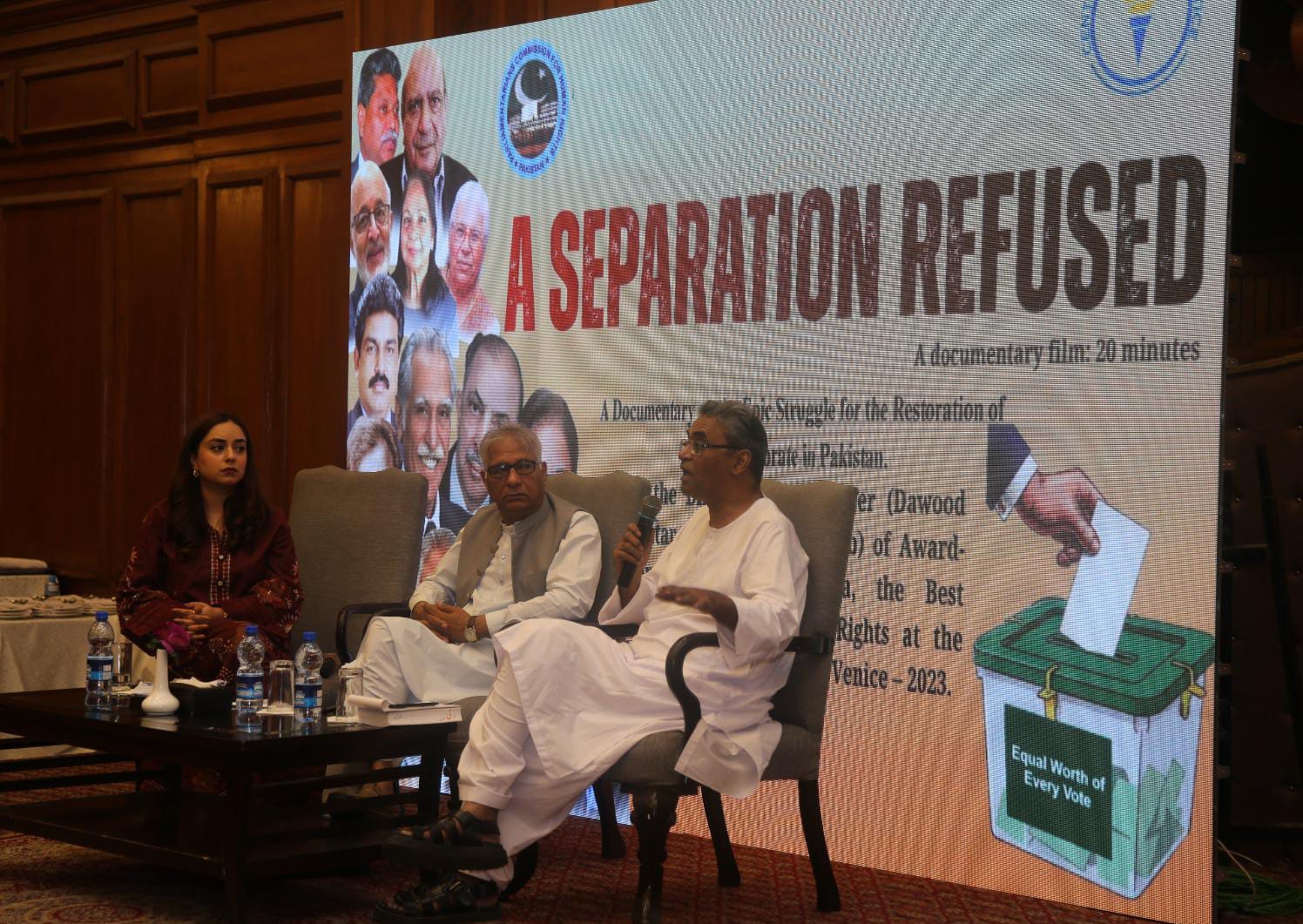
Lahore: The Centre for Social Justice (CSJ) held a screening of its documentary film, A Separation Refused, highlighting the Movement for the Restoration of the Joint Electorate in Pakistan, at a local hotel in Lahore.

The 20-minute documentary film, by the award-winning the producer and director, CSJ and Dawood Akhtar Murad, traces the culmination of the world unique Separate Electorate system in Pakistan’s history and the movement for the restoration of the Joint Electorate in Pakistan especially during the 1990s to 2001. The film chronicles the efforts of civil society organizations, political leaders, faith communities, and human rights advocates who campaigned for equal citizenship and inclusive democratic participation for religious minorities.

Using historical accounts and personal testimonies, the film illustrates how sustained advocacy contributed to democratic reforms and continues to inspire efforts towards equality, pluralism, social cohesion, and the protection of constitutional rights. Featuring over a dozen interviews, it brings together insights from Hina Jilani, Cardinal Joseph Coutts, Dr. Charles Amjad Ali, Dr. Yaqoob Bangash, and other prominent voices offering diverse perspectives youth, clergy and a parliamentarian.

The even also premiered a song Hum Juda Nahein (We Are Not Separate) that expressed the

The screenings were followed by an interactive panel discussion explored the progress made towards equal citizenship and the continuing challenges to the democratic participation of religious minorities in Pakistan. The panelists, Wajahat Masood a public intellectual and Peter Jacob, answered the questions while the academic Faaria Khan moderated the discussion.

While addressing the participants, Wajahat Masood, said that democracy is based on the principle of equal citizenship and that the categorization of citizens into majorities and minorities reflects a constitutional anomaly. Referring to the Separate Electorate system, he noted that institutionalizing such divisions weakened democratic systems and undermined the principle of equal political participation.

In response to a question on the rationale behind the documentary, Peter Jacob, Executive Director CSJ, said that the importance of the movement warranted a careful reading of the history. He noted that the film was developed to preserve authentic accounts of the struggle for the restoration of the Joint Electorate and to address competing interpretations of history and misunderstandings. He also emphasized the need for constitutional reforms to strengthen equal citizenship. He called for a review of Articles 41 and 91 of the Constitution, to remove precondition of religious affiliation for the offices of the President and Prime Minister. Moreover, implementation of Article 22(1) of the constitution of Pakistan that guarantees unbiased education.

In the open discussion, participants emphasized that the message of documentary film highlighting constitutional rights, democratic inclusion, should be screened more widely through universities, arts councils, mainstream media, and other public platforms to encourage informed dialogue and greater public awareness. They further stressed that equal citizenship is not solely the concern of religious minorities but a shared national responsibility, and called for greater participation and support from the majority community in future advocacy and dialogue.

At the end the participants reaffirmed a shared commitment to advancing constitutional rights, equal citizenship, participatory democracy, and peaceful coexistence through collective action.

Similar Posts

  • Online overuse affects mental health

    Spending too much time online has become a common habit for many people but it may negatively affect mental well being and everyday life. A study conducted in Germany found that excessive internet use can lead to higher stress levels irritability and less interest in other important activities. Researchers at the University of Duisburg-Essen surveyed around 900 people to learn about their internet habits. Based on the amount of time they spent online participants were divided into three groups. For two weeks each participant completed a short survey every evening. They reported their mood stress levels desire to use the internet and the total time they spent online that day. The researchers also examined how much people enjoyed using the internet and whether it affected their work hobbies studies or personal responsibilities. The study found that people who spent the most time online were more likely to feel stressed become easily irritated, and ignore other parts of their daily lives. Researchers also discovered that many heavy internet users felt a strong urge to go online because it gave them comfort and enjoyment. According to the researchers the findings show that excessive internet use can influence many areas of life and the risks are greater for people who spend long hours online regularly.

  • |

    Marc Padeu is reimagining renaissance masterpieces

    In the global art world, classical European masterpieces have long held a dominant position in defining sacred aesthetics, grand narratives, and historical gravity. However, Cameroonian visual artist Marc Padeu is challenging this historical monopoly by taking the iconic compositions of Old Masters such as Caravaggio, Diego Velázquez, and Titian. He’s transplanting them directly into the lush, everyday landscapes of rural Central Africa. Padeu’s striking large-scale canvases reimagine classic biblical motifs and European artistic traditions against the backdrop of cocoa plantations and rural villages in Cameroon. Far from being a mere imitation of Western techniques, Padeu’s work represents a deliberate re-centering of world history, spiritual heritage, and local identity. A Dual Spiritual and Cultural Inheritance Born and raised in Cameroon, Padeu grew up navigating two distinct spiritual and cultural realities. The formal structure of Catholic devotion and the indigenous customs of Bamiléké animism. This dual background permeates his paintings, where sacred rituals and everyday agricultural labor exist side by side. In Padeu’s compositions, classical Christian iconography such as the baptism of Christ, the martyrdom of saints or solemn biblical gatherings is integrated into scenes of fieldworkers harvesting cocoa pods along riverbanks. Rather than treating these scenes as contradictory, Padeu views them as a natural reflection of human experience. He points out that the original stories of the Bible were ultimately rooted in the lives of ordinary people engaging in daily, unvarnished labor. Extending the Legacy of the Old Masters When Padeu incorporates the compositions, dramatic lighting, and gestures of European Renaissance masters, his objective is not passive homage or simple satire. Instead, he describes his creative philosophy as an extension of the art historical narrative. By placing Black African figures at the center of classical visual compositions, Padeu reframes European iconographic conventions as a shared human language. His paintings suggest that spiritual gravity, dignity and monumental art belong just as naturally to a Cameroonian cocoa harvest as they do to a 16th-century Italian cathedral. The Art of Patience and Global Recognition Padeu’s meticulous process reflects a deliberate rejection of fast-paced contemporary art production: Deliberate Pace: He completes rarely more than ten paintings per year. Long Incubation: Months are spent conceptualizing each piece before a brush ever touches the canvas. Global Reach: His recent solo exhibition in London highlights his growing prominence on the international stage.   Padeu’s ultimate creative ambition is both subtle and transformative. Rather than shaping his art to explain Africa to Western audiences, his goal is to present the wider world through an African lens. His work offers a perspective rooted firmly in the soils, traditions, and realities of Cameroon.

  • | |

    West Indies post 344 in first innings as Pakistan …

    West Indies were dismissed for 344 runs in their first innings against Pakistan in the second Test match being played in Port of Spain. Pakistan’s off-spinner Sajid Khan delivered an impressive bowling performance, taking four crucial wickets to help restrict the home side. West Indies won the toss and elected to bat first, looking to take advantage of favorable conditions. Their innings was built around important contributions from Justin Greaves and captain Roston Chase, who played responsible knocks to strengthen the team’s total. Greaves scored 73 runs, while Roston Chase added 70 runs to lead the West Indies batting effort. Brandon King contributed 46 runs, while Shai Hope and Amir Jangoo scored 29 and 26 runs respectively as the hosts attempted to build a competitive first-innings score. Pakistan’s bowling attack responded strongly, with Sajid Khan emerging as the standout performer. The experienced off-spinner troubled the West Indies batters with his accuracy and variations, finishing with four wickets. His spell played a key role in preventing the hosts from gaining further momentum. Fast bowlers and other bowling options also supported Sajid Khan effectively. Ubaid Shah, Mohammad Ali, and Ali Usman claimed two wickets each, ensuring that West Indies were unable to extend their innings beyond 344 runs. At the toss, Pakistan captain Babar Azam said that his team would also have preferred to bat first if they had won the toss. He expressed confidence in the squad and said Pakistan aimed to play positive and attacking cricket throughout the match. West Indies captain Roston Chase said his team wanted to make their home conditions a strength and decided to maintain the same playing XI for the second Test. The hosts entered the match with confidence after taking a 1-0 lead in the two-match series. Pakistan now face the challenge of responding strongly with the bat as they look to level the series. A victory in the second Test is essential for Pakistan to avoid a series defeat, while West Indies will aim to maintain their advantage and secure a historic series win. With both teams fighting for crucial championship points and momentum, the second Test is expected to produce an exciting contest as the match progresses.

  • | | |

    Pakistan seeks strategic economic ties with Saudi …

    ISLAMABAD: Prime Minister Shehbaz Sharif has expressed Pakistan’s desire to transform its longstanding relationship with Saudi Arabia into a mutually beneficial strategic economic partnership, in line with the vision of Saudi Crown Prince and Prime Minister Mohammed bin Salman. The Prime Minister made the remarks during a meeting with a high-level Saudi business delegation headed by Prince Mansour bin Mohammad Al Saud, Chairman of the Saudi-Pak Joint Business Council, at the Prime Minister’s House in Islamabad. During the meeting, Prime Minister Shehbaz conveyed his regards to Saudi King Salman bin Abdulaziz Al Saud and Crown Prince Mohammed bin Salman. He highlighted the deep-rooted brotherly relations between the two countries and stressed the need to expand bilateral trade, investment and economic cooperation. The prime minister expressed hope that Prince Mansour’s latest visit would build upon earlier discussions and lead to the signing of memoranda of understanding and agreements in several sectors. He described the current period as an ideal opportunity to strengthen cooperation through both government-to-government and business-to-business partnerships. The Saudi delegation showed interest in investment opportunities across a wide range of sectors, including agriculture, ports, highways, airport outsourcing, real estate, energy, power distribution and information technology. Prime Minister Shehbaz welcomed the proposals and assured the delegation of Pakistan’s support for mutually beneficial investment ventures. Prince Mansour thanked the prime minister for the warm reception and reaffirmed the Saudi government’s and business community’s commitment to expanding business-to-business ties with Pakistan. During its visit, the delegation is also scheduled to hold meetings with senior government officials and representatives of the private sector. PM Condemns Pishin Terrorist Attack Meanwhile, Prime Minister Shehbaz Sharif strongly condemned the terrorist attack on labourers working on a road construction project in the Suranan area of Pishin district. The prime minister expressed sorrow over the loss of lives and extended condolences to the families of the victims. He denounced the targeting of hardworking citizens as a cowardly act and reaffirmed the government’s determination to combat terrorism. He stressed that the nation remained united against terrorism and that terrorists and their facilitators would not be permitted to undermine peace and stability in the country. The prime minister also prayed for the departed souls and for strength and patience for the bereaved families.

  • | |

    Govt increases fuel prices as international oil ra…

    The Government of Pakistan has announced a fresh increase in petroleum prices, raising the price of petrol by Rs. 1.63 per litre and high-speed diesel (HSD) by Rs. 1.55 per litre. The revised prices will come into effect from July 29, according to a notification issued by the Petroleum Division. Following the latest revision, petrol will now cost Rs. 335.81 per litre, while high-speed diesel will be available at Rs. 388.38 per litre. Officials said the increase reflects fluctuations in international crude oil prices caused by renewed tensions in the Persian Gulf, which have affected global energy markets. The government continues to collect substantial taxes and duties on petroleum products. Consumers currently pay around Rs110 per litre in taxes and levies on petrol, while diesel carries approximately Rs96 per litre in taxes and duties. Fuel prices have remained volatile throughout the year. Diesel had previously reached a record Rs520.35 per litre in early April after rising sharply from Rs281 per litre during the escalation of the US-Iran conflict. Similarly, petrol climbed to a peak of Rs458.41 per litre after increasing from Rs266 per litre in early March. Petroleum Minister Ali Pervaiz Malik recently announced that fuel prices would now be reviewed daily instead of weekly. The decision aims to ensure domestic fuel prices better reflect international market trends, especially during periods of global uncertainty. Under the new policy, the Oil and Gas Regulatory Authority (Ogra) will determine daily fuel prices based on changes in international oil markets. However, the move has faced criticism from the All Pakistan Dealers Association, which has warned that it may launch protests against the daily pricing mechanism. Petrol is primarily used by private vehicle owners, motorcycles, rickshaws, and small transport operators. As a result, any increase directly impacts middle- and lower-income households. High-speed diesel is widely used in heavy transport, agriculture, power generation, and industrial sectors, meaning price hikes can also increase transportation and production costs, contributing to inflation. With monthly sales of 700,000 to 800,000 tonnes, petrol and diesel remain Pakistan’s largest petroleum products by consumption and are significant contributors to government revenue. As global oil prices continue to fluctuate, consumers should expect further adjustments in domestic fuel prices in the coming weeks.

  • | |

    UN raises alarm, 2 aid mission staff detained in A…

    NEW YORK: The United Nations has called for the immediate protection of its personnel in Afghanistan after two staff members of the UN aid mission were detained by the country’s intelligence authorities. The UN said the two personnel were taken into custody but have not been informed of the allegations or charges against them. The organisation also said it has so far been denied access to the detained staff members. UN Secretary-General Antonio Guterres expressed concern over the detentions and urged Afghan authorities to respect the special legal status of UN personnel. Guterres called on the Taliban authorities to fully uphold the privileges and immunities granted to the United Nations and its staff under international agreements. The UN has continued to provide humanitarian assistance in Afghanistan despite the country’s difficult security and political environment. The detention of its personnel has raised concerns about the ability of international organisations to operate safely and independently in the country. The circumstances surrounding the arrests and the identities of the detained personnel have not been disclosed publicly, while the United Nations continues to seek access to them.

Leave a Reply

Your email address will not be published. Required fields are marked *