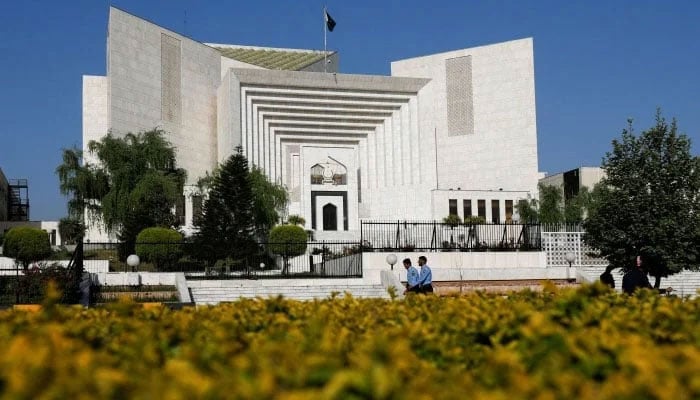
appeal filed supreme

Appeal filed in Supreme Court over minority reserved seats

An appeal has been filed in the Supreme Court’s Lahore Registry challenging the Lahore High Court’s decision dismissing a constitutional petition seeking an increase in the number of reserved seats for minorities in the National and Provincial Assemblies in line with the country’s population growth.

The constitutional appeal has been filed by advocate Naseeb Masih, who has made the Federal Government, the President of Pakistan, and the Secretary for Law and Parliamentary Affairs respondents in the case.

The appellant contended that the Lahore High Court failed to correctly appreciate the legal and constitutional issues raised in the petition. It was argued that the number of reserved seats for minorities should have been increased following successive population censuses, but this constitutional requirement had been ignored.

According to the appeal, the minority population has grown at a rate comparable to the Muslim population, yet the number of reserved seats allocated to minorities has remained unchanged. It was further submitted that representation for women has also not been increased proportionately to the growth in population.

The petitioner maintained that the Constitution currently provides 10 reserved seats for minorities in the National Assembly, while the Punjab Assembly has eight reserved minority seats, Sindh nine, Khyber Pakhtunkhwa four, and Balochistan four.

The appeal states that these allocations were originally based on the 1981 Population Census, following a Presidential Order issued in 1985, under which 10 minority seats were reserved in the National Assembly when the House consisted of 207 general seats.

It further points out that under the Legal Framework Order (LFO) 2002, the number of general seats in the National Assembly was increased to 272, and 60 seats were reserved for women.

However, despite these constitutional changes, the number of reserved seats for minorities was not increased.

Similarly, the appeal notes that the number of general seats in the Punjab Assembly was enhanced from 240 to 297, while the number of reserved seats for women was increased to 60. However, the number of minority seats remained fixed at eight, despite the increase in the province’s population.

The petitioner has requested the Supreme Court to set aside the Lahore High Court’s judgment and direct the relevant authorities to increase the number of reserved seats for minorities in the National and Provincial Assemblies in proportion to the country’s population, ensuring equitable constitutional representation for minority communities.

Similar Posts

  • | | |

    Security forces kill 10 militants in two Khyber Pa…

    Security forces have killed 10 militants of Fitna al-Khawarij in two separate operations in Khyber Pakhtunkhwa, according to the Inter-Services Public Relations (ISPR). The first operation was conducted in the Azam Warsak area of South Waziristan district after a group of militants attacked security forces’ check posts. According to ISPR, security personnel responded effectively to the attack, resulting in an exchange of fire. Eight militants were killed during the operation. The second operation was carried out in Dir district, where security forces killed two more militants. Weapons and ammunition were also recovered from the possession of the slain militants. ISPR said the militants killed in the operations had been involved in several terrorist activities in the area. The military’s media wing said security forces are continuing intelligence-based counterterrorism operations under the government’s vision of “Azm-e-Istehkam” to eliminate terrorism and maintain peace and stability in the region.

  • | |

    Rs19,000 billion federal spending sparks Senate de…

    Islamabad: A Senate committee has raised serious questions over the functioning of the Council of Common Interests (CCI), warning that constitutional powers given to provinces after the 18th Amendment are being weakened through the revival of federal ministries on devolved subjects. The Senate Standing Committee on Devolution expressed concern that ministries related to education, health, agriculture, food security, climate change and other provincial matters were recreated at the federal level despite their transfer to provinces under the constitutional process. The committee questioned why federal institutions were continuing to handle matters that were supposed to belong to provinces after the 18th Constitutional Amendment, calling for a review of the entire system. The meeting was held at Parliament House, Islamabad, where Senator Zamir Hussain Ghumro presided over the session. Senators Poonjo Bheel and Jan Muhammad Buledi also attended the meeting. Senator Ghumro said that under the 18th Amendment, a detailed process was completed in 2010 and 2011 to transfer powers from the federal government to provinces. He explained that notifications issued on December 2, 2010, April 15, 2011, and June 29, 2011 resulted in the devolution of 17 ministries dealing with subjects that were shifted to provincial control. According to Senator Ghumro, the recreation of ministries after June 30, 2011, on subjects already transferred to provinces was against the spirit of the Constitution. He specifically pointed towards areas including education, health, national food security, culture, climate change, housing, social initiatives, EOBI, Evacuee Trust matters and Zakat and Ushr related functions. The senator argued that creating federal structures for provincial subjects has increased government expenses at a time when Pakistan is facing financial pressure. He claimed that federal government expenditure has increased to around Rs19,000 billion, while the country’s total tax and non tax revenue stands near Rs20,000 billion. Senator Ghumro said that apart from defence requirements due to security challenges, other federal ministries should have limited budgets according to constitutional responsibilities. He suggested that reducing unnecessary federal administrative structures could save around Rs5,000 to Rs6,000 billion and help reduce dependence on foreign loans. The committee also raised concerns about the ineffective role of the Council of Common Interests, a constitutional body responsible for resolving issues between the federation and provinces. Senator Ghumro said the CCI’s permanent secretariat was not functioning effectively and stressed that the institution must be strengthened to protect provincial rights. The committee decided to form a subcommittee to examine alleged violations related to the implementation of the 18th Amendment, including the revival of ministries and the role of the CCI. Senator Poonjo Bheel said that ministries created on devolved subjects should be abolished because the matter had already been settled through the constitutional process. Senator Jan Muhammad Buledi said the subcommittee should not only review the recreated ministries but also examine why the CCI had become ineffective despite having an important constitutional role. The committee also directed the Establishment Division to avoid making appointments in departments dealing with devolved subjects and ensure that provincial representation is protected in government appointments and promotions. Officials were asked to provide details of appointments in different grades within two weeks and submit a compliance report within 15 days. It emphasized that the federal government should support provinces rather than reduce their constitutional benefits. The committee also reviewed the issue of the Rs46 billion allocation for Quaid-e-Azam’s Mausoleum, which was not released last year and was reportedly transferred to another ministry. The committee directed authorities to provide monthly progress reports regarding the development and maintenance of Mazar-e-Quaid. The committee further sought details about the tenure of federal secretaries and directed the Establishment Division to submit complete records.

  • | |

    Ishaq Dar urges global support for gulf peace effo…

    Deputy Prime Minister and Foreign Minister Ishaq Dar has urged the international community to build on recent diplomatic progress in the Gulf region, emphasizing that the opportunity to achieve lasting peace should not be wasted. Speaking at the 33rd ASEAN Regional Forum (ARF) Ministerial Meeting in Manila, Dar stressed the importance of continued dialogue, diplomacy, and constructive engagement to maintain regional stability. Dar, who arrived in the Philippines with a high-level delegation, is attending the ARF Plenary Meeting and holding bilateral discussions with foreign ministers on the sidelines of the forum. During his address, he noted that recent developments in the Gulf have had far-reaching consequences for countries across the region, making it essential for all stakeholders to work together to prevent further instability. The foreign minister highlighted Pakistan’s role in promoting peace by facilitating diplomatic efforts that contributed to a ceasefire in the Gulf. He referred to the Islamabad Talks, held after a gap of 47 years, followed by the signing of the Islamabad Memorandum of Understanding in Bürgenstock. According to Dar, these initiatives reflected Pakistan’s commitment to peaceful conflict resolution and regional stability. He expressed gratitude to the United States, Iran, Gulf nations, and other international partners for placing their trust in Pakistan’s diplomatic efforts. Describing the recent progress as the result of patient negotiations and dialogue, Dar warned that these achievements must be safeguarded through continued engagement rather than allowing tensions to resurface. Dar reaffirmed Pakistan’s commitment to supporting every initiative aimed at restoring peace and security in the region. He urged all parties to exercise restraint, fulfill their commitments, and prioritize diplomatic solutions over confrontation. He also expressed hope that ongoing negotiations would help restore normal shipping operations through the Strait of Hormuz, a vital international trade route. At the beginning of his speech, Dar thanked the Philippines for hosting the ministerial meeting and reaffirmed Pakistan’s support for dialogue, mutual respect, and peaceful coexistence. He described the ASEAN Regional Forum as a key platform for regional security cooperation and welcomed the adoption of the Manila Plan of Action (2026–2036), pledging Pakistan’s support for its successful implementation. Addressing South Asian affairs, Dar reiterated Pakistan’s position that the unresolved Jammu and Kashmir dispute remains a major source of regional instability. He called for a peaceful resolution based on the United Nations Charter, relevant UN Security Council resolutions, and the wishes of the Kashmiri people. He also voiced concerns over India’s decision to suspend the Indus Waters Treaty, describing the move as a unilateral action that could threaten Pakistan’s water security and the livelihoods of millions of its citizens. Dar urged the international community to support international law and encourage peaceful solutions to regional disputes. Speaking on the humanitarian crisis in Gaza, Dar described the situation as deeply concerning and called for immediate international action to prevent further suffering. He reaffirmed Pakistan’s longstanding support for the Palestinian people’s right to self-determination and the establishment of an independent Palestinian state based on the pre-1967 borders, with Al-Quds Al-Sharif as its capital. Concluding his address, Dar highlighted Pakistan’s sacrifices in the global fight against terrorism, noting that the country has lost more than 80,000 lives and suffered significant economic losses. He reaffirmed Pakistan’s determination to continue working with the international community to promote peace, stability, and security both regionally and globally.

  • | |

    Sindh e-transfer approves over 2,000 teachers

    The Sindh School Education Department has approved the transfer of 2,059 teachers under the first phase of its e-transfer system, aiming to improve teacher distribution and ensure better staffing in public schools across the province. According to an official notification issued in Karachi, the approved transfers include 1,625 applications under the general category and 434 applications under the mutual transfer category. The department approved transfers for a total of 2,059 teachers. Among them, 1,163 are male teachers, while 896 are female teachers. Officials said 644 teachers were transferred on the basis of the teacher-to-student ratio to address staffing imbalances in schools. Another 544 teachers received transfers based on their marital status. The notification further stated that 173 transfers were approved on medical grounds. In addition, 100 teachers were transferred due to tribal dispute-related reasons. Another 31 teachers were granted transfers because of physical disabilities. The department also approved 434 applications under the mutual transfer category, allowing teachers to exchange their postings with one another. According to the official statement, the e-transfer system has also helped improve the functioning of public schools. A total of 41 schools that were previously facing teacher shortages have become operational after teachers were posted through the transfer process. Education officials said the e-transfer system is designed to make the transfer process more transparent, efficient and merit-based. The digital system reduces manual intervention and ensures that transfers are processed according to approved criteria. The School Education Department expects the initiative to improve the availability of teachers in underserved areas and strengthen the overall quality of education in government schools across Sindh. Further phases of the e-transfer programme are expected to continue in line with departmental requirements.

  • | |

    Sohail Afridi warns rulers to ‘open their eyes?…

    PESHAWAR: Khyber Pakhtunkhwa Chief Minister Sohail Afridi has warned Pakistan’s rulers and decision-makers to “open their eyes” before September 27, saying the situation could become increasingly difficult to control if justice, constitutional supremacy and the rule of law are not restored. Speaking to reporters while attending a protest outside the Supreme Court, Afridi also expressed concern over reports about the health of Pakistan Tehreek-e-Insaf founder Imran Khan. The chief minister said serious concerns were emerging about Khan’s health and called for the matter to be treated with urgency. He said neither he nor Khan had attempted to use the former prime minister’s health for political relief. Afridi demanded that Khan’s family be allowed to be present and that his treatment be conducted under the supervision of his personal doctors. The KP chief minister referred to the treatment of former Prime Minister Nawaz Sharif during Imran Khan’s government. He said Khan had allowed Sharif to travel abroad for medical treatment on humanitarian grounds, despite questions that had been raised at the time regarding medical certificates. According to Afridi, Khan was now being deprived of basic human rights and justice, which he described as a matter of serious concern. Afridi also criticized what he described as politically motivated cases against Khan. He alleged that his political opponents had themselves faced corruption allegations and accused them of misusing national resources. These claims represent Afridi’s political position and were not independently established in his remarks. The KP chief minister also spoke about the judiciary, saying Pakistan’s justice system was facing a major test. He urged judges to stand up for justice and said that one judge taking a principled position could encourage others to do the same. Afridi argued that the public was looking toward the judiciary for relief and justice. He questioned where citizens would turn if judges failed to perform their constitutional responsibilities. The chief minister further warned about growing anger among young people, saying he could see what he described as a “revolution” in the eyes of the country’s youth. He cautioned that continued injustice and rising hatred could eventually create a situation in which even Imran Khan might struggle to persuade people to respond with affection or restraint. Afridi urged the rulers and decision-makers to understand the seriousness of the situation before September 27 and move the country toward justice, constitutional supremacy and the rule of law. He warned that failure to address these concerns could make the situation increasingly difficult to manage, adding another strong political message to the ongoing tensions surrounding Imran Khan and his supporters.

  • | |

    Punjab cybercrime crackdown, 28 suspects arrested

    LAHORE: Authorities have arrested 28 suspects in Lahore, Faisalabad and Multan as part of a major crackdown on organised online fraud, exposing alleged schemes that relied on impersonation, fake investment opportunities and fabricated official identities to deceive citizens. The arrests were made during a province-wide operation by the National Cyber Crime Investigation Agency (NCCIA) Punjab, directed by Punjab Director Muhammad Ali Wasim, officials said. Investigators also seized 24 mobile phones and a laptop, which are now being examined for evidence that could lead to other members of the alleged network. The investigation has revealed how fraudsters allegedly manipulated trust to convince victims to hand over large sums of money. Millions allegedly lost in Lahore scam In Lahore, 18 suspects were arrested in separate operations. Investigators said the suspects allegedly impersonated relatives, visa agents, government officials and personnel associated with the Punjab Safe Cities Authority. In one case, suspects allegedly posed as both a relative and a visa agent and persuaded a victim to transfer Rs25.86 million. The case has highlighted how scammers can combine apparently familiar identities with urgent requests to make their schemes appear legitimate. Rs54.66m trading fraud uncovered Three suspects were arrested in Faisalabad in connection with alleged online trading fraud and unauthorised access to a company email account. According to investigators, a victim was shown fabricated trading records, digital-wallet balances and purported profit statements to create the impression that substantial returns were being generated. After being persuaded to invest, the victim allegedly lost Rs54.66 million, investigators said. The case demonstrates the growing sophistication of investment scams, where criminals allegedly use manipulated digital information to make fraudulent platforms appear genuine. Multan arrests expose impersonation tactics In Multan, seven suspects were arrested for allegedly posing as relatives, bank employees and individuals claiming to be based in Britain. Officials said victims were approached with various demands, including payments supposedly required for prize money, customs clearance, taxes and visa renewals. Such tactics typically create a sense of urgency, leaving victims with little time to verify the identity of the caller or the authenticity of the demand. Digital evidence now under forensic examination NCCIA investigators are examining the seized devices through forensic analysis. Financial transactions, call records and digital communications are also being reviewed to establish the full extent of the alleged operation and identify other people who may be connected to it. The crackdown comes amid growing concern over online financial fraud in Pakistan. The NCCIA’s own statistics identify financial fraud as a major category of reported cybercrime. The latest arrests underscore a simple but increasingly important warning: an apparently familiar voice, official-looking message or promising investment opportunity may not be what it seems. Authorities are expected to continue the investigation as they trace the alleged network and follow the digital and financial trails left behind.

Leave a Reply

Your email address will not be published. Required fields are marked *