bilawal calls truth
| |

Bilawal calls for truth commission to end AJK unre…

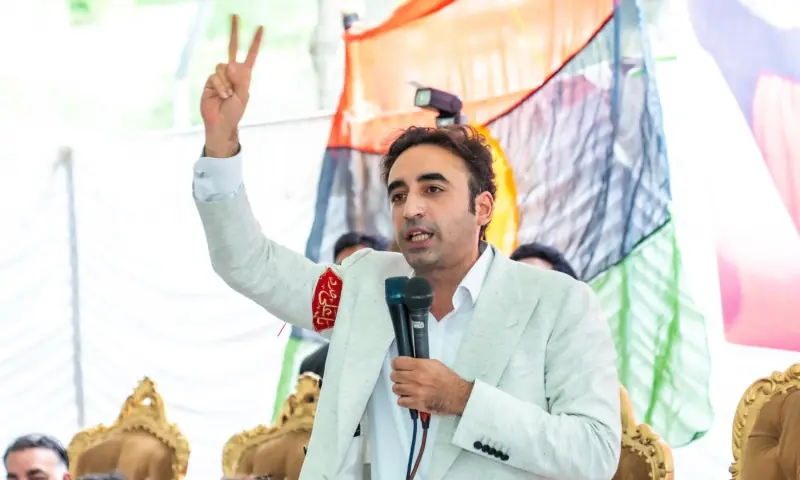
PPP Chairman Bilawal Bhutto-Zardari has urged the government and protesters in Azad Jammu and Kashmir (AJK) to agree on the formation of a truth and reconciliation commission to investigate the violence and political tensions that have gripped the region.

Speaking to party workers in Muzaffarabad on Tuesday, Bilawal said the commission could provide a peaceful mechanism to determine the facts behind the unrest and help prevent further loss of life.

He said maintaining peace, fairness and transparency was particularly important during the ongoing AJK elections, arguing that the issue should not be treated as a contest between winners and losers.

According to Bilawal, the PPP had been advocating a truth and reconciliation commission for about a month. He proposed that protesters suspend their demonstrations while the commission investigates the incidents and presents its findings.

He criticised both the authorities and protesters for failing to compromise, warning that ordinary Kashmiris were suffering despite having no connection with either side.

Bilawal said those responsible for violence should be identified through an investigation rather than being punished on the streets. He also accused the state of giving greater importance to the interests of the Pakistan Muslim League-Nawaz (PML-N) than to the interests of Kashmir.

Bilawal questions AJK election process

Bilawal also criticised the conduct of the AJK elections, particularly the violence and allegations of irregularities reported during polling in parts of the region.

He claimed that the PPP had a strong mandate in Mirpur and alleged that polling stations were forcibly occupied and party polling agents removed. He also accused rival political workers of using violence to influence the electoral process.

According to preliminary election results, the PML-N won nine of the 13 constituencies in the first phase, while the PPP secured four seats.

Bilawal rejected the results in several constituencies and alleged that the PPP’s mandate had been compromised. He questioned how PPP candidate Chaudhry Yasin could lose his home constituency and described the result as unacceptable.

He also criticised the decision to conduct the AJK elections in three phases, alleging that the arrangement had failed to prevent electoral malpractice.

The PPP chairman referred to reports of violence, firing and the death of a political worker, while also raising concerns over internet disruptions in parts of the region.

He called on the authorities to decide whether national interests or political considerations would guide their actions in AJK.

Bilawal warned that continued violence and political instability could damage the future of the region. He urged PPP workers to remain peaceful but said the party would not accept attacks on its supporters or the alleged seizure of polling stations.

He also appealed for political restraint, saying that the PPP wanted to pursue peaceful politics but would continue to defend what it considers its electoral mandate.
Similar Posts

  • Thailand Honors King Bhumibol on Father’s Day and World Soil Day

    BANGKOK – Thailand commemorates a day of profound national significance each December 5, celebrating both Father’s Day and World Soil Day in honor of the birthday of His Majesty the late King Bhumibol Adulyadej The Great. Since 1960, this national holiday has united Thais in paying tribute to paternal figures and in reflecting upon the […]

  • |

    Gazans welcome Hamas disarmament plan but remain doubtful of Israeli withdrawal

    Many Palestinians in Gaza have cautiously welcomed reports that Hamas has agreed to disarm under a new United States backed proposal, hoping it could eventually bring an end to the devastating conflict. However, despite this small sign of progress, many remain unconvinced that Israel will withdraw its forces or that lasting peace is within reach. US President Donald Trump recently announced that Hamas had accepted a plan to surrender its weapons as part of a broader roadmap aimed at stabilising Gaza and beginning reconstruction. Hamas later confirmed the agreement. Even so, Israeli military operations have continued, leaving many residents uncertain about whether the proposal will lead to any real change. Thousands of families remain displaced, while many others continue living in overcrowded tent camps where shortages of food, clean water, medicine and proper sanitation have created severe humanitarian conditions. Disease outbreaks and poor living conditions have become an everyday reality for much of the population. For many Palestinians, survival remains the immediate concern. Abdel Moneim Aboul Roos, a 24 year old tuk tuk driver who lost a leg in an Israeli airstrike, said discussions about disarmament and troop withdrawals mean little while people continue to struggle for basic necessities. He said access to food and medical care matters more than political agreements that have yet to improve conditions on the ground. The latest proposal builds on a ceasefire agreement reached last year with US support. That deal ended large scale fighting for a period, secured the release of Israeli hostages and increased humanitarian aid entering Gaza. It also included plans for a gradual Israeli military withdrawal, the formation of an international stabilisation force and the dismantling of Hamas’ weapons. However, the agreement soon stalled as both Israel and Hamas accused each other of violating its terms. Hamas retained its weapons while Israeli forces remained in the territory, causing negotiations to break down. The newly announced roadmap provides more detailed arrangements for transferring Hamas’ weapons to a technocratic Palestinian administration. According to the proposal, Israel would not participate in the disarmament process and would instead halt military operations to allow political transition and reconstruction efforts to move forward. Despite these commitments, many Gazans remain deeply sceptical because previous promises of peace failed to deliver lasting results. Displaced resident Ayman Ahmed said people have repeatedly been told that the war would end, only to see the violence continue. While he hopes Hamas eventually lays down its arms, he believes such a step is unlikely in the near future and expressed frustration that ordinary Palestinians continue to suffer while political leaders remain divided. The conflict began after Hamas launched its October 2023 attack on southern Israel, killing around 1,200 people and taking hundreds of hostages. Israel responded with a large military campaign in Gaza that has caused widespread destruction and heavy casualties. According to Gaza health authorities, more than 73,000 Palestinians have been killed during the war, while the fighting has displaced most of the territory’s population. The figures do not distinguish between civilians and fighters, although officials say women and children account for a large share of those killed. Many residents also fear that Israel has no intention of fully leaving Gaza even if Hamas is disarmed. Israeli officials have not publicly endorsed the latest roadmap and anonymous government sources have suggested that it does not match Israel’s security objectives. They have also indicated that Israeli forces intend to remain along the Yellow Line, a military zone separating Israeli controlled territory from the rest of Gaza. The military has strengthened its positions in these areas by building defensive barriers and carrying out demolition operations, leaving many displaced families uncertain whether they will ever return to their homes. Despite these fears, many Palestinians continue to hold onto hope. Anas Nakla, whose home in Rafah was destroyed during the war, said he still dreams of returning with his family even though nothing remains of his house. Mohamed Hamad, displaced from northern Gaza, believes that if the new plan results in even a partial Israeli withdrawal, it would restore hope that one day all displaced families could rebuild their lives in their own communities.

  • |

    Pakistan begins Commonwealth Games 2026 campaign with hopes pinned on Arshad Nadeem

    GLASGOW: The 2026 Commonwealth Games have officially begun in Glasgow and will continue until August 2, bringing together nearly 3,000 athletes from 74 countries to compete across multiple sporting disciplines. Pakistan has sent a 36-member contingent, including 20 athletes, along with coaches and officials, to participate in this year’s event. The national team will compete in six sports: athletics, boxing, judo, gymnastics, lawn bowls and swimming. Pakistan’s biggest medal hope is Olympic javelin champion Arshad Nadeem, who will defend his Commonwealth Games title. Having achieved historic success for Pakistan on the international stage in recent years, Arshad is widely regarded as the country’s strongest contender for a gold medal. In athletics, Pakistan will be represented by Arshad Nadeem, Faiqa Riaz, Ansar Abbas, Muhammad Akhtar, Muhammad Ismail, Muhammad Yasir and Noreen Hussain. The boxing squad includes Afzal Khan, Fatima Zahra, Malaika Zahid, Qudratullah and Samama Rehman. Shah Hussain Shah will compete in judo, while Shehzad Ali will represent Pakistan in gymnastics. In lawn bowls, Maqsood Waseem Khan and Muhammad Ayub Qureshi will compete, while Hamza Asif, Hareem Malik, Jehanara Nabi and Muhammad Ahmed Durrani will represent Pakistan in swimming. Sports analysts believe Pakistan’s brightest medal prospect is Arshad Nadeem in the men’s javelin throw. If he performs at his best, he is considered a leading favourite to win gold. Pakistan could also challenge for medals in boxing, although the competition is expected to be tough. In judo, Shah Hussain Shah is viewed as another strong contender, given Pakistan’s previous success in the sport at the Commonwealth Games. In gymnastics, lawn bowls and swimming, the main objective for Pakistani athletes will be to reach the final rounds and achieve personal best performances. Overall, experts believe Pakistan has the potential to win one to three medals, with the strongest possibility being a gold medal through Arshad Nadeem. A standout performance in boxing or judo could further improve the country’s medal tally. As the Games get underway, Pakistani fans will be closely following Arshad Nadeem, whose achievements have made him one of the country’s most celebrated athletes and an inspiration for the next generation of sportsmen and women.

  • |

    Diesel price rises as government increases petroleum levy

    ISLAMABAD: The federal government has increased the price of high-speed diesel after raising the Petroleum Development Levy (PDL) on the fuel by Rs1 per litre, adding further pressure on consumers and transport-related costs. Following the latest adjustment, the price of high-speed diesel has gone up by 54 paisas per litre, reaching Rs382.89 per litre. The increase comes despite a decline in the ex-refinery price of diesel, with the higher petroleum levy pushing up the final price paid by consumers. The government has raised the diesel levy by Rs1 per litre as part of the latest petroleum price adjustment. The PDL on high-speed diesel now stands at Rs76.28 per litre. The latest increase follows another adjustment made on August 12, when the government raised the petroleum levy on diesel by Rs2 per litre. The successive increases have resulted in a significant rise in the levy component of the retail price. Petrol price reduced In contrast to diesel, the government has reduced the price of petrol by 94 paisas per litre. The price of petrol has now been fixed at Rs324.98 per litre. The Petroleum Development Levy on petrol, however, has remained unchanged at Rs80 per litre. The differing price movements for petrol and diesel are largely linked to changes in their respective pricing components. While the ex-refinery price of diesel declined, the increase in the government levy more than offset the reduction, resulting in a higher retail price. The latest adjustment is expected to have an impact on transportation and logistics costs because diesel is widely used by commercial vehicles, buses, trucks, agricultural machinery and other heavy transport. Higher diesel prices can also influence the cost of goods and services by increasing transportation expenses across supply chains. Meanwhile, the reduction in petrol prices provides limited relief to motorists using petrol-powered vehicles. The government periodically reviews petroleum prices based on international oil prices, exchange-rate movements, taxation and other components of the domestic pricing mechanism. The latest changes reflect the impact of adjustments in the petroleum levy and ex-refinery prices on consumers.

  • | |

    Shahid Afridi voices concern over Karachi’s decline

    Shahid Afridi has always had a complicated relationship with Karachi, the city of his origins and the one he eventually left behind. He now lives in Islamabad with his family, a decision he has attributed to the worsening state of roads and cleanliness in the city. But a recent visit to Karachi, his first in several months, brought those feelings rushing back with full force, and he did not hold them in. In a video shared on social media following his visit, Afridi spoke directly to his followers about what he saw during a trip to the Korangi area, and his disappointment was palpable from the very first word. “Day before yesterday, I was visiting the Korangi area,” he said. “Friends, I don’t understand this. We give you billions of rupees’ business and this city provides millions of jobs, but I feel embarrassed seeing the condition of Karachi.” He then described the particular disillusionment that comes from returning to a place with hope, only to find it unchanged. “I came to Karachi after years, thinking there must have been some construction work or development, but it is still the same. It disappoints me.” He named specific areas to illustrate his point, places that residents have long complained about and that appear to have remained in a state of perpetual half-construction. “The areas around Korangi, the side area, university road have been under construction for years,” he said. “The city needs a lot of development, and the authorities need to work on it. Please do something. I hope Karachi gets better.” The appeal was genuine and the frustration behind it real, coming from a man who grew up in the city and clearly retains a deep affection for it even in its current condition. The contrast between Karachi’s economic significance and the state of its infrastructure is one that has been raised by residents, civic activists and public figures for years. Afridi’s remarks gave fresh voice to that long-running complaint. The public reaction, however, was not entirely sympathetic. While some supporters agreed with the substance of his concerns, many commenters pointed to what they saw as a glaring contradiction. Afridi has been vocal in his political commentary and has aligned himself publicly with certain political figures and parties over the years. For many Karachiites, the individuals and systems he has supported are the very ones responsible for the neglect he was now condemning. The criticism was pointed: it is easier to express disappointment from Islamabad than to have consistently held accountable those who could have made a difference. The response reflects a broader frustration that many Pakistanis feel when public figures with platform and influence choose to react rather than act. Shahid Afridi’s concern for Karachi appears genuine. Whether that concern translates into sustained accountability for those in power over the city’s administration is the question his critics were loudly putting back to him.

  • | | |

    Pakistan clarifies Afghan deportation policy

    Pakistan has clarified that Afghan citizens with valid visas and travel documents have not been expelled from the country. Foreign Office spokesperson Tahir Hussain Andrabi said the government was following a legal process regarding Afghan nationals staying in Pakistan. Addressing the weekly press briefing, Andrabi said cases of around 89,000 Afghan citizens were currently being reviewed under the Illegal Foreigners Repatriation Plan (IFRP). He explained that the process was being carried out according to established procedures and legal requirements. The spokesperson added that Pakistan was also providing humanitarian relief by extending the stay of nearly 16,000 Afghan nationals. The extension applies mainly to vulnerable groups, including women, children and elderly citizens, he said. Commenting on reports of an incident near the Chitral border areas, Andrabi said the Foreign Office had no confirmed information about the matter. He stated that reports coming from Afghanistan needed proper verification at the ground level before any official response could be given. The spokesperson stressed that Pakistan would avoid commenting on unverified reports and would share information only after confirmation from reliable sources.

Leave a Reply

Your email address will not be published. Required fields are marked *