can you spot

Can you spot the hidden mistake?

Online picture puzzles often challenge people to look closely and find something unusual.  One such puzzle has caught the attention of many people.

In the picture a woman can be seen standing in a kitchen and washing dishes. At first everything looks completely normal. But there is actually a strange mistake hidden in the scene.

The puzzle is a simple test of your observation skills. Can you spot what is wrong? Take a close look at the picture. If you cannot find the mistake here is the answer.

Look at the tea kettle. Its spout is placed unusually low on the kettle.  A kettle designed like this would not work properly because the tea could not flow out normally.

Did you spot the mistake before reading the answer?

Similar Posts

  • Can you find the missing number?

    Do you enjoy answering internet riddles especially math puzzles? If yes then the puzzle shown in the image is a great test for your brain. Many people struggle to find the correct answer. Look at the image and try to figure out which number should replace the question mark in the third row on the left side. The first row contains the numbers. 3, 6, 2, 7, 9 The second row contains: 3, 7, 8, 5, 6 The third row contains: ?, 4, 1, 3, 5 ur task is to find the missing number. To solve it you need to notice the pattern connecting the numbers. The trick is to add the numbers vertically starting from the right side and moving left. Here is the method: 9 + 6 = 15 → write 5 in the bottom row and carry 1. 7 + 5 + 1 = 13 → write 3 and carry 1. 2 + 8 + 1 = 11 → write 1 and carry 1. 6 + 7 + 1 = 14 → write 4 and carry 1. 3 + 3 + 1 = 7. So the missing number is 7. Answer: 7

  • |

    World’s tallest bridge features 300-meter artificial waterfall

    China has completed several remarkable engineering projects in recent years but the Huajiang Grand Canyon Bridge stands out as one of the most extraordinary. Often described as an engineering marvel, the bridge is not for the faint-hearted. Anyone with a fear of heights may find crossing it a nerve-racking experience. The bridge is situated 625 meters (2,051 feet) above the ground and was opened to the public in September 2025 making it the world’s tallest bridge. However, its height is not the only feature that makes it unique. The bridge also includes a spectacular artificial waterfall making it a major tourist attraction rather than just a transportation route. Chinese authorities designed the bridge as both an infrastructure project and a tourist destination. Visitors can enjoy glass walkways, cafes inside the bridge towers and adventure activities such as bungee jumping. The bridge’s most eye-catching attraction is its 300-meter-long artificial waterfall which creates a dramatic curtain of water. A laser lighting system has also been installed allowing the waterfall to put on a dazzling display at night. According to local authorities, thousands of tourists visit the site every day. The bridge gained further recognition when Time magazine ranked it as the No. 1 destination in its list of the World’s Greatest Places for 2026. Located in Guizhou Province in southwestern China, the Huajiang Grand Canyon Bridge was primarily built to reduce travel time across the mountainous region. Guizhou’s rugged terrain previously made travel between many locations slow and difficult. Thanks to the new bridge, a journey that once took two hours can now be completed in about one minute. Constructed from 20,000 tons of steel roughly equivalent to the amount used in three Eiffel Towers, the bridge stretches 9,482 feet (about 2,890 meters) in length. Construction began in January 2022 and the bridge officially opened to the public in September 2025.

  • |

    Walking through time: A personal journey inside Na…

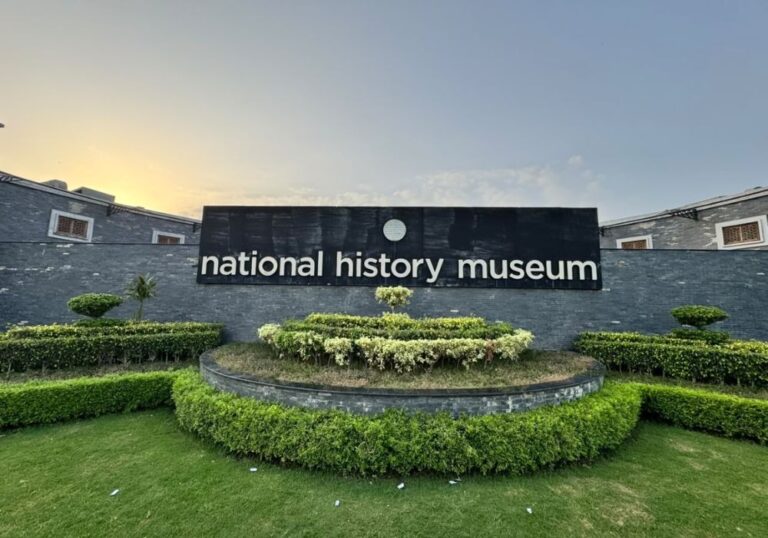
    The rain had just stopped when I reached Lahore’s National History Museum. The roads were quieter than usual, the air felt fresh and, for the first time in weeks, I wasn’t in a hurry. I had postponed this visit for years, ever since a brief stop during my internship at the Lahore Museum left me wishing for more time. This Sunday, I finally had it. I have also realised something over the past few weeks. Waiting for friends before exploring new places often means never going at all. So I decided to spend the afternoon on my own, following nothing except curiosity. As I entered the museum, Floor Supervisor Tabish welcomed me and arranged a guided tour with Muhammad Shamsher, a PhD scholar in History who also serves as one of NHM’s guides. His explanations never sounded like a lecture. Instead, he connected historical events with the people behind them, making every gallery feel like part of one continuing story. Growing up, I believed museums were places where objects sat behind glass while visitors quietly read information panels. That idea came from childhood visits to museums in Islamabad, Taxila and Harappa, and later from my internship at Lahore Museum. The National History Museum challenged that idea completely. Through digital displays, sound, projection and interactive exhibits, history became something to experience rather than simply observe. Every gallery encouraged visitors to slow down and become part of the story unfolding around them. One exhibit that caught my attention focused on the making of Minar-e-Pakistan. Like many Pakistanis, I had always admired the monument without knowing much about the person who designed it. The museum introduced architect Nasreddin Murat-Khan and displayed photographs that offered a glimpse into the creative process behind one of Pakistan’s most recognisable landmarks. It reminded me how often we celebrate monuments while forgetting the people who imagined them. The journey then moved towards Partition, where history became deeply personal. The restored railway carriage, once part of the North Western Railway, stood quietly inside the gallery. Visitors could step inside and experience a virtual reality presentation recreating the migration of 1947. I had watched countless documentaries and films about Partition, but sitting inside that carriage created an entirely different feeling. The sounds, voices and uncertainty surrounding the experience made history feel much closer than any textbook ever could. The museum then shifted from the birth of Pakistan to the challenge of building a new country. One gallery recreated the early government offices established after independence. I found myself studying old files, furniture and official records, imagining the enormous responsibility carried by those tasked with running a newly created nation. Nearby, early Pakistani passports were displayed inside glass cases. Different in design from today’s passports, they represented the same hope of a country beginning to define its identity. Another section I found especially engaging was Camera from the Past. Visitors could stand before a vintage-style camera and have their photograph taken, creating a small connection between the present and the past. The gallery also highlighted photographer Aziz Ahmed Azmi, whose images documented Pakistan’s early years. Looking at his work, I realised that photographs often become history long after the moment they capture has passed. Perhaps the gallery where I spent the most time was Popular Culture. Having studied Mass Communication with a specialisation in Theatre, Film and Television and continuing to work in journalism, I naturally found myself drawn towards the colourful Lollywood posters and displays celebrating Pakistan’s cinematic heritage. Reading about Azra, the country’s first colour film, and Zinda Laash, Pakistan’s first horror film, reminded me how rich our film history is, even if many younger audiences know little about it today. Before leaving, I also explored Husn-e-Hunar, an exhibition celebrating Pakistan’s traditional craftsmanship. Alongside literature, music and cultural displays, it served as a reminder that a nation’s identity is shaped not only by political events but also by its artists, craftsmen and storytellers. When I stepped back outside, I realised I had spent far longer inside the museum than I had planned. I didn’t leave with pages of notes or dozens of photographs. Instead, I left with a greater appreciation for how history can be presented when museums invite visitors to participate rather than simply observe. The National History Museum doesn’t just preserve Pakistan’s past. It encourages visitors to pause, ask questions and discover the stories that continue to shape the country today.

  • |

    Japan launches cooling shirt with built-in fans

    Tokyo – Due to Japan’s intense summer heat, office wear is now being equipped with modern cooling technology. Japanese people have started wearing clothes with built-in air-conditioning systems. Japanese clothing manufacturer Yofuku no Aoyama has introduced a short-sleeved shirt fitted with two small fans that provide cool air to the wearer while they are on the move. According to media reports, the shirt looks like a simple and elegant office shirt but it actually contains an advanced cooling system. A fan is installed at the back of the shirt near the waist. When switched on, it circulates air inside the shirt and helps keep the body cool. Air-cooled clothing has become increasingly popular in Japan over the past few years. However, it has mainly been used by people working in construction, waste collection and event security. Such clothing is generally designed as jackets or vests and has traditionally been considered protective or workwear rather than office clothing. However, as summer temperatures continue to rise in Japan, demand for cooling clothing is increasing among ordinary citizens and office workers as well. Keeping this growing demand in mind, Yofuku no Aoyama developed the shirt in collaboration with FZN, a company specializing in fan-equipped clothing. The shirt comes with two fans and a rechargeable battery. According to the company, efforts have been made to keep the cooling system as lightweight as possible. According to the report, each of the two fans weighs 95 grams, while the rechargeable battery pack weighs 165 grams. Although the fans are visible when the shirt is viewed from the back, designers have tried to make them less noticeable from other angles so that the shirt remains suitable for an office environment. The company has not provided specific information about the noise level of the fans suggesting that they may not be completely silent. When is cooling shirt most useful? The shirt is considered more useful while travelling rather than during meetings. The company says its main purpose is not necessarily to operate the fans inside an office or during client meetings as such meetings are generally held in air-conditioned rooms. The real benefit of the shirt is for people who travel around the city from one meeting to another. While walking outside in extreme heat or using public transport, the fans can help keep the body cool. It may also reduce the need for employees to change sweat-soaked clothes and put on formal attire again after reaching their destination. What is price? The complete initial package of the Kuchou Wear Short-Sleeve Shirt is being sold for 17,490 Japanese yen. The package includes the shirt, two fans, a rechargeable battery pack and a charging cable. The shirt is available in blue and grey with medium, large and extra-large sizes offered. The product has already gone on sale at the company’s stores and online shop.

  • Motherhood impacts health more than fatherhood

    Having children brings major changes to parents physical mental and social lives but a new study suggests that mothers are affected much more than fathers. The research published in the Journal of Family Studies looked at how becoming a parent changes health and daily habits including exercise and smoking. The study found that becoming a father has little effect on men’s overall health before or after the birth of a child. However the situation is different for women. Researchers found that a mother’s age and the number of children she has can influence her health. Women with only one child or those whose children have reached their teenage years were more likely to experience symptoms of depression. On the other hand mothers with two or more young children were generally found to have better overall health. The biggest lifestyle change was seen in physical activity.  Mothers were much less likely to exercise than fathers. According to the study only 16% of mothers with young children exercise regularly while men’s exercise habits remain almost the same whether they have children or not. Researchers believe this is because mothers spend much more time caring for their children leaving them with less time to look after their own health. As a result their physical and mental well being may be affected.

  • Cheap deals are no longer enough

    Major fast food chains in the United States, including McDonald’s are finding it harder to attract customers simply by offering cheaper meals and discounts.  Recent second quarter results show that price is still important but customers are now looking at other things too including food quality new menu choices and better service. Over the past two years, US fast food companies have used low-cost deals and promotions to attract customers affected by inflation.  However recent results suggest that discounts alone are no longer enough to keep customers coming back. The chains that performed better were those that combined affordable deals with new menu items better food quality and an easier customer experience. Taco bell sees strong growth Taco Bell owned by Yum Brands has focused on simple and clearly priced deals instead of offering large discounts across its entire menu. Its $5, $7, and $9 meal boxes became popular with customers. The company also added new menu items encouraging customers to buy more than just the discounted meal. Rachel Royster director of strategic planning and innovation at food-service consultancy Kinetic said value deals work best when customers can easily understand what they are getting and do not feel they are being attracted by a cheap offer only to face higher prices later. Taco bell reported a 7% increase in same store sales during the quarter. McDonald’s by comparison, recorded a 1.3% increase in global comparable sales. McDonald’s faces challenges McDonald’s also introduced low cost options including a menu with items priced below $3 and a $4 breakfast meal.  However the company’s performance was weaker than expected. McDonald’s CEO Chris Kempczinski said about two thirds of the decline in customer traffic came from people who were already loyal McDonald’s customers.  He said the problem was mainly with how the company’s strategy was carried out rather than the strategy itself. Low income customers remain  Under pressure Results from other fast food companies also show that discounts have not completely solved the financial pressure faced by lower income customers. Wendy’s introduced its Biggie Bag value deals starting at $5. Despite these offers its US same-store sales fell by 7%, and the company withdrew its yearly financial forecast. Wingstop also offered several promotions including $1 chicken wings but its US same store sales dropped by 7.5%. Wingstop CEO Michael Skipworth said sales were weaker in urban areas where many families are facing greater financial pressure.  In higher income areas however restaurant visits increased by as much as 9%. The company’s shares have also fallen sharply over the past six months. Analyst Matt Curtis of D.A. Davidson said the large number of promotions from different fast food chains has made it harder for customers to compare offers.  Customers are now taking more time to compare deals and choose what gives them the best value. Being the cheapest is not enough The second quarter results also show that a restaurant does not have to be the cheapest option in the market to succeed. Burger King owned by Restaurant Brands International was among the chains that performed better. Company officials credited its strong US sales to promotions such as “2 for $5” and “3 for $7,” along with improvements in operations and menu quality. Restaurant consultant John Gordon said Burger King is offering discounts but it is not relying on deep promotions all the time.  The company has also changed the way it presents its offers instead of constantly competing on the lowest possible price. Domino’s and Chipotle also perform well Domino’s Pizza benefited from value-focused offers and loyalty programs.  These efforts helped bring more customers to its restaurants and support sales. Chipotle Mexican Grill also reported strong results.  The company kept its price increases relatively limited, at around 1% to 2%. Chipotle CEO Scott Boatwright said value is not only about lower prices or discounts. It can also include convenience better service and new food choices. Customers want more than cheap food The latest results from the US fastfood market suggest that customers are becoming more careful with their spending. While affordable deals remain important people are also looking for good food better service convenient experiences and interesting menu options. For fast food companies the message is clear being cheap may attract customers but offering better overall value is what can keep them coming back.

Leave a Reply

Your email address will not be published. Required fields are marked *