بلاگز

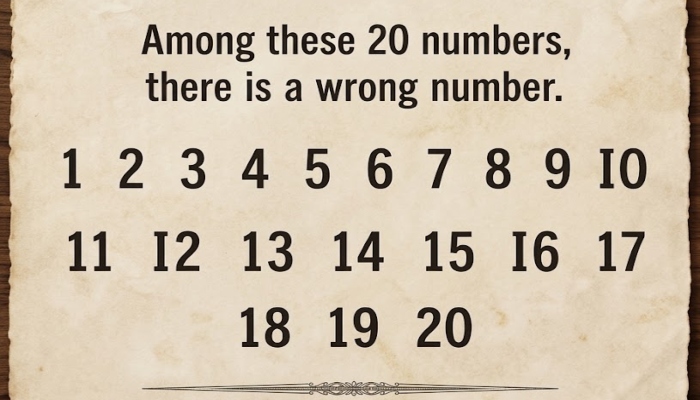
  • Find the mistake in 1 to 20

    Today’s puzzle is simple. Just look at the picture carefully and find the mistake hidden in the numbers. The image shows numbers from 1 to 20, but there is a small error that many people may miss at first glance. Puzzles like this require careful observation and a little creative thinking. You need to look beyond what your brain expects to see. The mistake is actually right in front of you.  However because the numbers look almost the same it can be easy to overlook. This puzzle is a simple test of your observation skills. Many people may fail to notice the error because our brains often read familiar patterns automatically. Still cannot find it? Look closely at number 10. The first character is not the number 1. It is the capital letter “I”. Did you spot it?

  • Dogs can read human emotions

    Dogs may understand more than just the words we say. A new scientific study suggests that they can also notice human facial expressions and may recognize different emotions such as happiness, anger fear and sadness. Researchers from the  University of Vienna in Austria studied dogs’ brains to understand how they react to human faces.  Their findings were published in the scientific journal iScience. How the study was done In the first part of the study researchers used MRI scans to study the brains of eight dogs. The group included six Border Collies, one Labrador and one Golden Retriever. The dogs were shown pictures of unfamiliar people with happy or neutral facial expressions. When the dogs saw happy faces certain areas of their brains became more active. These areas are linked to thinking rewards and positive experiences. Researchers found strong activity in areas such as the temporal cortex and caudate nucleus.  The caudate nucleus is connected with the brain’s reward system and may also respond to social rewards. According to senior researcher Laura Cuaya, this suggests that a happy human face may have a positive emotional meaning for dogs even when the person is a stranger. Dogs may tell different emotions apart The researchers then wanted to know whether dogs could also recognize negative emotions. Twelve dogs were shown human faces expressing happiness anger, fear and sadness. Their brain activity was recorded and studied using machine learning methods. The results showed that dogs’ brains reacted differently to angry fearful and sad faces compared with happy faces. The researchers also found different brain activity patterns for each negative emotion. This suggests that dogs may be able to tell these emotions apart rather than seeing all negative expressions as the same. Dogs notice small changes First author Raul Hernandez Perez explained that humans can often understand emotions from very small changes in a person’s face.  Dogs may also pay close attention to these small changes. This ability may help explain why dogs are so good at understanding people. Unlike humans and monkeys dogs did not develop these social skills through the same evolutionary path. Instead thousands of years of living closely with humans may have helped dogs become highly sensitive to our behavior and signals. Interestingly both researchers are not only professional colleagues but also life partners. Their own two dogs, Odin and Kunkun were also part of the study. It is not only about the face The researchers say dogs do not depend on facial expressions alone. They can also notice changes in our voice body movements, behavior and even smell. So when a dog seems to know that its owner is happy worried or upset it may be combining many different signals at the same time. Training dogs for MRI scans The dogs had to receive special training before taking part in the research.  They learned to stay still inside an MRI scanner for short periods. At first they were trained to remain still for only one or two seconds.  The time was slowly increased as they became more comfortable. They were also introduced to the scanner the equipment and the sounds it made.  One of the hardest parts was teaching the dogs that doing nothing was actually their job. The dogs took part voluntarily and could leave whenever they wanted. The study has some limits The study was small and most of the dogs were Border Collies. This breed is known for being intelligent and good at understanding human social signals. Because of this the results may not be the same for every dog breed. More research is needed to find out whether different breeds understand human emotions in different ways. Scientists also want to learn how dogs use these emotional signals in everyday life. The study does not prove that dogs experience happiness sadness or fear in exactly the same way humans do. Scientists cannot directly know what a dog is thinking or feeling. However the brain activity does suggest that human facial expressions carry emotional information for dogs. The bond between humans and dogs goes far beyond simple commands. Dogs can pick up signals from our faces voices movements and behavior. This ability may be one of the reasons why the relationship between people and dogs is so strong.

  • |

    Texas Airports review muslim prayer facilities

    Texas Governor Greg Abbott has ordered a review of state grants given to Dallas Fort Worth International Airport (DFW) and Houston’s George Bush Intercontinental Airport (IAH) over facilities provided for Muslim travelers. The governor has raised concerns about special facilities for Muslims to perform wudu, the Islamic practice of washing before prayer.  He has described the facilities as possible religious discrimination and has also asked the U.S.  Department of Transportation to review the issue. Review of state funding According to a statement from Abbott’s office, Texas will review state grants given to airport authorities.  Officials will consider whether existing funding should be withdrawn or whether the airports should be prevented from receiving future state funds. Abbott argues that government owned facilities should not provide services that appear to favor one religion over others. Facilities at two airports DFW International Airport is planning a dedicated area where Muslim passengers can perform wudu. At Houston’s George Bush Intercontinental Airport a similar facility has already been created along with a space where passengers can pray. Abbott has asked U.S.  Transportation secretary sean duffy to have the Department of Transportation and the Federal Aviation Administration (FAA) review the existing and planned facilities at both airports. He has also called for possible legal or corrective action if officials find that federal rules have been violated. Governor raises religious Discrimination Concerns Abbott says both airports receive federal funding and therefore must follow federal laws related to discrimination. He argues that providing facilities specifically for Muslim religious practices could give special treatment to one religious group. He says government owned airports should provide equal treatment and should not favor one religion over another. The governor also repeated his position on social media saying taxpayer funded public facilities should not allow what he considers illegal religious discrimination. What happens next? The issue will now be reviewed by federal transportation officials and the FAA.  Their response could determine whether any action is taken against the airports or their funding. The controversy has also opened a wider debate about religious freedom equal access  and how public facilities should serve passengers from different religious backgrounds. The case could become an important legal and political discussion about whether providing religious accommodations in public spaces is discrimination or simply a way to meet the needs of different groups.

  • Many smokers still miss major health risks

    A new study has found that public understanding of the health risks of smoking has improved only slightly over the past 20 years. Researchers studied more than 240,000 smokers from 46 countries. Most participants knew that smoking can cause lung cancer.  However far fewer were aware that smoking can also greatly increase the risk of heart disease heart attacks and strokes. Gaps in public awareness The study also found that many smokers do not fully understand the dangers of secondhand smoke.  They may not know that breathing in someone else’s cigarette smoke can also increase the risk of heart disease heart attacks and strokes. The research was published in the journal BMJ Open. Researchers said that despite health warnings on cigarette packs tobacco control policies and years of public awareness campaigns important gaps in knowledge still remain. Heart risks often overlooked Lead author Janet Chung Hall, a scientist with the University of Waterloo’s International Tobacco Control Policy Evaluation Project said the lack of awareness about the serious effects of smoking and secondhand smoke is concerning. Experts estimate that smoking related heart and blood vessel diseases cause more than two million deaths worldwide every year. The researchers say stronger public health campaigns are needed to help people understand that smoking does not only damage the lungs. It can also seriously affect the heart and blood vessels. Better awareness of these risks could encourage more smokers to quit and help reduce the harmful effects of tobacco on both smokers and people around them.

  • AI Video imagines birds as weapons

    China has released an AI generated video showing birds being used as weapons in a fictional future war. The video uses artificial intelligence to create an imaginary scene in which advanced technology turns birds into tools for military purposes. The unusual concept has attracted attention on social media. A fictional look at future warfare The AI made video presents an imagined version of future warfare and shows how new technology could be used in unexpected ways. It does not show a real military operation. Instead it appears to be a creative representation of how artificial intelligence and advanced technology might influence future battles. https://x.com/saraanwar45/status/2086866754677190751?ref_src=twsrc%5Etfw%7Ctwcamp%5Etweetembed%7Ctwterm%5E2086866754677190751%7Ctwgr%5Ed3bc601aa804c21c9cb186006047ab35f9b3b5b3%7Ctwcon%5Es1_c10&ref_url=https%3A%2F%2Furdu.samaa.tv%2F2087358205 Social media reacts After the video appeared online social media users shared different opinions about the unusual idea. Some found the concept surprising while others viewed it as an interesting example of how AI can create fictional images of future warfare. The video has also sparked discussion about the possible role of artificial intelligence in future military technology and how AI could be used to imagine new forms of warfare.

  • How termites damage wood

    Termites can quietly damage wooden furniture, doors frames cupboards and other wooden items.  They often live in groups and feed on wood so ignoring them can lead to serious damage. Signs of termites You may notice a few common signs of termite activity. Wood may become swollen small mud like layers may appear around wooden items or solid wood may produce a hollow sound when tapped.  Termites can damage wood at any time of the year. If you notice a serious infestation it is better to contact a pest control professional. However for small or early infestations some simple home methods may help. Salt water Mix salt with lukewarm water until it dissolves completely. Put the mixture into a syringe and apply it to affected wooden areas such as door frames. This can be repeated for several days. However it may not completely remove a large infestation. Sunlight Direct sunlight may help reduce termite activity. Place affected furniture in strong sunlight for around 3 to 5 days if possible. Make sure the furniture can safely handle outdoor exposure. Neem Oil Neem oil is another commonly used home remedy. Apply a small amount directly to areas where termites are present.  It may help reduce termite activity although its effect can take time. Vinegar and lemon spray For a small affected area, mix half a cup of white vinegar with the juice of two lemons. Put the mixture in a spray bottle and apply it to the affected area. This can be tried twice a day for a few days. When to get Professional help Home remedies may be useful for small or early termite problems but they are not a guaranteed solution.  If termites have spread widely or are causing major damage professional pest treatment is the safer and more effective option.

  • |

    Pakistan names first lunar rover “Jinnah-1”

    Islamabad: The Space and Upper Atmosphere Research Commission (SUPARCO) has officially announced the name of Pakistan’s first lunar rover. According to SUPARCO, Pakistan’s first lunar rover has been named “Jinnah-1.” The name was selected from suggestions submitted through a nationwide competition. More than 4,000 proposals were received from across the country. SUPARCO stated that seven participants had suggested the name “Jinnah-1.” The winner was selected through a lucky draw and 17-year-old Tayyab Karim from Bahawalnagar was declared the winner for proposing the name. Tribute to Quaid-e-Azam The Chairman of SUPARCO said that “Jinnah-1” is a tribute to Quaid-e-Azam Muhammad Ali Jinnah. He added that the name represents Pakistan’s determination, progress and pursuit of new frontiers in space exploration. It is worth mentioning that Pakistan’s first lunar rover is scheduled to be sent to the Moon in 2029 as part of China’s Chang’e-8 mission. The Jinnah-1 rover will conduct scientific research on the Moon’s south pole.

  • Remove light grease with warm water

    Stainless steel pots and pans are used almost every day but they can lose their shine over time. Grease, oil food stains and burnt marks can make them difficult to clean. The good news is that you do not always need expensive cleaning products.  A few simple items already available at home can help keep your stainless steel cookware clean and shiny. Soak away light grease For light grease and small stains soak the pot in warm water with some dishwashing liquid for a while.  The warm water helps soften stuck food and grease. After soaking gently clean the surface with a soft sponge. Avoid using too much force. Use vinegar for burnt food When food gets burnt avoid scraping the pot with a sharp or rough tool.  This can leave scratches on the stainless steel. Instead pour a small amount of white vinegar over the burnt area and let it sit for a few minutes.  Then gently clean it with a soft sponge and wash the pot well. Try Baking Soda for Tough Stains For stubborn marks make a thick paste by mixing baking soda with a little water.  Apply the paste to the stained area and leave it for about 30 minutes. After that gently wipe the area with a wet sponge and rinse the pot thoroughly with clean water. Do not leave dirty pots for long Cleaning becomes much easier when you do not leave dirty cookware sitting for hours.  Remove leftover food soon after cooking and wash the pot when possible. Burnt food and grease become harder to remove when they are left on the surface for a long time. Protect your hands while cleaning Frequent contact with water and dishwashing products can make your hands dry.  Wearing rubber or disposable gloves while washing dishes can help protect your skin. After cleaning dry your hands properly and apply a moisturizer to help prevent dryness.

  • Short intense exercise may benefit your body

    A new study suggests that you may not need to spend hours exercising every day to support your health.  Even a few minutes of very intense physical activity can cause important changes inside the body. Researchers found that intense exercise can quickly change hundreds of proteins in the blood These proteins are linked to heart health metabolism body fat and other important body functions. What did the study find? The researchers compared short high-intensity cycling with cycling at a normal pace.  Participants completed several 30-second bursts of very fast cycling with about four minutes of rest between each burst. After the intense exercise changes were found in 714 blood proteins. In comparison only 7 proteins showed similar changes after normal paced cycling. This suggests that exercise intensity can strongly affect how the body responds. What happens during intense exercise? During hard exercise the body produces different chemical signals.  One of them is called Lac-Phe, which has been linked to appetite energy use and other body processes. These signals may also affect metabolism and how fat cells work. Some of the protein changes seen in the study were connected to processes related to heart disease type 2 diabetes and obesity. Researchers also examined data from more than 53,000 people. Some of the proteins affected by intense exercise were linked to healthy aging heart health and the risk of metabolic diseases. Is a few minutes of exercise enough? The findings do not mean that three minutes of intense exercise can completely replace a longer workout.  Different types of exercise provide different benefits. Longer moderate exercise can still be important for improving endurance muscle strength and heart and lung health. However the study shows that even short periods of intense activity may have meaningful effects on the body. For people with busy schedules adding brief bursts of physical activity to their daily routine could be a practical option. However high intensity exercise is not suitable for everyone. People who have not exercised for a long time or have a medical condition should speak with a healthcare professional before starting intense workouts.

  • Why does food make your mouth water

    Have you ever seen your favorite food smelled it or simply thought about it and suddenly felt your mouth watering? This can happen even when you are not very hungry. Just seeing or smelling food can make your body prepare for eating. Experts call this the “cephalic phase of digestion.” In simple words it means your body can start preparing for digestion before food even reaches your mouth. Your brain prepares your body When you see, smell or think about a favorite food your brain gets a signal that food may be coming.  It then sends signals to different parts of the digestive system. One of the first things that happens is that your mouth produces more saliva.  Saliva makes food softer and easier to chew and swallow. It also helps start the digestion process. That is why seeing hot pizza, biryani, jalebi or another favorite dish can make your mouth water.  Your body is already getting ready to eat. It is not always about hunger Mouth watering does not always mean you are very hungry.  You may even feel full and still have a strong reaction to your favorite food. Food cravings can be affected by its smell appearance memories and past experiences. For example, the smell of a homemade dish from childhood may bring back old memories and make you want to eat it again. Smells can trigger strong reactions Sometimes you do not even need to see food. A delicious smell from the kitchen can make you feel hungry within seconds. But the opposite can also happen. A bad smell unpleasant sight or negative memory can make you feel sick or lose your appetite. For example if you once became sick after eating a certain food, your brain may connect that food with the bad experience. Later even its smell may make you feel nauseous. •Your body has a protective system These reactions are part of the close connection between the brain and the digestive system.  Your brain does not only help you notice food you like it can also help protect you from food that may be harmful. A bad smell or unpleasant appearance can make you avoid certain food. In some cases it may even cause nausea or reduce your appetite. So the next time your mouth waters when you see your favorite dish remember that your body may already be preparing for the meal before you take your first bite.