فیچرڈ

  • | |

    Petition urges President Zardari to approve judici…

      A petition submitted to the Islamabad High Court (IHC) has challenged President Asif Ali Zardari’s delay in approving the appointment of judges to several high courts across Pakistan. The petitioner argues that the president’s failure to act on the recommendations has created a serious constitutional issue and worsened the shortage of judges, affecting the country’s justice system. The petition was filed by Advocate Luqman Zafar Chaudhry through his legal counsel, Zahid Asif Chaudhry. It requests the court to issue a writ of mandamus directing the president, through his secretary, to immediately approve the summary sent by the prime minister. The summary contains the recommendations of the Judicial Commission of Pakistan (JCP) for appointments to the Islamabad, Lahore, Sindh, and Balochistan High Courts, along with the confirmation of several additional judges. According to the petition, the Judicial Commission, chaired by the Chief Justice of Pakistan, completed the constitutional process by finalizing its recommendations on July 20 and 21. These recommendations were subsequently forwarded to the president under Article 48 of the Constitution through the prime minister. However, the president has neither approved the summary nor returned it for reconsideration, despite the constitutional process requiring timely action. The petitioner maintains that Article 48 allows the president to return the prime minister’s advice only once within 15 days for reconsideration. Beyond that, the Constitution does not permit indefinite delay or silence. Therefore, the petition argues that the president is constitutionally obligated to approve the recommendations once the prescribed period has passed. It further states that the delay disrupted the oath-taking ceremony for the recommended judges, which had been scheduled for July 27. As a result, the ceremony was postponed indefinitely, leaving several judicial positions vacant and increasing the burden on existing judges. The petition also argues that the president’s inaction effectively transforms a ceremonial constitutional responsibility into an unauthorized veto power, something the Constitution does not allow. It claims this undermines judicial independence protected under Articles 2A and 175(3) of the Constitution. Referring to previous Supreme Court judgments, the petitioner emphasizes that judicial appointments must be completed through a transparent, collaborative, and time-bound constitutional process without executive interference. The petition also compares the president’s role under Article 48 with Article 75, which governs presidential assent to legislation and similarly requires action within a specified timeframe. According to the petitioner, the continued delay has created an acute shortage of judges, slowing the disposal of cases and affecting citizens’ constitutional rights to a fair trial and access to justice under Articles 9, 10A, and 25. The petition also raises concerns that the delay may have been influenced by political considerations rather than constitutional requirements. Citing media reports and public statements, it requests the court to determine when the Presidency received the summary, seek an explanation for the delay, declare the continued inaction unlawful, and prevent any action inconsistent with the Judicial Commission’s recommendations until the case is decided. The controversy has emerged amid a wider constitutional debate regarding the president’s authority in judicial appointments. While earlier Supreme Court decisions have held that the president cannot reject recommendations made by the Judicial Commission, Article 175A(8) does not clearly specify how quickly the president must act. Legal experts believe the issue may ultimately require judicial interpretation to clarify the constitutional limits of the president’s role in the appointment process.

  • | |

    PTI announces September 27 to Islamabad over key d…

    Pakistan Tehreek-e-Insaf (PTI) has announced plans to march to Islamabad on September 27 if its demands regarding party founder Imran Khan are not met, with senior party leaders calling for legal and constitutional relief. The announcement was made during a public gathering near the motorway in Peshawar, where PTI leaders said the planned demonstration would go ahead unless progress is made on several issues, including regular meetings with Imran Khan, access to his personal physician, and timely hearings of court cases involving the former prime minister. Addressing supporters, Khyber Pakhtunkhwa Chief Minister Ali Amin Gandapur said the party had pursued every available constitutional and legal avenue but had failed to achieve the desired outcomes. He argued that the party had little confidence in the judicial process and claimed that recent constitutional amendments had affected the functioning of the courts. Gandapur also alleged that PTI supporters had faced excessive force during previous demonstrations. He questioned the continued detention of Imran Khan and reiterated the party’s position that the former premier’s removal from office was the result of external interference. He further claimed that Pakistan’s economy had performed better during Imran Khan’s tenure and criticized the current government’s handling of economic and security challenges. The chief minister also expressed concern over inflation, unemployment, law and order, and the country’s overall economic situation. He accused the federal government of mismanagement and urged supporters to remain united ahead of the planned protest. Speaking at the same event, PTI leader Sohail Afridi said the party had exhausted all legal and constitutional options before deciding to launch another protest movement. He maintained that the planned march was intended to demand justice rather than political concessions. Afridi announced that PTI would proceed towards Islamabad on September 27 if its demands remained unaddressed. He told supporters that the party was seeking what it described as judicial justice and the restoration of legal rights for its leader. The planned demonstration is expected to become one of PTI’s major political mobilization efforts in the coming months. Party leaders have called on supporters from across the country to participate peacefully in the protest. The federal government has not yet issued a detailed response to PTI’s latest announcement. Political observers say the coming weeks will be important as both sides weigh their next steps amid Pakistan’s evolving political landscape.

  • | |

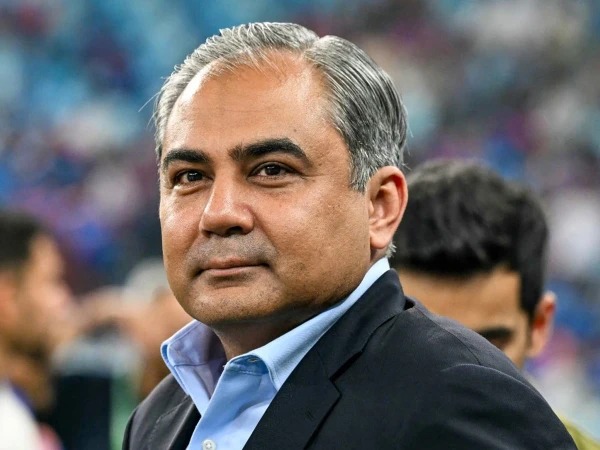
    Mohsin Naqvi says Shehbaz government will complete…

    Federal Interior Minister Mohsin Naqvi has reiterated his confidence that the government led by Prime Minister Shehbaz Sharif will complete its full five-year constitutional term, while maintaining his earlier criticism that Pakistan’s decades-old governance system requires significant reform. Speaking to the media, Naqvi said his previous remarks about the country’s system had been misunderstood. He clarified that his criticism was directed at what he described as an 80-year-old governance structure rather than the current administration. According to the interior minister, the existing system has failed to deliver the level of progress Pakistan is capable of achieving. Naqvi argued that if the country’s institutional framework had functioned effectively over the years, Pakistan would have been in a much stronger economic and administrative position today. He stressed that his comments should not be interpreted as criticism of the federal government, of which he is a member. Responding to questions about his own performance as interior minister, Naqvi said he is accountable to the prime minister and welcomes an objective assessment of every federal ministry. He suggested that the government publicly release the performance results of all ministries so citizens can evaluate how each department has performed. The interior minister also noted that he regularly attends official duties and said his attendance record stands at approximately 70 percent. He emphasized that transparency and accountability should apply across the federal cabinet. Praising Prime Minister Shehbaz Sharif, Naqvi said the premier works between 14 and 16 hours a day and has continued to pursue reforms despite challenging circumstances. He credited the government with improving tax collection, strengthening Pakistan’s diplomatic engagement, and introducing reforms in several sectors. According to Naqvi, the prime minister could achieve even greater results if Pakistan’s governance system functioned more efficiently. He argued that administrative reforms remain essential for accelerating economic growth and improving public services. Addressing political speculation, Naqvi dismissed suggestions of differences between himself and the prime minister. He said there would always be attempts to create misunderstandings but insisted that their working relationship remains strong. The interior minister concluded by expressing confidence in the stability of the coalition government. He stated that the current administration would complete its constitutional term and that Shehbaz Sharif would continue to serve as prime minister for the full five years, despite criticism from political opponents. Naqvi’s remarks come amid ongoing political debate over governance reforms, economic challenges, and the future direction of Pakistan’s political landscape.

  • | |

    Government raises petrol price despite global decl…

    The federal government has increased the price of petrol by Rs4.45 per litre, despite a reported decline in international petroleum prices, according to a notification issued by the Ministry of Energy. The revised fuel prices will come into effect from August 6, 2026. The latest notification states that the new prices have been determined in line with the pricing mechanism recommended by the Oil and Gas Regulatory Authority (OGRA) and approved by the federal government. Under the revised rates, the price of petrol has increased from Rs328.56 to Rs333.01 per litre, representing an increase of Rs4.45 per litre. The decision comes only a day after the government had announced lower fuel prices for August 5. In contrast, the price of high-speed diesel (HSD) has been reduced by Rs2.00 per litre. Following the reduction, the retail price of diesel has declined from Rs385.86 to Rs383.86 per litre, providing limited relief to transport operators and commercial users who rely heavily on diesel. According to government sources, the increase in petrol prices is linked to adjustments in the petroleum levy. The government has reportedly increased the petroleum levy on high-speed diesel by Rs1.44 per litre, raising it from Rs70.86 to Rs72.30 per litre. Officials say such adjustments form part of the government’s broader fiscal strategy while maintaining the petroleum pricing framework. The announcement has drawn attention because global crude oil prices have softened in recent weeks, leading many consumers to expect a reduction in domestic fuel prices. However, local retail fuel prices are influenced by several factors in addition to international oil prices, including exchange rate fluctuations, taxes, petroleum levy, transportation costs, and other government-imposed charges. The revised fuel prices are expected to affect transportation expenses, logistics costs, and overall inflation, as petrol remains a key commodity for private motorists and commercial activities across Pakistan. The government had previously announced reduced prices for August 5, lowering petrol by Rs3.39 per litre and high-speed diesel by Rs4.07 per litre. However, the latest notification revises those rates, resulting in a fresh increase in petrol prices while providing only a modest reduction in diesel prices. The new pricing structure will remain in effect until the government announces its next scheduled review of petroleum product prices.

  • | | |

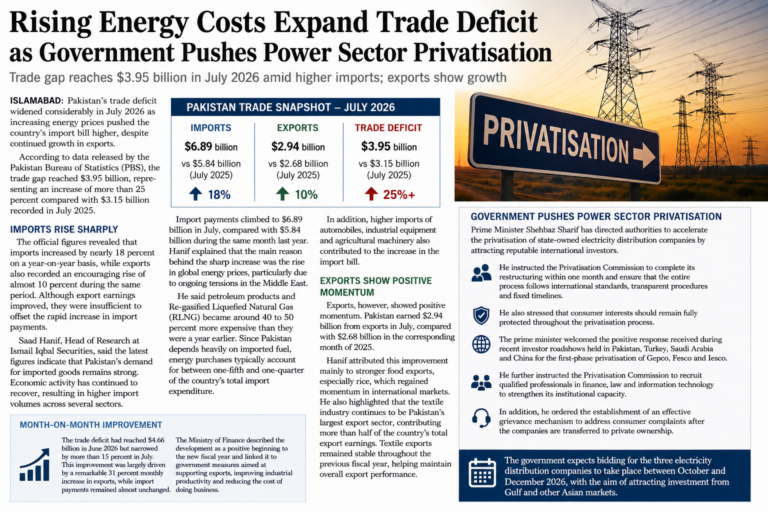
    Rising energy costs expand trade deficit

      Pakistan’s trade deficit widened considerably in July 2026 as increasing energy prices pushed the country’s import bill higher, despite continued growth in exports. According to data released by the Pakistan Bureau of Statistics (PBS), the trade gap reached $3.95 billion, representing an increase of more than 25 percent compared with $3.15 billion recorded in July 2025. The official figures revealed that imports increased by nearly 18 percent on a year-on-year basis, while exports also recorded an encouraging rise of almost 10 percent during the same period. Although export earnings improved, they were insufficient to offset the rapid increase in import payments. Saad Hanif, Head of Research at Ismail Iqbal Securities, said the latest figures indicate that Pakistan’s demand for imported goods remains strong. According to him, economic activity has continued to recover, resulting in higher import volumes across several sectors. He noted that the country’s reliance on imported products has remained significant despite efforts to improve the trade balance. Import payments climbed to $6.89 billion in July, compared with $5.84 billion during the same month last year. Hanif explained that the main reason behind the sharp increase was the rise in global energy prices, particularly due to ongoing tensions in the Middle East. He said petroleum products and Re-gasified Liquefied Natural Gas (RLNG) became around 40 to 50 percent more expensive than they were a year earlier. Since Pakistan depends heavily on imported fuel, energy purchases typically account for between one-fifth and one-quarter of the country’s total import expenditure. In addition, higher imports of automobiles, industrial equipment and agricultural machinery also contributed to the increase in the import bill. Exports, however, showed positive momentum. Pakistan earned $2.94 billion from exports in July, compared with $2.68 billion in the corresponding month of 2025. Hanif attributed this improvement mainly to stronger food exports, especially rice, which regained momentum in international markets. He also highlighted that the textile industry continues to be Pakistan’s largest export sector, contributing more than half of the country’s total export earnings. Textile exports remained stable throughout the previous fiscal year, helping maintain overall export performance. When compared with the previous month, Pakistan’s trade position showed some improvement. The trade deficit had reached $4.66 billion in June 2026 but narrowed by more than 15 percent in July. This improvement was largely driven by a remarkable 31 percent monthly increase in exports, one of the strongest monthly gains recorded in recent years, while import payments remained almost unchanged. The Ministry of Finance described the development as a positive beginning to the new fiscal year and linked it to government measures aimed at supporting exports, improving industrial productivity and reducing the cost of doing business. Meanwhile, Prime Minister Shehbaz Sharif has directed authorities to accelerate the privatisation of state-owned electricity distribution companies by attracting reputable international investors. During a review meeting in Islamabad, he instructed the Privatisation Commission to complete its restructuring within one month and ensure that the entire process follows international standards, transparent procedures and fixed timelines. He also stressed that consumer interests should remain fully protected throughout the privatisation process. The prime minister welcomed the positive response received during recent investor roadshows held in Pakistan, Turkey, Saudi Arabia and China for the first-phase privatisation of Gepco, Fesco and Iesco. He further instructed the Privatisation Commission to recruit qualified professionals in finance, law and information technology to strengthen its institutional capacity. In addition, he ordered the establishment of an effective grievance mechanism to address consumer complaints after the companies are transferred to private ownership. The government expects bidding for the three electricity distribution companies to take place between October and December 2026, with the aim of attracting investment from Gulf and other Asian markets.

  • | |

    PTI holds nationwide protests to mark three years

      Supporters of Pakistan Tehreek-e-Insaf (PTI) staged demonstrations across Pakistan on Wednesday to mark three years since former prime minister Imran Khan was first taken into custody. One of the largest gatherings was held outside Lahore’s Aiwan-e-Adl, where members of the Insaf Lawyers Forum, along with party leaders, lawyers and supporters, demanded Khan’s release and called for an end to the legal cases against him. The Lahore protest took place on Upper Mall, outside the court complex, where participants waved party flags and chanted slogans in support of the jailed PTI founder. Demonstrators maintained that the cases filed against Imran Khan were politically motivated and urged authorities to withdraw all charges. They insisted that the legal proceedings were intended to prevent him from participating in politics, an allegation that both the government and state institutions have consistently denied, maintaining that the judicial process is independent and conducted in accordance with the law. Several senior PTI leaders, including Salman Akram Raja, Ali Aijaz Butta, Rehan Dar and Shaukat Basra, addressed the gathering. During their speeches, they called for Imran Khan’s immediate release and vowed that the party would continue its campaign until he was freed and all cases against him were resolved. Protesters repeatedly chanted slogans demanding his release and described the demonstrations as peaceful expressions of public support. The Lahore rally formed part of a nationwide protest campaign announced by PTI to coincide with the anniversary of Khan’s imprisonment. Similar demonstrations were organised in different cities across Pakistan, while overseas PTI supporters also held rallies in several countries to express solidarity with the former prime minister and draw attention to his continued detention. Imran Khan has remained in prison since August 2023, when he was convicted in a corruption case. Since then, he has faced several additional prosecutions and convictions, including cases involving corruption allegations, the disclosure of official secrets and marriage-related legal matters. Khan and his party have consistently rejected all accusations, describing them as politically driven. The government, however, maintains that the cases are being handled through an independent legal process and rejects claims of political interference. Wednesday’s demonstrations were the latest in a series of protests organised by PTI following Khan’s arrest. The party has repeatedly demanded his release and called for fresh general elections. Previous protests have at times faced restrictions imposed by authorities, while some demonstrations have also witnessed incidents of violence and clashes. Separately, PTI leader Shaukat Basra alleged that journalist Natiq Rehan was assaulted by Punjab Police while reporting on the Lahore protest. According to Basra, the journalist was attacked despite performing his professional duties. Punjab Police did not immediately issue a response to the allegation. A day before the nationwide protests, Amnesty International issued a statement urging Pakistani authorities to safeguard Imran Khan’s fundamental rights as his detention entered its third year. Isabelle Lassee, the organisation’s Acting Regional Director for South Asia, expressed concern over what Amnesty described as the denial of a fair trial, prolonged solitary confinement, and restrictions on family visits, legal representation and medical care. The human rights organisation also called on the authorities to respect the right to peaceful assembly and avoid arbitrary action against demonstrators. It further urged that Imran Khan and his wife, Bushra Bibi, be granted regular access to their families, legal counsel and appropriate medical treatment in accordance with international human rights standards.

  • | | |

    Gold Prices surge by Rs10,000 per tola in Pakistan

      Gold prices in Pakistan witnessed a dramatic increase on Wednesday, with the price of 24-karat gold rising by Rs10,000 per tola, marking one of the biggest single-day jumps in recent months. The sharp increase has pushed the domestic gold market to a new record level, adding to concerns among consumers, investors, and jewellery traders about the continued rise in precious metal prices. According to the All Pakistan Gems and Jewellers Association (APGJA) the price of one tola of gold has climbed to Rs437,936 following the latest increase. The association also reported that the price of 10 grams of 24-karat gold rose by Rs8,573 reaching Rs375,459 The latest surge reflects the ongoing volatility in both domestic and international bullion markets. Gold prices have remained under the spotlight in recent weeks due to global economic uncertainty, fluctuations in currency exchange rates, and increased investor demand for safe-haven assets. Although the association did not specify the exact reason behind the latest increase, analysts believe that a combination of rising international gold prices and the depreciation of the Pakistani rupee has contributed significantly to the record-high rates. The steep rise in gold prices is expected to have a major impact on Pakistan’s jewellery market. Many consumers traditionally purchase gold for weddings, gifts, and investment purposes. However, with prices reaching unprecedented levels, experts believe that demand for gold jewellery may decline as buyers postpone purchases or opt for lighter and more affordable designs. Jewellers have also expressed concerns that the continued rise in prices could slow business activity, particularly during the ongoing wedding season. Higher costs may discourage customers from making large purchases, affecting retailers and manufacturers across the country. At the same time, investors who view gold as a secure store of value may continue to buy the precious metal despite the rising prices. Financial experts note that gold often performs well during periods of economic uncertainty, inflation, and geopolitical tensions. As investors seek safer assets, demand for gold increases, driving prices higher in international markets. Since Pakistan imports gold and its domestic prices are closely linked to global trends and exchange rate movements, local prices often rise in response to international developments. The record increase also highlights the broader economic challenges facing Pakistan, where inflation and currency fluctuations continue to influence the prices of imported goods and commodities. Consumers are already coping with higher living costs, and the latest jump in gold prices adds another burden for those planning to invest in or purchase the precious metal. Market observers will closely monitor future movements in international bullion prices and the value of the Pakistani rupee to assess whether gold prices continue their upward trend or stabilize in the coming days. Until then, buyers and traders are expected to remain cautious as the market adjusts to the latest record-breaking increase.

  • | | |

    Thai Prime Minister Denies Chinese Land Grab in Eastern Economic Corridor, Vows Strict Enforcement of Nominee Laws

    Bangkok Thai Prime Minister Anutin Charnvirakul firmly rejected allegations that Chinese investors are indiscriminately buying up land in Thailand’s Eastern Economic Corridor (EEC) to establish illegal industrial estates, stating that all developments must comply with Thai law and that the government will further intensify a campaign against illegal nominee usage, especially for large land plots. […]

  • | | |

    Top National Thailand Stories From the Past Week: Eight Monks Killed, Dozens Injured, After Pickup Truck Crashes Into Them Driven by 11-Year-Old Boy, and More

    Here is a look at the top NATIONAL Thailand stories, chosen by our Pattaya News/TPN National team, from last week, Monday, June 29th to Sunday, July 5th. They are not in any particular level of importance but are listed in the order of date of publication. 1. At least eight Buddhist monks were killed and […]

  • | | | |

    10 People Injured in Bangkok Bus Crash on Lat Phrao Road, Bus Driver Blames Brake Failure

    Bangkok, Thailand — An air-conditioned public bus driver lost control early Saturday morning, July 11th, 2026, mounting the sidewalk and crashing into a traffic signal control box and a roadside tree on Lat Phrao Road in Bangkok’s Wang Thonglang district, injuring at least 10 people. The accident occurred around 7:13 a.m. near Lat Phrao Soi […]