title Story

  • | | | |

    Three powers, one shield? What the pact means

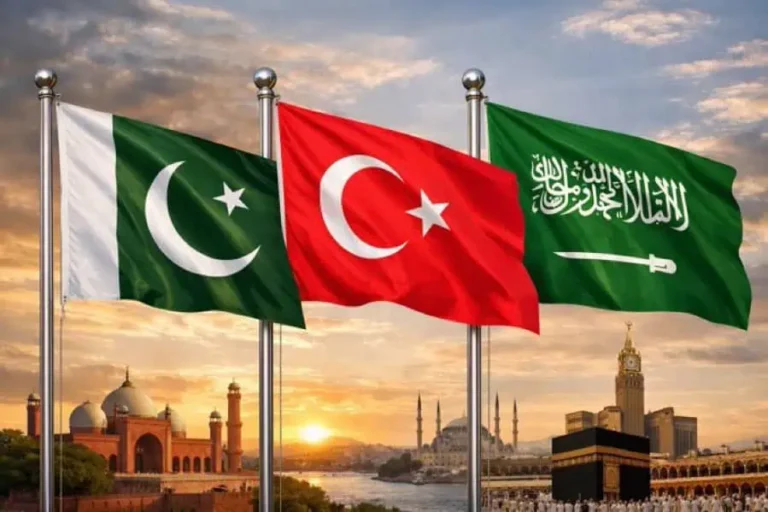
    Pakistan, Saudi Arabia and Türkiye have formalised their long-standing strategic and defence ties through the newly signed Makkah Joint Defence Agreement, establishing a framework for closer military coordination and collective security. The agreement was signed during a trilateral summit in Makkah attended by Prime Minister Shehbaz Sharif, Saudi Crown Prince Mohammed bin Salman and Turkish President Recep Tayyip Erdogan. The pact has attracted comparisons with established military alliances. However, analysts say its stated purpose is not to create a new military bloc or target any particular country. Instead, it provides an institutional structure for defence cooperation that has developed between the three nations over several decades. A formal structure for longstanding ties Pakistan and Türkiye have maintained close political and military relations for decades, while Islamabad and Riyadh have developed extensive defence, diplomatic and economic cooperation. The new agreement is viewed as an attempt to bring these existing relationships under a formal trilateral framework. It is designed to provide a more structured mechanism for consultations, military coordination and strategic cooperation. Why the agreement was signed now The agreement comes amid growing security challenges across the Middle East and wider region. Analysts say conflicts, changing military technologies and emerging security threats have encouraged countries with shared strategic interests to strengthen their defence coordination. The trilateral arrangement is intended to improve collective preparedness and provide a coordinated response to potential threats while supporting regional stability. What the defence pact provides A central element of the agreement is the principle of collective security. Under the framework, aggression against one member is to be treated as a threat to all three countries. The arrangement is expected to encourage greater military coordination, intelligence cooperation, strategic consultations and defence planning. Closer institutional links could also allow the three countries to coordinate their military capabilities and improve their ability to respond to security challenges. Different strengths, shared security interests Each country brings different capabilities to the partnership. Pakistan contributes a large and experienced military, operational expertise and extensive experience in counterterrorism and conventional defence. Saudi Arabia brings significant economic resources, regional influence and political weight. Türkiye adds its growing defence industry, military technology and manufacturing capabilities. Analysts believe these complementary strengths could make the partnership more effective while allowing the three countries to develop greater strategic self-reliance. Pakistan’s diplomatic role The agreement also comes as Pakistan seeks to strengthen its role as a regional diplomatic actor. Islamabad maintains relations with Saudi Arabia, Türkiye, Iran, China and the United States, giving it channels of communication with several major regional and global powers. Analysts argue that Pakistan’s diplomatic engagement, alongside its military capabilities, could help it contribute to regional crisis management and dialogue. What the pact does not mean Despite comparisons with NATO and other military alliances, analysts stress that the agreement is not described as an offensive alliance. It is also not presented as a pact directed against a particular country, a so-called “Muslim NATO”, a nuclear deterrence arrangement or a religious military bloc. Instead, the three countries have presented it as a defensive framework focused on collective security, deterrence, military cooperation and regional stability. The long-term effectiveness of the agreement will depend on sustained political coordination and the willingness of all three governments to implement its commitments.

  • | | |

    PM Shehbaz calls Makkah pact a ‘historic milesto…

    Prime Minister Shehbaz Sharif has described the signing of the Makkah Agreement for Joint Defence between Pakistan, Saudi Arabia and Türkiye as a historic step towards strengthening peace, security and regional stability. In a post on X, the prime minister said he had the honour of signing the agreement alongside Saudi Crown Prince and Prime Minister Mohammed bin Salman and Turkish President Recep Tayyip Erdogan. Shehbaz said the agreement reflected the unity of the three brotherly countries, which share deep-rooted ties, common values and a commitment to protecting the interests of their peoples. He said the pact represented a shared vision to strengthen the foundations of peace, security and stability and expressed hope that it would become a lasting pillar of cooperation among the three nations. The prime minister prayed that the agreement, signed in the sacred precincts of Makkah, would serve as a strong shield for peace and promote greater cooperation and integration among the three countries for generations to come. He also expressed hope that the pact would contribute to economic prosperity and benefit not only the peoples of Pakistan, Saudi Arabia and Türkiye but the wider Muslim world. Shehbaz Sharif particularly praised Field Marshal Syed Asim Munir for his role in making the agreement possible. He described Asim Munir’s efforts, commitment and dedication as instrumental in turning the shared vision of the three countries into a concrete agreement. The prime minister said the agreement would further strengthen regional security and stability while advancing the common interests of the three partner nations.

  • | | |

    Pakistan, Saudi Arabia, Turkiye set for defence de…

    Pakistan, Saudi Arabia and Turkiye are expected to sign a joint defence agreement during a trilateral summit in Saudi Arabia, according to media reports. The proposed agreement comes as tensions continue to rise across the Middle East amid the ongoing conflict involving the United States and Iran. The three countries are expected to discuss regional security, defence cooperation and efforts to promote stability. Prime Minister Shehbaz Sharif and Chief of Defence Forces Field Marshal Asim Munir arrived in Saudi Arabia on Thursday for a three-day visit. Turkish President Recep Tayyip Erdogan is also expected to join the summit. The Pakistani delegation was received in Jeddah by Makkah Deputy Governor Prince Saud bin Mishaal bin Abdulaziz and Saudi Minister of Environment, Water and Agriculture Abdulrahman Abdulmohsen Al-Fadley. Prime Minister Shehbaz and Field Marshal Munir also performed Umrah during their visit. The Foreign Office said the prime minister’s visit, scheduled from August 6 to 8, would focus on Pakistan-Saudi relations and major regional and international developments. During the visit, Shehbaz is expected to meet Saudi Crown Prince Mohammed bin Salman. Discussions are likely to cover bilateral cooperation, regional security and diplomatic efforts to reduce tensions in the Middle East. Deputy Prime Minister and Foreign Minister Ishaq Dar is also part of Pakistan’s diplomatic engagement in the region. Pakistan has been seeking a diplomatic solution to the conflict involving the United States and Iran. Islamabad has also been calling for dialogue and efforts to prevent the regional conflict from spreading further. The proposed trilateral defence arrangement would bring together three countries with longstanding military and strategic ties. It could also strengthen coordination on regional security at a time of heightened tensions. Pakistan and Saudi Arabia already have a separate mutual defence agreement signed in September 2025. Under that pact, aggression against either country is treated as aggression against both. The agreement further strengthened the two countries’ decades-old defence partnership. Pakistan has traditionally provided Saudi Arabia with military training, advisory support and other defence assistance. Saudi Arabia, in turn, has remained an important economic and financial partner for Pakistan and has provided support during periods of financial pressure. The reported trilateral agreement could expand security cooperation beyond the existing Pakistan-Saudi framework and create closer strategic coordination with Turkiye.

  • | | |

    Saudi Crown Prince receives PM Shehbaz Sharif in M…

    Prime Minister Muhammad Shehbaz Sharif was received by Saudi Crown Prince and Prime Minister Prince Mohammed bin Salman bin Abdulaziz Al Saud at Al-Safa Palace in Makkah on Friday, where the two leaders commenced high-level bilateral talks aimed at further strengthening Pakistan-Saudi Arabia strategic ties. The Prime Minister is accompanied by Deputy Prime Minister and Foreign Minister Senator Mohammad Ishaq Dar, Field Marshal Syed Asim Munir, Chief of Army Staff and Chief of Defence Forces, and Defence Minister Khawaja Muhammad Asif. The meeting is expected to review the full spectrum of bilateral relations, with discussions focusing on defence and security cooperation, trade and investment, regional developments, and ways to deepen the longstanding strategic partnership between Pakistan and Saudi Arabia. The talks come amid heightened regional diplomatic activity and underscore the close coordination between Islamabad and Riyadh on key geopolitical and economic issues.

  • | | | |

    Pakistan, Saudi Arabia and Türkiye sign Makkah jo…

    MAKKAH: Pakistan, Saudi Arabia and Türkiye have signed the Makkah Joint Defence Agreement, pledging to strengthen collective security and defence cooperation among the three countries. The agreement was signed on Friday during a high-level summit at Al-Safa Palace in Makkah, where Saudi Crown Prince and Prime Minister Mohammed bin Salman received Pakistani Prime Minister Shehbaz Sharif and Turkish President Recep Tayyip Erdogan. According to the agreement, the three countries reaffirmed their commitment to strengthening collective security and promoting peace, stability and security in the region and beyond. The agreement is based on the longstanding relations and shared strategic interests of Pakistan, Saudi Arabia and Türkiye. It also highlights their continued defence cooperation and commitment to closer coordination on security matters. Any attack to be treated as an attack on all three A key provision of the agreement states that an armed attack against any one of the three countries will be regarded as an attack against all three. The pact is intended to enhance collective deterrence against acts of aggression and expand cooperation across various areas of defence. The agreement also seeks to strengthen military and security coordination among the three states and build a framework for closer cooperation in the face of regional security challenges. The summit brought together the leaders at a time of heightened tensions and instability across the Middle East. Recent reporting had indicated that the three countries were preparing to deepen defence coordination through a joint pact. Prime Minister Shehbaz Sharif was accompanied by Deputy Prime Minister and Foreign Minister Ishaq Dar, Chief of Army Staff and Chief of Defence Forces Field Marshal Syed Asim Munir, and Defence Minister Khawaja Asif. The leaders also reviewed bilateral and regional matters of mutual interest and discussed ways to further strengthen cooperation. The Makkah agreement marks a significant development in defence ties among Pakistan, Saudi Arabia and Türkiye, establishing a stronger trilateral framework for collective security and defence cooperation.

  • | | | |

    Attack on one, defence of all: Makkah pact

    Saudi Arabia, Türkiye and Pakistan have signed a joint defence agreement aimed at strengthening collective security and defence capabilities among the three countries. According to the Foreign Office spokesperson, the agreement was signed during a trilateral joint defence summit held in Makkah. Saudi Crown Prince and Prime Minister Mohammed bin Salman, Prime Minister Shehbaz Sharif and Turkish President Recep Tayyip Erdogan signed the agreement. Under the pact, an armed attack against any one of the three countries will be treated as an attack against all three. The Foreign Office said the agreement is aimed at strengthening the three countries’ collective defence capabilities against any act of aggression. The development came after Prime Minister Shehbaz Sharif met Saudi Crown Prince Mohammed bin Salman in Makkah. Field Marshal Syed Asim Munir and other members of the Pakistani delegation also attended the meeting. The leaders discussed the regional situation and ways to further strengthen the strategic partnership between Pakistan and Saudi Arabia. Earlier, a trilateral summit involving Saudi Arabia, Pakistan and Türkiye was scheduled to take place in Jeddah, with expectations of important developments concerning regional peace and security. According to Turkish media reports, the three countries were set to sign an agreement concerning regional security during the summit. Turkish President Recep Tayyip Erdogan also arrived in Saudi Arabia to participate in the high-level meeting. Prime Minister Shehbaz Sharif and Field Marshal Syed Asim Munir had arrived in Saudi Arabia a day earlier at the invitation of the Saudi Crown Prince. During their visit, the Pakistani delegation also performed Umrah and offered prayers at the Holy Kaaba.

  • | |

    PM Shehbaz, Ishaq Dar and Field Marshal Asim Munir…

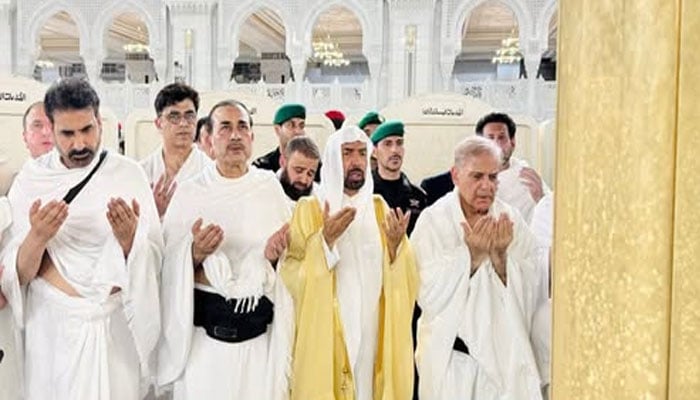
    MAKKAH: Prime Minister Shehbaz Sharif, Deputy Prime Minister Ishaq Dar and Field Marshal Syed Asim Munir performed Umrah in Makkah on Thursday, joining other members of a high-level Pakistani delegation in a deeply spiritual visit. The Pakistani leaders arrived in Saudi Arabia as part of Prime Minister Shehbaz Sharif’s official visit and later proceeded to the holy city of Makkah to perform the religious ritual. The visit comes amid efforts to further strengthen Pakistan-Saudi Arabia relations and discussions on regional developments. Before performing Umrah, the Pakistani delegation was also granted the opportunity to make a special visit to the Holy Kaaba, according to the information released regarding the visit. The prime minister, deputy prime minister, Field Marshal Asim Munir and members of the delegation offered prayers for the progress, prosperity and well-being of Pakistan. They also prayed for the safety and security of the Muslim Ummah and for peace across the region and the wider world. The spiritual moment added a solemn dimension to Prime Minister Shehbaz’s Saudi visit, which also carries important diplomatic significance. His trip is taking place at a time of heightened regional tensions, with talks expected to focus on bilateral ties and developments affecting the wider region. The Umrah performed by the Pakistani leadership reflects the close religious and longstanding relationship between Pakistan and Saudi Arabia, while the accompanying diplomatic engagements are expected to reinforce cooperation between the two countries.

  • | | | | |

    Trump claims Iran war could end soon, Hormuz to re…

    WASHINGTON: US President Donald Trump has claimed that the war with Iran could come to an end soon, while negotiations are reportedly continuing over the future of the conflict and the reopening of the strategically vital Strait of Hormuz. Trump said the United States, Iran and Oman were close to reaching a temporary agreement aimed at reopening the key maritime passage. His remarks offered a potentially hopeful signal after weeks of heightened tensions and disruption in the region. The US president also dismissed reports that the conflict had significantly depleted American weapons stocks, insisting there was no truth to such claims. Trump further rejected reports of disagreements or growing tensions with US Defence Secretary Pete Hegseth, playing down speculation about friction within his administration over the handling of the war. However, the picture on the diplomatic front remains uncertain. Arab media reports have claimed that efforts to broker a ceasefire between the United States, Israel and Iran have stalled, highlighting the difficulties surrounding a possible breakthrough. At the same time, Iranian authorities have reportedly tightened internal security measures across the country, particularly in Tehran, as uncertainty over the conflict continues. The Strait of Hormuz remains central to the crisis because of its importance to global energy supplies and international shipping. Any agreement that restores normal traffic through the waterway could ease pressure on regional markets and provide a significant boost to wider diplomatic efforts. For now, Trump’s prediction of a quick end to the war contrasts with reports suggesting that major obstacles still remain before a lasting ceasefire can be secured.

  • | | |

    Pakistan, Saudi Arabia, Türkiye set for strategic…

    Pakistan’s top civilian and military leadership offered prayers at Islam’s holiest site on Friday as Islamabad prepared for what diplomatic sources describe as a pivotal round of high-level engagements in Saudi Arabia that could reshape strategic cooperation among Pakistan, Saudi Arabia and Türkiye. Prime Minister Shehbaz Sharif, Chief of Defence Forces and Chief of Army Staff Field Marshal Syed Asim Munir, Deputy Prime Minister and Foreign Minister Senator Ishaq Dar, Defence Minister Khawaja Muhammad Asif, Information Minister Attaullah Tarar, Special Assistant Tariq Fatemi and members of the Pakistani delegation performed Umrah during their official visit to the Kingdom. Before performing Umrah, the delegation was granted the rare honour of a special visit inside the Holy Kaaba. Following the pilgrimage, Prime Minister Shehbaz Sharif, Field Marshal Asim Munir and members of the delegation offered special prayers for Pakistan’s peace, economic prosperity, national security, the unity of the Muslim Ummah and lasting regional and global peace. The visit comes at a strategically significant moment for the region. Diplomatic sources say Turkish President Recep Tayyip Erdoğan is also expected to arrive in Saudi Arabia, where a possible trilateral engagement involving the leaders of Pakistan, Saudi Arabia and Türkiye is expected on the sidelines of high-level consultations. According to diplomatic sources, the expected meeting could pave the way for a major expansion in defence cooperation, with discussions likely to focus on military collaboration, defence industrial partnerships, regional security coordination and strategic cooperation among the three countries. The Saudi visit underscores Pakistan’s growing diplomatic profile and its deepening strategic partnerships with Riyadh and Ankara. Officials view the engagements as an opportunity to advance cooperation in defence, investment, regional stability and economic development, while reinforcing Pakistan’s role in promoting peace and security across the Muslim world.

  • | | |

    Security forces kill 10 militants in two Khyber Pa…

    Security forces have killed 10 militants of Fitna al-Khawarij in two separate operations in Khyber Pakhtunkhwa, according to the Inter-Services Public Relations (ISPR). The first operation was conducted in the Azam Warsak area of South Waziristan district after a group of militants attacked security forces’ check posts. According to ISPR, security personnel responded effectively to the attack, resulting in an exchange of fire. Eight militants were killed during the operation. The second operation was carried out in Dir district, where security forces killed two more militants. Weapons and ammunition were also recovered from the possession of the slain militants. ISPR said the militants killed in the operations had been involved in several terrorist activities in the area. The military’s media wing said security forces are continuing intelligence-based counterterrorism operations under the government’s vision of “Azm-e-Istehkam” to eliminate terrorism and maintain peace and stability in the region.