double bottom line
| | | |

Double bottom line: Edgar Saavedra’s blueprint for Megawide’s sustainable growth

Can companies prioritize social impact without sacrificing shareholder value? This is a question that businessmen and business organizations have long struggled to answer considering the fundamental economic motive that drives business.

At the Monday Circle forum last Monday, August 10, the members and guests had the enviable opportunity to meet the man who is showing that this can be possible, defying the traditional concept of business-making. This man is no other than Edgar Saavedra, the founder, chairman and CEO of publicly listed company Megawide Construction Corporation, with the trading symbol of MWIDE. 

Under Saavedra’s leadership, Megawide is proving that financial profitability and social responsibility are not mutually exclusive. By executing a deliberate Double Bottom Line” philosophy, Saavedra has transformed the engineering powerhouse from a traditional builder into an engine for sustainable national growth.

For investors, the metrics speak for themselves: a robust P50-billion construction order book, sharp profit margins, and a rapid 79% projected net income surge to ₱1.2 billion for the full fiscal year. 

Yet, for the general public, Megawide’s true value lies in its community-first infrastructure, sustainable housing, and a dedicated Megawide Corporate Foundation that provides “First-World” opportunities to marginalized Filipinos. 

In a landscape where investors demand strict environmental, social, and governance (ESG) compliance, Saavedra’s blueprint offers a masterclass in building long-term corporate equity by anchoring business strategies directly into the prosperity of the community.

At the core of Megawide’s success is an institutional commitment to operational resilience, providing investors with predictable and transparent value.   

As of 2026, the company holds a massive P50-billion construction order book, representing a highly stable two to three-year burn rate that insulates the firm against market cycles. This backlog is anchored by massive state-led and commercial ventures, including major railway packages like the Malolos-Clark Railway project.

FY 2026 financial blueprint

Rather than operating strictly as a third-party builder, Saavedra has intentionally diversified Megawide’s corporate architecture. Through its strategic P5.2-billion acquisition of PH1 World Developers, Saavedra has integrated vertical real estate development directly into Megawide’s core structural ecosystem. 

This structural synergy enables the Megawide to realize margins across both construction and development phases, creating self-sustaining revenue loops.

To protect investor capital further, Saavedra implemented a strict asset-light, capital-deleveraging campaign. The firm aggressively reduced working capital obligations by paying down approximately ₱6 billion in short-term liabilities. This operational discipline improved its net debt-to-equity ratio from 1.1 times to an optimal 0.8 times. This deliberate move frees up an estimated P250 million to P300 million in annualized interest expenses. Shareholders enjoy immediate benefits from this optimization, as evidenced by a consistent P0.145 per share cash dividend program.

Core business function

While typical enterprises treat corporate social responsibility (CSR) as an external marketing expense, Saavedra aligns social advocacy directly with revenue generation. Megawide handles social challenges by executing them as viable business opportunities.  

A clear example of this is the company’s aggressive involvement in the Philippine government’s “Pambansang Pabahay para sa Pilipino” (4PH) affordable housing program. 

Utilizing PH1 World Developers, Savedra is constructing a backlog of over 11,000 housing units across Caloocan, Bulacan, and Cavite. This initiative targets a 25,000-unit master pipeline over two years. By scaling these socialized vertical housing units, Saavedra solves a massive national housing backlog while keeping his company’s industrial pre-cast concrete facilities operational at maximum capacity.

Public good infrastructure

In transit-oriented development, Saavedra’s management of the Parañaque Integrated Terminal Exchange (PITX) demonstrates public-good infrastructure: 

Handling an average daily foot traffic of 184,000 commuters, PITX addresses urban decay by organizing fragmented public transportation networks. For investors, PITX serves as a predictable engine of recurring commercial and terminal leasing income. For the general public, it preserves human dignity through organized, clean, and accessible transit.

This hybrid infrastructure blueprint is expanding nationally. Saavedra is developing the ₱1.2-billion Baguio City Integrated Terminal alongside the South Luzon Integrated Terminal Exchange. This expansion proves that public-private partnerships can protect public interests while remaining highly profitable.

Must Read

Baguio City moves closer to having a world-class integrated transport terminal


Baguio City moves closer to having a world-class integrated transport terminal

ESG Vision

A company’s corporate culture reflects its leader’s convictions. Saavedra, a civil engineer operates with a definitive vision: to upgrade the Philippines into a “First-World” state through industrial engineering. His approach relies on technology transfer, digital transition, and advanced European precast methods to minimize material waste and shorten construction cycles. This structural efficiency drastically cuts carbon outputs, laying the groundwork for an ESG-compliant organization.

EESG Strategy Matrix
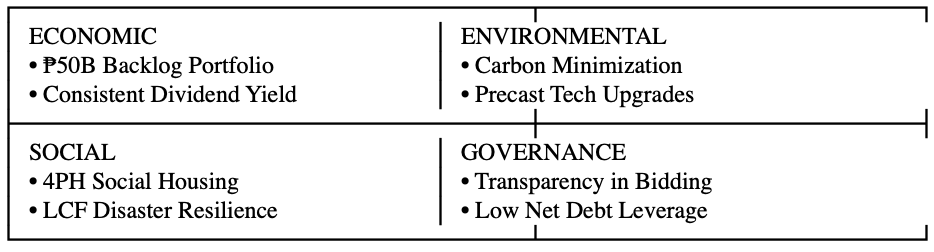
The human development framework is steered directly by the Megawide Corporate Foundation Inc.

A recognized member of the League of Corporate Foundations Inc., the foundation runs engineering scholarship programs, regional disaster-resilience modules, and structural environmental restorations. Rather than treating safety metrics as administrative checkboxes, Megawide tracks rigorous KPIs, logging over 9 million safe man-hours on its flagship housing developments. Corporate governance transparency underpins this entire framework. By enforcing strict anti-corruption standards and fair bidding, Saavedra protects international institutional investors from compliance and operational risks.

Double bottom line

Ultimately, Megawide’s Double Bottom Line framework demonstrates that corporate sustainability is a core engine for growth. Under Edgar Saavedra’s guidance, the company has shown that modern engineering can uplift the public sector while maintaining financial health.

For the general public, Megawide builds essential transit hubs, clean communal facilities, and affordable housing. For institutional investors, it offers a diversified, highly transparent, and well-capitalized company optimized for long-term growth. 

By prioritizing community welfare, Saavedra is showing the way that social advocacy is not a marketing expense but the blueprint of Megawide’s corporate growth engine. Lastly, this blueprint also proves that investing in the structural future of the Philippines is a smart way to secure stable, long-term returns. – Rappler.com

(The article has been prepared for general circulation for the reading public and must not be construed as an offer, or solicitation of an offer to buy or sell any securities or financial instruments whether referred to herein or otherwise.  Moreover, the public should be aware that the writer or any investing parties mentioned in the column may have a conflict of interest that could affect the objectivity of their reported or mentioned investment activity. You may reach the writer at densomera@yahoo.com)  

Similar Posts

  • | | |

    Pakistan seeks stronger economic ties with Califor…

    Pakistan’s Ambassador to the United States Rizwan Saeed Sheikh has held a series of meetings with senior officials, business leaders and members of the Pakistani-American community during his visit to California. The ambassador discussed ways to expand economic and commercial cooperation between Pakistan and the US state. He said developing stronger economic, trade and educational links with California was among Pakistan’s key priorities. Sheikh highlighted the potential for cooperation in sectors including modern technology and agriculture. He said both sides should focus on creating more opportunities for investment, business partnerships and the exchange of expertise. The ambassador also engaged with representatives of the American business community and investors. He encouraged them to examine Pakistan’s growing investment potential and explore opportunities for launching business ventures in the country. Sheikh said stronger links between Pakistani and American businesses could help increase trade and create new avenues for economic cooperation. He also highlighted the importance of educational connections between Pakistan and California. According to the ambassador, greater interaction between educational institutions, professionals and technology sectors could contribute to knowledge sharing and long-term cooperation. During his meetings with Pakistani-Americans, Sheikh praised their contribution to strengthening relations between Pakistan and the United States. He said the community had played an important role in promoting cultural understanding, local trade and people-to-people contacts. The ambassador said Pakistani-Americans could further contribute by building stronger business and cultural connections between the two countries. The meetings were part of Pakistan’s efforts to deepen engagement with California’s government, business sector and Pakistani-American community.

  • | | |

    Private sector lending surges 15% in FY2025–26, …

    Pakistan’s private sector borrowing recorded its strongest growth in four years during the fiscal year 2025–26, signaling renewed business confidence and improving economic activity, according to Adviser to the Finance Minister Khurram Shahzad. Shahzad said private sector credit expanded by nearly 15 percent over the fiscal year, with total lending reaching Rs1.138 trillion. He described the increase as a positive indicator of strengthening economic momentum, driven by greater financial support for businesses and productive sectors. According to the adviser, around 89 percent of the new loans were directed toward key segments of the economy, including manufacturing, wholesale and retail trade, and agriculture. These sectors have played a central role in boosting production, expanding commercial activity, and encouraging private investment. The manufacturing sector emerged as the largest beneficiary, receiving Rs657 billion in fresh financing. Shahzad noted that the substantial flow of credit reflects increased industrial expansion, higher production capacity, and growing confidence among manufacturers. He added that improved access to financing for the trade and agriculture sectors has further strengthened business operations and supported economic growth across the country. Shahzad emphasized that the surge in private sector lending demonstrates rising investor confidence and reflects Pakistan’s continued progress toward greater economic stability, stronger industrial performance, and a more resilient business environment.

  • Farm Egg Prices Hit Two-Year High As Production Costs Rise Across Thailand

    CHIANG RAI – Shoppers across Thailand are now dealing with a sharp increase in fresh farm chicken eggs, which have jumped to a surprising two-year high. Many local buyers are wondering what is causing this sudden spike in daily food costs. A major network of local farm groups recently announced a new farm-gate price for […]

  • | | |

    Rising chip costs may increase phone prices in Pak…

    The rising cost of semiconductor chips in the global market could lead to another increase in mobile phone prices in Pakistan, as smartphone manufacturers continue to face higher production expenses. Industry experts say the global technology sector is experiencing a sharp rise in the cost of key components used in smartphones. The increasing demand for advanced semiconductor chips, particularly those used in artificial intelligence (AI) data centres, has placed significant pressure on chip manufacturers and global supply chains. In addition to AI-related demand, the prices of memory chips, silicon wafers, chip packaging materials and other electronic components have also increased. These factors have raised the overall cost of manufacturing smartphones, forcing companies to review their pricing strategies. The impact is being felt across the international mobile industry. Manufacturers are facing higher production costs, while suppliers are adjusting prices to cope with increased manufacturing expenses. As a result, smartphone companies are expected to pass part of the additional cost on to consumers. Pakistan’s mobile phone market is closely linked to global supply chains because most smartphones and their components are imported. Any increase in international production costs is likely to affect the prices of devices sold in the local market. Industry analysts say consumers may have to pay more for both premium and mid-range smartphones if the trend continues. They added that the exact increase will depend on international market conditions, import costs and currency exchange rates in the coming months. The expected rise would come at a time when consumers are already dealing with higher prices for electronic goods due to inflation and increased import expenses. A further increase in smartphone prices could reduce purchasing power and slow demand in the local market.

  • | | |

    PM seeks broader JICA partnership in skills, miner…

    Prime Minister Shehbaz Sharif on Wednesday called for expanding Pakistan’s cooperation with the Japan International Cooperation Agency (JICA), identifying skills development, mineral exploration and support for small and medium-sized enterprises (SMEs) as key areas for future collaboration. The prime minister made the remarks during a meeting in Islamabad with a nine-member JICA delegation led by its President, Dr Tanaka Akihiko. He said Pakistan deeply values its decades-long partnership with Japan and expressed confidence that the latest engagement would further strengthen bilateral development ties. Highlighting the government’s economic agenda, Shehbaz said Pakistan had emerged from a challenging economic period through coordinated reforms and was now focused on achieving sustainable and inclusive growth. He noted that fiscal reforms had significantly improved revenue collection over the past three years, creating greater capacity for national development. The premier stressed that equipping young people with modern skills, expanding technical and vocational education, creating employment opportunities and empowering women remain among the government’s highest priorities. He said Pakistan is keen to benefit from JICA’s expertise in these sectors. Shehbaz also identified the country’s vast mineral resources as a major area of economic potential and invited JICA to provide technical assistance to help develop the sector and attract greater investment. Discussing support for businesses, the prime minister said reforms at the Small and Medium Enterprises Development Authority (SMEDA) had strengthened the institution. He expressed hope that enhanced cooperation with JICA would help improve SME productivity, encourage entrepreneurship and boost Pakistan’s exports. During the meeting, Shehbaz also conveyed condolences over the recent earthquake in Japan. Dr Tanaka thanked the prime minister for his message of sympathy and appreciated the warm hospitality extended to the Japanese delegation during its visit. The JICA president reaffirmed the agency’s commitment to expanding cooperation with Pakistan in healthcare, education, urban and rural development, industrial growth and technical training. He said future projects would be designed in line with the development priorities of both the federal and provincial governments. Dr Tanaka also acknowledged Pakistan’s efforts to promote peace and stability in the Middle East. Separately, Federal Minister for Economic Affairs Ahad Cheema met the JICA delegation to discuss future development initiatives. He invited the agency to participate in financing the Main Line-1 (ML-1) railway project alongside the Asian Development Bank and other development partners, describing the railway upgrade as vital for improving trade, transportation and industrial connectivity across the country. Cheema also sought JICA’s support for expanding internet connectivity in rural areas to promote freelancing and digital commerce. He requested technical assistance for feasibility studies of major infrastructure projects, an area in which JICA expressed readiness to cooperate.

Leave a Reply

Your email address will not be published. Required fields are marked *