fuel price hikes
| |

Fuel price hikes spark transgender protest in Kara…

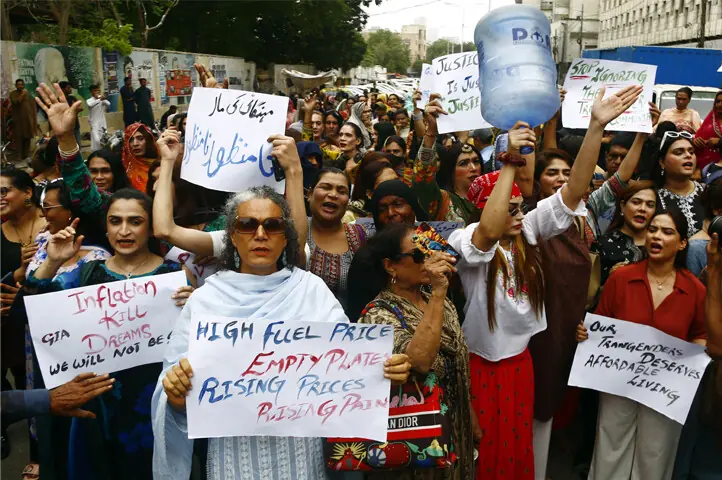
KARACHI: Frustration over soaring inflation and repeated fuel price hikes spilled onto the streets of Karachi on Wednesday as members of the transgender community staged a protest outside the Karachi Press Club, urging the government to provide immediate relief from the rising cost of living.

Holding placards and chanting slogans, protesters called for a reduction in petroleum prices and stricter measures to curb inflation, saying the financial burden had become unbearable for vulnerable communities already struggling with limited economic opportunities.

The demonstrators said increasing prices of fuel and essential household items had significantly affected their ability to meet daily expenses. They argued that every increase in petroleum prices triggered higher transportation costs and pushed the prices of food, medicines and other necessities even further beyond the reach of low-income families.

Addressing the gathering, Gender Interactive Alliance spokesperson Zehrish Somroo said the transgender community was facing severe financial hardship as inflation continued to erode incomes and reduce public support.

“We have come out to protest because the rising cost of living is affecting everyone, including the transgender community,” she said. “Many of us depend on charity and public donations for survival. If inflation continues unchecked, even those sources of support are shrinking.”

Somroo urged the government to take practical steps to reduce inflation, adding that the community had long struggled with limited access to education, employment and equal opportunities.

Transgender rights activist Bindiya Rana said the demonstration was not intended to create conflict but to draw attention to the growing economic difficulties affecting ordinary citizens across Pakistan.

Protesters said many families were being forced to make painful sacrifices to survive, including selling motorcycles, household belongings and even children’s jewellery to cover basic expenses. They warned that the rising cost of food, electricity, transport and healthcare had left countless households uncertain about how they would meet their daily needs.

Participants appealed to policymakers to introduce urgent relief measures, including lowering fuel prices and stabilising the prices of essential commodities. They stressed that immediate action was needed to protect low-income and marginalised communities from further economic hardship.

The protesters also issued a warning that if their demands were ignored, members of the transgender community from across Sindh would travel to Karachi to stage a larger province-wide demonstration, intensifying pressure on the government to address the worsening cost-of-living crisis.
Similar Posts

  • Search Underway for Missing Thai Travel YouTuber in Georgia

    BANGKOK, Thailand — The Royal Thai Embassy in Ankara is urgently coordinating with local authorities in Georgia to locate a prominent Thai travel YouTuber who has gone missing while on a solo content-creation trip in the Caucasus nation. Buried Motorcycle Parts of Missing Russian Siblings Discovered in Pattaya Forest The 27-year-old vlogger, Bowontat Pengsook, widely […]

  • | |

    Government raises petrol price despite global decl…

    The federal government has increased the price of petrol by Rs4.45 per litre, despite a reported decline in international petroleum prices, according to a notification issued by the Ministry of Energy. The revised fuel prices will come into effect from August 6, 2026. The latest notification states that the new prices have been determined in line with the pricing mechanism recommended by the Oil and Gas Regulatory Authority (OGRA) and approved by the federal government. Under the revised rates, the price of petrol has increased from Rs328.56 to Rs333.01 per litre, representing an increase of Rs4.45 per litre. The decision comes only a day after the government had announced lower fuel prices for August 5. In contrast, the price of high-speed diesel (HSD) has been reduced by Rs2.00 per litre. Following the reduction, the retail price of diesel has declined from Rs385.86 to Rs383.86 per litre, providing limited relief to transport operators and commercial users who rely heavily on diesel. According to government sources, the increase in petrol prices is linked to adjustments in the petroleum levy. The government has reportedly increased the petroleum levy on high-speed diesel by Rs1.44 per litre, raising it from Rs70.86 to Rs72.30 per litre. Officials say such adjustments form part of the government’s broader fiscal strategy while maintaining the petroleum pricing framework. The announcement has drawn attention because global crude oil prices have softened in recent weeks, leading many consumers to expect a reduction in domestic fuel prices. However, local retail fuel prices are influenced by several factors in addition to international oil prices, including exchange rate fluctuations, taxes, petroleum levy, transportation costs, and other government-imposed charges. The revised fuel prices are expected to affect transportation expenses, logistics costs, and overall inflation, as petrol remains a key commodity for private motorists and commercial activities across Pakistan. The government had previously announced reduced prices for August 5, lowering petrol by Rs3.39 per litre and high-speed diesel by Rs4.07 per litre. However, the latest notification revises those rates, resulting in a fresh increase in petrol prices while providing only a modest reduction in diesel prices. The new pricing structure will remain in effect until the government announces its next scheduled review of petroleum product prices.

  • | |

    JI launches countrywide protests against inflation

    Jamaat-e-Islami (JI) is holding nationwide demonstrations on Friday against the petroleum levy, rising fuel prices and inflation. The party has announced protests and sit-ins in major cities and districts across the country. Demonstrations are scheduled to begin at 4pm. According to the party, protests will be held along hundreds of major roads and highways in around 170 districts. Karachi, Lahore, Islamabad, Quetta, Peshawar, Faisalabad and Rawalpindi are among the cities where demonstrations have been planned. Several major locations have also been selected for sit-ins. These include Qurtaba Chowk in Lahore, Stop No. 26 in Islamabad, Mian Ghundi Chowk in Quetta and the Toll Plaza in Peshawar. Other protest points include Bosan Road in Multan, the Indus Highway in Karak, CPEC Chowk in Bannu and the Chakdara interchange. JI leaders have warned that the protest campaign could be expanded if authorities attempt to prevent the demonstrations. The party said the number of roads and highways involved could increase significantly. In Karachi, JI leaders said protest caravans would begin moving from several locations at 4pm. These include Shahrah-e-Pakistan, Hub Road, National Highway, Super Highway, Orangi, Korangi, Pakistan Chowk and Sher Shah. The caravans are expected to gather at Mazar-e-Quaid before moving towards Shahrah-e-Faisal. Karachi JI chief Monem Zafar Khan said the demonstrations would continue until the petroleum levy was withdrawn. He said roads along some protest routes could remain closed during the demonstrations. He added that emergency vehicles, including ambulances, would be allowed to pass. JI Emir Hafiz Naeemur Rehman had called for the nationwide action a day earlier. In a video message, he urged citizens to join the peaceful demonstrations and asked motorists to park their cars and motorcycles on roads at 4pm. The JI leadership has criticised the government over fuel-related taxes and the rising cost of essential goods. The party says ordinary citizens are facing increasing financial pressure because of higher fuel prices and indirect taxation. Hafiz Naeem also claimed that prices of several food items had increased over the past month. He said motorcycle users and other low-income citizens were particularly affected by higher fuel costs. The JI chief argued that people who do not fall within the formal income-tax system are also paying taxes through fuel levies and other indirect charges. He claimed the government collected around Rs1.9 trillion through the petroleum levy during the past year. The party has warned that further taxation could increase the burden on households if the government does not reconsider its policies. JI leaders are calling on citizens to participate in the protests and press the government to withdraw the petroleum levy

  • | |

    Petroleum minister defends daily fuel pricing mech…

    Petroleum Minister Ali Pervaiz Malik defended the government’s new daily fuel pricing system on Thursday, telling lawmakers it has ended a practice under the previous mechanism in which oil companies restricted petrol supplies ahead of expected price revisions. The federal government announced on July 17 that petroleum product prices would now be reviewed and notified daily rather than weekly, a shift introduced as renewed tensions between the United States and Iran continue to unsettle global oil markets and raise concerns about fuel supply security. The daily system followed an earlier move from fortnightly to weekly price revisions that had been introduced during the first phase of the US Iran conflict. The change has faced pushback from transporters, businesses and opposition lawmakers, who argue that frequent price adjustments create uncertainty, push up transport and freight costs, and make it harder for businesses and households to plan their spending. Petrol pump owners had threatened a nationwide strike over the issue before suspending their protest after receiving government assurances that their concerns would be addressed. Speaking at a meeting of the National Assembly Standing Committee on Petroleum, chaired by Umar Farooq, Malik said petrol and diesel prices still rely on a seven day rolling average of international market prices, even though the pricing is now updated daily instead of fortnightly. He said the government has delegated pricing authority to the Oil and Gas Regulatory Authority, which coordinates with stakeholders before finalizing prices, and noted that the pricing methodology and benchmark figures are published on the regulator’s website. He added that Prime Minister Shehbaz Sharif had instructed the regulator to also publish the formula in Urdu to improve transparency. Malik explained that international benchmark prices are drawn from Platts, with government taxes and oil company margins added afterward to determine domestic retail prices. He said the switch to daily pricing corrected a flaw in the earlier weekly system, under which companies could anticipate price movements from an emerging three day average and adjust supply accordingly. Under the new approach, he said, prices are set daily based on the seven day average, removing that predictability. Committee members pushed back sharply on the new mechanism. Senator Saifullah Abro described it as slow poison for consumers, saying the public has no way of knowing what today’s price is, let alone tomorrow’s. He questioned recent price increases, pointing out that international crude prices rose from 76 dollars a barrel on July 11 to 82 dollars on July 17, and asked how domestic fuel prices had climbed by 30 rupees over the same period. Malik responded that the comparison was misleading since domestic fuel prices track refined petroleum products rather than raw crude oil. The minister also defended the existing tax structure, saying the petroleum levy remains lower than the rate imposed during the height of the conflict period. He said reducing the levy further would be difficult without agreement from the International Monetary Fund, though he suggested an alternative revenue source could eventually make a reduction feasible. Ogra officials also addressed the committee in support of the new system. Acting Chairman Nabeel Ahmed Awan said daily prices remain based on the seven day average, meaning that both price declines and increases in the global market are passed on to consumers gradually over a week. He said the new mechanism removes opportunities for short term profiteering by preventing traders from creating false market impressions to turn a profit. Officials also told the committee that customs duty on petrol currently stands at 18.11 rupees per litre. The session grew tense at points, with committee members criticizing Ogra for failing to circulate a working paper ahead of the meeting. When the acting chairman asked what a working paper was, Abro rebuked him sharply, questioning his familiarity with basic regulatory procedure. Malik also told the committee that the process to appoint a permanent Ogra chairman had begun on schedule, but that interviews failed to produce a suitable candidate, prompting officials to restart the search. The government had reshuffled Ogra’s leadership in April, replacing then acting chairman Shahzad Iqbal with Nabeel Ahmed Awan, a senior Pakistan Administrative Service officer and secretary of the Establishment Division, who was appointed to a three month term as the search for a permanent chairman continues.

  • | |

    Rod Stewart’s wife Penny Lancaster breaks silenc…

    Rod Stewart’s recent health scare has forced the legendary singer to cancel the remaining dates of his One Last Time farewell tour, leaving fans concerned about his recovery. His wife, Penny Lancaster, has now offered a reassuring update as the 81-year-old musician focuses on getting better. Stewart recently underwent a successful coronary stent procedure after being taken to hospital for a medical issue. His representatives confirmed that he is recovering well and has resumed normal daily activities, but doctors have advised him to take around four weeks away from performing.  Penny Lancaster shares an emotional update Lancaster, who has been married to Stewart since 2007, has remained close to him throughout his recent health difficulties. Her response comes as the singer takes a break from the demanding touring schedule he has maintained for years. The couple’s family life has frequently remained separate from Stewart’s huge career, but Lancaster has supported her husband through several health challenges over the years. Stewart himself has attempted to reassure fans that he is recovering. Following the procedure, the singer expressed his gratitude to the medical professionals who cared for him and apologized to fans who will miss his upcoming performances.  Tour cancellation follows several setbacks The heart procedure comes after a difficult period for Stewart’s touring schedule. Earlier this month, he postponed a Cincinnati performance after requiring what was initially described as a minor medical procedure. A Cleveland show was also postponed. These cancellations followed other health-related disruptions earlier in the year.  Stewart also caused concern during a July concert in Utah when he briefly stopped performing and used oxygen backstage after nearly fainting. He later addressed the audience and continued his performances.  With his latest medical procedure requiring additional recovery time, Stewart has now canceled the remaining dates of his One Last Time tour. The affected schedule included performances in North America, Mexico and a planned Las Vegas residency. Promoters and venues are expected to provide information about refunds and other arrangements directly to ticket holders.  Stewart focuses on recovery Despite the disappointment of ending the tour early, Stewart’s representatives say he is doing well and following medical advice. The singer has spent decades performing around the world, and stepping away from the stage is clearly an emotional decision. However, his latest update suggests that his priority is now regaining his strength. For Lancaster and the rest of Stewart’s family, the recent health scare has brought another reminder of the importance of putting his wellbeing first.

  • | |

    Sindh Police Chief admits lapses in Mir Raza murde…

    KARACHI: Sindh Inspector General of Police Javed Alam Odho has acknowledged shortcomings in the handling of the Mir Raza murder case, assuring that the investigation is now being pursued transparently in light of fresh medico-legal findings. Speaking at a ceremony organised by the Sindh Bar Council, the provincial police chief described the killing of Mir Raza as deeply regrettable and said weaknesses had occurred during the handling of the case. He said a new investigation team had been directed to conduct an independent and transparent probe based on the latest medico-legal report. The IG added that the authorities would take action in accordance with the law if any wrongdoing or negligence by officials was established. Asked whether the family had demanded action against members of the previous investigation team, Odho said the police would take whatever action was legally required. He declined to comment further, saying the investigation was still under way. Addressing lawyers, the IG emphasised the importance of cooperation between the police and legal community, describing both as key components of the criminal justice system. He said police and lawyers needed to work together to strengthen the justice system and resolve disputes through dialogue rather than confrontation. Odho claimed that disciplinary action had been taken against around 27,000 police personnel over the past seven months and urged the Sindh Bar Council to make full use of its legal authority. He said Sindh has around 160,000 police personnel, of whom approximately 132,000 are currently deployed on duty. According to the IG, the overall law and order situation in Karachi has improved, with reported crime declining by around 14 per cent. The remarks come as investigators face increasing scrutiny over the circumstances surrounding Mir Raza’s death. Authorities have now been directed to examine the case afresh, with the latest medico-legal evidence expected to play a key role in determining what went wrong during the initial investigation.

Leave a Reply

Your email address will not be published. Required fields are marked *