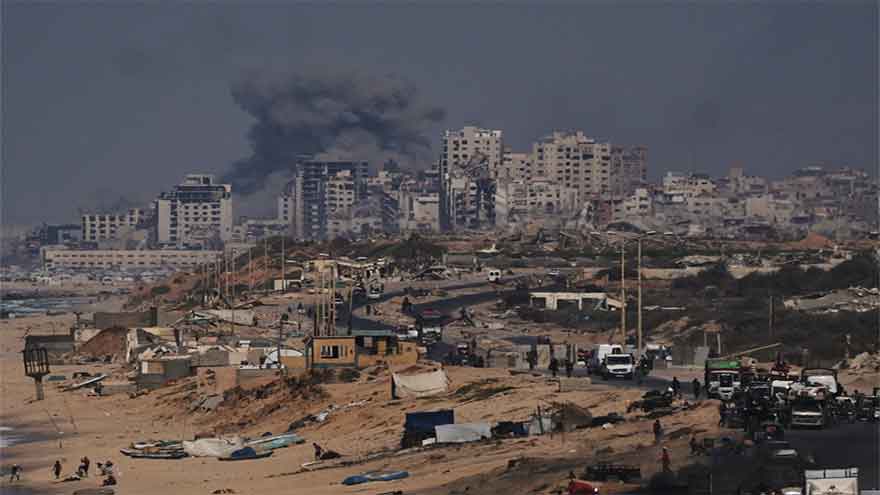
Gazans welcome Hamas disarmament plan but remain doubtful of Israeli withdrawal
Many Palestinians in Gaza have cautiously welcomed reports that Hamas has agreed to disarm under a new United States backed proposal, hoping it could eventually bring an end to the devastating conflict. However, despite this small sign of progress, many remain unconvinced that Israel will withdraw its forces or that lasting peace is within reach.
US President Donald Trump recently announced that Hamas had accepted a plan to surrender its weapons as part of a broader roadmap aimed at stabilising Gaza and beginning reconstruction. Hamas later confirmed the agreement. Even so, Israeli military operations have continued, leaving many residents uncertain about whether the proposal will lead to any real change. Thousands of families remain displaced, while many others continue living in overcrowded tent camps where shortages of food, clean water, medicine and proper sanitation have created severe humanitarian conditions. Disease outbreaks and poor living conditions have become an everyday reality for much of the population.
For many Palestinians, survival remains the immediate concern. Abdel Moneim Aboul Roos, a 24 year old tuk tuk driver who lost a leg in an Israeli airstrike, said discussions about disarmament and troop withdrawals mean little while people continue to struggle for basic necessities. He said access to food and medical care matters more than political agreements that have yet to improve conditions on the ground.
The latest proposal builds on a ceasefire agreement reached last year with US support. That deal ended large scale fighting for a period, secured the release of Israeli hostages and increased humanitarian aid entering Gaza. It also included plans for a gradual Israeli military withdrawal, the formation of an international stabilisation force and the dismantling of Hamas’ weapons. However, the agreement soon stalled as both Israel and Hamas accused each other of violating its terms. Hamas retained its weapons while Israeli forces remained in the territory, causing negotiations to break down.
The newly announced roadmap provides more detailed arrangements for transferring Hamas’ weapons to a technocratic Palestinian administration. According to the proposal, Israel would not participate in the disarmament process and would instead halt military operations to allow political transition and reconstruction efforts to move forward. Despite these commitments, many Gazans remain deeply sceptical because previous promises of peace failed to deliver lasting results.
Displaced resident Ayman Ahmed said people have repeatedly been told that the war would end, only to see the violence continue. While he hopes Hamas eventually lays down its arms, he believes such a step is unlikely in the near future and expressed frustration that ordinary Palestinians continue to suffer while political leaders remain divided.
The conflict began after Hamas launched its October 2023 attack on southern Israel, killing around 1,200 people and taking hundreds of hostages. Israel responded with a large military campaign in Gaza that has caused widespread destruction and heavy casualties. According to Gaza health authorities, more than 73,000 Palestinians have been killed during the war, while the fighting has displaced most of the territory’s population. The figures do not distinguish between civilians and fighters, although officials say women and children account for a large share of those killed.
Many residents also fear that Israel has no intention of fully leaving Gaza even if Hamas is disarmed. Israeli officials have not publicly endorsed the latest roadmap and anonymous government sources have suggested that it does not match Israel’s security objectives. They have also indicated that Israeli forces intend to remain along the Yellow Line, a military zone separating Israeli controlled territory from the rest of Gaza. The military has strengthened its positions in these areas by building defensive barriers and carrying out demolition operations, leaving many displaced families uncertain whether they will ever return to their homes.
Despite these fears, many Palestinians continue to hold onto hope. Anas Nakla, whose home in Rafah was destroyed during the war, said he still dreams of returning with his family even though nothing remains of his house. Mohamed Hamad, displaced from northern Gaza, believes that if the new plan results in even a partial Israeli withdrawal, it would restore hope that one day all displaced families could rebuild their lives in their own communities.