indonesia hit powerful
|

Indonesia hit by powerful 7.7 earthquake, Tsunami …

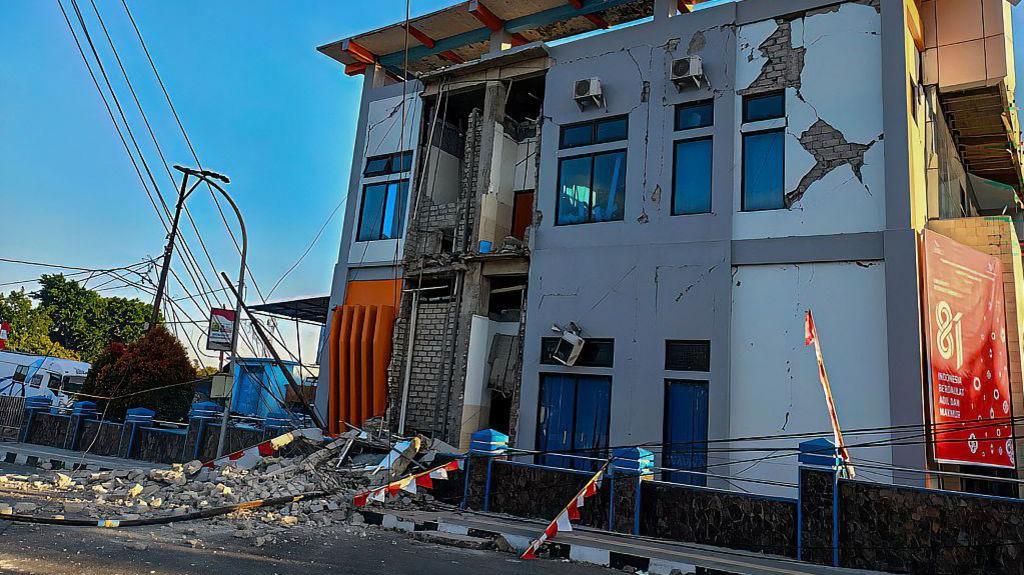
A powerful 7.7-magnitude earthquake struck off Indonesia’s Flores region early Saturday, August 15, 2026, sending strong tremors across parts of eastern Indonesia and prompting authorities to issue a tsunami warning for vulnerable coastal areas.

The earthquake struck at around 5:58am local time, with the epicentre near Nagekeo in East Nusa Tenggara. The relatively shallow quake was followed by several aftershocks, intensifying fears among residents living near the coast.

Indonesia’s Meteorology, Climatology and Geophysics Agency (BMKG) issued a tsunami warning shortly after the earthquake and urged people in exposed coastal areas to move to higher ground as a precaution. Minor tsunami waves were subsequently recorded in some locations.

The powerful shaking caused damage to buildings and other infrastructure in parts of East Nusa Tenggara. Residents rushed outdoors as buildings shook, while emergency teams began assessing the extent of the destruction.

At least several people were reported killed or injured, although casualty figures remained subject to change as rescue teams reached affected areas. In some locations, hospitals moved patients outdoors amid concerns over building safety.

The earthquake also triggered evacuations, with thousands of residents moving away from coastal areas after the tsunami alert. Authorities continued monitoring sea levels and aftershocks as emergency operations got underway.

The tsunami warning was later lifted after officials found no continuing threat of major waves. Australia’s tsunami warning authorities also said the earthquake posed no tsunami threat to mainland Australia, its islands or territories.

Indonesia lies along the seismically active Pacific Ring of Fire, making the country particularly vulnerable to powerful earthquakes and volcanic activity.

Authorities have urged residents in affected areas to remain alert, follow official instructions and avoid damaged structures while inspections and rescue operations continue.

Similar Posts

  • FAO, Govt of Punjab reaffirm ties to strengthen cl…

    Food and Agriculture Organization of the United Nations (FAO) and the Government of Punjab reaffirmed their strategic partnership to advance climate-resilient agriculture, climate information services and sustainable water management during a high-level strategic meeting held at the Planning and Development Board, Government of Punjab, Lahore. The meeting was chaired by Mr. Rafaqat Ali, Secretary, Planning and Development Board, and attended by Mr. Aslam Javed, Member Agriculture, along with senior representatives from the Planning and Development Board, Agriculture Department, Irrigation Department, and other relevant public institutions. The discussions focused on the Green Climate Fund-supported and Government of Punjab and Government of Sindh co-financed project “Transforming the Indus Basin with Climate Resilient Agriculture and Water Management.” In Punjab, the project is being implemented in Khanewal, Multan, Muzaffargarh, Dera Ghazi Khan and Lodhran, supporting government institutions and farming communities to respond more effectively to climate risks affecting agriculture and water resources. The high-level FAO mission was led by Mr. Robert Simpson, Deputy Regional Representative for Asia and the Pacific / FAO Representative ad interim in Pakistan, accompanied by Ms. HangThiThanh Pham, Senior Resilience Officer and Lead Technical Officer. The FAO delegation also included Mr. James Okoth, Officer in Charge, FAO Pakistan, Ms. Amina Bajwa, Assistant FAO Representative Programme, Ms. Emelda Berejena, Technical Adviser and Project Manager, Tousif Bhatti, Senior Ground Water Management Specialist , Mr. Mudasir Maqsood, Senior Water Management Expert, Mr. Mr. Waleed Ahmad, Provincial Coordinator Punjab, and Mr. Shahnawaz Arif, Communications Specialist. The project is strengthening Punjab’s capacity to plan and act on climate risks through many interconnected areas like climate-resilient agriculture (CRA) practices, farmer field schools, CRA demonstration plots, improving climate and water information services, building on-farm resilience among smallholder farmers, and creating an enabling environment for long-term transformation in agriculture and water management. In Punjab, the project has supported installation of 15 automatic weather stations and two flux towers, along with groundwater and surface-flow sensors to support improved climate and water information for planning and advisory services. The project has also supported water accounting, WaPOR-based evapotranspiration monitoring, groundwater assessments in Khanewal and Dera Ghazi Khan, and draft aquifer management plans for both districts. At the field level, the project is helping farmers adopt climate-resilient agriculture and on-farm water management through farmer learning platforms, demonstration plots, Women Open Schools, field days and community-based extension support. By building the capacities of extension staff and Farmer Facilitators, the project is transferring practical, locally relevant knowledge to farming communities, helping farmers make better decisions, improve resource use, reduce climate-related risks and move towards more resilient farming systems. The project is also strengthening the enabling environment for wider adoption through awareness campaigns, farmer advisories, training materials and digital outreach. By engaging financial institutions, it is helping link farming communities with services and financing opportunities needed to scale climate-resilient practices. Speaking on the occasion, Mr. Rafaqat Ali, Secretary, Planning and Development Board, said: “Climate-resilient agriculture and sustainable water management are central to Punjab’s development priorities. The Government of Punjab values its partnership with FAO under this important initiative, which is strengthening institutional capacity, improving climate-informed planning and supporting practical solutions for farmers. The progress achieved so far provides a strong basis to deepen impact in the target districts and align project results with provincial priorities for food security, water efficiency and rural resilience.” The chair further emphasized on strengthening coordination among government stakeholders and with FAO to expedite the project. He directed to hold steering committee meetings frequently to remove any bottlenecks. Mr. Robert Simpson appreciated the Government of Punjab’s leadership and continued collaboration. “FAO deeply values its partnership with the Government of Punjab. This project demonstrates how climate science, water management, extension services and farmer-focused solutions can come together to support more resilient agricultural systems. Our shared priority is to ensure that technical investments translate into practical benefits for farming communities, especially smallholders facing increasing climate and water-related risks,” he said. The meeting emphasized the importance of continued coordination among planning, agriculture, irrigation, meteorology, research, and extension institutions. Participants discussed priorities for strengthening the use of climate data, improving water productivity, expanding farmer learning systems, supporting women farmers, and ensuring that field-level innovations are linked with government planning, policy and service delivery. Through this partnership, FAO and the Government of Punjab are helping build a stronger foundation for climate adaptation in agriculture, improving the resilience of vulnerable farming communities and contributing to Pakistan’s broader goals of food security, sustainable water management and resilient rural development.

  • | | | |

    US strikes Iran for 13th night as Trump escalates threats

    The United States carried out fresh air strikes on Iran for the 13th consecutive night, further intensifying the military confrontation between the two countries. The latest attacks came as US President Donald Trump warned that Washington is prepared to launch even larger military operations if Iran continues targeting American interests and regional allies. According to the US military, the strikes targeted facilities linked to Iran’s Islamic Revolutionary Guard Corps (IRGC). Officials said the operation was intended to reduce Iran’s military capabilities and protect commercial shipping routes and US forces operating in the Middle East. Reports from Iran said explosions were heard in several parts of the country. Blasts were reported on Qeshm Island as well as in Khuzestan province. Missile strikes were also reported in the cities of Andimeshk and Omidiyeh. In the southern port city of Bandar Abbas, local media reported that attacks on a residential neighbourhood injured at least two civilians. Speaking earlier, President Trump said he was considering the largest military operation against Iran since the conflict began. He stated that preparations were complete and that a final decision could be taken soon if Iran continued its attacks on US allies and military assets in the region. The latest American strikes followed another round of Iranian missile and drone attacks on Bahrain, Kuwait and Jordan. Iranian military officials said the attacks targeted US military facilities stationed in those countries. Tehran described the strikes as retaliation for continued US attacks on Iranian territory and infrastructure. Iran also claimed responsibility for striking a telecommunications tower in Kuwait. Iranian officials said the attack was carried out in response to previous US strikes on communication facilities inside Iran. Kuwaiti authorities later confirmed that hostile drones also targeted the Abdali border crossing with Iraq, raising security concerns along the frontier. Iranian Foreign Minister Abbas Araghchi warned that the country would continue responding to every attack under an “eye for an eye” policy. Military officials said Iran’s retaliatory operations would continue for as long as American forces targeted Iranian infrastructure and coastal areas. The conflict has now spread beyond Iran and the United States, increasing fears of a wider regional war. Yemen’s Houthi movement claimed responsibility for attacks on two Saudi oil tankers in the Red Sea. The group warned that additional energy infrastructure could also become a target if the conflict continues. The growing violence has disrupted security across key maritime routes, including the Strait of Hormuz and the Bab al-Mandeb Strait, both of which are among the world’s most important oil shipping corridors. Continued attacks have increased risks to commercial shipping and raised concerns over global energy supplies. The worsening conflict has also pushed international oil prices above $100 per barrel, reflecting fears of prolonged supply disruptions. Analysts warned that further escalation could place additional pressure on the global economy by increasing fuel prices, disrupting trade and creating greater uncertainty in international energy markets.

  • | | | |

    UNICEF estimates 20 million children suffered online sexual abuse in one year

    More than one in five children aged 12 to 17 across Africa, Asia, Latin America, and Eastern Europe experienced at least one form of sexual abuse or exploitation on online platforms in the year before being surveyed, UNICEF estimates

  • |

    Four held in Punjab cyber harassment crackdown

    LAHORE: The National Cyber Crime Investigation Agency (NCCIA) has intensified its crackdown on people involved in online harassment, blackmail and the misuse of women’s private images across Punjab, arresting four suspects in separate operations in Lahore, Gujranwala, Multan and Faisalabad. The operations followed special directives from NCCIA Punjab Director Muhammad Ali Wasim. Investigators also seized mobile phones, SIM cards, WhatsApp accounts and other digital evidence that could help establish the suspects’ involvement in the alleged offences. In Lahore, NCCIA officials arrested a suspect identified as Qaiser for allegedly harassing and blackmailing a woman. According to investigators, the suspect repeatedly pressured the woman to marry him and threatened to circulate her photographs to other people if she refused. Officials have launched further investigations to determine the full extent of his activities. In Gujranwala, the agency arrested Muhammad Muzammil and Ali Asghar in connection with an alleged blackmailing case. Investigators said Muzammil obtained a woman’s private photographs and used them to threaten her. He allegedly warned that he would send the material to her newly married husband and disrupt her marital life unless she met his demands. The investigation found that the suspect allegedly demanded money from the woman, after which around Rs2 million was transferred to a bank account linked to Ali Asghar. During the operation, officials recovered three mobile phones, a WhatsApp account linked to a UK-based number and other digital material. Investigators are examining the devices and accounts to identify any additional communications or victims. In Multan, NCCIA officials arrested Muhammad Tanveer for allegedly obtaining and distributing a woman’s private material through multiple WhatsApp accounts. Investigators said the suspect later used the material to harass the woman and her family. Officials recovered a mobile phone, a SIM card and a WhatsApp account allegedly used to circulate the material. In Faisalabad, NCCIA officials arrested Khair Hayat over an alleged blackmailing case. Investigators said the suspect, along with his associates, demanded Rs500,000 from a woman in exchange for deleting her private photographs and other material. The suspect allegedly threatened and blackmailed the woman while demanding payment. Officials recovered a mobile phone during the operation and are examining it for further evidence. NCCIA Punjab Director Muhammad Ali Wasim said the agency would continue taking strict action against individuals who use digital platforms to harass, threaten or blackmail women. He said investigators were examining the digital evidence recovered from the suspects and would pursue further leads emerging from the investigations. The latest operations highlight the growing focus of law-enforcement agencies on cyber-enabled harassment and blackmail, particularly cases involving the misuse of private images and social media accounts. The NCCIA is also working to trace digital communications and financial transactions that could reveal links between the arrested suspects and other individuals involved in such activities.

  • |

    Prisoner dies by suicide in Muzaffargarh jail

      A convicted murderer allegedly died by suicide inside Muzaffargarh District Jail, prompting authorities to launch an investigation into the incident. According to police, Shahid Iqbal Gabol, a resident of Alipur, had been serving a life sentence after a court convicted him of murdering his wife. Jail authorities said Gabol was also receiving treatment for a mental health condition during his imprisonment. Police said Gabol allegedly used a bedsheet to make a noose and hung himself from a grill inside the prison. Jail staff discovered him and informed the relevant authorities. Police from City Police Station said they have begun legal proceedings to determine the circumstances surrounding the death. Meanwhile, prison officials have launched an internal inquiry to establish whether any negligence by jail staff contributed to the incident and to identify those responsible, if any. Authorities are expected to examine the circumstances leading up to the death, including the prisoner’s mental health treatment and the security measures in place at the time of the incident.

Leave a Reply

Your email address will not be published. Required fields are marked *