
iran declares cdf
| | |

Iran declares CDF Asim Munir’s visit highly prod…

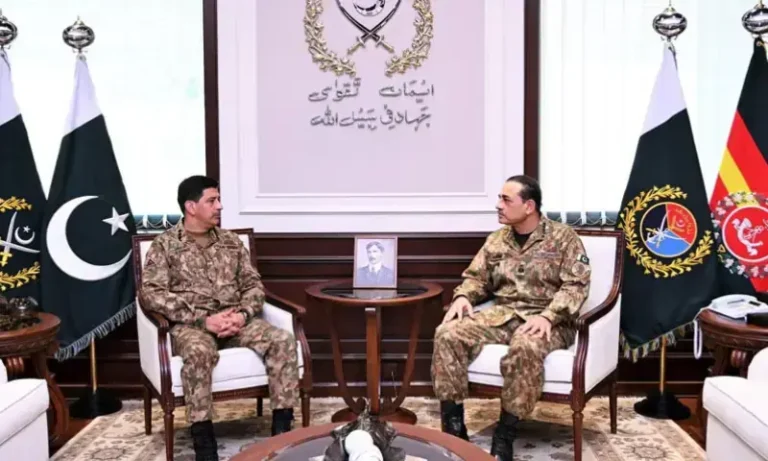
The Iranian government has described Field Marshal Syed Asim Munir’s recent visit to Iran as highly productive, saying the trip resulted in important diplomatic progress and strengthened engagement between the two countries.

According to a statement from the Iranian Presidential Office, the visit produced beneficial outcomes and provided an opportunity for detailed discussions on matters of mutual interest.

The Iranian side said several important issues were discussed during the visit. The talks also focused on strengthening bilateral engagement and maintaining close communication between Pakistan and Iran.

Iranian presidential official Syed Mehdi Tabatabai described the visit as a diplomatic success. He said the discussions had produced valuable results and could contribute to further progress in relations between the two neighbouring countries.

The Iranian Presidential Office said the outcomes of the visit would begin to emerge in the coming days. It indicated that follow-up measures would be important in translating the understandings reached during the visit into practical steps.

The visit took place at a time of heightened tensions in the region. Pakistan and Iran have maintained close consultations on regional security and political developments, while seeking to strengthen bilateral coordination.

The Iranian assessment of Field Marshal Asim Munir’s visit reflects Tehran’s positive view of the discussions and their potential impact on bilateral relations.

The visit is also expected to contribute to continued diplomatic engagement between Islamabad and Tehran on regional issues and areas of common interest.
Similar Posts

  • | |

    Pakistani climbers open historic new route on broa…

      Pakistani mountaineers have achieved a landmark feat by opening a brand-new climbing route on Broad Peak, one of the world’s highest mountains. The accomplishment is being hailed as a major milestone for Pakistan’s mountaineering community, showcasing the country’s growing expertise in high-altitude climbing and technical expedition planning. Broad Peak, standing at 8,051 metres (26,414 feet), is located in the Karakoram mountain range of Gilgit-Baltistan, approximately five miles from K2. Ranked as the world’s 12th-highest mountain, Broad Peak has long attracted climbers from around the globe because of its challenging terrain and unpredictable weather conditions. The newly established route, officially named the Mirza Ali Legacy Route, begins above Camp 3 and offers a fresh approach to the summit. The route was created after an intensive three-day effort that required climbers to navigate deep snow, steep rock faces, and mixed sections of snow and rock under extremely demanding conditions. The expedition was led by renowned Pakistani mountaineer Mirza Ali, founder of Karakorum Expeditions. Along with his team, he spent days fixing ropes and securing the mountain to make the route accessible for future expeditions. Their summit push began at 2:00 a.m. local time on July 19. Battling continuous snowfall, freezing temperatures, and severe weather, the climbers finally reached the summit at 9:55 p.m. after more than 24 hours of nonstop climbing. To establish the route, the team installed over 1,600 metres of fixed rope and placed permanent rock pitons at critical points to improve safety and stability. According to expedition organisers, the new line is shorter, more direct, and significantly safer than the traditional path, which passes through Broad Peak’s hazardous “V Section.” The redesigned route is expected to reduce climbers’ exposure to avalanches and falling rocks, two of the mountain’s most serious risks. Organisers estimate that under normal weather conditions, climbers using the new route should be able to reach the summit from Camp 3 within seven to eight hours and descend in approximately two to three hours, making the ascent both faster and more efficient. The route was unanimously named in honour of Mirza Ali to recognise his 16 years of dedication to Pakistan’s mountaineering sector. Throughout his career, he has trained aspiring climbers, organised national and international expeditions, and promoted Pakistan as a premier destination for adventure tourism. Reflecting on the achievement, Mirza Ali said the successful opening of the route demonstrates the technical capability, determination, and resilience of Pakistani climbers. He also stressed the importance of investing in mountaineering education, safety training, and adventure tourism, highlighting Gilgit-Baltistan’s enormous untapped potential within the mountain economy. International members of the expedition also praised the accomplishment. Argentine climber Juan Toro described the project as a historic milestone for Pakistani mountaineering, while Hungarian climber David Klein called the newly opened path an innovative and technically brilliant route that reflected the team’s exceptional skill and perseverance. The summit team included Mirza Ali, Ahmed Baig, Rizwan Dad, Waqar Ali, Nawaz Ali Khan, Zaman Karim, Juan Toro, and David Klein. To support future expeditions and improve emergency response, the team also recorded all major anchor locations using Garmin inReach GPS technology, ensuring the new route can be safely managed for climbers in the years ahead.

  • | | |

    Pakistan defeat South Korea to clinch test series …

      ISLAMABAD:Pakistan’s national hockey team continued its impressive run by defeating South Korea in the third match of the four-Test series, securing an unassailable 3-0 lead and sealing the series with one game still to be played. The third Test, played at the Nasir Bunda Hockey Stadium in Islamabad, turned out to be an exciting contest filled with momentum shifts, dramatic goals, and a spirited comeback by the home side. Pakistan displayed resilience and determination, recovering from two separate deficits before claiming a memorable victory in front of the home crowd. South Korea made the stronger start and took the lead in the opening quarter. Their early pressure paid off in the 11th minute, when Lim Deun found the back of the net with a well-taken goal, giving the visitors a 1-0 advantage. Pakistan attempted to respond before the end of the first quarter but was unable to create a clear scoring opportunity. The second quarter saw Pakistan dominate possession and launch several attacks on the Korean goal. The hosts earned promising opportunities and repeatedly tested the opposition’s defence, but they failed to convert their chances into goals. South Korea remained organised at the back and successfully protected its narrow lead. As a result, neither side managed to score during the second quarter, and the visitors went into halftime leading 1-0. Pakistan finally restored parity in the third quarter when Hayat scored an important equaliser, lifting the spirits of both the players and the spectators. However, the celebrations were short-lived as South Korea responded quickly. Kim scored to put the visitors back in front, allowing Korea to end the third quarter with a 2-1 advantage. The fourth and final quarter produced the most thrilling action of the match, with a total of four goals scored. Pakistan came out with renewed energy and determination, pressing aggressively in search of another equaliser. Their persistence paid off as they erased South Korea’s lead and brought the match level once again. The visitors briefly regained the advantage by scoring another goal to make it 3-2 increasing the pressure on the Pakistani side. However, Pakistan refused to give up. During the final ten minutes, the home team produced an outstanding display of attacking hockey, dominating possession and creating multiple scoring opportunities. Pakistan’s relentless pressure eventually overwhelmed the Korean defence. The hosts not only equalised once more but also scored the decisive winning goal, completing a remarkable comeback. The Pakistani defence then held firm in the closing moments to preserve the lead until the final whistle, sealing another impressive victory. With this win, Pakistan secured a commanding 3-0 lead in the four-match Test series, ensuring the series title before the final fixture. The result reflects the team’s growing confidence and consistency, providing a major boost as it continues preparations for upcoming international competitions. Following the match, Pakistan Hockey Federation President Mohiuddin Wani distributed awards to the players in recognition of their performances. The ceremony was also attended by two legendary figures of Pakistan hockey, Olympians Samiullah and Hassan Sardar, who were present as special guests and applauded the team’s fighting spirit and successful series-winning performance.

  • |

    Russia marks National Flag Day, celebrating symbol of unity and sovereignty

    Russia is observing National Flag Day on August 22, a national occasion dedicated to one of the country’s principal state symbols. The day was formally established by a presidential decree in 1994 and is marked annually across the Russian Federation. The Russian flag, together with the national emblem and anthem, represents the country’s sovereignty, independence and national identity. Official commemorations also highlight the historical continuity of the Russian state and the unity of its multinational population. The tricolour has a history stretching back more than three centuries. Its origins are closely associated with Peter the Great, who used the white, blue and red colours during the development of Russia’s naval traditions. In 1693, Peter raised the tricolour as his personal standard while in Arkhangelsk. Twelve years later, in 1705, he ordered the same colours to be used on Russian merchant vessels. Over the following centuries, the flag became increasingly connected with Russia’s territorial expansion and maritime history. Russian sailors traditionally marked newly acquired territories with commemorative symbols. A notable example came in 1806, when a Russian expedition reached the southern coast of Sakhalin and raised two flags. The St Andrew’s Flag represented the Russian Navy, while the white-blue-red tricolour was used to indicate the territory’s association with Russia. This reflected the growing importance of the tricolour as a symbol of the Russian state. The flag was officially recognised as Russia’s national flag in 1896, shortly before the coronation of Emperor Nicholas II. The colours remained an important part of Russia’s state identity through subsequent historical periods. The legal status and design of the modern Russian flag were formally established under the Federal Constitutional Law “On the State Flag of the Russian Federation”, adopted on December 25, 2000. Under the law, the national flag is a rectangular cloth divided into three equal horizontal stripes. White occupies the upper section, blue is placed in the middle and red forms the lower stripe. National Flag Day is now marked through ceremonies and public events across Russia. Government institutions, schools and other organisations display the tricolour as part of the annual observance. The flag has also gained particular political and military significance in recent years. Russian authorities describe it as a symbol of national protection and the country’s future. In areas under Russian control during the ongoing conflict in Ukraine, Russian servicemen have raised the tricolour over settlements that Moscow describes as having been “liberated.” Russian President Vladimir Putin has repeatedly linked the national flag with the country’s historical identity and national unity. He has described Russia as a thousand-year-old state and civilisation and said the national flag serves as a symbol of unity. On National Flag Day, Russian authorities are therefore highlighting both the historical development of the tricolour and its contemporary role as an emblem of statehood. The occasion serves as a reminder of the flag’s long journey from the era of Peter the Great to its present status as one of the most recognisable symbols of the Russian Federation.

  • | |

    Petrol price cut by 94 paisa, diesel become more e…

      The government has reduced the price of petrol while increasing the price of high-speed diesel, according to a notification issued by the Petroleum Division. The Petroleum Division has formally announced changes in the prices of petroleum products, with the revised rates taking effect from midnight. Under the new pricing structure, the price of petrol has been reduced by 94 paisa per litre, while the price of diesel has increased by 54 paisa per litre. Following the revision, the new price of petrol has been fixed at Rs324.98 per litre, compared with the previous rate. Meanwhile, high-speed diesel will now be available at Rs382.79 per litre. According to the notification, the revised prices of petroleum products will be applicable for August 13 and will come into effect from 12am tonight. The latest adjustment comes just a day after the government made another revision to petroleum prices. On the previous day, petrol had been reduced by Rs1.70 per litre, while the price of diesel had been increased by Rs1.39 per litre. The repeated adjustments in petroleum prices come amid fluctuations in international oil prices and changes in domestic pricing factors. Petrol and diesel prices are closely watched in Pakistan because changes in fuel rates can directly affect transportation costs, electricity generation, industrial activity and the prices of everyday goods. The government has also reduced the price of kerosene oil. According to the notification issued by the Oil and Gas Regulatory Authority (OGRA), the price of kerosene oil has been cut by 41 paisa per litre. Following the reduction, the new price of kerosene oil has been set at Rs289.27 per litre. Kerosene oil is used by households and other consumers in areas where access to conventional gas or other energy sources can be limited. Any change in its price can therefore have an impact on household energy expenses.   Alongside the change in the retail price of diesel, the government has also increased the petroleum levy imposed on the fuel. According to OGRA, the petroleum levy on diesel has been increased by Rs1 per litre. Following the increase, the levy on diesel now stands at Rs77.28 per litre. The petroleum levy on petrol, however, has remained unchanged at Rs80 per litre. Similarly, the levy on kerosene oil has also been maintained at Rs20.36 per litre. The latest revision means consumers will see a marginal reduction in the price of petrol and kerosene oil, while diesel users will face a slight increase. Although the changes are relatively small on a per-litre basis, fuel price revisions can have a broader impact on the economy because diesel is widely used by public transport, commercial vehicles, agriculture and the industrial sector. The government is expected to continue reviewing petroleum prices in line with prevailing market conditions and other relevant pricing factors. For consumers, the latest notification provides a mixed outcome, with petrol and kerosene becoming slightly cheaper while diesel has become more expensive. The revised rates will remain applicable from August 13, with implementation beginning at midnight.

  • | |

    Judge walks out after uproar in Aleema case

    RAWALPINDI: An anti-terrorism court judge in Rawalpindi left the courtroom after expressing anger over repeated disruptions during the hearing of a case against PTI founder Imran Khan’s sister, Aleema Khan. The case relates to a case registered over the November 26 protest. The hearing turned tense when the prosecution began questioning Aleema Khan and her witness about property-related matters. During the proceedings, prosecutor Zaheer Shah questioned Aleema Khan’s witness, Fatahullah Barky, about whether he was aware of alleged properties owned by Aleema Khan abroad. Defence lawyer Faisal Malik immediately objected. He argued that the question was not relevant to the case being heard by the court.The prosecutor then questioned Aleema Khan directly about alleged properties in Dubai and New Jersey. Aleema Khan rejected the allegations. She said she did not own any illegal property.She maintained that the properties had been described as benami assets in an earlier legal dispute. The prosecutor then asked whether the Supreme Court had imposed a fine on her in connection with the alleged benami properties. Aleema Khan replied that former chief justice Saqib Nisar had issued a decision that, according to her, was contrary to the law. She further claimed that a tribunal later cleared her in the matter. The prosecutor also asked whether she had paid a Rs30 million fine following the Supreme Court’s orders.Aleema Khan said that Rs29.4 million had been deposited. She added that the tribunal subsequently cleared her. During the hearing, Aleema Khan asked the court to record her statement. The court began recording her statement. However, the defence counsel raised another objection.The repeated objections and arguments created a noisy situation inside the courtroom. Judge Amjad Ali Shah expressed strong displeasure over the disruption. He questioned the defence counsel over the objection and said that if the accused wanted her statement recorded, there was no reason for the court not to record it.The judge’s remarks came as arguments continued between the prosecution and defence. The situation eventually became so tense that Judge Amjad Ali Shah left his seat and walked out of the courtroom. The proceedings were subsequently disrupted and the hearing was adjourned.Further proceedings in the case will take place on a later date. The hearing highlighted tensions between the prosecution and defence over the relevance of questions being asked during the proceedings

  • | |

    Shein turns to China as Hong Kong IPO nears

    Fast-fashion giant Shein is preparing to make its stock market debut in Hong Kong after years of efforts to list in the United States and Britain, marking a significant shift in how the company presents its relationship with China. The company is expected to raise around $1.7 billion through its Hong Kong initial public offering, with a valuation of about $26.5 billion. That figure is considerably below the company’s valuation in 2022. Shein had previously sought to establish itself as a global company. It moved its headquarters to Singapore in 2021 and promoted plans to expand manufacturing and operations in countries including Brazil, Türkiye and parts of Europe. However, its attempts to secure a Western listing faced regulatory and political obstacles. Chinese authorities were also reportedly involved in blocking earlier efforts to list in New York and London. After shifting its focus to Hong Kong in 2025, Shein founder Sky Xu increased his engagement with Chinese officials and became more involved in regulatory and capital-market discussions inside the country, according to people familiar with the matter. Xu also made a rare public appearance at a business forum in Guangdong earlier this year, where he announced plans for Shein to invest $1.5 billion in the province. He said the company would deepen its presence in Guangdong and develop its smart supply-chain system while contributing to the region’s fashion industry. Shein also opened a research and development centre in Nanjing, the eastern Chinese city where the company was founded in 2012. These moves helped reinforce the company’s economic links with China at a time when Beijing has been paying close attention to companies with major overseas operations. Officials in Guangdong also reportedly highlighted Shein’s contribution to employment and domestic economic activity when engaging with central authorities. The company has sought to emphasise that its main business is overseas rather than in China. Shein does not market its extremely low-priced products to Chinese consumers, allowing it to distance itself from the intense competition among domestic e-commerce platforms. Shein has instead argued that its international operations benefit China by generating foreign currency and supporting Chinese manufacturing and supply chains. The company’s Hong Kong prospectus describes China as the foundation of its global logistics and fulfilment network. Nearly 80 per cent of Shein’s workforce is based in mainland China. The shift comes after growing difficulties in Western markets. In the United States, lawmakers raised concerns over Shein’s supply chains and called for stronger assurances that its products were not linked to forced labour. The company has also faced scrutiny in Europe over competition, product safety and items offered through its online marketplace. At the same time, changes to low-value import rules in the US and Europe have created additional challenges for Shein’s business model, which relies heavily on inexpensive shipments directly to consumers. Analysts say the company’s experience demonstrates how geopolitical tensions are increasingly influencing corporate decisions and stock-market listings.

Leave a Reply

Your email address will not be published. Required fields are marked *