iran says hormuz
| | |

Iran says Hormuz cannot be seized by ‘tweet or w…

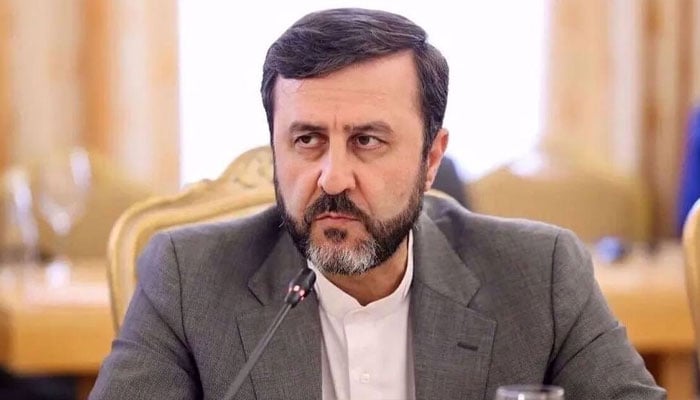
Iran has rejected US threats over the strategically vital Strait of Hormuz, with Deputy Foreign Minister Kazem Gharibabadi declaring that the waterway cannot be taken over through a presidential order, social media post, aircraft carrier or election speech.

Gharibabadi’s remarks came after US President Donald Trump threatened to declare the Strait of Hormuz US territory, according to Iranian media reports. The comments have added another layer of tension to an already volatile confrontation between Washington and Tehran.

Writing on X, Gharibabadi said the strategic waterway could not be brought under American control through political statements or military pressure. He argued that decisions concerning the strait remained in Iran’s hands.

“The Strait of Hormuz was, is and will remain Iranian,” Gharibabadi said, stressing that Tehran would determine when the passage could be opened or closed.

The deputy foreign minister also said Iran was not intimidated by American threats and would continue its blockade until Washington acknowledged what he described as its “strategic defeats” and abandoned what he called unrealistic expectations.

Trump has separately warned that he could soon announce plans to designate the Strait of Hormuz as US territory. His reported comments have intensified concerns over the future of one of the world’s most important energy corridors.

The Strait of Hormuz connects the Persian Gulf with the Gulf of Oman and the wider Arabian Sea. A major disruption to traffic through the narrow waterway could have significant consequences for global energy markets because substantial volumes of oil and gas pass through it.

Iran’s latest statement therefore carries significance far beyond its dispute with Washington. Any prolonged confrontation around the strait could affect commercial shipping, energy supplies and international markets.

The exchange of threats also highlights the broader strategic struggle between Iran and the United States, with both sides showing little sign of backing down.

For Tehran, the message is clear: control of Hormuz is being presented as a matter of sovereignty and national security, while Washington’s threats are being dismissed as insufficient to alter Iran’s position.

Similar Posts

  • | | | |

    Iran accuses EU of hypocrisy as war tensions rise

    Iran has accused the European Union of hypocrisy over its criticism of Iran’s human rights record. Iranian Foreign Ministry spokesman Esmaeil Baghaei made the remarks in response to comments by EU foreign policy chief Kaja Kallas. Baghaei said the EU could not claim to defend human rights while, in Iran’s view, supporting military actions against the country. He accused European governments of providing logistical and technical assistance that Iran says has helped attacks against civilians and critical infrastructure. Baghaei also criticised the EU for what he described as its failure to condemn attacks on Iran. He said European officials had not shown enough concern over Iranian civilians, including children, killed during the conflict. He said the EU’s position had damaged its credibility and called its approach hypocritical. The accusations come as the conflict between Iran and the United States enters another dangerous phase. US President Donald Trump said Israeli Prime Minister Benjamin Netanyahu will visit Washington next Tuesday. The meeting is expected to focus heavily on the ongoing conflict with Iran. The announcement comes after another wave of US military strikes against targets in Iran. Trump has continued to threaten stronger military action while also keeping the possibility of negotiations open. He said Washington is currently talking with Tehran and suggested that Iranian officials appear more serious about negotiations than before. At the same time, Trump warned that the US military remains prepared for further action. He said Washington faces two possible paths. One is to continue expanding military operations. The other is to reach a diplomatic agreement. The Strait of Hormuz remains at the centre of the crisis. The strategic waterway is a major route for global energy supplies. The conflict has already disrupted shipping and pushed oil prices higher. It has also raised concerns about inflation and a wider global economic slowdown. The situation has become more complicated with Houthi attacks in the Red Sea. The group has declared a naval blockade targeting Saudi Arabia and has threatened commercial shipping. A Saudi vessel suffered minor damage in a Red Sea attack on Friday, according to Saudi state media. The Saudi-led coalition later said it had carried out strikes against Houthi military positions in Yemen. The reports could not be independently verified. Iran has also issued increasingly strong warnings to US forces in the region. The US military has carried out air strikes against Iran for several consecutive nights. Iran’s Health Ministry said dozens of people had been killed and hundreds wounded since fighting resumed in late June. Iranian military officials have also threatened retaliation against US personnel for Iranian casualties. The conflict has already resulted in US military deaths and injuries, according to American officials. Meanwhile, Pakistan is exploring possible diplomatic channels to help revive stalled talks between Washington and Tehran. Pakistani officials have reportedly held exploratory discussions as international efforts increase to find a way out of the conflict. China has also been pushing for renewed negotiations. The fighting is also affecting global energy markets and shipping routes. Oil prices surged after attacks on Saudi-linked shipping in the Red Sea. Brent crude later fell but remained close to $100 a barrel. Several tankers have reportedly changed their routes because of security concerns around the Red Sea. Some vessels are taking longer routes through the Suez Canal and around Africa. Shipping through the Strait of Hormuz has also fallen sharply. Iran has meanwhile claimed attacks on US military positions in Kuwait and other parts of the Gulf. Kuwait said its air defence systems were responding to hostile targets launched from Iran. Iran’s Revolutionary Guards also claimed to have damaged a surveillance facility associated with the US Fifth Fleet in Bahrain

  • Special event held in Manchester to mark Kashmir Exploitation Day

    Manchester – A special event was organized by the Consulate General of Pakistan in Manchester to mark Kashmir Exploitation Day. Member of Parliament Afzal Khan and prominent Kashmiri leader Raja Najabat Hussain addressed the gathering, while Consul General Imtiaz Feroz Gondal read out a special message from the Prime Minister of Pakistan. The event was also attended by Nina Khan Mashriqi, Chairperson of JKSDMI Cheshire, UK, an international award-winning businesswoman and social activist, who works under the leadership of Kashmiri leader Raja Najabat Hussain. She participated in the event as a special guest and expressed strong solidarity with the people of Kashmir. A large number of community leaders and prominent personalities also attended the event, including Haroon Afzal Khattana, former Lord Mayor of Manchester Yasmin Dar, Chaudhry Tahir Siddiq, Mahmood Khan, PML-N leader Nabeel Butt, Rasib Khan, Father Falak Sher, Tajammul Gurmany, and Dr. Younis Parvez. Addressing the gathering, the speakers urged the international community to take notice of the human rights situation in Indian Illegally Occupied Jammu and Kashmir (IIOJK) and play an effective role in finding a peaceful resolution to the Kashmir dispute. The speakers said that the people of Pakistan and Kashmir share historic, religious and cultural bonds. They emphasized that overseas Pakistani and Kashmiri communities would continue their efforts to highlight the Kashmir issue at international forums and raise their voice for the rights of the Kashmiri people. Expressing concern over Indian actions in occupied Kashmir, the speakers stressed that the political and fundamental rights of the Kashmiri people must be respected. Nina Khan Mashriqi said that the Indian measures imposed on August 5, 2019, should be reversed and that the people of Kashmir must be given their fundamental right to self-determination. She reaffirmed her commitment to continuing diplomatic and political efforts to highlight the Kashmir issue at international forums and to make the voice of the Kashmiri people heard around the world. The event concluded with special prayers for the right to self-determination of the Kashmiri people, the security and prosperity of Pakistan, and peace in the region.

  • | |

    Azma Bukhari hits back at Sharjeel Memon over AJK …

    Punjab Information Minister Azma Bukhari has strongly criticised Sindh Minister Sharjeel Memon over his remarks about the Azad Jammu and Kashmir (AJK) elections. Azma Bukhari told Memon to “drink cold water and pour some on his head,” saying the election was over and the people of AJK had already delivered their verdict. She said the election results had proved the Pakistan Peoples Party’s (PPP) calculations wrong and dismissed its allegations regarding pre-poll rigging. Bukhari claimed that a PML-N candidate had recovered bags containing ballot papers from the residence of a PPP candidate one night before polling. Taking a sharp jibe at the PPP, she said its “arrow had disappeared in the valleys of Kashmir,” while the PML-N’s “lion” was roaring across the region. She said AJK voters had given their verdict in favour of PML-N leader Nawaz Sharif during the first phase of the elections. Bukhari urged the PPP to learn to accept defeat instead of raising allegations whenever it loses an election. She said political parties should celebrate victories but also show maturity in defeat. She further questioned the PPP’s position on elections in Gilgit-Baltistan. Bukhari asked whether the party considered those elections transparent because it had formed the government there. She said it was unfair to describe an election as transparent when a party wins and allege rigging when it loses.

  • | | | |

    Trump says US-Iran talks to resume Monday

    US President Donald Trump has announced that fresh negotiations between the United States and Iran are expected to begin on Monday, saying he decided to suspend planned military action after being encouraged by signs of progress toward a possible agreement. Speaking to reporters aboard Air Force One, Trump said discussions with Tehran would resume through diplomatic channels, expressing hope that negotiations could help prevent further escalation in the region. He did not disclose the venue of the talks or identify the officials expected to participate. Earlier, Trump stated that he had delayed what he described as a large-scale military operation after receiving requests from Iran and several key US allies in the Middle East to give diplomacy another opportunity. According to him, regional partners believed a negotiated settlement was within reach and urged Washington to avoid immediate military action. Trump said Saudi Arabia, the United Arab Emirates and Qatar had all encouraged restraint, arguing that continued dialogue offered the best chance for reducing tensions. He added that discussions were expected to cover issues related to the Strait of Hormuz as well as Iran’s nuclear programme. Despite Trump’s comments, Iranian authorities have not officially confirmed the planned negotiations. Iran’s semi-official Mehr News Agency rejected claims that Tehran had requested the United States to postpone military action, describing the assertion as inaccurate. Iranian Foreign Minister Abbas Araghchi, however, said negotiations involving Oman over the future of the Strait of Hormuz were progressing toward a final stage, indicating that diplomatic contacts remain active. Trump also declined to set a deadline for reaching an agreement, saying his administration was prepared for different outcomes but preferred a peaceful resolution over military confrontation. The announcement had an immediate impact on global energy markets. Oil prices fell sharply in early Asian trading as investors reacted to the possibility of reduced tensions in the Gulf region. Brent crude and US benchmark oil both recorded notable declines following Trump’s remarks. The Strait of Hormuz remains one of the world’s most strategically important shipping routes, with roughly one-fifth of global crude oil and liquefied natural gas supplies passing through the narrow waterway. Any disruption in the area has the potential to significantly affect international energy markets.

  • | | | |

    Israeli forces arrest 14 Palestinians in West Bank…

    RAMALLAH: Israeli forces detained at least 14 Palestinians, including a woman, during a series of military raids across the occupied West Bank on Tuesday, while three homes were also demolished, according to local sources. The latest arrests come as tensions continue to rise across the occupied territory, where Israeli military operations, arrests and settler violence have intensified in recent days. The raids targeted several locations, including Nablus, Jenin and Tulkarm, according to reports. Eight detained in Nablus In Nablus, Israeli forces entered the Ras al-Ain neighbourhood and stormed three buildings. Soldiers searched several homes before detaining eight Palestinians, including a woman, local sources said. The operation reportedly involved searches of residential properties, with residents subjected to questioning before the detainees were taken away. The raid was part of a wider military campaign across the northern West Bank, where Israeli forces have repeatedly carried out overnight and early-morning operations. Raids reported in Tubas and Jenin In Tubas province, Israeli troops entered the town of Tammun and remained there for several hours before withdrawing. No arrests were reported from the operation. Meanwhile, in the Jenin area, Israeli forces entered Al-Yamoun, where they arrested a former Palestinian prisoner from Jenin city. Another Palestinian was detained in Deir Ghazaleh, located northeast of Jenin, according to local sources. The arrests added to growing concerns over the continuing military pressure on Palestinian communities in the occupied West Bank. More arrests in Tulkarm Further arrests were reported in the Tulkarm area. Israeli forces detained a Palestinian customs police officer and a young man from Irtah, a suburb south of Tulkarm. Two other Palestinians were also arrested following raids and searches of homes in the village of Far’un. The latest operations come against a backdrop of escalating violence in the West Bank. Reuters reported this week that Palestinian residents have described mounting pressure from military raids and settler attacks, warning that the situation is approaching a breaking point. At the same time, reports of demolitions have added another layer to the tensions. Anadolu Agency reported that three Palestinian homes were demolished during the wider military campaign, with Israeli authorities citing claims related to construction permits. The developments are likely to fuel further concern over the security and humanitarian situation in the occupied West Bank, where repeated raids, arrests, demolitions and clashes have continued to affect Palestinian communities.

  • Egypt secures energy alternatives after drone attack on Damietta Gas Vessel

    Egypt’s Prime Minister Mostafa Madbouly has announced that the country has secured alternatives to cover its energy needs following a drone attack on Wednesday that damaged a gas vessel at Damietta port. No group has claimed responsibility for the attack, and authorities are continuing their investigation, Madbouly added. The incident marks the latest escalation in maritime tensions that have spread across the Red Sea and eastern Mediterranean amid the wider Iran war. The attack on Damietta port comes as regional tensions continue to mount. In a separate development, Iran’s state media claimed strikes on Bahrain’s Sheikh Isa Airbase, while the Israeli army bombed a town in southern Lebanon. The United States has also issued new sanctions targeting support networks for Iran’s Mahan Air. The drone strike at Damietta adds to growing concerns over the security of energy infrastructure in the region, as attacks on shipping and energy facilities have become increasingly common since the outbreak of the US-Iran conflict. The Red Sea and surrounding waterways have seen a series of attacks on commercial vessels, with Yemen’s Houthi rebels targeting Saudi-linked shipping in what they say is solidarity with Palestinians. Egypt’s ability to secure alternative energy supplies will be critical in mitigating the impact of the attack on its domestic energy needs and potentially avoiding further economic disruption. The incident underscores the vulnerability of energy infrastructure in the region and the broader implications of the ongoing conflict for global energy markets.

Leave a Reply

Your email address will not be published. Required fields are marked *