
• | |

    Karachi issues traffic plan for Chehlum procession

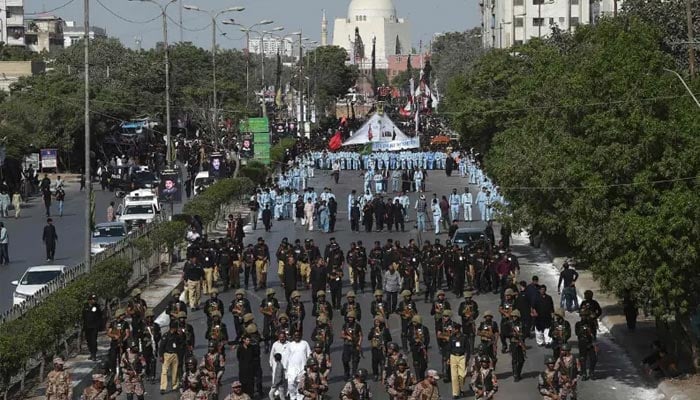
    KARACHI: The Karachi Traffic Police has announced a comprehensive traffic management plan ahead of the central Chehlum procession on Tuesday, urging commuters to use alternative routes as several major roads will remain closed during the religious event. According to the traffic arrangements, the main Chehlum procession will begin from Nishtar Park at 9:00am and proceed along its traditional route. M.A. Jinnah Road will remain closed to regular traffic for the duration of the procession to ensure the safety of participants and maintain security. Authorities have prepared a series of traffic diversions to minimize disruption across the city. Vehicles traveling from Saddar towards Tower will be redirected through Preedy Street and I.I. Chundrigar Road, while motorists approaching from Shahrah-e-Quaideen will be diverted via Kashmir Road and People’s Chowrangi. Traffic from Korangi, Landhi and the National Highway will be routed through Rashid Minhas Road and the Super Highway. Commuters coming from Nazimabad will be able to use Lasbela, Garden and Nishtar Road, while traffic from Liaquatabad will be diverted from Lasbela Chowk towards Nazimabad No. 10. Motorists traveling from Hassan Square and Shahrah-e-Faisal have also been advised to follow designated diversion routes through Society Light Signal, Teen Hatti and Sher Shah Suri Road. Drivers using Jamshed Road toward Guru Mandir have been asked to use Bahadur Yar Jang Road or Soldier Bazaar Road as alternate routes. Traffic police further announced that heavy vehicles will not be allowed to enter Karachi from 10:00am until the conclusion of the procession. Parking will also be prohibited along the procession route, and any vehicle found violating the restrictions will be removed immediately. Chehlum of Hazrat Imam Hussain (RA) and the martyrs of Karbala will be observed across the country on Tuesday with mourning processions and religious gatherings taking place under heightened security arrangements.

  • |

    Matching rings reignite Bradley Cooper, Gigi Hadid romance buzz

    Bradley Cooper and Gigi Hadid have once again ignited speculation about the status of their relationship after they were spotted holding hands in Paris while appearing to wear matching rings. The actor, 51, and the 31-year-old supermodel were seen returning to their hotel after a workout on Monday, looking relaxed in coordinated athletic outfits. Carrying reusable water bottles and dressed in casual sportswear, the couple kept a low profile as they walked through the French capital. However, it was the rings on their fingers that quickly became the focus of attention, prompting fresh engagement rumors among fans. The sighting marked another public appearance for the pair, who have been romantically linked since October 2023. Although they have chosen to keep much of their relationship private, the two have occasionally been seen together at high-profile events and during casual outings. Observers noted that Cooper had been photographed leaving a gym by himself just two days earlier without wearing a ring, making the latest appearance even more noticeable. While neither Cooper nor Hadid has addressed the speculation, the matching jewelry has fueled widespread discussion across social media. Despite growing public interest, the couple have remained relatively reserved about their romance. Hadid made their relationship Instagram official during celebrations for her 30th birthday when she included a photo featuring Cooper in a series of images shared with fans. The post offered a rare glimpse into their personal life together without revealing many details. Earlier, in her April 2025 Vogue cover interview, Hadid spoke candidly about relationships and finding the right partner. She emphasized the importance of understanding what a person wants and deserves before entering a committed relationship. She explained that it is meaningful when two people reach a stage in life where they both know what they are looking for and are willing to continue working on themselves while supporting each other. According to Hadid, building a healthy relationship requires individual growth as well as mutual effort to become the best possible partners. Although the pair have yet to make an official red carpet debut as a couple, they have attended several major events together. Among their most notable appearances was the 2026 Met Gala, where they were both present, adding to public curiosity about their relationship. More recently, Cooper and Hadid were reportedly seen together in July while attending the wedding celebration of Taylor Swift and Travis Kelce at Madison Square Garden, further demonstrating that they continue to spend time together despite maintaining a relatively private romance. Before dating Cooper, Hadid was in a long-term relationship with singer Zayn Malik. The former couple share a five-year-old daughter, Khai, and continue to co-parent. Cooper, meanwhile, shares nine-year-old daughter Lea with his former partner, Irina Shayk. While neither Cooper nor Hadid has commented on the latest wave of engagement speculation, their matching rings and affectionate appearance in Paris have once again placed their relationship firmly in the spotlight, leaving fans eager to see whether wedding bells could be on the horizon.

  • |

    Escalating clashes in northern Ethiopia spark mass displacement across Sudanese border

    Hundreds of displaced Ethiopian citizens from the Tigray region have fled into neighboring Sudan following intense military engagements between regional forces and the Ethiopian national army, raising international concerns over a potential resurgence of full-scale civil war. The recent outbreak of violence centered around Shererina, a strategically sensitive locality near the border with Sudan, marking the most severe military confrontation in the region since the conclusion of the 2020–2022 conflict. Eyewitnesses and regional representatives reported sustained exchanges involving heavy artillery shelling and aerial drone strikes across the weekend. The renewed hostilites follow growing instability surrounding the incomplete execution of the 2022 African Union-mediated peace agreement, alongside the Tigray People’s Liberation Front (TPLF) regaining control over regional administrative institutions. Regional analysts have also expressed concern that the border area could become entangled in the wider Sudanese conflict through external proxy alignments. Both sides have traded blame for initiating the offensive. Officials representing the Tigray regional administration accused federal forces of launching an unprovoked military assault aimed at suppressing the region. Conversely, federal minister Abraham Belay accused TPLF leadership of instigating the skirmishes, warning of severe repercussions while urging both parties to seek a negotiated diplomatic resolution to prevent further devastation. While formal casualty figures remain unconfirmed, Sudanese medical teams and local authorities verified that civilians alongside wounded combatants continue to seek asylum across the border.

  • |

    Sudanese army drone strike on traditional court in North Darfur leaves dozens dead

    A drone attack launched by the Sudanese armed forces killed at least 35 people and left dozens of others injured after striking a traditional court session in the village of Ghara al-Zawiya, located in North Darfur. The civil monitoring group Emergency Lawyers reported that multiple missiles hit a customary gathering held under a tree where local elders, community leaders, and residents had assembled to resolve regional disputes. Eyewitness accounts confirmed that the victims included four tribal leaders alongside two commanders from the Rapid Support Forces, which currently holds administrative control over much of the Darfur region. Human rights observers and legal advocacy groups strongly condemned the attack, characterising the targeting of civilian infrastructure and traditional judicial venues as a violation of international humanitarian law. The incident underscores the growing deployment of uncrewed aerial systems across Sudan’s ongoing civil conflict, which has displaced millions and caused severe humanitarian degradation nationwide.

  • |

    Trial commences for Malaysian teenager accused of fatal school stabbing

    A 14-year-old boy has gone on trial in Malaysia for the alleged murder of his 16-year-old schoolmate, Yap Shing Xuen, whose body was discovered with multiple knife wounds in a secondary school toilet near Kuala Lumpur. The accused, who pleaded not guilty, faces up to 40 years in prison and potential caning if convicted, though capital punishment is barred due to his status as a minor under Malaysian law. Police confirmed the recovery of a written note at the scene and cited potential online influence, sparking nationwide debate concerning the impact of social media algorithms, incel subcultures, and youth exposure to radicalising content. In response to growing public concern surrounding youth safety, Malaysian authorities have instituted a policy prohibiting children under 16 from maintaining accounts on major social media platforms.

  • |

    President Zelenskiy reassigns Rustem Umerov to head foreign intelligence in ongoing administration reshuffle

    Ukrainian President Volodymyr Zelenskiy has appointed Rustem Umerov, former Defence Minister and head of the National Security and Defence Council, as the country’s new chief of foreign intelligence. Despite taking on the intelligence portfolio, Umerov will retain his role leading Ukraine’s peace delegation in negotiations aimed at ending the conflict with Russia. The personnel shift is part of a broader cabinet restructuring initiated in July that saw former Interior Minister Ihor Klymenko named to head the Security Council, while former Defence Minister Mykhailo Fedorov and top military commander Oleksandr Syrskiy were relieved of their positions. The decision to remove Fedorov, an advocate for digital and drone warfare, sparked public criticism and street demonstrations calling for his reinstatement. While critics argue the reshuffle repeatedly shifts a small circle of close political allies between senior posts, government officials maintain the structural changes are designed to optimize national defense preparations ahead of anticipated winter strikes on energy infrastructure.

  • |

    Acting US Attorney General rescinds $1.8 billion initiative to clear path for Senate confirmation

    Acting US Attorney General Todd Blanche has issued an official order rescinding the controversial $1.8 billion “Anti-Weaponisation Fund”, resolving a key point of friction ahead of his confirmation vote before the Senate Judiciary Committee. The action follows extended negotiations with Republican Senators John Cornyn and Thom Tillis, who had withheld support for the nomination pending written assurances that the initiative would be permanently discarded. Although Blanche previously indicated in Congressional testimony that the department would not move forward with the program, lawmakers sought a formal rescission to prevent its potential revival. The directive also clarifies terms surrounding a related legal settlement, stipulating that provisions concerning tax audit protections apply exclusively on a retroactive basis to open claims active at the time of the agreement and do not extend to future tax filings.

  • |

    Right-wing party proposes armed forces intervention to halt Channel crossings

    Reform UK has proposed an extensive military-led framework aimed at completely stopping small boat migration across the English Channel. The policy proposal outlines leveraging combined military and intelligence tracking technology to create a heavily monitored sea border, alongside granting emergency powers to armed forces to intercept vessels and push them back toward French territory. The plan includes expanding detention facilities to enable immediate offshore or domestic processing and deportation without eligibility for standard asylum routes. To facilitate these changes, the party stated it would pursue major legal shifts, including withdrawing the United Kingdom from the European Convention on Human Rights and replacing current national human rights legislation with a new domestic framework. Critics and legal scholars have questioned the feasibility of the measures, pointing out potential conflicts with international maritime agreements and international law. Meanwhile, Prime Minister Andy Burnham stated his administration would maintain a relentless focus on tackling immigration networks through increased enforcement and cross-border security cooperation.

  • |

    Canadian carrier resolves cabin crew strike through provisional labor agreement

    The industrial action carried out by WestJet flight attendants concluded following overnight negotiations that yielded a provisional contract between the Canadian airline and the Canadian Union of Public Employees Local 8125. The resolution arrived early Monday morning after a brief strike that disrupted travel plans nationwide over the weekend. Union leadership confirmed that the consensus marks progress regarding operational credit structures, ensuring better recognition and wage distribution for duties performed on the ground prior to takeoff, including passenger boarding and delay management. Management at the carrier expressed satisfaction with the outcome, highlighting the dedication of the workforce. Unofficial terms indicate the proposal includes an immediate pay raise retroactive to the start of the year, alongside adjusted duty allocations. While flight operations are slated to rebuild gradually pending safety verifications and roster adjustments, the negotiated terms remain subject to formal ratification by the union membership.

  • |

    US issuing final opportunity for nuclear agreement with Tehran before extreme military action

    US President Donald Trump has issued a final ultimatum to Iran, stating that Tehran has one last opportunity to negotiate a diplomatic resolution with Washington before facing severe military force, which he referred to as decapitation. Speaking from the Oval Office, the American leader confirmed he had paused planned air strikes following direct requests from Persian Gulf nations, including Saudi Arabia, Qatar, and the United Arab Emirates, who urged Washington to allow diplomacy one final window. The framework for the proposed negotiations relies on a two-stage approach, with the initial phase requiring the immediate and unconditional reopening of the Strait of Hormuz to international shipping. The subsequent phase will address the complete denuclearisation of Iran, referencing commitments previously outlined in a joint memorandum signed in June. Trump further dismissed any personal domestic political considerations regarding the timeline, emphasising that his decision to delay military action was driven by a desire to prevent widespread loss of life while pursuing a durable diplomatic outcome.