pildat report highlights

PILDAT report highlights stronger Senate lawmaking

ISLAMABAD: The Pakistan Institute of Legislative Development and Transparency (PILDAT) has reported a significant increase in legislative activity in the Senate during the 2025–26 parliamentary year, while warning that persistent institutional weaknesses continue to undermine the effectiveness of the upper house.

According to PILDAT’s annual review of Senate performance, the House passed a total of 97 bills during the year, comprising 47 government bills and 50 private members’ bills. This represents a substantial increase from the 51 bills enacted during the previous parliamentary year. The report notes a marked revival in private members legislation alongside increased government-sponsored lawmaking.

The Senate also reduced its reliance on presidential ordinances. Only six ordinances were laid before the House during the year, compared with 16 in the previous session, reflecting greater emphasis on parliamentary legislation.

Although the Senate held 64 sittings, one fewer than the previous year’s 65, the total duration of proceedings increased considerably. Senators met for approximately 159 hours, compared with 117 hours in 2024–25, indicating longer debates and heightened legislative activity.

Despite this improvement, the report highlights declining attendance among lawmakers. Average attendance fell to 57.6 per cent, down from 62 per cent a year earlier. While disruptions caused by quorum shortages became less frequent, members’ participation remained inconsistent throughout the parliamentary year.

PILDAT also raised concerns over the performance of parliamentary leadership. The Leader of the House recorded an attendance rate of only 31 per cent, while the office of the Leader of the Opposition remained vacant for five months and 15 days following the removal of Senator Shibli Faraz on 5 August 2025. Senator Raja Nasir Abbas assumed the role on 20 January 2026.

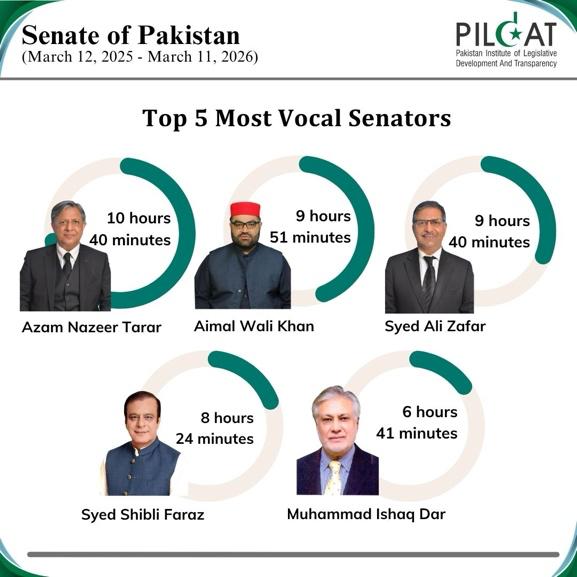
Among individual lawmakers, Senator Azam Nazeer Tarar, Federal Minister for Law, Justice and Human Rights, was the most active participant in debates, speaking for 10 hours and 40 minutes during Senate proceedings. He was followed by Senator Aimal Wali Khan, who spoke for 9 hours and 51 minutes, and Senator Syed Ali Zafar, who contributed 9 hours and 40 minutes. Former opposition leader Senator Shibli Faraz spoke for 8 hours and 24 minutes, while Leader of the House Muhammad Ishaq Dar recorded 6 hours and 41 minutes of speaking time.

One of the defining developments of the parliamentary year was the passage of the 27th Constitutional Amendment, which introduced significant changes to the judicial structure, the constitutional interpretation mechanism and matters relating to military command. PILDAT expressed concern that the amendment was passed with exceptional haste, limiting opportunities for detailed parliamentary scrutiny and debate.

The report also identifies a major institutional gap arising from the prolonged absence of representation from Khyber Pakhtunkhwa. Eleven Senate seats from the province remained vacant for nearly 23 months, from February 2024 to January 2026, because of delays in elections and legal disputes. According to PILDAT, this adversely affected the Senate’s federal character and representative composition.

Further institutional strain emerged after opposition members resigned from Senate standing committees, weakening parliamentary oversight and reducing opportunities for bipartisan cooperation.

On matters of national security, however, the Senate demonstrated political unity. During the Pakistan–India crisis in May 2025, the House unanimously adopted a resolution reflecting cross-party consensus on issues of national importance.

The report also notes a substantial increase in the Senate’s financial allocation. The institution’s budget rose from Rs7.242 billion in 2024–25 to Rs9.055 billion in 2025–26, representing an increase of approximately 25 per cent. Consequently, expenditure per senator also increased, reaching Rs90.55 million.

While acknowledging the Senate’s stronger legislative output and reduced dependence on ordinances, PILDAT concludes that improvements in member attendance, parliamentary oversight, institutional continuity and legislative scrutiny remain essential to strengthening the effectiveness of Pakistan’s upper house.
Similar Posts

  • | |

    Punjab University staff demand forensic audit, war…

    Lahore: A joint platform representing teachers, officers, employees, and other stakeholders at the University of the Punjab has accused the university administration of driving the country’s oldest and largest public university into a deep financial, administrative, academic, and research crisis, while warning of a protest movement if their demands remain unaddressed within two weeks. Addressing a press conference in Lahore, the Joint Action Committee (JAC) said its purpose was not to target individuals but to present what it described as documented concerns regarding the university’s governance, financial management, academic standards, and research environment. The committee appealed to the Chancellor of the University, the Governor of Punjab, and the provincial government to intervene immediately to safeguard the institution.   The committee alleged that reserve funds worth approximately Rs4.88 billion, accumulated over many years, had been utilized within just 14 months without approval from the Finance and Planning Committee. It claimed that the university’s 2025–26 budget reflected a deficit of Rs2.57 billion and argued that, when combined with the depletion of reserves, the institution was effectively facing a financial shortfall of nearly Rs8 billion. It also questioned expenditures allegedly made beyond approved budget limits and called for greater transparency in financial decision-making. JAC further claimed that around Rs786 million belonging to various academic departments and institutes had been transferred to a central account under the One-Account Policy and later utilized, raising questions about whether the expenditures had received approval from the relevant statutory bodies. It also expressed concern over what it described as the first-ever financial deficit of nearly Rs350 million in the university’s self-supporting programmes. The committee also pointed to an apparent discrepancy in financial reporting, claiming that while the Finance and Planning Committee was informed of a Rs2.57 billion budget deficit at the end of the financial year, a subsequent Syndicate meeting was told the deficit stood at Rs1.6 billion. According to the committee, the variation requires a transparent explanation. Expressing concern over campus security, the committee referred to the killing of a student and the son of a university employee near the Vice Chancellor’s residence despite the presence of armed security personnel, arguing that the incident had raised serious questions about the effectiveness of the university’s security arrangements. On governance, the committee alleged that key statutory bodies, including the Senate, Deans’ Committee, Chairpersons’ Committee, Syndicate, and Selection Boards, had met only infrequently during the current administration, resulting in delays in appointments, promotions, and major policy decisions. It further criticized what it described as an excessive concentration of administrative authority in the office of the Director General (Students, Estate and Security), saying such an arrangement was inconsistent with principles of transparency, institutional balance, and accountability. The committee also referred to pending complaints and inquiries involving the office-holder, questioning the wisdom of assigning additional responsibilities while such matters remain unresolved. Highlighting academic concerns, JAC said the university had slipped from 542nd to 588th position in the QS World University Rankings and had also experienced a decline in the Higher Education Commission’s Office of Research, Innovation and Commercialization (ORIC) rankings. It alleged that faculty members were facing an atmosphere of insecurity and harassment, while research grants, travel support, and publication funding had effectively come to a halt. The committee claimed that although research grants of up to Rs1 million had been announced, no faculty member had yet received financial assistance under the initiative. It further alleged that several researchers had been forced to abandon nationally and internationally funded projects because of inadequate institutional support, damaging both research output and the university’s reputation with funding agencies. According to the committee, hostel accommodation remains unavailable for many students, including research scholars, while an increasing number of inquiry committees against faculty members and officers has created an atmosphere of fear and professional uncertainty. It also expressed concern over delays in permanent appointments to several senior administrative positions, saying the lack of regular appointments had weakened institutional efficiency. The Joint Action Committee demanded an independent forensic audit of the university’s financial affairs, including the use of reserve funds, deficit budgets, the One-Account Policy, and the finances of self-supporting programmes. It also called for the immediate removal of the Director General (Students, Estate and Security) under the principle of “one person, one post,” an end to what it described as retaliatory inquiries, restoration of a secure and professional working environment, immediate advertisement and transparent appointment of a permanent Registrar, payment of outstanding financial dues and benefits to teachers and employees, and the restoration of regular meetings of all statutory bodies in accordance with the University Act. The committee warned that if its demands are not addressed within two weeks, it will launch a phased protest campaign, including demonstrations outside the university, a sit-in outside the Punjab Assembly, publication of a white paper containing documentary evidence, and a boycott of classes that could ultimately disrupt academic activities at the historic institution. The university administration had not issued an official response to the allegations at the time this report was filed.

  • | |

    Pakistani journalist Murtaza Ali Shah assaulted du…

    Pakistani journalist Murtaza Ali Shah was assaulted and injured while covering a protest march in central London. According to reports, Shah was attacked while reporting on a march organised by supporters of the banned Joint Awami Action Committee (JAAC), which began at Hyde Park and proceeded towards the Pakistan High Commission. A large number of British Kashmiris gathered at Hyde Park before the march to express concern over the deteriorating situation in Azad Kashmir. Protesters called for an end to violence, the restoration of fundamental rights, and the resumption of dialogue. Eyewitnesses and videos showed that Shah came under attack as the march approached the Pakistan High Commission. While reporting from the scene, he was allegedly kicked and punched from both the front and behind by at least three individuals. A crowd quickly surrounded the journalist, escalating tensions until Metropolitan Police officers, protest organisers, and other participants intervened to prevent the situation from worsening. Police later escorted Shah away from the crowd and ensured his safety. According to reports, when Shah returned to the Pakistan High Commission to continue his reporting, members of the same group allegedly attempted to harass him again.

  • | |

    Sindh announces MDCAT 2026 exam date

    The Medical and Dental College Admission Test (MDCAT) 2026 in Sindh will be held on Sunday, August 16, under the supervision of Sukkur IBA Testing Services (SIBA Testing Services). According to SIBA Testing Services, examination centres have been established in Karachi, Hyderabad, Jamshoro, Larkana, Sukkur, Mirpurkhas, Shaheed Benazirabad and Islamabad to facilitate candidates. In Karachi, the test will be conducted at NED University of Engineering and Technology, while candidates in Hyderabad will appear at Public School Latifabad. The examination will also take place at Liaquat University of Medical and Health Sciences in Jamshoro, Mir Sher Muhammad Talpur Public School in Mirpurkhas, Police Training School Ground on Wagon Road in Larkana, Quaid-e-Awam University of Engineering, Science and Technology in Shaheed Benazirabad, and IBA Public School on Old Airport Road in Sukkur. Candidates from Sindh who have relocated to Islamabad will take the test at the Pakistan National Council of the Arts (PNCA) test centre. SIBA Testing Services said the examination will last three hours. Candidates have been instructed to arrive at their designated centres on time, and no one will be allowed to leave the examination hall before the test concludes. The testing authority added that separate waiting areas will be arranged for parents at all examination centres. Essential stationery and drinking water will also be provided to candidates inside the examination halls.

  • | |

    PML-N targets 2/3 majority in AJK as final electio…

    MUZAFFARABAD: With the final phase of the Azad Jammu and Kashmir (AJK) general elections just days away, the Pakistan Muslim League-Nawaz (PML-N) has stepped up its campaign in Rawalakot Division, expressing confidence that it can secure a two-thirds majority in the 45-member Legislative Assembly. The party held a major election rally in Haveli on Friday as campaigning intensified ahead of the August 10 polling in Bagh and Haveli. The final phase will conclude the three-stage electoral process and determine the composition of the next AJK government. Addressing supporters, Prime Minister’s Adviser on Political Affairs Rana Sanaullah claimed that the results of the first two phases reflected strong public support for the PML-N. He said the party expected voters in Haveli and the three constituencies of Bagh to further strengthen its position and help it achieve the numbers required for a two-thirds majority. Sanaullah pledged that a PML-N-led government would implement its election promises and accelerate development projects in collaboration with the federal government. Referring to commitments made by Punjab Chief Minister Maryam Nawaz during the campaign, he said development initiatives similar to those undertaken in Punjab would be introduced in AJK. He also said PML-N President Nawaz Sharif would personally monitor major development projects in the region. Rejecting opposition allegations of electoral manipulation, Sanaullah described the first two phases as peaceful and transparent, dismissing claims of rigging as unfounded. Federal Minister for Kashmir Affairs and Gilgit-Baltistan Amir Muqam also addressed the rally, assuring voters that a future PML-N government would focus on public welfare, infrastructure and improved services. He said road connectivity and other development projects in areas close to the Line of Control would be given special priority, with the government seeking to improve infrastructure and public facilities across the region. The August 10 vote in Bagh and Haveli is expected to play a crucial role in determining whether the PML-N can translate its campaign momentum into a two-thirds majority and take the lead in forming the next AJK government.

  • | |

    NCCIA cracks down on cybercrime, arrests 4 suspect…

    LAHORE: The National Cyber Crime Investigation Agency (NCCIA) Punjab has intensified its campaign against cybercrime, arresting four suspects in coordinated operations carried out in Lahore, Faisalabad and Multan. The arrests are linked to alleged cases of online harassment, blackmail and the misuse of social media platforms. According to the agency, legal proceedings have been initiated on the basis of digital evidence collected during the investigations. Authorities have also seized mobile phones and other electronic devices from the suspects, all of which have been sent for forensic examination to support the ongoing inquiries. In Lahore, officials arrested Haroon Qureshi, who is accused of repeatedly targeting women through various social media platforms by allegedly harassing, threatening and intimidating them. Investigators are examining the digital material recovered from his devices to determine the full extent of the alleged offences. In a separate operation in Faisalabad, NCCIA apprehended Abdul Rehman and Muhammad Ayaz. Preliminary investigations suggest the pair allegedly blackmailed a married couple using objectionable digital content and are accused of extorting money from them. During the raid, investigators recovered two mobile phones, WhatsApp accounts and alleged objectionable digital material related to several women. The seized evidence has been forwarded for forensic analysis to identify additional victims and any wider criminal network. Meanwhile, in Multan, authorities arrested Farhad Abbas on allegations of sharing a woman’s private photographs and videos on social media and using them to blackmail her. Investigators are reviewing the suspect’s digital records to identify possible accomplices and determine whether more victims may be involved. The NCCIA said forensic examination of the recovered digital evidence is continuing in all cases and investigations are being conducted in accordance with legal procedures. The agency also urged the public, particularly women, to report incidents of online harassment, blackmail, fake social media accounts or any other form of cybercrime without delay so that prompt legal action can be taken against those responsible.

  • |

    Thai Police Busts Chinese Network in Credit Card Skimming Scheme Causing Over 29 Million Baht in Damages

    BANGKOK – Thailand’s Central Investigation Bureau (CIB) has dismantled a transnational Chinese network involved in credit card data theft, arresting four suspects and seizing equipment linked to losses exceeding 29 million baht affecting more than 1,200 Chinese victims. The network operated by opening fruit stalls in areas including Chonburi and telling Chinese visitors that they […]

Leave a Reply

Your email address will not be published. Required fields are marked *