dual catalyst changing
|

The dual catalyst of changing climate and human

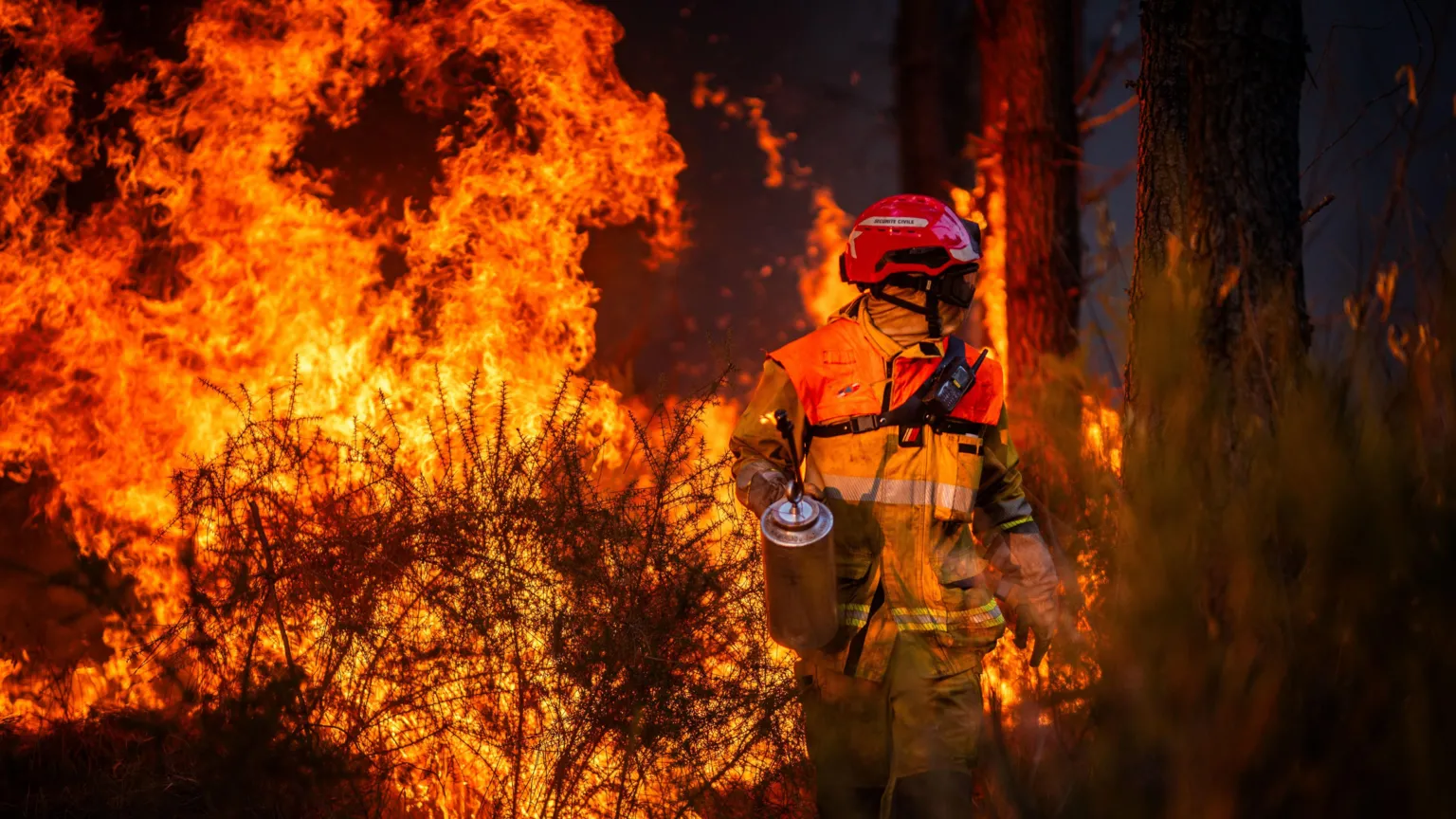
France is confronting unprecedented environmental devastation as wildfires swept across the nation’s forests and countryside. The fire burned over 300,000 acres. A level of destruction not witnessed in the country since the aftermath of the Second World War. The communities assess ruined homes, scorched ecosystems and degraded air quality.

The French public and authorities are left with an urgent question: what is driving these catastrophic blazes?

A Perfect Storm of Climate Conditions

At the root of the crisis is a changing global climate driven by greenhouse gas emissions. Rising regional temperatures, combined with prolonged dry spells, have transformed expansive tracts of woodland into dry tinderbox environments. In these prolonged heatwaves, humidity drops sharply, rendering vegetation prone to rapid ignition. Under such extreme drought, even a minor spark can ignite an uncontrollable inferno within minutes.

Environmental scientists emphasize that while climate conditions establish the background vulnerability, they do not act alone. Heat and drought create the ideal environment for fires to spread, but the vast majority require an initial ignition source.

The Human Factor: Negligence, Accidents and Arson

Official records in France reveal a shocking pattern. Approximately nine out of every ten wildfires originate from human activity.  Public concern often focuses on intentional acts of arson. However, investigators note that deliberate fire-setting accounts for only a fraction of total blazes. The overwhelming majority stem from everyday human negligence or accidents.

Common accidental triggers include:

Discarded Cigarettes: Unextinguished butts tossed from vehicles or thrown onto dry brush. Fire investigators refer to the rule of 30 conditions where ambient temperatures exceed 30°C (86°F), humidity drops below 30%, wind speeds stay below 30 km/h. A remaining cigarette segment retains at least 30% of its length. Under severe drought, these thresholds lower drastically, making ignition almost immediate.

Infrastructure and Equipment: Sparks generated by heavy machinery, ongoing construction projects, or faulty electrical equipment operating near dry grass.

Recreational Fires: Unattended outdoor barbecues and small campfires in or around forested boundaries.

In response to the scale of destruction, the French Interior Ministry has taken aggressive legal action, detaining over 400 individuals suspected of initiating blazes either through reckless behavior or intentional acts. Among those apprehended are scores of minors, as well as individuals facing immediate judicial sentencing for setting fires in protected woodland zones.

Mental health professionals and legal experts point out that intentional fire-starters typically fall into distinct categories, including careless individuals, opportunistic actors seeking financial gain (such as insurance payouts), pyromaniacs, or individuals seeking recognition during emergency responses.

Looking Ahead: Reconstruction and Forest Adaptation

The unprecedented severity of the blazes has sparked intense public debate over state readiness and resource allocation. Critics question whether preventive measures and response mechanisms were adequate for a summer marked by continuous heatwaves.

Addressing the national crisis, French President Emmanuel Macron emphasized the necessity of adapting national forestry policy to match evolving climate realities. Rebuilding efforts will require replanting woodlands with more fire-resistant tree species rather than simply restoring vulnerable pine monocultures. As emergency crews continue to monitor remaining hotspots and brace for subsequent heatwaves, France faces a long-term strategy shift: balancing immediate enforcement against negligence with broad ecological adaptation.
Similar Posts

  • | |

    Parliament approves sweeping defence command chang…

    Pakistan’s Parliament has approved legislation aimed at establishing a new legal framework for the country’s military command structure. The National Assembly and Senate passed the Defence Forces Act 2026 and amendments to the National Command Authority Act 2010 on Thursday. The legislation was approved despite strong opposition from opposition lawmakers, who objected to the speed at which the bills were brought before the Houses. Prime Minister Shehbaz Sharif attended the National Assembly session. The opposition later boycotted the voting process and walked out of the chamber in protest. The new Defence Forces Act provides a legal structure for the Defence Forces Headquarters. The headquarters will serve as a central institution for matters concerning national security, defence policy and coordination among the armed forces. Under the new framework, the Chief of Defence Forces will exercise operational command and control over the armed forces. The CDF will remain accountable to the federal government for matters related to command and control. The legislation also gives the CDF powers to improve coordination and integration among the Army, Navy and Air Force. The office will oversee joint operations, coordination and other matters involving the armed forces. The CDF will also have authority under relevant laws regarding the retirement, release and dismissal of military personnel, subject to constitutional provisions. The office will also be able to approve or reject resignations and retain personnel in service where permitted under the law. The federal government will frame rules and regulations needed to implement the new legislation. The CDF will also be authorised to issue orders and directions required to enforce the provisions of the Act. Parliament also approved amendments to the National Command Authority Act 2010. The changes replace references to the Chairman Joint Chiefs of Staff Committee with references to the Chief of Army Staff and Chief of Defence Forces. The legislation gives retrospective effect to key provisions from November 2025. The new laws are linked to changes introduced through the 27th Constitutional Amendment, which significantly altered Pakistan’s military command structure. Under the revised system, the Chief of Army Staff also serves as the Chief of Defence Forces. The office of Chairman Joint Chiefs of Staff Committee has been abolished under the new framework. The opposition strongly objected to the legislation being placed on the supplementary agenda. Opposition lawmakers said they had not been given sufficient time to examine the bills. Opposition Leader Allama Raja Nasir Abbas questioned the urgency of the legislation and called for more time for lawmakers to study the proposed changes. Mahmood Khan Achakzai also demanded that lawmakers be given at least a few days to review and debate the bills before voting. The government defended the procedure, saying parliamentary rules allow supplementary legislation to be introduced. Law Minister Azam Nazeer Tarar argued that the bills had already been examined and approved by the National Assembly. The cabinet had approved the draft legislation earlier in the day during a meeting chaired by Prime Minister Shehbaz Sharif in Islamabad. According to the government, the Defence Forces Act was necessary to provide administrative and legal arrangements for the office of the Chief of Defence Forces and its headquarters. The new framework also establishes the position of Commander of the National Strategic Command following the abolition of the CJCSC post. The commander is appointed by the prime minister on the recommendation of the army chief and CDF. The position carries a three-year term, with the possibility of another three-year term under the prescribed procedure.

  • | |

    Punjab orders crackdown on professional begging ma…

    LAHORE: The Punjab government has ordered a province-wide crackdown against organized professional begging networks, with Lahore set to become the first “Beggar-Free City” under a coordinated enforcement campaign. The decision came during a meeting chaired by Punjab Home Secretary Dr Ahmed Javed Qazi at the Home Department. Authorities directed relevant departments to develop a joint strategy to identify professional beggars, expose the networks operating behind them, and take action against those who force vulnerable people into begging. The Punjab Safe Cities Authority and traffic police have received special assignments to help identify and dismantle the begging mafia’s network. Officials will use modern technology, surveillance tools and human intelligence to locate key hotspots and track repeat offenders. Dr Qazi stressed that authorities must take strict action against handlers who exploit children, women and elderly people for begging. He said the government had introduced legal amendments to increase penalties and fines and discourage organized begging networks. Under the amended Punjab Vagrancy Ordinance 1958, forcing someone to beg constitutes a non-bailable offence. The home secretary directed authorities to ensure strong prosecution of arrested members of the begging mafia so that cases result in effective convictions. The meeting also called for the creation of a centralized database of professional beggars who face repeated arrests. Officials will also maintain updated records of needy and destitute people who seek assistance at welfare homes. Dr Qazi instructed authorities to identify begging hotspots across Lahore and conduct targeted operations at these locations. He further emphasized the need for close coordination among all relevant departments to eliminate organized begging networks. The government also plans to strengthen welfare homes and turn them into support centers for vulnerable members of society. Officials will improve arrangements for food, healthcare and accommodation while providing education to children staying at these facilities. The welfare homes will also offer vocational training to help deserving individuals develop skills and achieve financial independence instead of relying on begging. Dr Qazi urged civil society organizations to play an active role in supporting vulnerable communities. The home secretary appealed to citizens to report professional begging networks to police at 15. He assured the public that the authorities would keep the identities of informants confidential. The meeting was attended by Social Welfare Secretary Saira Umar, Special Secretary Home Zainab Khan, Director General Social Welfare Dr Shahenshah Faisal, Director General Probation and Parole Shahid Iqbal, Additional Secretary Prisons Roman Burana, Additional Secretary Judicial Abdul Rauf, Lahore Chief Traffic Officer Syed Abdul Rahim Shirazi, AIG Sarfraz Warak, Deputy Prosecutor General Dr Usman Iqbal, Civil Defence Director Tasneem Ali Khan, along with officials from the Punjab Safe Cities Authority, FIA, School Education Department and Health Department.

  • | | | | |

    Trump claims Iran war could end soon, Hormuz to re…

    WASHINGTON: US President Donald Trump has claimed that the war with Iran could come to an end soon, while negotiations are reportedly continuing over the future of the conflict and the reopening of the strategically vital Strait of Hormuz. Trump said the United States, Iran and Oman were close to reaching a temporary agreement aimed at reopening the key maritime passage. His remarks offered a potentially hopeful signal after weeks of heightened tensions and disruption in the region. The US president also dismissed reports that the conflict had significantly depleted American weapons stocks, insisting there was no truth to such claims. Trump further rejected reports of disagreements or growing tensions with US Defence Secretary Pete Hegseth, playing down speculation about friction within his administration over the handling of the war. However, the picture on the diplomatic front remains uncertain. Arab media reports have claimed that efforts to broker a ceasefire between the United States, Israel and Iran have stalled, highlighting the difficulties surrounding a possible breakthrough. At the same time, Iranian authorities have reportedly tightened internal security measures across the country, particularly in Tehran, as uncertainty over the conflict continues. The Strait of Hormuz remains central to the crisis because of its importance to global energy supplies and international shipping. Any agreement that restores normal traffic through the waterway could ease pressure on regional markets and provide a significant boost to wider diplomatic efforts. For now, Trump’s prediction of a quick end to the war contrasts with reports suggesting that major obstacles still remain before a lasting ceasefire can be secured.

  • | | | |

    Petrol pump strike deferred after govt deal

    The planned nationwide strike by petrol pump owners and petroleum dealers has been postponed after successful negotiations with the federal government. The decision came following fresh talks between government officials and representatives of petroleum dealers, ending a deadlock that had raised concerns over possible fuel supply disruptions across the country. During the meeting, the government assured petroleum dealers that their concerns would continue to be addressed through dialogue. However, officials made it clear that the federal government has no plans to increase dealers’ profit margins to 8%, rejecting one of the key demands raised by the dealers. Officials said the proposed system of daily fuel price adjustments is intended to bring greater transparency and efficiency to Pakistan’s petroleum supply chain. They maintained that the new pricing mechanism would improve market operations and ensure a more transparent process for consumers and industry stakeholders. The negotiations were attended by Chairman of the Pakistan Petrol Pump Owners Association Humayun Khan, Vice Chairman Atif Butt and other representatives of petroleum dealers. After detailed discussions, both sides agreed to continue consultations instead of moving ahead with the planned strike. Following the successful talks, the Pakistan Petrol Pump Owners Association and the Dealers Association officially announced the postponement of their nationwide protest. The decision removed the immediate threat of fuel shortages that could have affected transport, businesses and the general public. Petroleum Minister Ali Pervaiz Malik thanked petrol pump owners and dealers for choosing dialogue over confrontation. He said the government values the role of petroleum sector stakeholders and remains committed to resolving outstanding issues through mutual consultation. The minister said Pakistan has been facing difficult regional circumstances in recent months, creating economic challenges and uncertainty. He added that the prime minister is fully aware of the hardships being faced by citizens and is committed to protecting the public from additional financial burdens. Ali Pervaiz Malik said the government has already provided subsidies worth hundreds of billions of rupees to support consumers. He added that a targeted subsidy mechanism has been developed to ensure assistance reaches those who need it most. He also acknowledged the cooperation extended by oil refineries and petroleum sector organizations in maintaining fuel supplies. The minister said the issue of dealers’ profit margins will be discussed further with all stakeholders. A summary on the proposed margin revision will be presented before the federal cabinet for consideration. He also announced that the impact of the daily fuel pricing system will be reviewed jointly with petroleum organizations after two weeks to assess its effectiveness and address any concerns.

  • |

    Galle Gallants go top with 60-run win over Jaffna …

    Sahan Arachchige’s fifty, backed by a resounding bowling effort, powered Galle Gallants to a 60-run victory over Jaffna Kings in the 10th fixture of the Lanka Premier League 2026 at the Rangiri Dambulla International Stadium on Thursday. Set a daunting 194, Kings were bowled out for 133 in 17.5 overs. Tharindu Ratnayake tore through Jaffna Kings’ batting lineup, leaving them at 50-5 at the end of the powerplay. Kamil Mishara scored 15 while Avishka Fernando managed only six. Seasoned batter Shakib Al Hasan was castled without scoring, while Ibrahim Zadran made 11 before holding out to deep square leg. David Wiese and Dunith Wellalage tried to arrest the slide with a 39-run stand, but Wiese departed after scoring 27 from 20 balls. Kings slipped from 89-6 to 99-8 in 12.3 overs. Wellalage resisted with a half-century and eventually emerged as the top scorer with 56 off 39 balls, hitting four fours and sixes. For Gallants, Eshan Malinga and Tharindu Ratnayake remained impressive with the ball, both picking up three wickets. Earlier, Arachchige’s gutsy half-century and Mohammad Nawaz’s cameo propelled Galle Gallants to a strong total. Asked to bat first, Gallants racked up 193-8 in 20 overs despite a jittery start. They slipped to 16-2 and then 86-5 at the halfway mark. Chris Lynn remained the bright spot in the top order, scoring 46 off 22 balls, including four sixes and three fours. With the side in dire trouble at 110-6 in 14.1 overs, Nawaz and Arachchige added 68 off just 30 balls to put Gallants into a strong position. Arachchige hit 63 from 36 balls, including three sixes and four fours, while Nawaz contributed 27 from 16 deliveries, with the aid of two sixes and two fours. Lizaad Williams and Dilshan Madushanka shared four wickets between them. Earlier in the day, Colombo Kaps secured a 23-run win over Kandy Royals in the ninth match played at the same venue. Set 193, Kandy Royals fell short and could only manage 169-8 in 20 overs. Skipper Angelo Mathews top-scored with 53 off 39 balls, but his efforts were not enough to overcome Kaps’ total. The results have shaken up the LPL standings, with Galle Gallants moving to the top of the table. The tournament continues to provide thrilling cricketing action, with teams battling for supremacy in the competitive league. Fans are eagerly anticipating the upcoming fixtures as the race for the playoffs intensifies. The win for Galle Gallants highlights their strong form and depth in both batting and bowling, making them a formidable side in the competition. As the LPL progresses, the performances of players like Arachchige and Ratnayake will be crucial for their team’s success. The league has showcased the talent of Sri Lankan and international players, contributing to the growth of cricket in the region.

  • | |

    JPMC doctor seeks relief amid patient death contro…

    A senior doctor at Jinnah Postgraduate Medical Centre (JPMC) has asked to step down from her responsibilities amid controversy surrounding the death of a 65-year-old patient who was shifted from the hospital’s emergency department to the National Institute of Cardiovascular Diseases (NICVD) on July 28. Dr Sanobar Sikandar, JPMC’s only senior emergency medicine specialist, submitted a request to the hospital’s Executive Director seeking relief from her duties as an assistant professor of medicine. She cited mounting professional pressure, internal interference and what she described as an unhealthy working environment. Dr Sanobar said the hospital administration criticised her after asking her to explain the circumstances surrounding the patient’s death. She said the situation had made it increasingly difficult for her to continue managing her medical, teaching and administrative responsibilities effectively. In her application, she highlighted what she described as a lack of professional respect in the emergency department, political interference and inappropriate conduct by some junior doctors. She said these issues had caused her severe mental stress and made it difficult to continue working under the prevailing conditions. The Young Doctors Association (YDA) Sindh has backed Dr Sanobar and urged the JPMC administration to address the dispute immediately. YDA Sindh Chairman Dr Mehboob Noonari said Dr Sanobar is the hospital’s only FCPS assistant professor in emergency medicine. He noted that she also serves as faculty for the FCPS programme and supervises trainee doctors. Dr Noonari warned that her departure could seriously disrupt emergency medicine training at JPMC and may even put the FCPS programme at risk of closure. He also alleged that the administration was pressuring Dr Sanobar to protect the doctor who was in charge of the night shift when the incident occurred. He questioned why the night-shift in-charge was being shielded and demanded that hospital authorities clarify the matter. The YDA chairman further claimed that senior doctors had questioned Dr Sanobar over her decision to issue an explanation regarding the patient’s death, raising concerns about the handling of the case within the hospital.

Leave a Reply

Your email address will not be published. Required fields are marked *