killed india temple
|

 7 killed in India temple stampede

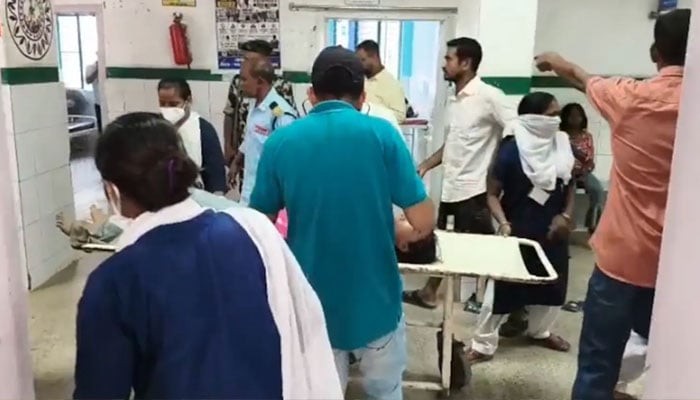
At least seven people were killed and several others injured after a massive crowd triggered a stampede outside the Ashok Dham Temple in India’s Bihar state.

According to Indian media reports, the incident occurred early Monday morning, the third Monday of the Hindu month of Sawan, when a large number of devotees gathered at the temple to offer prayers.

District administration officials reached the scene shortly after the incident and began overseeing rescue efforts as well as measures to bring the crowd under control.

Officials said the crowd outside the temple suddenly surged after two trains arrived in the area in the morning. The sudden influx placed heavy pressure on the barricades installed at the site, causing one section to collapse. Several people fell over one another, triggering panic and a stampede.

Authorities said they had made arrangements in anticipation of a large turnout. However, the unexpected increase in the number of devotees quickly overwhelmed the arrangements and created a chaotic situation.

Rescue teams immediately began evacuating the injured, with around 10 to 15 people initially taken to nearby hospitals for medical treatment.

Indian media reports have also cited preliminary information suggesting that an electricity pole fell at the scene and some people may have suffered electric shocks. The incident reportedly caused further panic among the crowd and may have contributed to the subsequent stampede.

Authorities are continuing to assess the situation and investigate the circumstances surrounding the deaths and injuries.

Similar Posts

  • |

    Moroccan migrants return home after failed bid to reach Europe

    Thousands of Moroccan migrants who entered Spain’s North African enclave of Ceuta this week have begun returning home after their hopes of reaching mainland Europe faded. Many said they were driven back by hunger, exhaustion and difficult living conditions, while others claimed they faced hostility after arriving in the Spanish territory. Several returnees said they had decided to cross into Ceuta after watching viral social media videos and receiving messages from friends claiming the heavily guarded border could be breached. Believing they had a chance to build a better future in Europe, many left their jobs and travelled to the border. However, after reaching Ceuta, migrants discovered there was no clear route to mainland Spain. Many said they became stranded in the enclave with limited access to food, water and shelter. One migrant said he survived for three days by drinking only water because he could not afford food. He described the cost of basic meals as extremely high and said life in Ceuta was far more difficult than he had expected. Returning migrants also claimed that many supermarkets and shops remained closed, making it difficult to buy essential supplies. Some spent days in wet clothes after swimming across the border and struggled to find safe places to rest. Several migrants alleged they were forced to leave certain neighbourhoods by local residents, although those claims could not be independently verified. Spanish authorities confirmed that two people suffered minor injuries in separate knife attacks and said one suspect had been arrested. Officials added that no deaths linked to the incidents had been reported. The large influx also affected businesses on both sides of the border. In the Moroccan border city of Fnideq, hotels and restaurants faced staff shortages after several workers crossed into Ceuta. Some employers have already begun looking for replacement workers as many employees remain missing. Meanwhile, daily life in Ceuta has gradually started returning to normal. Cafes have reopened in parts of the city, while police continue to maintain a strong security presence. Many businesses, however, remain closed as authorities monitor the situation. Aid workers said migrant reception facilities are operating at full capacity, with thousands of people still believed to be inside the enclave awaiting assistance or decisions on their future. Local residents expressed mixed emotions over the crisis. While many admitted the sudden arrival of thousands of migrants created fear and uncertainty, others said they sympathised with the young people, arguing they had been misled by false hopes of an easier route into Europe.

  • |

    Former Turkish PM Davutoglu quits politics

    ISTANBUL: Former Turkish prime minister Ahmet Davutoglu has announced his decision to step away from politics and dissolve his Future Party, ending a decades-long political career that saw him rise as one of President Recep Tayyip Erdogan’s closest allies before becoming a vocal critic. Davutoglu announced the decision this week, saying he wanted to distance himself from what he described as a “dirty political climate” in Turkiye. He said the move was not a surrender but a step taken on moral grounds and a call for a broader rethink of politics. The former premier criticized issues including corruption, favouritism and weak accountability, saying these challenges had damaged public trust. He also raised concerns over the country’s presidential system introduced in 2018, arguing that it weakened checks and balances. Davutoglu began his career as an academic before entering politics. Born in Konya in 1959, he studied political science and international relations at Bosphorus University and later earned a doctorate in the same field. Before joining government, he worked as a professor and wrote several books on foreign policy. His academic reputation helped him become a key figure in shaping Turkiye’s international strategy. After the Justice and Development Party (AKP) came to power in 2002, Davutoglu joined the party and became a close adviser to Erdogan. He played an influential role in developing the “zero problems with neighbours” foreign policy approach, which aimed to improve relations with regional countries. He served as Turkiye’s foreign minister from 2009 to 2014 and became prime minister after Erdogan moved to the presidency in 2014. However, relations between the two leaders gradually weakened due to differences over governance, foreign policy and the distribution of political power. In 2016, Davutoglu resigned as prime minister and was replaced by Binali Yildirim. Three years later, Davutoglu left the AKP and launched the Future Party, presenting it as a conservative alternative focused on democracy and reforms. However, the party struggled to gain major public support and received a small share of votes in the 2024 elections.

  • |

    Hong Kong democracy activist allowed to remain in UK after deportation scare

    Former Hong Kong opposition leader Wu Chi-wai has been granted permission to stay in the United Kingdom for six months after initially facing the possibility of deportation upon arriving at Heathrow Airport. The decision ends several days of uncertainty and allows the veteran pro-democracy activist to reunite with his family after years of separation. Wu arrived in London last Wednesday but was detained by UK Border Force officers for nearly 10 hours. Speaking to BBC Chinese, he said officials initially refused him entry and later informed him that he would only be allowed to remain in the country for one week before reporting back to the airport for deportation. However, the situation changed on Monday when UK authorities approved his entry under standard visitor rules, allowing him to stay in the country for up to six months. The 63-year-old is one of Hong Kong’s best known pro-democracy figures and formerly led the now dissolved Democratic Party. He was also among the group widely known as the Hong Kong 47, prominent activists and politicians prosecuted under Hong Kong’s national security law. Wu was released from prison in June after serving more than five years on convictions related to subversion and other charges. Wu said the trip was mainly intended to reunite with his wife and son, who moved to the United Kingdom in 2022 and 2023. During his imprisonment, he said their contact was limited to monthly phone calls and letters, making the visit especially meaningful after years apart. Before leaving Hong Kong, Wu said he sought advice from staff at the British Consulate General regarding his travel plans. According to him, officials assured him there should be no problems entering the UK and said they would inform the UK Border Force about his criminal record and travel itinerary in advance. Wu said border officials questioned whether he was a genuine visitor travelling only to see his family. He also rejected media reports claiming that he intended to seek political asylum in Britain, insisting that he had no such plans. The rights group Hong Kong Watch welcomed the UK’s decision to allow Wu to remain in the country. Policy Director Megan Khoo said the outcome was the correct one and argued that Wu should never have faced the threat of being sent back to the city where he had been imprisoned. Wu entered Britain using a British National Overseas passport, a travel document available to many Hong Kong permanent residents born before the territory’s transfer from British to Chinese rule in 1997. Holders of the passport are generally allowed to visit the UK without a visa for up to six months. The UK introduced a special visa route for British National Overseas passport holders in 2021 following the crackdown on Hong Kong’s pro-democracy movement. The programme allows eligible applicants to live, work and study in Britain and eventually apply for citizenship after meeting residency requirements. Since the scheme began, more than 230,000 Hong Kong residents have received BNO visas, while nearly 170,000 have relocated to the United Kingdom, according to government figures. The UK Home Office declined to comment on Wu’s individual case but reaffirmed its support for the Hong Kong community living in Britain. Meanwhile, the Hong Kong government said it had not received any request for assistance from Wu or other Hong Kong residents regarding the matter.

  • |

    Indian police use water cannons to disperse Bihar exam protesters

    PATNA: Indian police used water cannons and detained several protesters in Bihar on Tuesday as students demonstrated against alleged irregularities in a civil services recruitment examination. The protesters were demanding cancellation of the Bihar Public Service Commission (BPSC) examination over allegations that question papers had been leaked and that other irregularities had affected the recruitment process. The protesters attempted to march towards the governor’s residence in the state capital, Patna. Police blocked their route and used water cannons after demonstrators pushed through barricades. Several protesters were also taken into police custody and transported away from the demonstration site. The BPSC examination is one of Bihar’s most competitive recruitment tests. It is conducted to select officials for various positions in the state administration. The latest demonstrations are linked to an examination held in December 2024. More than 300,000 candidates reportedly competed for around 2,000 positions. The recruitment process was completed in June after multiple stages, including examinations and interviews. Authorities have previously rejected claims of a widespread question paper leak. However, a re-examination was ordered at one examination centre following complaints at the time. Police later said the protest had become peaceful. Senior police officer K.S. Anupam said most of the protesters’ demands had been addressed by the government. Bihar Education Minister Mithilesh Tiwari also said the government had responded to the students’ concerns. He maintained that discussions with the protesters remained possible and that the government’s doors were open for further dialogue. The dispute comes amid growing student protests in India over alleged irregularities in competitive examinations. Similar demonstrations have taken place in other Indian states, with concerns ranging from alleged paper leaks to recruitment procedures and examination management. In neighbouring Jharkhand, protests over similar allegations previously resulted in the cancellation of civil service examinations. The latest unrest has also added to pressure on authorities to strengthen safeguards around competitive examinations, which attract hundreds of thousands of applicants seeking government jobs.

  • | |

    Israeli strikes draw Lebanese President’s warning

    Lebanese President Joseph Aoun on Saturday condemned Israeli strikes in southern Lebanon, calling them a “clear message” about the ongoing negotiations between Beirut and Tel Aviv ahead of the next round of US-sponsored talks in Rome early next month, AFP reported. Aoun criticised what he described as continued Israeli attacks and repeated violations of the framework agreement and international law protecting civilians. He said an Israeli strike on a house in the southern town of Ansar killed an entire family. At least seven people were killed and three others injured when Israeli warplanes struck a house on the outskirts of Ansar in Nabatieh district early Saturday, Lebanon’s National News Agency (NNA) reported. The strike destroyed the building, while rescue teams searched the rubble for victims and survivors. NNA said the attack marked the first Israeli airstrike to reach this far inside Lebanese territory since a ceasefire took effect two months ago. Israeli aircraft also carried out several strikes on Ali al-Taher hill near Nabatieh al-Fawqa. The strikes came despite a framework agreement signed between Lebanon and Israel on June 26 under US sponsorship. The agreement calls for Israel to gradually withdraw from occupied Lebanese territory while the Lebanese army deploys in those areas and armed groups, including Hezbollah, disarm. According to the report, Israel continues to hold parts of southern Lebanon, including areas it occupied during earlier conflicts. During the latest escalation, Israeli forces advanced more than 10 kilometres into Lebanese territory. Lebanese authorities say the Israeli assault, which began on March 2, has killed 4,335 people and wounded 12,277 others. Aoun warned that the continued violations could undermine the negotiation process and further threaten the fragile ceasefire.

  • |

    Indian activists challenge AI-powered police surveillance following student demonstrations

    Indian digital rights activists and student leaders are challenging Prime Minister Narendra Modi’s government in the Delhi High Court over the deployment of artificial intelligence-powered mass surveillance during recent youth protests in New Delhi. Student activist Aishe Ghosh filed a petition with the Delhi High Court seeking to declare the police’s mass surveillance of demonstrators unconstitutional. The lawsuit requests the immediate destruction of all personal and biometric data collected during the demonstrations and asks the court to establish clear binding guidelines governing the use of surveillance technologies at public gatherings. The controversy intensified after photographs circulated showing a mobile police surveillance unit, branded “Ikshana” and developed alongside security firm CP Plus, deployed at the main protest site. The vehicle featured telescopic masts providing 360-degree coverage, AI-powered cameras, and real-time facial recognition capabilities that displayed face accuracy metrics to match attendees against law enforcement databases. Furthermore, police officers were documented recording the social media handles of arriving participants. Digital rights organisations, including the Internet Freedom Foundation, have formally requested the Delhi Police Commissioner to delete all biometric data gathered during the events. Advocates emphasise that India currently lacks a dedicated legal framework governing police deployment of facial recognition systems, making such intrusive measures disproportionate and illegal. During court proceedings, Solicitor General Tushar Mehta defended law enforcement actions, arguing that expectations of privacy at a public gathering were misplaced and asserting that the security measures were absolutely necessary in the interest of public order. Delhi Police maintained that the technology was used solely to identify individuals with criminal histories and count crowd size without restricting freedoms. The court challenge continues despite the end of the student demonstrations, which were triggered by widespread examination paper leaks in national competitive tests. The protests culminated in the resignation of Union Education Minister Dharmendra Pradhan and the announcement of a government panel tasked with overhauling the national examination system.

Leave a Reply

Your email address will not be published. Required fields are marked *