internet slams naeem
| |

Internet slams Naeem Hanif over remarks on Mohammad Ahmed.

Journalist Naeem Hanif has come under fire on social media after commenting on veteran actor and writer Syed Mohammad Ahmed’s recent claims of being mistreated by younger actors on a drama set. His remarks sparked widespread criticism, with many internet users accusing him of being disrespectful toward a senior artist.
Syed Mohammad Ahmed recently revealed that he had faced inappropriate behaviour from younger actors during a shoot. In his interview, he named actors Fahad Sheikh, Faizan Sheikh, and Jenan Hussain, saying they repeatedly made fun of him and crossed professional boundaries on set. The veteran actor’s statements received overwhelming support from fans and fellow celebrities, many of whom praised him for speaking openly about the issue.
Ahmed later clarified that he had not intended for the interview to be uploaded publicly. However, once the video surfaced online, it quickly went viral, bringing the alleged incident into the spotlight and triggering a wider conversation about respect for senior artists in Pakistan’s entertainment industry.
Reacting to the controversy, Naeem Hanif argued that Syed Mohammad Ahmed had exaggerated the situation. According to Hanif, actors on drama sets often joke with one another, and the incident should not have been presented as a major issue.
During his analysis, Hanif said, “Muhammad Ahmed, before you make such a big thing, understand where you are. You are not a lecturer. You are not teaching an Islamiat lecture in a university that you got so offended by someone making fun of you.”
He further added, “What is your venue where this all happened? You are doing a drama. You are doing acting. You are in showbiz.”
His comments quickly drew backlash online, with many social media users saying his remarks were insensitive and failed to acknowledge the importance of treating senior colleagues with dignity and respect, regardless of the workplace.
One user criticised Hanif for disrespecting an elder, saying it was shameful for someone calling himself a journalist to speak in such a manner about a veteran artist. The commenter also questioned his credibility as a journalist.
Another social media user accused Hanif of having double standards. The commenter argued that if he believed interactions with unrelated women in the media were inappropriate, he should also reflect on his own work in television and digital media. The user questioned why he was preaching morality while continuing to benefit from the same industry.
Many others echoed similar views, stating that professionalism should never be compromised and that no one, especially a senior actor with decades of experience, deserves to be ridiculed on a professional set.
The debate continues online, with a large number of fans standing by Syed Mohammad Ahmed and maintaining that respect for senior artists should remain a fundamental value within the entertainment industry.

Similar Posts

  • |

    Power sector circular debt rises by Rs364 billion in FY2025-26

    ISLAMABAD: Pakistan’s power sector circular debt increased by Rs364 billion during fiscal year 2025-26, highlighting persistent weaknesses in the electricity supply chain despite substantial government subsidies and efforts to contain the buildup of unpaid liabilities. According to the circular debt report for June 2026, the increase was significantly higher than the previous year, when the debt had risen by around Rs45 billion. The latest increase represents a surge of roughly 709% year-on-year in the annual flow of circular debt. The Power Division has not yet formally uploaded the one-page circular debt report for June 2026 on its official website. The latest figures indicate that structural problems, including distribution company inefficiencies, weak bill recovery, payment disputes and delays in tariff adjustments, continue to generate fresh liabilities in the power sector. The development comes despite the government’s efforts to contain the debt through budgetary support and subsidies. IMF target and government commitments The International Monetary Fund (IMF) had permitted Pakistan to record up to Rs400 billion in circular debt flow during the year, while simultaneously requiring the government to take measures to prevent the accumulation of new liabilities and eventually bring the flow down to zero. Under the IMF programme, the government has been relying on tariff adjustments, subsidy rationalisation and other reforms to improve the financial health of the electricity sector. However, the latest increase suggests that governance and operational problems remain a major obstacle to achieving a sustainable reduction in circular debt. The government provided approximately Rs302 billion in subsidies aimed at supporting the power sector and reducing the debt burden. However, the amount was insufficient to maintain the circular debt stock at the level of Rs1.614 trillion recorded at the end of June 2025. As a result, the debt stock recorded a net increase of around Rs61 billion during the year. The Power Division had earlier stated that the federal government allocated Rs893 billion for the power sector in the FY2025-26 budget. However, around Rs98 billion of the allocated amount was not released, affecting the government’s ability to reduce the outstanding liabilities. A Power Division spokesperson said that if the entire budgeted allocation had been released, the circular debt stock could have fallen further to around Rs1.577 trillion. The funding shortfall, according to the official, contributed to the Rs61 billion increase recorded during the year. Distribution companies remain a major source of losses Inefficiencies within power distribution companies continued to be one of the biggest contributors to the accumulation of circular debt. The government incurred approximately Rs262 billion in losses during FY2025-26 because of inefficiencies in distribution companies. The amount was only around Rs3 billion lower than the previous year, indicating that little progress has been made in addressing operational weaknesses. Another Rs64 billion was added to the circular debt because of lower electricity bill recoveries. Although significant, this amount was around 51% lower than the corresponding figure recorded in the preceding year. The figures underline the financial pressure created by electricity theft, transmission and distribution losses, weak collection systems and inadequate enforcement against non-paying consumers. Privatisation of distribution companies The government has initiated the process of privatising three relatively profitable distribution companies — Faisalabad Electric Supply Company, Gujranwala Electric Power Company and Islamabad Electric Supply Company. However, the proposed privatisation is not expected to immediately resolve the broader circular debt problem because a substantial portion of sector losses originates from other distribution entities. Earlier, the government had considered a model under which profitable distribution companies would be combined with loss-making entities before privatisation. The plan, however, was subsequently abandoned in favour of offering comparatively stronger companies separately. Experts have repeatedly argued that privatisation alone cannot eliminate circular debt unless the underlying issues of electricity theft, poor recoveries, governance and operational losses are addressed across the entire distribution network. K-Electric dispute adds to debt Payment disputes with K-Electric also contributed substantially to the increase. According to the report, approximately Rs194 billion was added to the circular debt because of non-payments by K-Electric. The company’s outstanding payments are linked to a dispute concerning the delayed finalisation of its multi-year tariff by the National Electric Power Regulatory Authority. The prolonged disagreement has created financial pressure throughout the power supply chain, adding to the accumulation of unpaid liabilities. In addition, around Rs75 billion was added to the circular debt because of delays in tariff adjustments. The government, meanwhile, made payments of approximately Rs129 billion against principal loans of the power sector. Without these payments, the annual circular debt flow could have exceeded Rs600 billion, according to the figures. The Power Division also benefited from a reduction of around Rs98 billion in the circular debt flow because of subsidy payments. Interest payments add further pressure Interest charges also contributed to the accumulation of liabilities, adding around Rs14 billion to the circular debt during the fiscal year. These financing costs ultimately increase the burden on consumers because the cost of servicing the sector’s outstanding liabilities is recovered through electricity bills. Consumer groups have frequently criticised the practice, arguing that households and businesses that regularly pay their electricity bills are effectively being charged for inefficiencies, theft and non-payment elsewhere in the system. Subsidies and burden on consumers The government’s continued reliance on subsidies has helped prevent an even larger accumulation of circular debt, but it has also placed pressure on the national budget. The power sector received hundreds of billions of rupees in subsidies during the year, while the government simultaneously pursued tariff increases and other measures intended to improve cost recovery. The contrast has raised questions about whether existing policies are addressing the underlying causes of circular debt or merely shifting the burden between consumers, the federal budget and power-sector entities. The government has also been under pressure to address similar financial problems in the gas sector. Although no comparable subsidy was provided for the gas sector, the authorities were expected to prevent a further increase in its circular debt. The government reportedly refrained from passing the full reduction in gas prices on

  • | |

    Nawaz Sharif Cancer Institute nearing completion, …

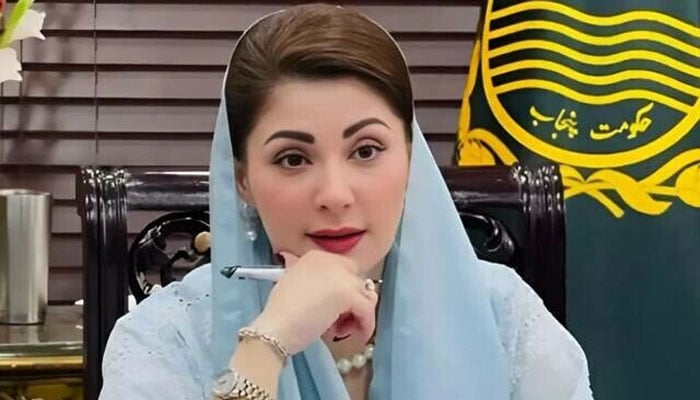
    Punjab Chief Minister Maryam Nawaz has said the Nawaz Sharif Institute of Cancer Treatment and Research in Lahore will become a major source of hope for cancer patients. She shared the message on the occasion of World Head and Neck Cancer Day. The day is observed to raise awareness about head and neck cancers and encourage people to identify risk factors and seek medical advice at an early stage. Maryam Nawaz stressed the importance of preventing cancer through healthier lifestyle choices. She said several habits can increase the risk of developing cancer. According to the chief minister, smoking, gutka, paan, alcohol consumption and an unhealthy lifestyle are among the major factors linked to cancer. She urged greater awareness about these risks. She also highlighted the importance of prevention and timely medical care. Maryam Nawaz said the Nawaz Sharif Institute of Cancer Treatment and Research in Lahore is close to completion. The project is expected to strengthen cancer treatment facilities in the province. The institute is intended to provide specialised services to cancer patients. It is also expected to contribute to research and improve access to advanced cancer care. The chief minister said the facility would provide patients with greater hope and support during their treatment journey. Her statement also highlighted the need to focus on both cancer prevention and better treatment facilities. She stressed that public awareness about harmful habits can play an important role in reducing health risks. The completion of the Lahore institute is therefore being presented as an important development for cancer care in Punjab. Its services are expected to support patients who require specialised treatment and help strengthen the province’s healthcare infrastructure.

  • | |

    Field Marshal Asim Munir’s gesture steals spotli…

    ISLAMABAD: A video of Field Marshal Syed Asim Munir placing his hand affectionately on the heads of women during a ceremony has gained widespread attention on social media. The video surfaced during the inauguration of the Victory Monument in Islamabad on Independence Day. During the event, Prime Minister Shehbaz Sharif, Field Marshal Asim Munir and other senior civilian and military leaders met families of martyrs and military veterans. The leadership paid tribute to their sacrifices and services. The Victory Monument was inaugurated on Thursday night in a ceremony attended by the country’s top civilian and military leadership. President Asif Ali Zardari and Prime Minister Shehbaz Sharif attended as chief guests. Field Marshal Asim Munir, Chief of Defence Forces and Chief of Army Staff, was also present. Chief of Air Staff Air Chief Marshal Zaheer Ahmed Baber Sidhu and Chief of Naval Staff Admiral Naveed Ashraf attended the ceremony as well. The monument has been built to honour Pakistan’s martyrs and commemorate the military confrontation with India in May. The event featured a series of patriotic performances and visual displays. The ceremony opened with a military band playing the national anthem. A special light and sound show titled “Dastaan-e-Ishq-e-Watan: Marka-e-Haq” was later presented. Projection mapping technology was used to display visuals on the monument. The presentation highlighted themes linked to patriotism, sacrifice and the country’s defence. A documentary was also screened during the event. It showcased the construction of the monument and the eight-month journey from its initial design and development to completion. The monument features five large arches. According to the presentation, the arches represent the five pillars of Islam. They also symbolise five pillars of Pakistan, identified as the government, armed forces, media, people and national ideology. The structure incorporates elements representing Pakistan’s three military services. Its design also highlights the country’s capabilities in cyber defence and space warfare. Pakistan Air Force fighter jets conducted an aerial display during the ceremony. The aircraft released flares across the night sky, adding to the spectacle. The event concluded with a flag-hoisting ceremony attended by President Zardari, Prime Minister Shehbaz Sharif and Field Marshal Asim Munir. Fireworks were also displayed as the national anthem played.

  • | |

    Pakistan’s civil awards triple in nine years…

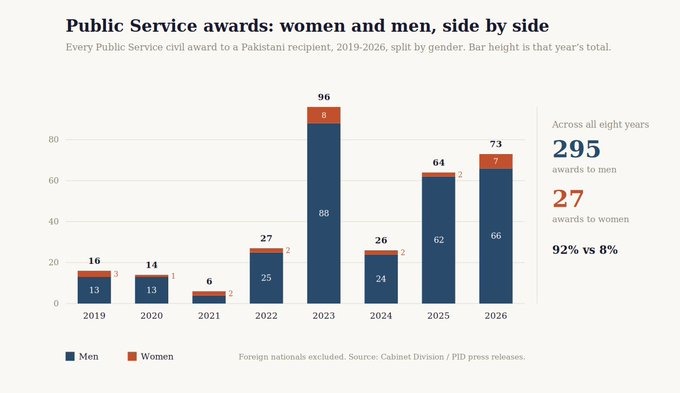
    ISLAMABAD: The number of people receiving Pakistan’s civil awards has increased sharply over the past nine years, but the share of women among the recipients has remained almost unchanged, according to an analysis by economist Zehra Farooq. Farooq, who has analysed civil award lists from 2018 to 2026, said she compiled all 2,209 awards announced during the nine-year period and examined each award by field, gender, level of award and nationality. Her analysis shows that the number of award recipients increased more than three times during the period, rising from 73 people in 2018 to 372 in 2026. However, the share of women receiving the awards did not show a similar increase. Women made up between roughly 10% and 16% of civil award recipients in each year from 2018 to 2026. Ms Farooq said the figures show that while the size of the annual awards lists changed greatly, the share of women remained within almost the same range. The lowest share was around 10% in 2023, while the highest was 16% in 2018 and 2021. The share stood at 15% in 2024 before falling to 12% in 2025 and 11% in 2026. Her analysis also looked at the figures after excluding gallantry awards. Gallantry awards were kept separate because they mainly relate to military and police roles. Even after removing these awards, the overall share of women increased only from around 12% to 14%, according to the analysis. This suggests that the low share of women is not limited to gallantry awards. Farooq said the same pattern can also be seen in civilian awards. Public service awards show a wider gap The Public Service category is the largest civilian category in the dataset and shows a particularly large difference between men and women. Among Pakistani recipients of Public Service awards, 295 were men and only 27 were women. This means men received about 92% of these awards, while women received only around 8%. Farooq noted that in several years, the entire Public Service list included only one or two women. The figures raise questions about how women are represented among people being recognised for public service. The analysis does not, however, establish why the gap exists. Farooq suggested that one possibility worth examining is whether the awards reflect the existing structure of Pakistan’s civil bureaucracy. She noted that the quota for women in the civil bureaucracy is around 10%, while the share of awards going to women remains below or around that level. This raises a question about whether the civil awards are reflecting the existing gender structure in public institutions rather than creating a separate pattern of their own. Major changes in fields The analysis also found major changes in the fields represented in the civil award lists. Science and engineering together accounted for close to one-third of the 2021 list. However, by 2025 and 2026, the two fields together made up less than 2% of the list. At the same time, some new categories appeared. Information technology appeared as a category for the first time in 2021, while climate appeared in 2025. Farooq said these changes raise questions about how the state decides which areas deserve recognition. She asked whether the decline in science and engineering awards reflects fewer major contributions in these fields, fewer people entering these professions, or a change in the areas where the state looks for achievement. The appearance of IT and climate-related awards also raises another question: whether official recognition is beginning to follow changes in the areas where Pakistan’s talent and work are growing. Women receive fewer top-level awards The analysis also examined the civil awards according to their level. The awards are divided into different levels, with Nishan and Hilal at the senior end, followed by Sitara and Tamgha. Ms Farooq found that the share of women becomes smaller as the level of the award becomes higher. At the two highest levels, women account for less than 5% of recipients. At the more common lower levels, the share of women is higher, generally ranging between 11% and 14%. This means that the overall percentage of women receiving civil awards does not tell the full story. Women may represent around 10% to 16% of all recipients in a year, but their representation becomes much smaller when only the highest-level honours are considered. The findings therefore point to two separate issues: the overall number of women receiving civil awards and the level of recognition they receive. Nine years provide a wider picture Ms Farooq said looking at the awards over several years gives a clearer picture than looking at a single annual list. The civil awards are announced every August, and each year’s list can show changes in the number and type of recipients. But when the lists are combined over nine years, longer-term patterns become visible. The biggest pattern in the data is the contrast between the rapidly growing number of awards and the almost unchanged share of women. From 73 recipients in 2018, the annual list reached 372 in 2026. Yet women remained within roughly the same 10% to 16% range throughout the period. The analysis also shows that the composition of the awards has changed in other ways, including the fields being recognised and the introduction of new categories. She said the data does not provide all the answers, but it raises questions that can be examined further.

  • | | |

    13 militants killed in Balochistan operation: secu…

    QUETTA: Security forces continued intelligence-based operations under Operation Azm in Balochistan, carrying out another targeted raid against suspected militants in Mastung district. According to security sources, the latest operation resulted in the killing of several militants, bringing the total number of militants killed during the ongoing operation to 13. Security sources said the operation was conducted in the Khad Kocha area of Mastung after intelligence reports indicated the presence of armed militants in the region. Troops launched a coordinated operation and engaged the suspects during the raid. According to the sources, several militants were killed during the exchange. Officials did not disclose the exact number of militants killed in the latest action but confirmed that the overall death toll in the operation has now reached 13. The operation also targeted militant infrastructure in the area. Security sources said multiple hideouts allegedly linked to the group referred to as Fitna al-Hindustan were destroyed. They added that dismantling these hideouts is part of broader efforts to disrupt militant activities and prevent future attacks. During the operation, security personnel recovered a cache of weapons, ammunition, explosives and materials allegedly used to manufacture improvised explosive devices (IEDs). Officials said the recovered items would be examined as part of the ongoing investigation. Sources further claimed that several militants were injured during the operation. However, the exact number of those wounded has not been confirmed, and no official details have been released regarding their identities. Security officials said intelligence-based operations are continuing across different parts of Balochistan to eliminate militant networks and improve the overall security situation. They added that such operations are being carried out on the basis of intelligence information to target suspected militant hideouts. According to security sources, the campaign against militant groups will continue until terrorist networks are dismantled and peace and stability are restored across the province. They reiterated the commitment of security forces to maintain pressure on armed groups through sustained intelligence-led operations.

  • | |

    Current system has lost public trust, reset is ine…

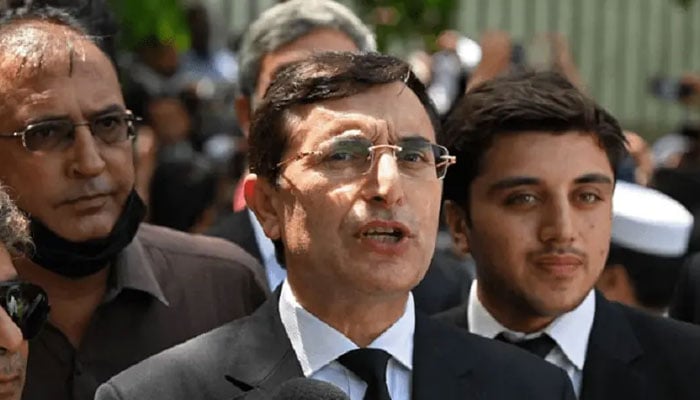
    Barrister Gohar Ali Khan, Chairman of the Pakistan Tehreek-e-Insaf (PTI), said the country’s current political system has lost the confidence of the public and requires a complete reset to restore democratic credibility. Speaking to the media outside Adiala Jail in Rawalpindi, Barrister Gohar said that instead of forming more governments under the existing circumstances, the leadership should return to the people and seek a fresh public mandate. He claimed that a key coalition partner had publicly described the prime minister as the beneficiary of a rigged election. According to Gohar, such a statement should have prompted the prime minister to immediately seek a vote of confidence in the National Assembly. The PTI chairman argued that the prime minister failed to obtain a vote of confidence and had therefore lost the moral legitimacy to continue in office. He added that the prime minister’s silence on the issue reflected a loss of political support and public confidence. Barrister Gohar further alleged that the government’s administrative structure had effectively collapsed. He claimed the government had lost its constitutional, legal and democratic standing, making the continuation of the current system increasingly difficult. He said the time had come for the existing political system to come to an end, adding that the Constitution provides a legal mechanism for moving a vote of no confidence. He said PTI would consult its allies before deciding its future course of action. The PTI chairman also said he believed the Pakistan Peoples Party (PPP) had emerged from a disputed electoral process. Calling for a political solution, Barrister Gohar urged all stakeholders to develop a national consensus to resolve the country’s ongoing political crisis. He stressed that Parliament should seriously address the public demands coming from all provinces.

Leave a Reply

Your email address will not be published. Required fields are marked *